| App Type | Complexity | Estimated Cost (GBP) | Timeline |
|---|---|---|---|
| Simple App | Low | £10,000 – £40,000 | 1 – 3 months |
| Medium-Complexity App | Moderate | £40,000 – £100,000 | 3 – 6 months |
| Complex Enterprise App | High | £100,000 – £250,000+ | 6 – 12+ months |
| AI, Real-time, or Fintech App | Very High | £150,000 – £500,000+ | 9 – 18+ months |


Loading...
How Much Does It Cost to Develop an App in UK?
Posted
July 10, 2026
Category Mobile App Development
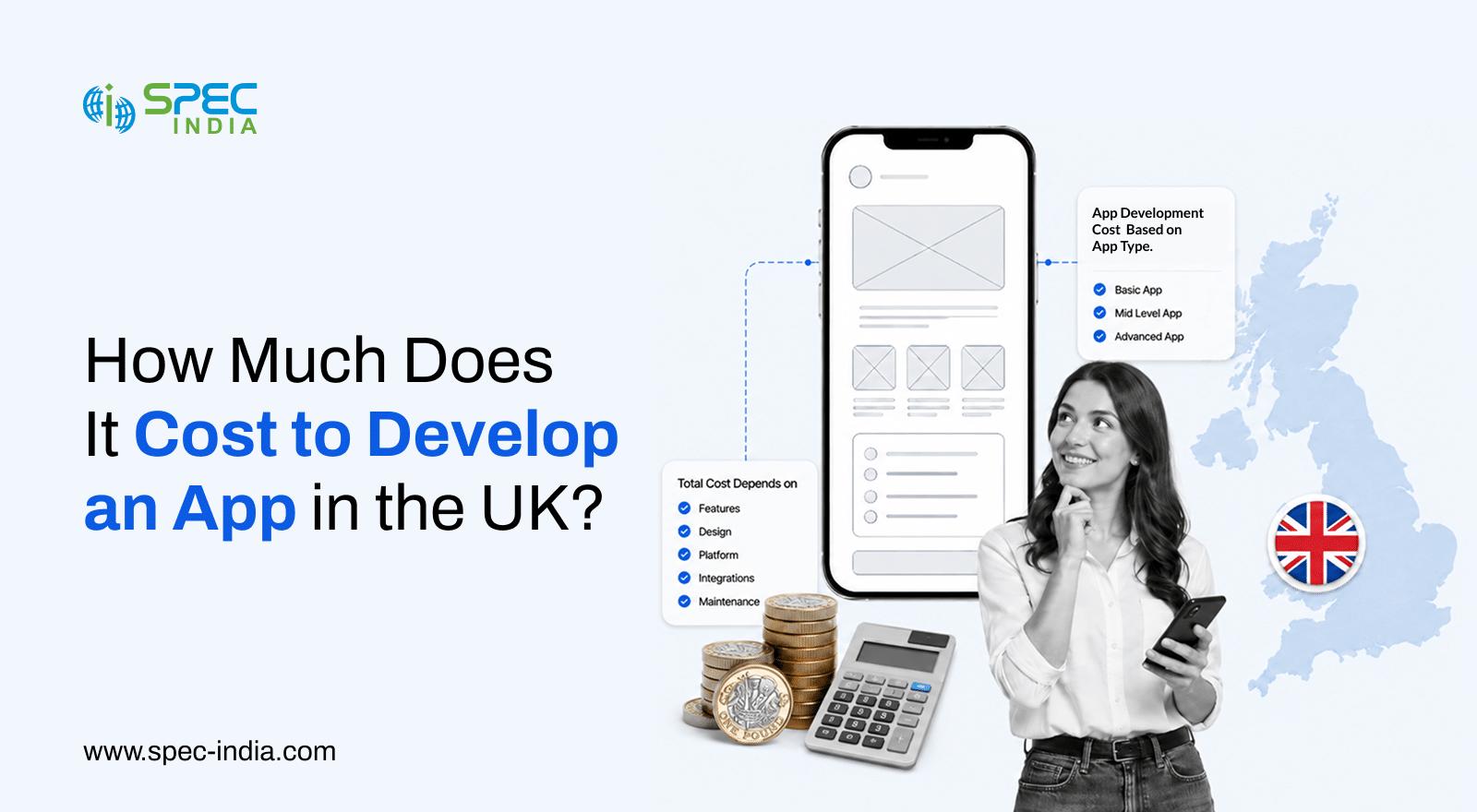
There’s nothing like fixed pricing when it comes to app development in the UK. Each project is different, and so is its cost. Utility and enterprise apps differ in features, team size, timelines, and other aspects. Knowing how much it costs to develop an app in the UK is vital for businesses to establish their budget and understand the expenses they should expect.
Ofcom’s Online Nation 2025 Report shows that adults in the UK use an average of 41 apps each month. It also revealed that adults in the UK used mobile apps three times as much as the previous year. Those who are online spend 4.5 hours each day, with 77% of that time on mobile devices, highlighting the need for mobile apps for UK businesses.
Below, we shall see the primary factors that affect the mobile app development cost in UK. If you understand these factors, you’ll be able to plan and operate your business better. You’ll also be able to invest in more value-added services.
Mobile App Development Cost by App Complexity
Many factors affect the cost of developing an app in the UK. These are approximate quotes from industry reports and leading companies in the UK’s app development sector, and ought to be taken as a guide when budgeting a project.
When estimating the cost of custom app development in UK, partnering with an experienced custom mobile app development company helps define the project scope and provides a more accurate cost estimate.
Mobile App Development Cost Breakdown by Project Stage
Every mobile app passes through several development stages. Below are the average costs of app development in the UK for major companies in the industry. The actual costs depend on the complexity of your application, its features, and your business needs.
| Stage | What It Covers | Estimated Cost (GBP) | % of Total Budget |
|---|---|---|---|
| Discovery | Research, scope, wireframes | £2,000 – £10,000 | 5 – 10% |
| UI/UX Design | Prototypes, design system | £5,000 – £25,000 | 10 – 20% |
| Development | Frontend, backend, APIs | £20,000 – £150,000+ | 40 – 60% |
| Testing / QA | Functional, security, performance | £3,000 – £20,000 | 10 – 15% |
| Deployment | App store setup, launch | £1,000 – £5,000 | 2 – 5% |
| Maintenance | Updates, bug fixes, support | 15 – 20% of build cost/year | Ongoing |
A precise mobile application development process aids in understanding and estimating the mobile app development cost in UK. It also helps to keep projects on schedule and within your set budget.
Key Factors That Influence Mobile App Development Costs in the UK
The technical and business needs of each app can differ significantly, so development costs can vary. Once you have grasped them, you can make a more accurate estimate of an app’s cost in the UK.
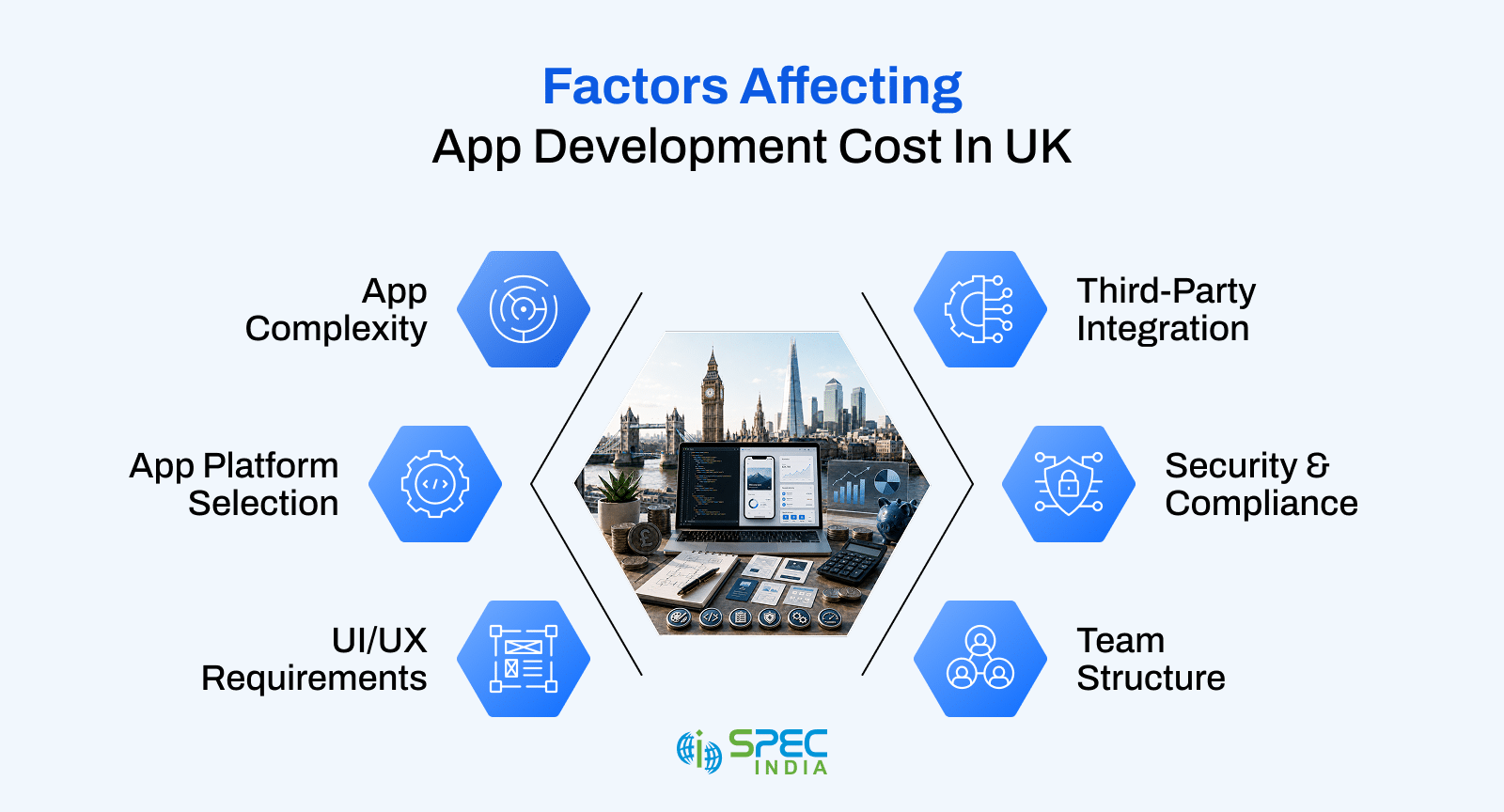
1. App Complexity
App development costs primarily depend on app complexity. If you wish to build a simple app with limited functionality, it will take less time than building any other enterprise application. An enterprise app development project would involve a potentially complex workflow, automated services, and real-time processing.
- Simple apps: Basic interface, limited features, minimal backend
- Medium apps: User accounts, databases, and third-party integrations
- Complex apps: AI capabilities, real-time processing, and advanced backend infrastructure
- Enterprise apps: Role-based access, large-scale data storage, and compliance requirements
2. Platform Selection
The app development stages and the platform used determine its timeline and budget. With native applications, you must build the apps twice (iOS and Android apps). On the other hand, cross-platform platforms let you build both versions from a single codebase.
- iOS: Suitable for premium user segments
- Android: Wider market reach across devices
- Native apps: Best performance but higher development effort
- Cross-platform: Faster delivery with lower development costs
3. UI/UX Requirements
The adoption and retention of technology are enhanced by an intuitive user experience, which makes user interface and user experience (UI/UX) an investment rather than an expense.
- Basic UI: Standard layouts and limited customization
- Custom UI: Branded interfaces, animations, and interactive elements
- Accessibility: WCAG compliance for inclusive user experiences
- User research: Wireframing, usability testing, and journey mapping
4. Integrations
Most business apps depend on connectivity to external systems to deliver the user experience. Each integration introduces development, testing, and life support effort.
- Payment gateways: Stripe, PayPal, and open banking APIs
- Push notifications: Firebase, OneSignal, or custom solutions
- Location services: Google Maps, Mapbox, or device GPS
- Cloud services: AWS, Azure, or Google Cloud for scalable backend infrastructure
5. Security and Compliance
Security needs to be incorporated from the get-go, particularly in an application that involves personal or financial data. After you release software, it’s more expensive to correct compliance problems than when fixing them during software development.
- UK GDPR: Data protection, user consent, and privacy requirements
- Healthcare apps: NHS standards and clinical safety compliance
- Fintech apps: FCA regulations, PSD2, AML, and Consumer Duty
- General security: Data encryption, secure APIs, and penetration testing
6. Team Structure
The team of app developers in the UK you hire directly impacts your budget, delivery speed, and product quality.
- In-house team: Greater control but higher long-term overheads
- UK agencies: Typically charge £80 to £150 per hour
- Offshore partners: Cost-effective with access to experienced development teams
- Freelancers: Lower upfront cost but require closer project management
According to the UK Government’s Cyber Security Breaches Survey 2025, 43% of businesses in the UK suffered a cyber security attack or breach in the past 12 months. Installing security and compliance systems in mobile apps and software at an early stage can help reduce risks, safeguard customer information, and prevent rework costs in complex apps.
All projects are unique in how they combine these factors. Prioritizing objectives in advance and selecting the most suitable strategy for a cross-platform mobile app development service can help you manage the entire app development budget without compromising app quality.
MVP vs Full-Featured App: Which Approach Makes More Financial Sense?
Deciding whether to build an MVP or a fully featured, complex app from the beginning is one of the most important choices you will make when developing an application. The decision depends on your business objectives, budget, and the time you must validate your idea. Let’s compare:
| Factor | MVP Approach | Full-Featured App |
|---|---|---|
| Initial Cost | £10,000 – £50,000 | £80,000 – £500,000+ |
| Time to Market | 3 – 5 months | 9 – 18+ months |
| Risk Level | Low. Validates the idea before scaling | Higher upfront investment before market validation |
| User Feedback | Early feedback shapes future development | Feedback comes after launch |
| Feature Set | Core features only | Complete functionality from day one |
| Best For | Startups, new markets, and unproven ideas | Established businesses with validated demand |
| Scalability | Expand based on user insights | Designed for long-term growth from the start |
The more viable starting point for many UK businesses is to launch an MVP. It saves you on initial investment and market entry costs and gives you feedback from actual users on how to refine the product before adding more features.
Ready to Plan Your App Budget?
SPEC India helps UK businesses map out their app development scope, estimate realistic costs, and choose the right engagement model. Start with a free consultation.
Mobile App Development Costs Across Different Industries
App development costs in the UK vary based on an industry’s mobile app vision. Every sector has unique compliance requirements, integration needs, and user experience. The table below provides typical cost ranges across major industries.
| Industry | Typical Cost Range | Key Cost Drivers |
|---|---|---|
| Healthcare | £80,000 – £300,000+ | NHS standards, clinical safety, HL7/FHIR integration |
| Fintech | £100,000 – £500,000+ | FCA compliance, PSD2, fraud detection, open banking APIs |
| Retail / eCommerce | £40,000 – £150,000 | Product catalogs, payment gateways, inventory sync |
| Logistics | £50,000 – £200,000 | Real-time tracking, route optimization, fleet management |
| Manufacturing | £60,000 – £250,000 | IoT integration, ERP connectivity, offline functionality |
| Best For | Startups, new markets, and unproven ideas | Established businesses with validated demand |
| Education | £30,000 – £120,000 | LMS integration, content delivery, interactive tools |
The cost to create an app ranges above and serves as a general benchmark. Here’s what typically drives development costs across industries.
1. Healthcare
Healthcare apps with advanced features require strict regulatory compliance and the secure handling of patient information.
- NHS standards, DCB0129, and HL7/FHIR integrations
- Secure patient data and extensive testing
AI in mobile app development is also expanding across diagnostics, patient triage, and appointment management.
2. Fintech
Fintech apps demand strong security and compliance, making them among the most complex applications to build.
- PSD2, open banking, and FCA requirements
- Fraud detection and biometric authentication
3. Retail
Retail apps are designed to provide a smooth shopping experience and to integrate business systems effectively.
- Payment gateways, inventory, and POS integration
- Personalization and push notifications
The decision to choose cross-platform development for application development services in the UK often came up, and businesses chose this option because it allowed them to go further.
4. Logistics
Logistics apps cannot operate without correct real-time data and a connection.
- Route optimization and fleet management
- GPS tracking and offline functionality using scalable mobile app development architecture
5. Manufacturing
Manufacturing Apps integrate factories into enterprise systems.
- IoT device connectivity
- ERP integration and cloud infrastructure
6. Education
Education apps support digital learning through interactive and secure experiences.
- LMS integration and SCORM compliance
- Gamification, assessments, and content delivery
The success of a project greatly depends on industry expertise. Working with game developers is advantageous for reducing the risk of failure, improving delivery quality, and reducing unnecessary development expenses.
Hidden Expenses That Can Increase Your App Development Budget
When businesses discuss developing their apps, they tend to focus on the price tag and overlook the app’s running costs. By incorporating these expenses into your budget early, you avoid unpleasant surprises later and gain a clearer idea of how much it will cost to create an app in the UK.
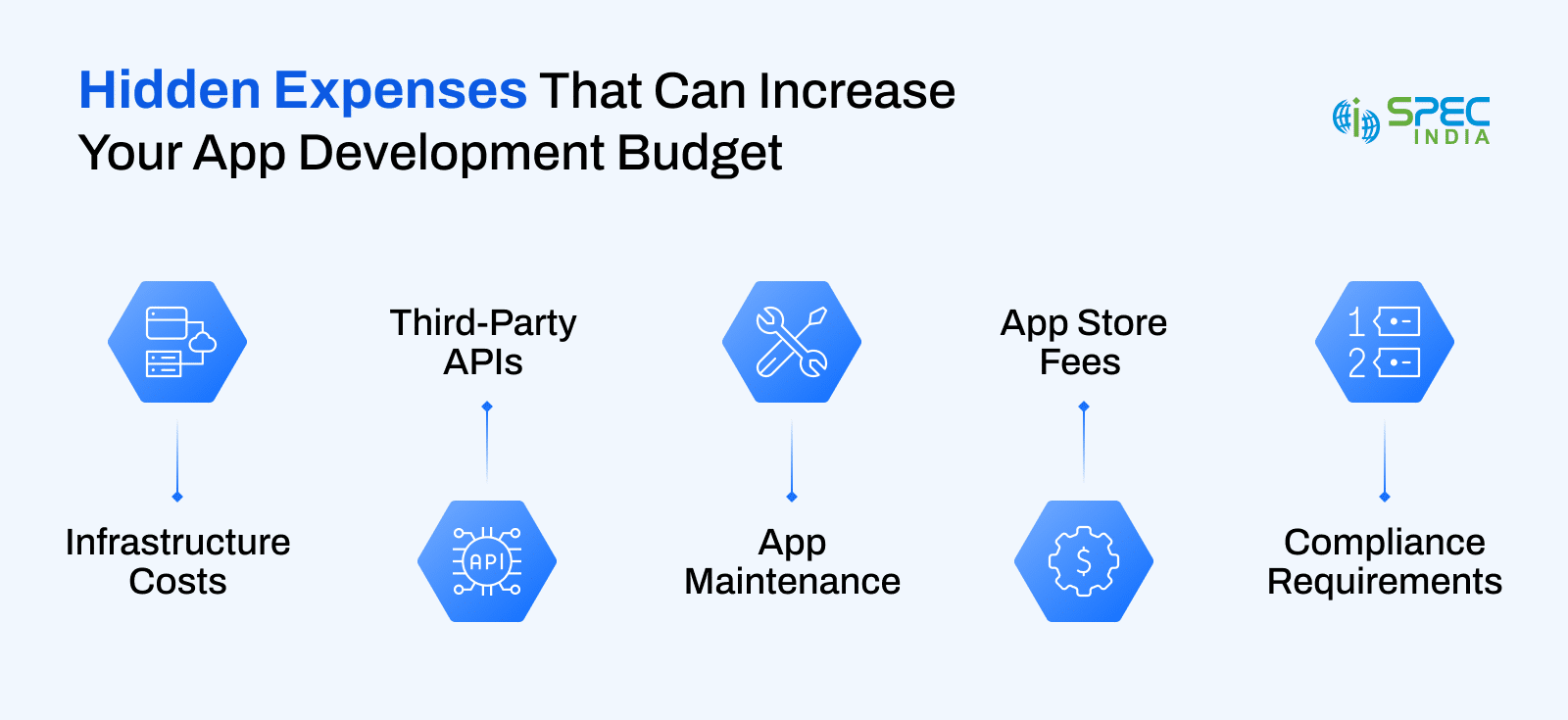
1. Infrastructure Costs
Once your app is launched, you need robust hosting, storage, and servers to ensure smooth operation.
- Cloud services such as AWS, Azure, or Google Cloud charge based on usage.
- Database management and storage requirements grow as your user base expands.
From time to time, these expenses are ongoing and should be included in your app’s cost estimate. These expenses will increase with traffic and usage.
2. Third-Party APIs
Numerous applications rely on external services for payments, mapping, messaging, and analytics. However, these integrations can reduce development time but incur ongoing fees.
- Payment gateways charge transaction and service fees.
- Google Maps API and similar platforms bill based on API usage.
Beware that third-party tools can become very expensive if you use them on free plans as your app grows.
3. Maintenance
Getting your app started is just a first step. It is continually updated to remain secure, compatible, and perform well.
- App maintenance costs in the UK typically range from 15% to 20% of the original development cost each year.
- Operating system updates and bug fixes require ongoing attention.
The best companies that develop mobile applications partner with top mobile app development companies to ensure predictable post-launch support.
4. App Store Fees
It’s not a single upload to publish. App stores charge app developers and transaction fees for both services.
- Apple App Store: £79 annual developer fee
- Google Play Store: £20 one-time registration fee
Both platforms charge commissions on eligible mobile in-app purchases and charges for subscriptions.
5. Compliance Requirements
Compliance is an ongoing task, particularly for apps that handle personal or financial information.
- DPIAs may be required for data-intensive applications.
- WCAG accessibility reviews improve usability and support regulatory compliance.
In terms of security and compliance, it’s hard to gain as much control when developing an app with native components, but these need to be considered in your long-term budget, not just when you’re starting.
Smart Ways to Reduce Mobile App Development Costs Without Sacrificing Quality
Lowering the cost of app development in the UK isn’t all about sacrifice; it’s about making better decisions along the way. Using the right approach, tools, and product delivery strategy will keep the expenses under control without sacrificing quality.
1. Build a Minimum Viable Product (MVP)
Before you commit to building a full-blown app, an MVP helps validate the idea.
- Launch with essential features only
- Improve the app using real user feedback
2. Choose Cross-Platform Frameworks
Flutter and React Native are cross-platform frameworks that help accelerate development.
- One codebase for iOS and Android
- Faster updates and lower maintenance effort
3. Leverage Pre-built UI Kits and Open-Source Libraries
Implementing well-trodden frameworks will not compromise quality and will shave time off the development process.
- Reuse tested UI components
- Accelerate frontend and backend development
4. Implement Continuous Automation and Testing
Automated testing aids in the early detection of problems and raises the quality of the release.
- Reduce manual testing effort
- Speed up deployments with CI/CD pipelines
Keeping up with recent mobile app development trends also enables teams to deliver applications more effectively.
5. Strategically Outsource or Augment Teams
Collaborating with offshore experts offers the advantage of having proficient developers to work on your projects without imposing rigidity.
- Scale resources based on project needs
- Access specialized expertise when required
When businesses need to hire mobile app developers, they tend to choose flexible engagement models that compromise on quality, speed, and cost.
With an informed understanding of which strategy is best for you upfront, you can align your budget to be as efficient as possible and better plan your return on investment for app development in the UK without compromising long-term success.
Mobile App Monetization Models: How Businesses Generate Revenue
Building an app is only part of the investment. Choosing the right monetization model helps generate sustainable revenue while delivering value to users.
According to Business of Apps, the UK app market earned $4.8 billion in 2024, a 9% increase from the previous year, with 51.5 million smartphone users accounting for 82% of the population. This highlights the growing opportunity for businesses to generate revenue through well-planned mobile apps.
1. Subscription
Users pay a recurring fee to access premium features or services. Subscription models work well for apps that provide continuous value and encourage long-term engagement.
- Ideal for productivity, healthcare, education, and media apps
- Creates predictable recurring revenue
Subscription models are widely adopted by businesses offering enterprise application development services.
2. In-App Purchases
Users download the app for free and pay only for additional content, premium features, or digital products.
- Popular for gaming and lifestyle apps
- Encourages users to spend based on their needs
3. Freemium
A free version attracts users, while premium features encourage upgrades over time.
- Lowers the barrier to adoption
- Supports gradual revenue growth
4. Advertising
Advertising allows businesses to generate revenue without charging users to download the app.
- Suitable for apps with large user bases
- Works well alongside other monetization models
AI in mobile app development in the UK also helps deliver more relevant ads and improve user engagement.
5. Transaction Fees
Marketplace and on-demand apps earn revenue by charging a fee for every completed transaction.
- Common for service marketplaces and booking platforms
- Revenue grows as platform activity increases
The right revenue strategy depends on your business model and target users. When estimating the cost of building an app in UK, choose a monetization approach that supports long-term growth over short-term returns.
What to Look for When Choosing a Mobile App Development Company in UK
Choosing the right development partner affects your app’s quality, delivery timeline, and long-term success. Keep these factors in mind when evaluating a mobile app development company in UK.
1. Portfolio and Industry Experience
A strong portfolio shows whether the team understands your industry and business challenges.
- Review case studies relevant to your sector
- Look for projects with similar complexity and compliance needs
2. Platform and Technical Capabilities
Choose a team with expertise in both native app development and cross-platform technologies.
- Verify experience with Swift, Kotlin, Flutter, and React Native
- Assess backend, cloud, and API integration capabilities
3. Reputation and Client Reviews
Independent reviews offer valuable insight into a company’s reliability and delivery quality.
- Check ratings on Clutch, GoodFirms, and DesignRush
- Ask for references from UK clients where possible
4. Communication and Development Process
Clear communication keeps projects on schedule and reduces misunderstandings.
- Review the mobile app development process and delivery approach
- Confirm regular updates, sprint reviews, and communication channels
5. Cost and Engagement Model
Select an engagement model that matches your project scope and flexibility.
- Fixed price for well-defined projects
- Time and materials for evolving requirements or MVPs
6. Post-Launch Support and Maintenance
A reliable partner should continue to support your app after it launches.
- Check SLAs for maintenance and issue resolution
- Ensure ongoing updates and feature enhancements are available
The right development partner brings technical expertise, transparent communication, and long-term support. Reviewing their mobile app development architecture capabilities early also helps build a scalable app that can grow with your business.
Build Your App with SPEC India
SPEC India works with UK businesses to deliver mobile apps on time, within budget, and built to scale. Get a no-obligation consultation and find out how much does it costs to develop an app in the UK for your specific requirements.
How SPEC India Helps Businesses Build Cost-Effective Mobile Apps
SPEC India helps UK businesses build secure, scalable, and cost-effective mobile applications, drawing on over 39 years of software development experience. From MVPs to enterprise solutions, the team supports every stage of the development journey.
- 39+ years of experience delivering solutions across multiple industries
- UK-focused expertise with a strong understanding of GDPR and business requirements
- Agile delivery with transparent communication and faster releases
- Flexible engagement models to match different project needs
- End-to-end support from discovery and development to deployment and maintenance
With ISO-certified processes, in-house AI capabilities, and an experienced offshore team, SPEC India delivers high-quality mobile solutions with long-term support. If you’re evaluating how much it costs to develop an app in UK, connect with SPEC India for a tailored consultation and cost estimate.

SPEC INDIA is your trusted partner for AI-driven software solutions, with proven expertise in digital transformation and innovative technology services. We deliver secure, reliable, and high-quality IT solutions to clients worldwide. As an ISO/IEC 27001:2022 certified company, we follow the highest standards for data security and quality. Our team applies proven project management methods, flexible engagement models, and modern infrastructure to deliver outstanding results. With skilled professionals and years of experience, we turn ideas into impactful solutions that drive business growth.
Table of contents
- Mobile App Development Cost by App Complexity
- Mobile App Development Cost Breakdown by Project Stage
- Key Factors That Influence Mobile App Development Costs in the UK
- MVP vs Full-Featured App: Which Approach Makes More Financial Sense?
- Mobile App Development Costs Across Different Industries
- Hidden Expenses That Can Increase Your App Development Budget
- Smart Ways to Reduce Mobile App Development Costs Without Sacrificing Quality
- Mobile App Monetization Models: How Businesses Generate Revenue
- What to Look for When Choosing a Mobile App Development Company in UK
- How SPEC India Helps Businesses Build Cost-Effective Mobile Apps
Delivering Digital Outcomes To Accelerate Growth
Let’s TalkTable of contents
- Mobile App Development Cost by App Complexity
- Mobile App Development Cost Breakdown by Project Stage
- Key Factors That Influence Mobile App Development Costs in the UK
- MVP vs Full-Featured App: Which Approach Makes More Financial Sense?
- Mobile App Development Costs Across Different Industries
- Hidden Expenses That Can Increase Your App Development Budget
- Smart Ways to Reduce Mobile App Development Costs Without Sacrificing Quality
- Mobile App Monetization Models: How Businesses Generate Revenue
- What to Look for When Choosing a Mobile App Development Company in UK
- How SPEC India Helps Businesses Build Cost-Effective Mobile Apps
Delivering Digital Outcomes To Accelerate Growth
Let’s Talk


Let’s get in touch!
India
SPEC House, Parth Complex, Near Swastik Cross Roads, Navarangpura, Ahmedabad 380009, INDIA.
-
 +91-79-26404031, 32-33-34
 -
 [email protected]