| Feature Type | Complexity Level | Cost Impact |
|---|---|---|
| Basic Features | Low | Low development costs |
| User Authentication | Medium | Moderate cost impact |
| Payment Gateways | Medium | Increased integration cost |
| Real-Time Features | High | Higher cloud infrastructure cost |
| AI & Predictive Analytics | Very High | Significant project costs |
| Enterprise Security Systems | Very High | Increased compliance and maintenance costs |


Loading...
How Much Does Mobile App Development Cost in Australia?

Whether it is a startup testing a minimum viable product (MVP) or a large enterprise building an AI-powered digital ecosystem, companies across industries are investing aggressively in mobile app development.
Yet one question continues to challenge every app development project: how much does mobile app development cost Australia?
The answer is never straight here, as app development costs in Australia can vary dramatically depending on several factors, such as app complexity, core features, cross platform development requirements, and more.
Based on industry estimates, the average cost of mobile app development in Australia can vary from AUD 50k for basic apps to over AUD 600k for enterprise apps with advanced features, real-time functionality & AI capabilities.
Now, estimating the cost of app development gets even harder with online app cost calculators, as they fail to account for hidden costs like ongoing maintenance, cloud hosting, security patches, app store fees, and post launch support. The mobile app development cost goes far beyond coding.
The Biggest Factors That Influence Mobile App Development Cost
First, you must understand the levels that drive costs. Australian businesses or ventures that go into application development without clarity on these factors or levers underestimate their budgets by 30-80%.
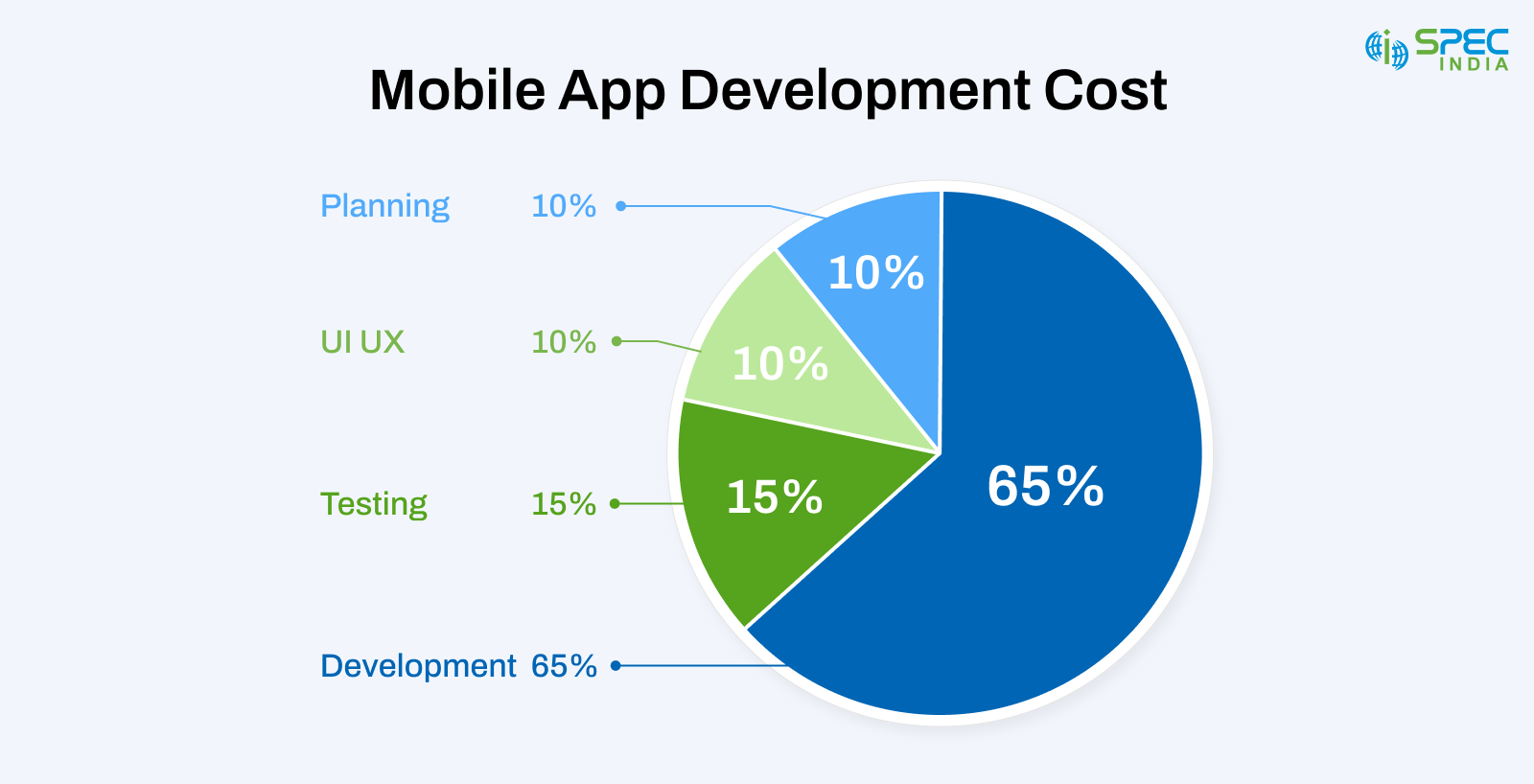
1. App Platform Selection (iOS, Android, or Both)
Building a native Android app & an iOS app separately increases app development costs, as two dedicated codebases are required.
Cross-platform development can help reduce app development costs while putting deployment on a fast track.
Note: Cross-platform mobile app development frameworks like React Native & Flutter have decreased this gap by enabling code sharing of 70-90% between platforms without compromising app performance.
2. UI/UX Design Sophistication
A highly interactive user interface with custom animations, advanced navigation, & personalized user engagement features boosts both design & development costs.
Basic apps with simple layouts cost significantly less.
Note: Budget for design alone can be between AUD $8k & AUD $80k+, based on complexity and the number of unique screens.
3. Backend Infrastructure Complexity
Some apps that require advanced backend features demand more development resources and infrastructure investment. These features are
- User authentication
- API orchestration
- Third-party integrations
- Cloud databases
- Real-time syncing
- Scalable backend systems
- Third-Party Integrations and APIs
Integrating third party API integration adds to the final cost of app development. These integrations include
- Payment gateways
- Google Maps
- Social media apps
- Location services
- Analytics tools
And more.
4. Real-Time Functionality and Cloud Architecture
Real-time functionalities like push notifications, live tracking, and real-time data processing increase cloud hosting and infrastructure costs. These apps can be
- Marketplace apps
- Healthcare apps
- On-demand platforms
- Delivery apps
- Security and Compliance Requirements
Apps handling financial or healthcare data require powerful security features like
- Encryption
- Security patches
- Compliance frameworks
Implementing these features increases the net mobile application development costs.
5. AI and Automation Capabilities
AI in mobile app development is a necessity today. With this, it increases the complexity and ongoing maintenance expenses. AI features in an app include
- Chatbots
- Predictive analytics
- Automation engines
Note: Adding AI features in an app can add up to AUD $20k to $80k to a project.
Mobile App Development Cost by App Complexity
One of the biggest aspects that affects mobile app development cost Australia is app complexity.
- A simple app with basic features & minimal backend infrastructure costs less
- A high or medium complexity app with AI capabilities, real-time functionality, & enterprise-grade security costs more
The final cost also depends on
- Development time
- Third-party integrations
- Cross platform development requirements
- Ongoing maintenance needs
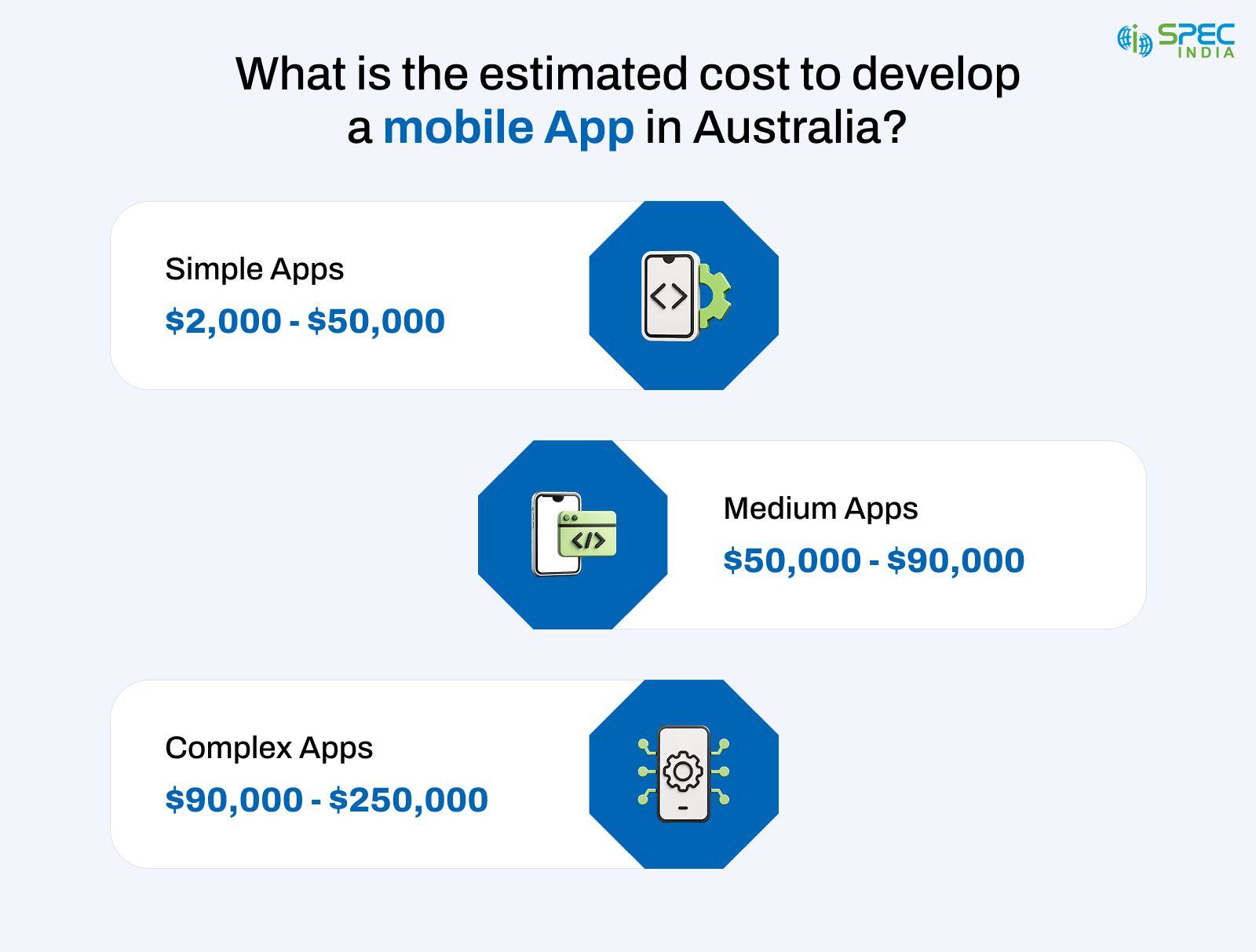
| App Level | Best For | Estimated Timeline | Estimated Cost Range (AUD) |
|---|---|---|---|
| MVP Applications |
|
2 to 4 Months | 50k to 100k |
| Mid-Scale Business Applications |
|
4 to 8 Months | 100k to 300k |
| Enterprise-Grade Mobile Applications |
|
8 to 15+ Months | 300k to 600k+ |
Note: The timeline and costs mentioned in the table are estimates and may vary based on the requirements of a business and mobile app development trends.
1. MVP Applications
A minimum viable product (MVP) or a simple app focuses only on essential features required to validate a business idea quickly.
These mobile app development projects typically include:
- User authentication
- Push notifications
- Simple user interface design
- Basic third-party API integration
- Simple data storage
- Mid-Scale Business Applications
Mid-scale apps usually include advanced features like –
- Payment gateways
- Multiple user roles
- Location services
- Analytics dashboards
- User engagement tools
- Scalable backend systems
These apps require higher app development budgets and more extensive testing.
2. Mid-Scale Business Applications
Mid-scale apps usually include advanced features like –
- Payment gateways
- Multiple user roles
- Location services
- Analytics dashboards
- User engagement tools
- Scalable backend systems
These apps require higher app development budgets and more extensive testing.
3. Enterprise-Grade Mobile Applications
Enterprise mobile app development in Australia involves:
- Highly scalable cloud architecture
- AI in mobile app development
- Advanced security systems
- Complex third-party integrations
These projects demand larger development teams, continuous post-launch support, and higher mobile app maintenance costs over time.
Mobile App Development Cost by Industry in Australia
The complexity of an app is somehow related to the industry of the app in terms of cost. For example, the cost of finance and healthcare apps is usually higher as there is more complexity involved. Besides, different industries require different levels of –
- Security
- Third party integrations
- Compliance standards
- Real-time functionality
- User engagement capabilities
| Industry | Key Features | Development Complexity | Approx Cost Impact (AUD) |
|---|---|---|---|
| Fintech Applications |
|
Very High | 250k to 700k+ |
| Healthcare & Telemedicine Apps |
|
High | 180k to 500k+ |
| Retail & eCommerce Apps |
|
Medium to High | 80k to 300k |
| Logistics & Transportation Apps |
|
High | 120k to 400k |
| On-Demand Service Platforms |
|
High | 150K to 500k+ |
1. Fintech Applications
Australia’s fintech ecosystem is a sophisticated one in the Asia-Pacific region. The ecosystem is underpinned by
- CDR (Consumer Data Right) open banking mandates
- APRA oversight
- New Payments Platform (NPP)
Hence, building a fintech application in Australia means navigating strict licensing requirements (AFSL, ADI authorizations), implementing robust KYC/AML workflows & ensuring data sovereignty.
2. Healthcare & Telemedicine Applications
The COVID-19 pandemic shifted the Australian consumer perspective on telehealth. Moreover, the federal government’s My Health Record infrastructure has opened meaningful integration opportunities for healthcare application developers.
However, all of this comes with significant compliance obligations under the Privacy Act, the My Health Records Act, & state-based health legislation.
3. Retail and eCommerce Apps
Retail apps in Australia must compete with high consumer expectations, particularly around performance, personalization, and frictionless checkout. Key features include
- Dynamic product catalogs
- Afterpay/Zip integration
- Loyalty programs
- Push-notification campaigns
- Inventory synchronization with platforms like Shopify,
- Magento, or SAP Commerce Cloud
- Logistics and Transportation Apps
4. Logistics and Transportation Apps
Australia’s vast geography makes logistics app development uniquely challenging. Several aspects add to its complexity, such as
- Real-time GPS tracking
- Route optimization at scale
- Multi-stop delivery workflows
- Driver management dashboards
- Integration with freight APIs (StarShipIT, Transvirtual, SAP TM)
Many logistics apps also require an offline-capable mobile client for drivers operating in low-connectivity regional areas.
5. On-Demand Service Platforms
Marketplace apps, such as those connecting service providers with consumers in real-time, are among the most architecturally complex apps in this cost guide. Apps like tradesperson booking, home cleaning & beauty services require
- Two-sided experience (customer-facing and provider-facing apps
- Real-time availability
- Dynamic pricing
- In-app payments
- Dispute resolution workflows
- Robust rating systems
Native vs Cross-Platform Apps: Which Is More Cost-Effective?
Choosing between native and cross platform development is one of the biggest decisions affecting mobile app development cost Australia.
The right approach for your business depends on your
- App complexity
- Business goals
- Target audience
- Long-term scalability requirements
While native applications provide performance & user experience, cross-platform frameworks like React Native help businesses reduce app development costs & reduce time to market.
| Factor | Native Apps | Cross-Platform Apps |
|---|---|---|
| Development Cost | Higher due to separate iOS & Android codebases | Lower with a shared codebase |
| Development Time | Longer | Faster deployment |
| Performance | Excellent for complex apps | Good for a medium complexity app |
| User Experience | Highly optimized native UI | Consistent but slightly limited |
| Maintenance Costs | Higher ongoing maintenance | Lower app maintenance costs |
| Scalability | Ideal for enterprise apps | Suitable for MVP and business apps |
-
Initial Development Investment
Native app development for iOS and Android needs two separate engineering teams working on parallel codebases. This increases your initial investment by approximately 60% to 80% compared to a single-platform build. For a typical mid-complexity app, this adds up to an additional AUD $40k to $100k.
On the other hand, cross-platform development with React Native or Flutter allows a single team to deliver apps for both platforms simultaneously, which reduces the initial development costs.
-
Maintenance and Scalability Costs
Over a 5-year horizon, maintenance costs often equal initial development costs. Native apps require separate maintenance cycles for iOS and Android, such as
- OS updates
- New device compatibility
- Security patches
- Feature enhancements
This must be implemented twice. Besides, cross-platform frameworks centralize this work, reducing ongoing maintenance costs by 30% to 50%.
-
Performance and User Experience Considerations
If you aim to build an app with complex animations, video processing, augmented reality, heavy sensor usage (GPS, camera, accelerometer), or demanding real-time graphics, native development delivers superior performance. But this also charges up the development cost.
For most business apps, such as
- Booking systems
- Service platforms
- Enterprise productivity tools
- Marketplace apps
And more, React Native and Flutter deliver user experiences that are indistinguishable from native at a meaningfully lower cost.
-
Long-Term Business ROI
From a business ROI perspective, cross-platform development wins for most Australian SMEs and startups. The savings on initial development and maintenance free up budget for marketing, user acquisition, and feature iteration.
Native development is the best choice when your application’s competitive differentiation is genuinely dependent on platform-specific capabilities that cross-platform frameworks cannot match.
The Hidden Costs Most Australian Businesses Ignore
One critical and must-not-ignore aspect of mobile app development is understanding the true mobile app development price.
Many businesses underestimate the true mobile app development cost in Australia because they focus only on the original development cost.
But the overall cost to develop an app includes the following aspects.
- Continuous investment in infrastructure
- App maintenance
- Security
- Feature improvements long after launch
Ignoring these hidden costs can significantly impact the total cost of app development over time.
-
App Maintenance and Support
Mobile app maintenance is not optional and should not be ignored. iOS and Android release major OS updates annually and minor updates throughout the year. Each update can
- Break existing functionality
- Deprecate APIs
- Introducing new security requirements
Beyond OS compatibility, bug fixes reported by real users, performance optimization, and content updates all require ongoing engineering attention.
Note: Industry benchmarks suggest that mobile app maintenance costs 15% to 20% of the original development cost annually.
-
Cloud Hosting and Infrastructure
Your app’s backend infrastructure includes
- Databases
- APIs
- Authentication services
- Storage
- CDN
- Monitoring
All of these run on cloud platforms that bill monthly. AWS, Google Cloud, and Azure all operate Australian data centers, but costs in the Sydney and Melbourne regions run 15% to 25% higher than US East equivalents.
-
App Store Submission and Licensing Fees
Apple charges AUD $149/year for an Apple Developer Program membership, required for any iOS app in the App Store.
Google charges a one-time AUD $38 registration fee for Google Play Console.
Beyond these direct fees, Apple’s App Store Review process can introduce delays (1 to 7 business days) for new submissions & 1 to 3 days for updates. Repeated rejections (which do happen) can delay your launch & add engineering costs.
-
Security Monitoring and Compliance Updates
Cybersecurity is not a one-time investment, but it is an important one. Australian businesses face evolving threats and a tightening regulatory environment. The 2022 Cyber Security Strategy and subsequent legislative changes have raised the compliance bar for organizations handling sensitive data.
Regular penetration testing (AUD $5k to $20k per engagement), security monitoring tools, and compliance audit support are recurring costs your budget must accommodate.
-
Continuous Feature Enhancements
Post-launch is where most apps win or lose. User feedback, competitive pressures, and evolving business needs require continuous feature development.
Note: Successful apps in Australia allocate 20% to 30% of their original development budget annually for new features and UX improvements.
Hidden Cost Area Why It Matters Frequency App Maintenance Bug fixes and performance optimization Ongoing Cloud Infrastructure Scalability and real-time operations Monthly App Store Fees Publishing and licensing requirements Annual Security Updates Compliance and data protection Ongoing Feature Enhancements User engagement and app growth Periodic
Cost Comparison: Australian Agencies vs Offshore Teams vs Freelancers
In the overall app development cost, the development team’s location plays a major role. Businesses today can choose between
- Local Australian app developers
- Offshore app development companies
- Freelancers
- Hybrid engagement models
Each option offers different advantages in terms of mobile app development budget, communication, scalability, and project quality.
| Development Model | Cost Range (AUD) | Advantages | Challenges |
|---|---|---|---|
| Australian Development Agencies | 120 to 250 per hour |
|
Higher labor costs |
| Offshore Development Companies | 30 to 100 per hour |
|
Time zone and communication challenges |
| Freelance App Developers | 25 to 120 per hour |
|
Limited scalability and reliability |
| Hybrid Engagement Models | Moderate overall cost | Balanced cost and quality | Requires strong project management |
1. Local Australian Development Agencies
Working with an experienced mobile app development company in Australia provides better collaboration, regulatory understanding, and long-term support.
Australian businesses often prefer local agencies for
- Enterprise apps
- Healthcare apps
- Fintech mobile app projects
2. Offshore Development Companies
Offshore teams help reduce app development costs significantly, especially for MVP apps and cross platform development projects.
However, businesses may face communication gaps, inconsistent quality, and slower feedback cycles.
3. Freelance App Developers
Freelancers are the most cost-effective option for POC app development or simple app projects with basic features.
Relying on individual developers may create risks related to scalability, security, and ongoing maintenance.
4. Hybrid Engagement Models
Many businesses now combine offshore development with local project management to optimize app development costs without compromising quality.
This model offers
- Better scalability
- Reduced labor costs
- Improved communication throughout the app development process
How AI Is Transforming Mobile App Development Costs?
In the modern-day business landscape, AI can help Australian businesses by reducing certain development costs while introducing new categories of infrastructure spend.
-
AI-Assisted App Development Acceleration
AI-powered development tools like
- GitHub Copilot
- Cursor
- Claude Code
And others are materially accelerating engineering productivity.
Experienced Australian developers using AI coding assistants report 20% to 40% reductions in time spent on boilerplate code, documentation, test generation, & debugging.
Businesses can save up to $30k to $60k on an AUD $200,000 project.
-
AI-Powered App Features Increasing Infrastructure Costs
The flip side of AI integration is infrastructure cost. Large language model (LLM) API calls, image recognition inference, real-time recommendation engines, and personalization pipelines all carry usage-based pricing that scales with your user base.
An app processing 100,000 AI interactions per month can easily accumulate AUD $5k to $30k in monthly API costs, depending on the model and call complexity.
-
Personalization and Predictive Analytics Expenses
Personalization (surfacing the right content, product, or service to the right user at the right time) is one of the most commercially valuable AI applications in mobile apps.
But building personalization requires investment in data pipelines, user behavior tracking, model training infrastructure, and A/B testing frameworks that surge app development costs.
Budget Planning Framework for Australian Businesses
If you have a structured approach to budget allocation, you can prevent the most common cause of app project failure: Underfunding critical phases.
This happens because the budget gets consumed by development before essential testing, launch preparation, and post-launch iteration. Here is a tabular representation of budget allocation based on the development phase.
| Development Phase | Typical Budget Allocation |
|---|---|
| Discovery & Product Strategy | 8% to 12% |
| UI/UX Design & Prototyping | 12% to 18% |
| Frontend & Backend Development | 40% to 55% |
| QA & Testing | 8% to 12% |
| Launch & App Store Submission | 3% to 5% |
| Post-Launch Support (6 months | 10% to 15% |
Skipping any of these steps of the app development process can significantly shift the overall cost, affecting long-term planning and scalability.
Smart Ways to Reduce Mobile App Development Costs Without Sacrificing Quality
Reducing the app development cost in Australia is not always about cutting corners. It is about making smarter decisions at every stage of the project. Here are the strategies that consistently deliver the highest cost savings with the lowest quality risk.
Cost Optimization Strategies
| Strategy | Potential Savings | Business Impact |
|---|---|---|
| Start with MVP and iterate | 30% to 50% on initial build | Faster validation, lower risk |
| Use a cross platform framework (React Native / Flutter) | 20% to 40% vs dual-native | Minimal performance trade-off for most apps |
| Leverage managed cloud | 15% to 30% on backend | Reduced DevOps burden |
| Services (Firebase, Supabase) | costs | |
| Use third-party APIs instead of custom builds | 20% to 40% on feature costs | Faster time to market |
| Adopt agile with fixed sprint budgets) | 10% to 20% on change management | Predictable cost control |
| Choose a hybrid engagement model | 30% to 50% vs fully local | Strategic oversight + cost efficiency |
Why Choose SPEC India for Mobile App Development in Australia?
SPEC India is a trusted mobile app development company Australia businesses rely on for scalable, secure, and future-ready digital solutions. With 30+ years of software engineering expertise, the company delivers high-quality mobile app development services across fintech, healthcare, retail, logistics, and enterprise sectors.
Key advantages of partnering with SPEC India include:
- End-to-end mobile app development process, from discovery and UI/UX design to development, QA, deployment, and post launch support.
- Expertise in native and cross platform development using React Native, Flutter, iOS, and Android technologies.
- Transparent app development cost structures with flexible engagement models.
- Strong capabilities in AI in mobile app development, including predictive analytics and automation.
- Secure and scalable architecture aligned with Australian business requirements.
- A hybrid engagement model combining offshore cost efficiency with dedicated Australian client communication.
Whether you need an MVP, enterprise app, or AI-powered mobile platform, SPEC India helps Australian businesses optimize mobile app development budgets without compromising quality or scalability. Get a Consultation Today!
Conclusion
As new businesses enter the market every day, the need for differentiation has become increasingly necessary. Moreover, as market competition rises, user demand has shifted, leading to the need for innovative apps. If you are a budding business in Australia, you must have a clear idea about the overall app development cost in Australia. It is also critical to ensure that you choose the right development model and team to ensure limited costs while obtaining quality. Keeping a tab on the latest trends is also critical to build a demanding app.

SPEC INDIA is your trusted partner for AI-driven software solutions, with proven expertise in digital transformation and innovative technology services. We deliver secure, reliable, and high-quality IT solutions to clients worldwide. As an ISO/IEC 27001:2022 certified company, we follow the highest standards for data security and quality. Our team applies proven project management methods, flexible engagement models, and modern infrastructure to deliver outstanding results. With skilled professionals and years of experience, we turn ideas into impactful solutions that drive business growth.
Table of contents
- The Biggest Factors That Influence Mobile App Development Cost
- Mobile App Development Cost by App Complexity
- Mobile App Development Cost by Industry in Australia
- Native vs Cross-Platform Apps: Which Is More Cost-Effective?
- The Hidden Costs Most Australian Businesses Ignore
- Cost Comparison: Australian Agencies vs Offshore Teams vs Freelancers
- How AI Is Transforming Mobile App Development Costs?
- Budget Planning Framework for Australian Businesses
- Smart Ways to Reduce Mobile App Development Costs Without Sacrificing Quality
- Why Choose SPEC India for Mobile App Development in Australia?
- Conclusion
Delivering Digital Outcomes To Accelerate Growth
Let’s TalkTable of contents
- The Biggest Factors That Influence Mobile App Development Cost
- Mobile App Development Cost by App Complexity
- Mobile App Development Cost by Industry in Australia
- Native vs Cross-Platform Apps: Which Is More Cost-Effective?
- The Hidden Costs Most Australian Businesses Ignore
- Cost Comparison: Australian Agencies vs Offshore Teams vs Freelancers
- How AI Is Transforming Mobile App Development Costs?
- Budget Planning Framework for Australian Businesses
- Smart Ways to Reduce Mobile App Development Costs Without Sacrificing Quality
- Why Choose SPEC India for Mobile App Development in Australia?
- Conclusion
Delivering Digital Outcomes To Accelerate Growth
Let’s Talk



Let’s get in touch!
India
SPEC House, Parth Complex, Near Swastik Cross Roads, Navarangpura, Ahmedabad 380009, INDIA.
-
 +91-79-26404031, 32-33-34
 -
 [email protected]