| ERP for Managing Enterprise Operations | MES for Managing Shop Floor Execution |
|---|---|
| ERP systems run the business functions that exist above the plant floor, and this includes parts of the company that plan, sell, buy, and account for what gets made.
ERP software for manufacturers covers;
|
MES operates a layer down from the ERP, at a stage where the plan comes into action, letting managers manage the shop floor.
MES implementation supports the following business operations;
|


Loading...
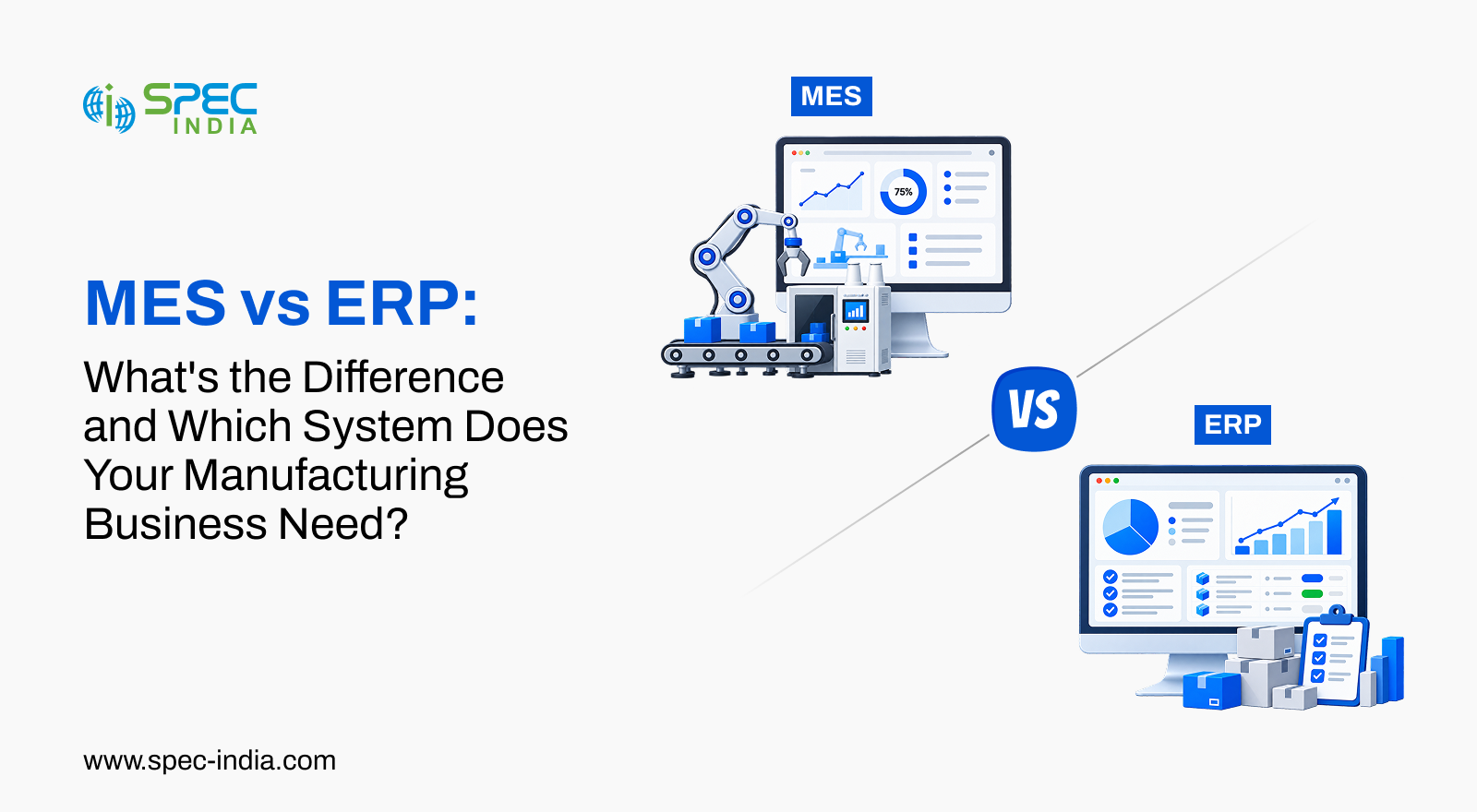
MES vs ERP: What’s the Difference and Which System Does Your Manufacturing Business Need?
Posted
August 25, 2026
MES and ERP systems work with product data, promise better visibility, and are used by vendors to answer all your operational headache questions.
It’s as if they overlap, and hence the confusion about understanding their scope and why procurement teams buy one when they need the other.
A manufacturer that installs an ERP system expecting real-time machine-level control will be disappointed within a quarter. A plant that deploys MES solutions hoping it will handle accounts payable and demand forecasts will hit the same wall from the opposite direction.
Today, 93% of manufacturers have implemented the MES system, and after seeing success, 28% have deployed it at an enterprise scale. At the same time, manufacturers are no longer asking whether they need digital systems; they are asking how to connect ERP, MES, machines, and operational data to achieve measurable performance improvements.
For effective implementation, we first need to understand the difference between MES and ERP in operational terms, and that’s what we will be discussing in this article.
Why Manufacturers Struggle Without the Right System
Most manufacturers don’t start their search by asking “MES or ERP? But the right way is to first define a business problem and then talk about production, inventory, and so on.
Production delays are rarely caused by one bad decision, and these are the result of schedules built on outdated data, machines running without anyone tracking throughput, and supervisors relying on phone calls instead of live dashboards.
Inventory mismatches are commonly seen when raw materials get consumed on the shop floor faster than the system records them, leaving finance and procurement working with numbers that are less relevant today than they were tomorrow.
And if these issues are not enough, limited shop floor visibility compounds everything else.
Manual production data tracking, including using clipboards, whiteboards, end-of-shift spreadsheets and all of these are scarred with delays and human error that carries forward with every handoff.
So, if a unit’s operations and management systems run on separate versions of the truth, coordination is difficult, which is why management plans a delivery date that operations can never expect to follow.
If your distribution requirements are highly complex, investing in custom logistics software development services can bridge the gap between standard warehouse routing and your actual delivery capabilities.
MES software for manufacturing answers a different question for the organizations, including what is actually happening on the plant floor right now, and how do we control it?
To sum it up, there is no race between MES or ERP, as both systems don’t compete for the same job. They handle different but complementary roles, as one runs the business, the other runs production. Problems start when a manufacturer expects one to do the other’s work.
MES vs ERP | Comparing their Functions and Outcomes
| Criteria | ERP | MES |
|---|---|---|
| Primary Purpose | Plan and manage core business processes | Execute and control production processes |
| Users | Finance, procurement, sales, human resources, executive leadership | Plant managers, process engineers, machine operators, quality teams |
| Business Focus | Business planning, financial resource management, supply chain | Shop floor operations, production execution, process control |
| Data Visibility | Enterprise-wide, transactional, often updated daily or per shift | Plant floor, granular, updated in real time |
| Planning vs Execution | Long-range and mid-range planning | Short-interval execution and control |
| Production Monitoring | Aggregated production summaries | Real-time production efficiency monitoring at the machine and line level |
| Inventory Management | Business-level stock valuation and replenishment planning | Real-time consumption tracking of raw materials and WIP |
| Quality Management | Compliance reporting, high-level quality metrics | Detailed control of inspections, defects, and process parameters |
| Reporting | Financial and business performance reporting | Production performance, downtime, yield, and OEE reporting |
The key differences come down to altitude and speed: ERP operates at the altitude of the business and the speed of a planning cycle; MES operates at the altitude of the plant floor and the speed of the production line.
When to Choose Between ERP, MES, or Both?
Again, the discussion between MES vs ERP isn’t about which is better, but it’s more about which solution is fit for your problem.
Choose ERP If;
- Your core pain points are related to departments like finance, procurement, or supply chain management, not related to the plant floor
- You need better demand forecasts, order processing, or business planning across multiple sites for your manufacturing process.
- Even though you have the required visibility in production, broader business processes like accounts payable and warehouse management are fragmented.
Choose MES If;
- Your smart factory already has functioning ERP software, but you still need to use spreadsheets, ask floor managers, and sift through paperwork to know what’s happening on the line right now.
- Quality documentation of your manufacturing unit is manual, and traceability is nearly impossible to reconstruct after the process is complete.
- Production scheduling with the factory management software looks fine on paper but consistently falls apart when it’s time to execute the tasks.
Choose Both If;
- You are scaling past the point where spreadsheets and manual handoffs can keep operations and business planning in synchronization.
- You need seamless data exchange between order commitments and shop floor equipment.
- You are pursuing genuine manufacturing digital transformation across the organization and do not just want to fix one or two points. Hence, leveraging comprehensive digital transformation services can ensure your ERP and MES systems are strategically aligned to scale, rather than just technically connected.
How ERP and MES Work Together for Manufacturing Automation?
When a single customer order is routed through both these production planning and manufacturing operations management systems, the relationship becomes clearer.
Here’s how it goes:
Customer Order → ERP Planning → MES Production Execution → ERP Inventory & Finance Update
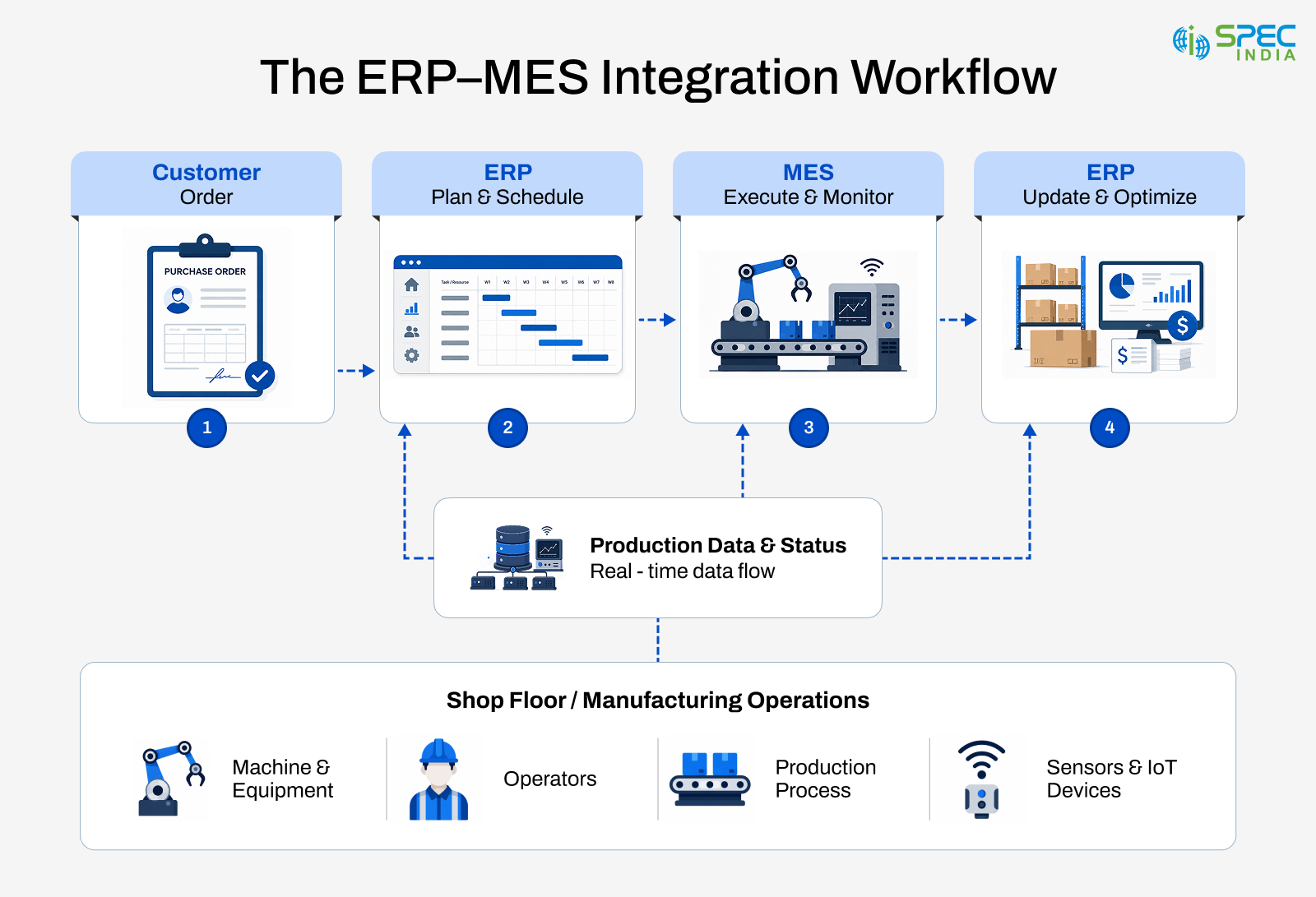
- ERP receives the order, checks available capacity, and generates a production plan and material requirements.
- That plan is handed down to MES, which breaks it into work orders, dispatches them to specific machines, and collects real-time data.
- As the product moves through the production cycle, the MES updates machine status, cycle times, scrap, and quality checks.
- Once the job closes, that shop floor data flows back up to ERP, updating inventory, cost accounting, and finance in near real time.
This is just an example of integrating MES with ERP in practice, and it’s where most manufacturers either succeed or quietly fail. MES and ERP systems that don’t talk to each other create data silos: finance works from one number, the shop floor works from another, and nobody trusts either one completely.
| ERP Responsibility | MES Responsibility |
|---|---|
| Demand forecasts and order intake | Work order dispatch and sequencing |
| Demand forecasts and order intake | Work order dispatch and sequencing |
| Procurement of raw materials | Machine-level data acquisition |
| Business-level inventory valuation | Real-time consumption of raw materials |
| Financial and cost reporting | Production performance and downtime tracking |
| Supply chain and logistics coordination | Quality control and traceability at the point of production |
| Long-term production planning | Short-interval scheduling and process control |
Once you connect these two systems, your enterprise data stops being a historical record and starts becoming a live operation with real-time updates defining every decision.
Signs Your Manufacturing Business Has Outgrown its Current System
In addition to the obvious warnings pointing towards the old manufacturing software solutions you are still using, here are some other signals that will convince you to evolve and adapt.
- Production teams use spreadsheets to track and update jobs that should be running through automated MES systems.
- Inventory doesn’t match actual stock, and cycle counts routinely turn up discrepancies nobody on your team can explain.
- No real-time production tracking exists, and supervisors have to find out about downtime after the shift ends, not when it happens.
- Frequent production delays occur even when the ERP-generated schedule was meant to be accurate and achievable on paper.
- Manual quality documentation makes traceability a multi-hour research project instead of a lookup.
- ERP and shop-floor systems run disconnected, forcing someone to manually reconcile numbers between departments every week.
Any of the signs you are experiencing at present are manageable, but if they are the only issues. If 3 or 4 of these are currently disrupting operations, it means your existing manufacturing execution system has hit its ceiling, and you need a better system for production scheduling, shop floor management, and production planning.
Should You Choose a Standard ERP/MES Software or Build a Custom Manufacturing Solution
Off-the-shelf platforms work well for manufacturers whose processes look like everyone else’s, but in reality, fewer manufacturers fit that description than software vendors would like to admit.
When operational complexity outstrips generic configurations, engaging specialized manufacturing software development services aligns the technology directly with your specific production realities instead of forcing your plant floor to adapt to a vendor’s template.
| Standard Software | Custom Manufacturing Solution |
|---|---|
| Fixed workflows built for generic manufacturing processes | Workflows configured around your actual production line and process engineers’ requirements |
| Limited integrations with legacy or specialized equipment | Built-in MES integration with ERP, IoT sensors, and existing plant floor equipment |
| Generic manufacturing processes with heavy customization fees | Purpose-built for your specific manufacturing operations from day one |
| Limited scalability across multiple plants or product lines | Scales with the business, including ERP modernization paths for legacy systems |
| Standard dashboards and canned reports | Custom dashboards and reports tied to the metrics that matter to your plant managers |
Even if you go with the standard software, it will still help you become a part of the Industry 4.0 revolution, and it’s often the faster, cheaper starting point. Conversely, if your operations refuse to fit generic molds, exploring custom ERP software development services allows you to architect a system tailored exactly to your floor’s reality from day one.
However, for manufacturers running complex, regulated, or highly specific production processes, these systems frequently outgrow standard configurations within a few years. At this point, the challenges around adapting rigid workflows begin inflating the overall ERP implementation cost far beyond what a custom build would have required.
Why Choose SPEC for Manufacturing Software Solutions Development?
SPEC India has spent over 39 years building enterprise software for organizations that don’t fit neatly into off-the-shelf boxes. That experience translates directly into how the company approaches manufacturing software solutions.
Our work spans custom ERP and MES development built around actual plant floor operations rather than generic templates, with a clear focus on manufacturing digital transformation that connects business planning to production execution instead of leaving them as separate systems.
We integrate ERP, MES, IoT, AI, and Business Intelligence into a single operating solution as per your requirements to ensure you leverage advanced technologies and business performance reporting.
For manufacturers running on aging platforms, we can provide legacy application modernization of old manufacturing systems without disrupting your existing systems and processes.
The MES vs ERP decision isn’t really about picking a category, but it’s more about matching software to where your operational pain actually lives and building a path for both systems to work as one connected operation instead of two disconnected tools.

SPEC INDIA is your trusted partner for AI-driven software solutions, with proven expertise in digital transformation and innovative technology services. We deliver secure, reliable, and high-quality IT solutions to clients worldwide. As an ISO/IEC 27001:2022 certified company, we follow the highest standards for data security and quality. Our team applies proven project management methods, flexible engagement models, and modern infrastructure to deliver outstanding results. With skilled professionals and years of experience, we turn ideas into impactful solutions that drive business growth.
Table of contents
- Why Manufacturers Struggle Without the Right System
- MES vs ERP: Comparision
- When to Choose Between ERP, MES, or Both?
- How ERP and MES Work Together for Manufacturing Automation?
- Signs Your Manufacturing Business Has Outgrown its Current System
- Should You Choose a Standard ERP/MES Software or Build a Custom Solution
- Why Choose SPEC?
Delivering Digital Outcomes To Accelerate Growth
Let’s TalkTable of contents
- Why Manufacturers Struggle Without the Right System
- MES vs ERP: Comparision
- When to Choose Between ERP, MES, or Both?
- How ERP and MES Work Together for Manufacturing Automation?
- Signs Your Manufacturing Business Has Outgrown its Current System
- Should You Choose a Standard ERP/MES Software or Build a Custom Solution
- Why Choose SPEC?
Delivering Digital Outcomes To Accelerate Growth
Let’s TalkRelated Blogs
Let’s get in touch!
India
SPEC House, Parth Complex, Near Swastik Cross Roads, Navarangpura, Ahmedabad 380009, INDIA.
-
 +91-79-26404031, 32-33-34
 -
 [email protected]