For organizations deploying on-premises ERP systems, infrastructure costs represent a substantial capital investment, which includes expenses like;
This can add $20,000 to $200,000+ to project budgets. |
Cloud based systems shift much of this responsibility to the software provider.
Infrastructure expenses become embedded within subscription fees, eliminating hardware refresh cycles and reducing internal maintenance requirements. |


Loading...
ERP Implementation Cost: Industry-Wise Estimates and ROI Benefits
Posted
June 30, 2026
Category ERP
Budgeting for an ERP implementation is rarely as simple as comparing software quotes. Enterprise Resource Planning (ERP) initiatives affect multiple aspects of a business, including;
- Processes
- Data architecture
- Workforce adoption
- Infrastructure strategy
- Long-term operational performance.
A platform that appears affordable during vendor selection can become significantly more expensive once you also factor in customization, integrations, data migration, training, and ongoing support.
That complexity explains why ERP implementation cost remains one of the most researched topics among CIOs, CFOs, and digital transformation leaders. This guide breaks down ERP implementation costs across industries, identifies the factors that influence total investment, and provides practical frameworks for evaluating ERP ROI with greater confidence.
What is ERP Implementation?
ERP (Enterprise Resource Planning) is a unified software platform that integrates and manages core business functions such as;
- Finance
- Supply chain management
- Inventory control
- Customer relationship management (CRM)
- Human resources
- Procurement
- Manufacturing
- Operations
You can add more functionalities as per your requirements. ERP implementation cost represents the total investment required to deploy, configure, integrate, adopt, and maintain an ERP system across an organization.
Businesses often mistake the cost of ERP implementation as a static expense, but in reality, it’s a dynamic expense with multiple variables influencing the final cost. This includes;
- Business size
- Industry requirements
- Number of users
- Integration complexity
- Customization depth
- Regulatory obligations
- Condition of existing systems
For the management and CFOs evaluating how much an ERP system costs, three cost categories deserve separate consideration:
- Initial Investment: It includes software licensing, implementation services, infrastructure, and deployment activities.
- Ongoing Costs: It includes subscriptions, maintenance, upgrades, support, and administration.
- Indirect Costs: It includes productivity disruption, change management, training, and process redesign.
To answer your question in one line, how much does an ERP system cost? It’s somewhere between $150,000 to $2M. But this is not enough, and now we will dig deeper into the underlying cost drivers.
The cost of ERP implementation differs, for instance, a manufacturing company with a complex production planning will have a different ERP system cost profile than a professional services firm working on a standardized solution.
The ERP Implementation Cost Breakdown | Drivers that Influence the Cost
ERP implementation budgets typically expand or contract based on a handful of predictable variables. Understanding where money is spent allows organizations to build realistic business cases, evaluate vendor proposals accurately, and reduce the risk of budget overruns.
Software Licensing and Subscription Costs
Software licensing cost is simply the amount you pay to get access to the ERP software functionality. Here, the ERP pricing models have two categories;
- Perpetual Licensing: Under a perpetual licensing model, organizations make a one-time capital expenditure to purchase software rights.
- Subscription-based SaaS Licensing: In the subscription model, organizations pay recurring subscription fees, generally ranging from $75 to $300 per user per month, with infrastructure, updates, and platform maintenance included.
While on-premise ERP systems are common in highly regulated sectors where data sovereignty and compliance are integral to the infrastructure, most modern organizations, especially service-based companies, are choosing cloud-based ERP offerings.
Implementation and Consulting Fees
The professional services required to configure, deploy, and operationalize an ERP system are the cost of implementing ERP system. For most organizations, consulting fees represent the largest component of ERP implementation cost.
ERP consulting rates generally range from $175 to $350 per hour, while project-based engagements commonly fall between $50,000 and $500,000+. Consulting activities typically include:
- Business process mapping
- Solution architecture design
- ERP configuration
- System integration
- Data migration planning
- User acceptance testing (UAT)
- Go-live support
A smarter approach is to consider ERP consultants as different from vendor implementation processes. You cannot exclusively rely on vendor-provided resources, as then you will be dependent on them, have reduced implementation flexibility, and also limit negotiating leverage.
Data Migration Costs
The expense associated with transferring business data from legacy systems into a new ERP environment is the data migration cost, and this is different from ERP modernization costs. Still, data migration remains one of the most underestimated ERP cost drivers.
The process extends far beyond moving records from one database to another, and it also involves;
- Data extraction
- Cleansing
- Transformation
- Validation
- Reconciliation
- Controlled loading into the new ERP system
As for the costs of ERP data migration are concerned, you will spend somewhere between $15,000 to $150,000, depending on the volume of data and the number of legacy systems involved.
Training Costs and Change Management
Training your staff to use the ERP system is essential, hence let’s consider this as an investment required to prepare employees, administrators, and business leaders to operate the ERP system effectively.
At its core, ERP implementation is ultimately a people transformation initiative as much as a technology project. Even technically successful deployments can fail to generate ROI if users resist adoption or continue operating through manual workarounds.
Training costs generally range from $5,000 to $75,000, depending on;
- Number of users
- Business functions affected
- Complexity of role-specific workflows.
Common activities include end-user training, administrator certification, train-the-trainer programs, and documentation development.
With training, you will also need to consider change management, that is, preparing your organization to adopt new workflows, responsibilities, and operating procedures. Change management accounts for 10% to 15% of the total ERP implementation budget.
Infrastructure, Hardware, and Ongoing Support
Infrastructure cost represents expenses on building the technology environment required to host, operate, secure, and scale the ERP platform. In addition to this, there are ongoing support costs, which are the recurring expenses you need to maintain ERP performance, security, compliance, and user productivity.
Infrastructure costs have two forms, on-premise and cloud-based, as we have discussed before.
So, your long-term budgeting towards ERP implementation cost is best determined through a Total Cost of Ownership Framework.
Total Cost of Ownership (TCO) = Software License Cost + Implementation Cost + Training Cost + Infrastructure Cost + Ongoing Support Cost + Hidden Costs
Hidden ERP Implementation Costs
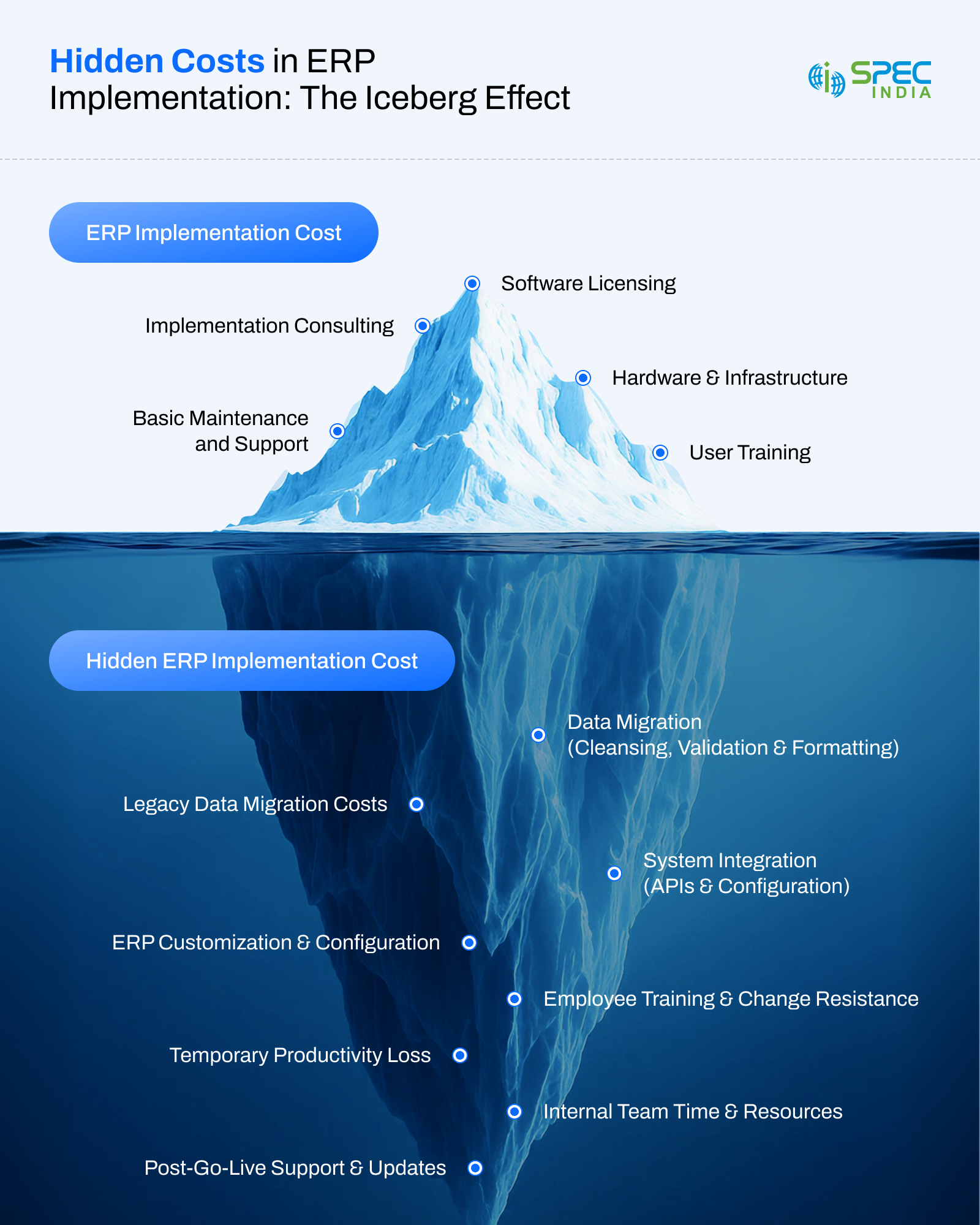
While software licenses and implementation services are easy to budget for, many ERP projects exceed expectations because of hidden costs. These expenses are often overlooked during planning but can significantly impact the total ERP implementation cost.
ERP Systems Cost by Business Size | Small, Mid, and Enterprise
The cost of ERP for a small business bears little resemblance to the investment required for a multi-entity enterprise operating across regions, currencies, and regulatory environments.
Business size affects nearly every ERP cost variable discussed in the previous section, including licensing, implementation effort, data migration scope, customization requirements, training, and ongoing support.
| Business Size | Typical Deployment Model | Avg. Implementation Cost | Avg. Timeline | Key Cost Driver |
|---|---|---|---|---|
| Small Businesses (<50 users) | Cloud-Based ERP Solutions | $10,000 to $100,000 | 2 to 6 months | Number of modules deployed and user count |
| Mid-Sized Businesses (50–500 users) | Cloud ERP or Hybrid ERP | $100,000 to $750,000+ | 6 to 18 months | Multi-department rollout and legacy system migration |
| Enterprise Organizations (500+ users) | Hybrid ERP or On-Premise ERP | $1M to $10M+ | 12 to 36+ months | Global integrations, compliance, and customization complexity |
Industry-Wise ERP Implementation Costs Estimates
Industry requirements are among the strongest predictors of ERP implementation cost. Two organizations with identical employee counts can face dramatically different implementation budgets based on compliance obligations, operational complexity, integration requirements, and data architecture maturity.
Manufacturing ERP Implementation Cost
| Estimated Cost: $200,000 to $1.5M |
Manufacturing environments are among the most complex ERP implementations due to their dependence on interconnected operational processes. In manufacturing units, ERP systems must coordinate;
- Inventory management
- Production planning
- Procurement
- Warehouse operations
- Shop floor control
- Quality management
- Supply chain management
While all these systems and processes must work together, the ERP system cost drivers in manufacturing units include;
- Production scheduling and capacity planning
- Multi-site manufacturing operations
- Shop floor automation integration
- IoT-enabled equipment connectivity
- Supply chain visibility requirements
- Advanced inventory management functionality
The ROI of spending up to $1.5M on custom ERP software is optimization of inventory, reducing production downtime, better forecast accuracy, and better on-time delivery performance.
Healthcare ERP Implementation Cost
| Estimated Cost: $300,000–$2M |
Healthcare organizations have higher ERP implementation costs, among all other industry types, because operational requirements intersect with strict regulatory obligations and highly sensitive patient data environments. Key cost drivers include:
- HIPAA compliance controls
- HL7 and FHIR integration requirements
- EHR and EMR system integration
- Patient data migration complexity
- Revenue cycle management workflows
- Audit and governance requirements
Healthcare ERP projects require extensive validation, security testing, and documentation efforts. Due to this, even the implementation timelines and consulting costs are higher.
Now, when an organization spends this much on ERP, they expect to get some great returns. For a healthcare organization, the ROI is flawless billing, almost zero compliance risk exposure, efficient workforce scheduling, and stronger financial visibility.
Retail and eCommerce ERP Implementation Cost
| Estimated Cost: $75,000 to $500,000 |
Retail organizations often adopt ERP systems incrementally, which means they begin with inventory management and financial management before expanding to other management systems and then finally adopt an ERP for omnichannel operations. Key cost drivers include:
- Point-of-sale (POS) integration
- eCommerce platform integration
- Multi-channel inventory synchronization
- Seasonal demand management
- Customer relationship management integration
- Marketplace connectivity
In these types of companies, the complexity of existing systems is a big cost driver. Reason being retailers often work across multiple channels, like online marketplaces, physical stores, fulfillment centers, and more. So, integrating all these into a single architecture requires more work and effort as compared to a business working on a single channel.
As for the ROI, eCommerce businesses and retailers benefit from lower inventory carrying costs, improved order fulfillment speed, better stock visibility, and a smooth returns management process.
Logistics and Freight Forwarding ERP Implementation Cost
| Estimated Cost: $150,000–$800,000 |
Logistics and freight forwarding organizations rely heavily on real-time information exchange across carriers, customs agencies, warehouses, ports, and customers. Key cost drivers include:
- Carrier API integrations
- Customs documentation workflows
- Multi-modal transport management
- Shipment tracking infrastructure
- Regulatory reporting requirements
- Customer portal integrations
Logistics focused ERP implementations focus on operational visibility and event-driven data synchronization, which a traditional ERP in freight forwarding system does not offer. The real-time data synchronization has integration complexity, which frequently becomes the largest budget component.
Organizations investing in ERP for freight forwarding get ROI through improved shipment visibility, lower manual processing costs, stronger compliance management, and better resource utilization.
Energy and Utilities ERP Implementation Cost
| Estimated Cost: $250,000 to $1.2M |
Energy and utility providers operate on a large scale and often with multiple assets spread across different environments. For these organizations, operational reliability, regulatory compliance, and long-term infrastructure planning directly influence ERP requirements. Key cost drivers include:
- Enterprise Asset Management (EAM) integration
- Renewable energy asset tracking
- Regulatory reporting modules
- ESG performance management
- Field service operations
- Capital project management
In this industry, several implementations you already have must connect with ERP systems, whether it is operational tech, maintenance systems, or asset monitoring platforms. As the number of such integrations increases, the implementation effort and long-term governance requirements also amplify.
But if you look at the benefits side, the ROI includes better asset utilization, lower maintenance costs, enhanced regulatory reporting efficiency, and stronger visibility into capital investment performance.
Professional Services ERP Implementation Cost
| Estimated Cost Range: $50,000 to $400,000 |
Professional services firms generally experience lower ERP implementation costs because they operate with fewer physical assets and less infrastructure-intensive workflows than manufacturing or logistics organizations. Key cost drivers include:
- Project management integration
- Resource planning and workforce allocation
- Financial management processes
- Time and expense tracking
- Revenue recognition requirements
- Business intelligence and analytics capabilities
Professional services organizations, after ERP implementation, can monitor project profitability, forecast resource demand, and track utilization rates. In many cases, improvements in billable utilization and project margin generate measurable ROI within the first 12 to 24 months after deployment.
ERP ROI | How to Calculate Real Returns on your ERP Investment
CFOs and boards typically identify the ROI of their investment in ERP by focusing on;
- Measurable financial outcomes
- Payback period
- Risk reduction
- Long-term value creation
It is recommended that an ERP investment be evaluated using the same financial strictness applied to any strategic capital initiative.
ERP ROI Calculation = [(Annual Financial Benefits − Annual Total Cost) ÷ Total ERP Investment] × 100
The most common sources of measurable ERP value include:
- Inventory cost optimization: Businesses experience a 20 to 30% reduction in inventory management costs through improved inventory visibility, forecasting, and supply chain coordination.
- Order processing time: Due to workflow automation and system integration brought in by ERP software development services, companies record a 30–50% reduction in processing orders.
- Finance close cycle: Our clients have experienced a 40–60% speed increase in financial close due to centralized financial management and real-time reporting.
- IT cost consolidation: With the retirement of redundant legacy systems, databases, and support contracts, your business will save on IT costs, whether it’s maintenance or troubleshooting.
- Compliance risk reduction: Your business will have lower exposure to audit findings, regulatory penalties, and reporting errors, which justifies the higher ERP system cost, especially in healthcare and manufacturing establishments.
- Improved cash flow: Faster accounts receivable processing and stronger working capital management mean you will better understand where the money is coming and going.
Typical ERP Payback Period | Business Size
Payback period varies based on business requirements, implementation scope, and organizational maturity.
| Business Size | Typical ERP Payback Period |
|---|---|
| Small Businesses | 18–36 months |
| Mid-Market Organizations | 24–48 months |
| Enterprise Organizations | 36–60 months |
For a business, efficiency gains aren’t the only ROI metric they want to see after spending thousands of dollars on ERP implementation. ERP platforms, if built from scratch or used as a SaaS service;
- Reduce operational risk
- Improve audit readiness
- Support acquisitions and post-merger integration
- Create a scalable foundation for future growth
Before we move to the next section, a recommendation for you. If you are evaluating ERP investment, also factor in ERP adoption trends as these can materially expand long-term returns.
From Manual Processes to a Connected Mobile ERP
Discover how SPEC built a customized Mobile ERP solution that unified production, inventory, sales, finance, and distribution on a single platform. With real-time reporting, offline functionality, and seamless device integrations, the solution helped simplify complex enterprise operations and improve productivity.
How to Reduce or Optimize ERP Implementation Costs?
Reducing ERP implementation costs is not about selecting the cheapest software or skipping CRM integration with ERP.
The most successful organizations focus on eliminating avoidable expenses while adding the components and capabilities required to achieve business objectives.
1. Adopt a Phased ERP Implementation Approach
Attempting to deploy every ERP module simultaneously increases implementation complexity and introduces unnecessary risk.
A phased roadmap allows organizations to launch high-impact modules such as finance, procurement, and inventory management first, followed by advanced functionality in later phases.
2. Prioritize Cloud-based ERP Solutions
Cloud-based ERP solutions eliminate many infrastructure-related expenses associated with on-premises deployments, which you cannot skip in an on-premises deployment.
In a cloud-based environment, things like hardware procurement, server maintenance, database administration, and upgrade management shifts are the responsibility of the vendor, which means you spend less and deploy faster.
3. Invest in Data Quality
Organizations that perform data cleansing, master data governance, and validation activities before implementation experience fewer delays and lower consulting costs, especially during data migration.
Let alone for medium to large-scale businesses, the data migration cost of ERP for small businesses can also punch a big hole in the budget.
4. Fixed Scope Engagement Model
When you hire an ERP software development company in USA, build your project scope before signing the contract.
Poorly defined project scope creates budget volatility and increases exposure to change requests later, which increases costs. Organizations should establish clearly documented business requirements, milestone-based deliverables, and payment structures tied to measurable outcomes.
5. Partner with a Specialized ERP Software Development Company
Industry expertise matters when you are building a customized ERP system for your organization. Generalist system integrators often spend significant project time learning industry processes, resulting in higher consulting costs and rework rates.
On the other hand, an experienced ERP software development company with domain-specific delivery experience can accelerate implementation timelines, reduce configuration effort, and improve project predictability.
This becomes particularly valuable for organizations seeking customized ERP solutions tailored to unique operational requirements.
Why SPEC India is the Perfect ERP Implementation Partner?
ERP success is rarely determined by software selection alone, and in our experience, it’s determined by;
- Implementation discipline
- Cost governance
- Industry expertise
- Ability to align technology investments with business outcomes
With more than 35 years of software engineering and enterprise solution delivery experience, SPEC India helps organizations design customized ERP solutions that balance functionality, scalability, and financial accountability.
Our delivery model incorporates cost governance frameworks from the earliest planning stages, helping clients avoid the most common sources of ERP budget overruns.
Moreover, we have supported ERP initiatives across manufacturing, logistics, healthcare, energy, and other operationally complex industries, leveraging domain-specific accelerators that reduce ERP software costs, shorten implementation timelines, and improve deployment predictability.
If you are planning a new ERP initiative, request a tailored ERP Implementation Cost Estimate or TCO Assessment to understand the financial implications before committing budget and resources.

SPEC INDIA is your trusted partner for AI-driven software solutions, with proven expertise in digital transformation and innovative technology services. We deliver secure, reliable, and high-quality IT solutions to clients worldwide. As an ISO/IEC 27001:2022 certified company, we follow the highest standards for data security and quality. Our team applies proven project management methods, flexible engagement models, and modern infrastructure to deliver outstanding results. With skilled professionals and years of experience, we turn ideas into impactful solutions that drive business growth.
Table of contents
Delivering Digital Outcomes To Accelerate Growth
Let’s TalkTable of contents
Delivering Digital Outcomes To Accelerate Growth
Let’s TalkRelated Blogs
Let’s get in touch!
India
SPEC House, Parth Complex, Near Swastik Cross Roads, Navarangpura, Ahmedabad 380009, INDIA.
-
 +91-79-26404031, 32-33-34
 -
 [email protected]