
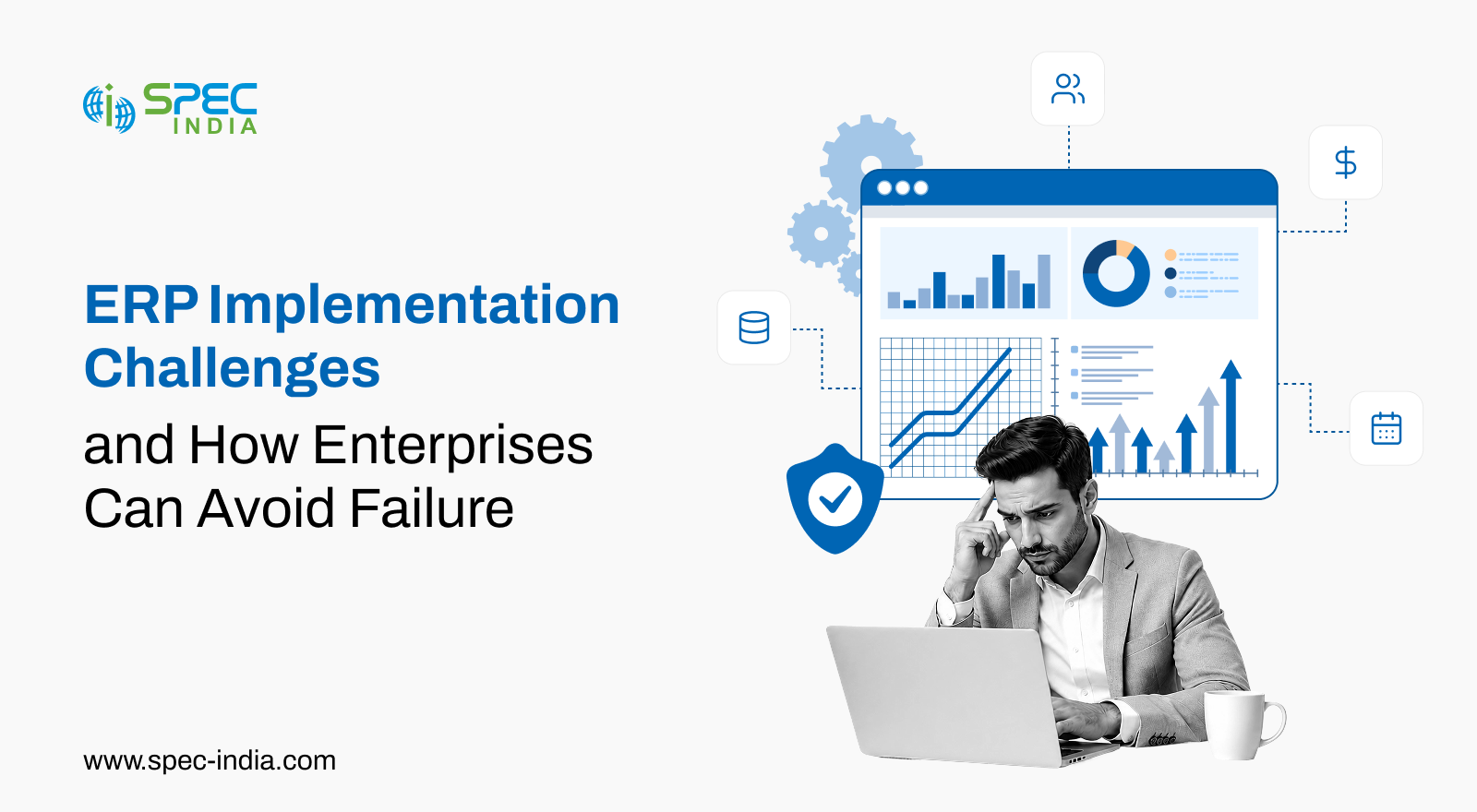
ERP Implementation Challenges and How Enterprises Can Avoid Failure
June 4, 2026
Enterprise resource planning or ERP is the key part of modern-day business workflow & plays a major role in overall process management. ERP helps companies streamline processes, increase their efficiency, and improve decision-making. But, when it comes to ERP implementation, the entire process can be challenging.
As of now, enterprise ERP initiatives continue to fail at an exponential rate (55-75% of ERP initiatives fail to meet their projected goals). Besides, multiple industry studies portray that most of the ERP projects exceed budgets, miss timelines, or fail to deliver projected business results.
These common ERP implementation challenges have become a key concern for business leaders & management that aim to invest in digital transformation, operational efficiency & long-term scalability. Enterprises face irregular business operations, data migration issues, budget overruns, communication breakdowns, etc., due to ERP implementation failures.
No matter what, ERP is important & needs to be implemented. In this blog, we will discuss common ERP challenges, the ERP risks & the strategies that leaders can use to reduce implementation risk & improve project outcomes.
Why ERP Implementations Fail?
Failing of an ERP system means that it did not deliver the expected outcomes and benefits. There can be a number of reasons behind this. Let’s take a look at them!
Misaligned Business Goals
Most of the ERP implementation challenges begin when businesses deploy an ERP system without aligning it to its goals, which include
- Business processes
- Operational efficiency goals
- Long-term growth strategies
This often leads to unnecessary process complexity and communication breakdowns.
Poor Planning
Poor planning is a leading cause of ERP implementation failure. When organizations underestimate project scope, resource constraints, data migration requirements, and implementation timelines, the ERP project often experiences operational disruption.
Lack of Leadership
Successful ERP implementation requires strong executive sponsorship and active leadership involvement. Without clear direction, decision-making slows, key stakeholders become misaligned, communication breakdowns increase, and project teams struggle to achieve business objectives.
Wrong Vendor
Poor ERP vendor selection can often result in implementation partners with less expertise, inadequate ongoing support, and poor project planning. These aspects directly increase ERP implementation issues, project delays & unnecessary operational disruption.
Underestimating Project Scope
Over 50% of the organizations underestimate the internal resources, implementation process complexity, and resource allocation required for a successful ERP implementation. This causes cost overruns, communication breakdowns, & implementation challenges later.
Unrealistic Timelines
Many businesses rush the ERP implementation project. You need to understand that if ERP project timelines are driven by executive pressure instead of realistic implementation planning, they can lead to
- Rushed deployment
- Inadequate employee training
- Poor data migration
- Reduced user adoption
Insufficient Testing of the Software
Insufficient software testing is like going to war without a gun. Limited or no user acceptance testing (UAT), load testing, & system integration validation create significant challenges during deployment. These can lead to
- Increasing data inconsistencies
- Operational downtime
- Poor user experience
All of these across integrated systems and business functions.
Poor Data Preparation
Key ERP risks & challenges are because of poor data quality, incomplete ERP data mapping, and unresolved data inconsistencies. Their origination affects data integrity, reporting accuracy, and decision-making throughout the ERP implementation journey.
The Most Common ERP Implementation Challenges
While we are clear on the reasons why ERP implementations fail, let’s unravel what are the key challenges that businesses face while implementing the ERP solution.
Change Management and User Resistance
One of the key challenges behind the failure of an ERP system is when employees resist new workflows & business processes. If you don’t have strong change management strategies, comprehensive training programs, & stakeholder communication, you may struggle with
- User adoption
- Reduced productivity
- Operational disruption during the ERP implementation process
Data Migration Complexity
Data migration and data compatibility remain one of the most significant challenges in ERP implementation projects.
Factors like poor data quality, inconsistent ERP data structures, data formats, & incomplete data integration planning can compromise data accuracy, disrupt business operations, & weaken trust in the new ERP platform after deployment.
Integration With Legacy Systems
Many enterprises operate with outdated legacy systems. These systems are not designed for modern integrated systems, and this is where the challenge arrives. These ERP integration challenges
- Create compatibility issues
- Increase system integration costs
- Slow down the implementation journey
Note: These scenarios happen especially when all the systems across departments must function through a unified platform.
Budget Overruns and Hidden Costs
Budget overruns are common ERP implementation risks or challenges that enterprises face due to several reasons. Factors like employee training, ongoing support, infrastructure upgrades, load testing & resource allocation add up to your overall ERP implementation costs. This causes ERP investments to exceed projected financial expectations.
Inadequate ERP Consulting or Internal Expertise
Lack of expert ERP consultants and internal project leadership can slow down your well-funded ERP implementation projects.
Enterprises that fail to invest in qualified ERP consulting services encounter communication breakdowns, poor project planning & delayed implementation outcomes.
Scope Creep and Timeline Delays
Scope creep occurs when enterprises continuously expand project requirements during the ERP implementation process. For example, changing priorities, unclear business objectives, and unmanaged customization requests create project delays.
These untimely needs & interrupts overwhelm project teams & introduce unnecessary complexity that impacts successful implementation outcomes.
Understanding the ERP Project Risks Before You Begin
ERP initiatives are complicated in terms of operational & organizational factors. But, most ERP risks & challenges can be reduced with proactive planning, realistic expectations, and strong implementation governance.
Weak project planning increases ERP implementation risk
Organizations that rush the implementation process without proper project planning, stakeholder alignment, or resource allocation experience countless issues, including
- Project delays
- Budget overruns
- Operational disruption
Poor ERP procurement decisions create long-term problems
Effective ERP procurement requires more than comparing software features. Enterprises must evaluate other critical factors to ensure the safe implementation of the new ERP system. These factors include
- Scalability
- Ongoing support
- Implementation methodologies
- Compatibility with existing systems and business processes
Technical risks grow without experienced implementation support
Partnering with experienced ERP software development services providers not only reduces the possibility of issues in the planning process and execution, but it also helps reduce
- Data migration issues
- System integration failures
- Data inconsistencies
- Infrastructure-related implementation challenges
Legacy systems require a deeper risk assessment
Connecting legacy systems, manual processes, and integrated systems to a unified ERP platform is critical and tough at the same time. As it supports all business functions, a bit deeper assessment of the legacy systems and their data formats is important.
ERP implementation challenges should not discourage digital transformation initiatives. Instead, businesses must treat risk management as part of a structured implementation journey focused on operational efficiency, user adoption & long-term business value.
How Enterprises Can Avoid ERP Implementation Failure?
Avoiding ERP failure consists of things beyond selecting the correct ERP system. Businesses that achieve successful ERP implementation outcomes approach ERP initiatives as long-term enterprise transformation programs. These are supported by strong leadership, disciplined planning & continuous stakeholder engagement.
Ensure executive sponsorship & cross-functional team alignment
Successful ERP implementations start with active executive involvement & alignment between finance, operations, supply chain, HR, and IT teams.
Clear ownership of dedicated tasks to the team members helps
- Reduce communication breakdowns
- Keeps key stakeholders in the loop throughout the implementation process
Choose a phased rollout instead of an all-in deployment
A phased implementation means rolling out features & functionalities gradually. This allows businesses to
- Test business functions gradually
- Resolve implementation challenges early
- Improve user acceptance testing before scaling the ERP platform
This approach reduces operational disruption and implementation risk.
Partner with experienced ERP consulting services providers
Experienced ERP consulting services partners bring a lot with them, including
- Implementation expertise
- Project governance
- Strategic guidance
These capabilities help enterprises manage scope creep, project delays, resource constraints, and complex system integration requirements.
Invest in change management and employee training from Day 1
Many challenges in ERP implementation are people-related (inadequate training & resistance) rather than technical. To ensure smooth ERP implementation, businesses must prioritize
- Employee training
- Comprehensive training materials
- Ongoing support
And more to improve user adoption & reduce resistance to new business processes.
Monitor ERP adoption trends and deployment models
Enterprises that track ERP adoption trends are better positioned to evaluate cloud-based ERP solutions, integrated systems, automation capabilities, and scalable deployment strategies aligned with evolving business needs. Some of the key ERP trends are
- AI
- Generative capabilities
- Cloud-first dominance
- Modular ERP
Consider ERP Modernization before full replacement
In some cases, ERP Modernization offers a more practical alternative than replacing the entire ERP system. Modernizing existing systems can
- Reduce implementation costs
- Preserve business continuity
- Minimize ERP implementation challenges associated with large-scale replacement projects
How SPEC India Helps Your Business Handle ERP Implementation Challenges?
Handling ERP implementation challenges does not just require software deployment expertise. Businesses need strategic planning, experienced ERP consultants, strong project governance & a structured implementation process that aligns technology ideally with business operations.
SPEC India helps organizations reduce ERP implementation risks while improving operational efficiency, user adoption, and long-term ERP investment outcomes.
Strategic ERP consulting and implementation planning
SPEC helps enterprises define clear business goals, optimize enterprise resource planning, and create structured project planning strategies. These preparatory methods reduce implementation challenges & support successful ERP implementation outcomes.
Expertise in legacy system integration and data migration
Their ERP team helps organizations manage complex data migration, system integration, and ERP data challenges while maintaining data integrity, data accuracy, and seamless connectivity across integrated systems.
Support for change management and user adoption
The company focuses on employee training, comprehensive training programs, and stakeholder communication to improve user adoption and reduce resistance during the ERP implementation process.
Reduced project delays and scope creep
Through proactive project management and experienced ERP consultants, SPEC India helps enterprises manage scope creep, communication breakdowns, and budget overruns before they impact business operations.
ERP Modernization and ongoing support
SPEC India also supports ERP Modernization initiatives, helping enterprises upgrade existing systems, streamline manual processes, and align ERP platforms with evolving ERP adoption trends and modern business requirements.

SPEC INDIA is your trusted partner for AI-driven software solutions, with proven expertise in digital transformation and innovative technology services. We deliver secure, reliable, and high-quality IT solutions to clients worldwide. As an ISO/IEC 27001:2022 certified company, we follow the highest standards for data security and quality. Our team applies proven project management methods, flexible engagement models, and modern infrastructure to deliver outstanding results. With skilled professionals and years of experience, we turn ideas into impactful solutions that drive business growth.
Table of contents
Delivering Digital Outcomes To Accelerate Growth
Let’s TalkTable of contents
Delivering Digital Outcomes To Accelerate Growth
Let’s TalkRelated Blogs
Let’s get in touch!
India
SPEC House, Parth Complex, Near Swastik Cross Roads, Navarangpura, Ahmedabad 380009, INDIA.
-
 +91-79-26404031, 32-33-34
 -
 [email protected]