

Digital Twin Platform Development for Wind Plant Operations
Our client was based in the USA and operated multiple wind farms across different locations. They were facing challenges related to unplanned turbine downtime, limited visibility into asset performance, and inefficient maintenance planning. To address these issues, they wanted to develop a digital twin platform for real-time monitoring and predictive maintenance. Hence, they approached us to build a solution that could centralize operational data, improve asset reliability, and optimize wind plant performance.
-
Industry
Energy -
Country
USA
Technologies
 ReactJS
 .NET Core
 Python
 SCADA Integration
 REST APIs

Years in Business

Projects Delivered

Enterprise Clients

Countries Served
Business Goals
The client aimed to modernize its wind plant operations by leveraging digital twin technology to gain deeper operational insights, improve asset reliability, and maximize energy generation efficiency. The key business objectives included:
- Develop a centralized digital twin platform for wind farm assets.
- Improve turbine availability and operational efficiency.
- Enable predictive maintenance to reduce unexpected equipment failures.
- Monitor real-time turbine performance and environmental conditions.
- Optimize energy generation and maintenance scheduling.
- Reduce operational and maintenance costs across wind plant operations.
Business Challenges

Lack of Centralized Asset Monitoring
The wind turbines were distributed across multiple onshore and offshore locations, making it difficult for operations teams to monitor asset health and performance from a single platform. This fragmented visibility delayed issue identification and response times.

Limited Predictive Insights from Existing Systems
Although the client had SCADA systems in place, they primarily provided raw operational data without advanced analytics or predictive capabilities. As a result, identifying potential equipment failures before they occurred was a significant challenge.

Frequent Unplanned Equipment Downtime
Critical components such as gearboxes, generators, and blades experienced unexpected failures, leading to costly downtime, reduced energy production, and increased maintenance expenses.

Data Silos and Manual Performance Analysis
Asset performance, maintenance records, and environmental data were stored across different systems. Operations teams had to rely on manual analysis to identify trends and diagnose performance issues, resulting in inefficiencies and delayed decision-making.

Inefficient Maintenance Planning
The client followed a time-based maintenance approach rather than a condition-based strategy. This often led to unnecessary inspections, higher maintenance costs, and missed opportunities to address issues before they escalated into major failures.
Technical Solution
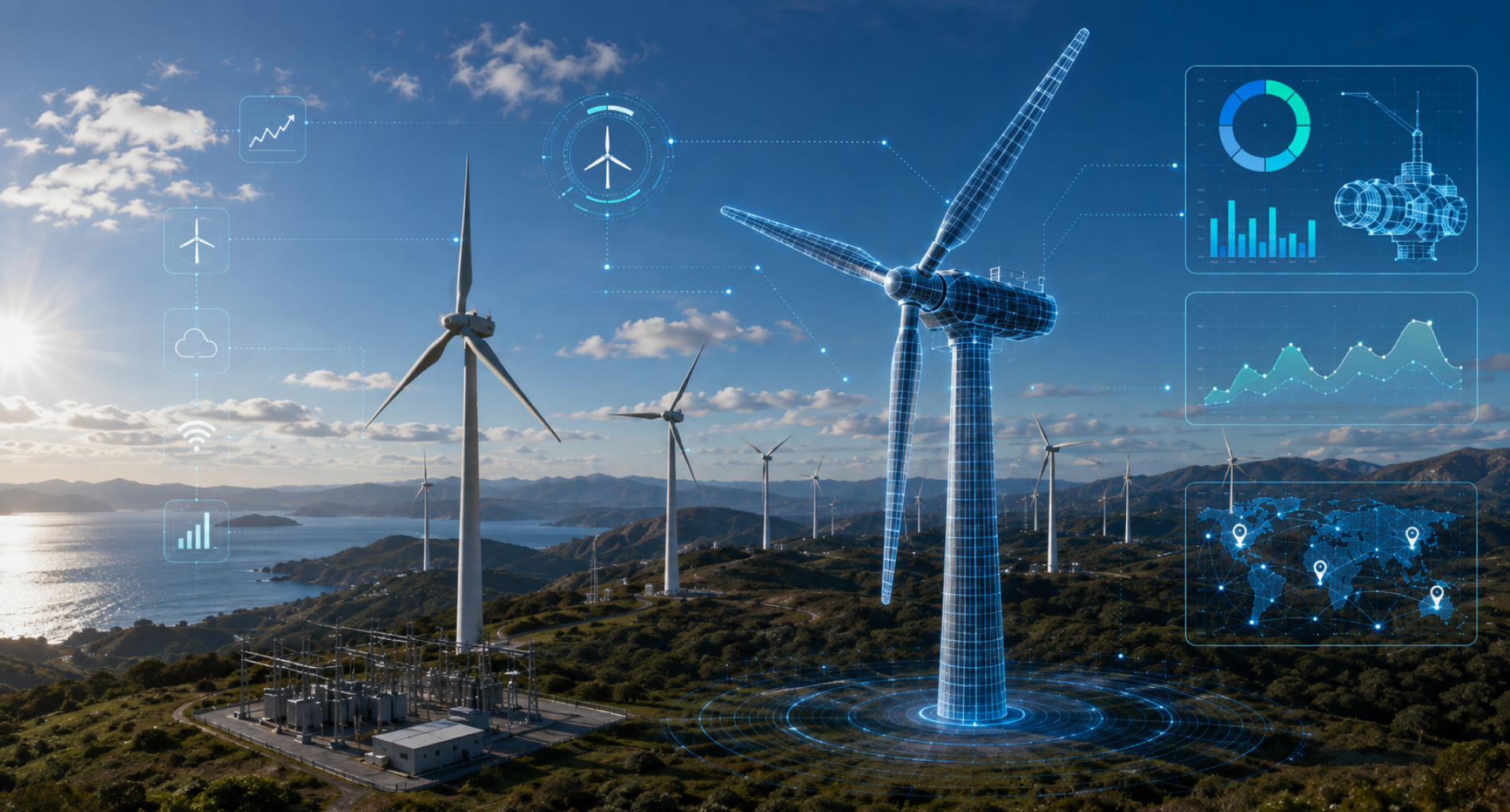
To help the client improve operational efficiency and reduce downtime, we developed a Digital Twin Platform that centralized wind farm monitoring, enabled predictive maintenance, and provided real-time visibility into asset performance.
-
Digital Twin Modeling of Wind Assets
We created digital replicas of wind turbines, substations, and related infrastructure using Azure Digital Twins. This allowed the client to visualize asset relationships, monitor operational conditions, and gain a holistic view of wind plant performance.
-
Real-Time Data Integration and Monitoring
The platform integrated data from SCADA systems, IoT sensors, weather monitoring systems, and historical maintenance records into a centralized environment. This enabled continuous monitoring of turbine health, operational metrics, and environmental conditions in real time.
-
Predictive Maintenance and Anomaly Detection
Advanced analytics and machine learning models were implemented to analyze equipment behavior, detect anomalies, and predict potential failures before they occurred. This helped maintenance teams proactively address issues and reduce unexpected downtime.
-
Centralized Operations Dashboard
We developed an scalable dashboard that provided asset managers, operators, and maintenance teams with real-time insights, performance KPIs, alerts, and maintenance recommendations. The dashboard supported faster decision-making and improved operational efficiency across all wind farm locations.
-
Data-Driven Maintenance Optimization
The solution enabled the transition from time-based maintenance to condition-based maintenance by leveraging real-time asset data and predictive insights. This helped reduce unnecessary inspections, optimize maintenance schedules, and lower operational costs.
Project Glimpse


Key Features

Digital Twin Asset Modeling

Real-Time Asset Monitoring

SCADA System Integration

IoT Sensor Data Integration

Centralized Operations Dashboard

Predictive Maintenance Engine

Anomaly Detection System

Condition-Based Maintenance Module

Asset Relationship Mapping

Weather Data Integration

Performance Analytics & Reporting

Maintenance Recommendation System

Historical Data Analysis

Fleet-Wide Asset Monitoring

Role-Based Access Control (RBAC)
Business Outcomes
-
01.
Reduced Unplanned Downtime
Predictive maintenance capabilities helped reduce unplanned turbine downtime by 32%, minimizing operational disruptions and improving reliability.
-
02.
Improved Asset Performance
The solution increased turbine availability from 94% to 98% and contributed to an 11% increase in annual energy production.
-
03.
Lower Maintenance Costs
By adopting a condition-based maintenance approach, the client achieved a 25% reduction in maintenance costs.
-
04.
Enhanced Operational Visibility
Centralized monitoring and real-time insights reduced fault diagnosis time by 60% and improved decision-making across all wind farm locations.
Let’s get in touch!
India
SPEC House, Parth Complex, Near Swastik Cross Roads, Navarangpura, Ahmedabad 380009, INDIA.
-
 +91-79-26404031, 32-33-34
 -
 [email protected]