| Business Challenge | Business Impact | Solution |
|---|---|---|
| Data Silos | Disconnected decisions, wasted effort | Unified data integration across departments |
| Duplicate Data | Wasted time, customer confusion | Master data management and cleansing |
| Poor Data Quality | Flawed reports, financial risk | Continuous data quality management |
| Limited Visibility | Delayed, reactive decisions | Real-time data synchronization and dashboards |
| Compliance Risks | Audit failures, regulatory fines | Governed, traceable, auditable data flows |


Loading...
Enterprise Data Management: A Strategic Foundation for Data-Driven Business Growth
Posted
September 8, 2026
The challenge for most enterprises is not a lack of data; it is having information spread across systems, teams, and processes that may not align. Conflicting records, manual reporting, and limited visibility can slow decisions, increase operating costs, and create compliance risks.
Enterprise data management brings these disconnected pieces together, giving organizations a structured way to manage data across its lifecycle. It also helps improve quality and establish clear ownership. Fortune Business Insights estimates that the global enterprise data management market will reach USD 294.99 billion by 2034, up from USD 111.28 billion in 2025. The growing market reflects the need for reliable, connected, and well-governed enterprise data.
For enterprise leaders, the focus is not simply on managing data, but on making it useful for the business. This blog explores the core capabilities, business benefits, implementation steps, and key considerations for building an enterprise data management strategy that supports better decisions and sustainable growth.
The Real Meaning of Enterprise Data Management
Enterprise Data Management (EDM) is the process of gathering, structuring, and managing data at an enterprise level, across the organization. It creates an accurate source of information for all departments, including finance, sales, operations, and more.
More Than Data Storage and Organization
Most decision-makers underestimate the amount of work and hassle they eliminate each day with this single discipline. It goes far beyond storage or basic file organization and shapes how an enterprise uses data to compete and grow.
Companies with a strong enterprise data management framework typically gain:
- Consistent data definitions shared across every department
- Fewer duplicate and conflicting records in daily operations
- Faster access to business data for frontline teams
- Stronger data governance that lowers compliance risk
It also manages the data lifecycle, helping organizations control storage costs, reduce unnecessary data exposure, and meet retention and compliance requirements.
Building a Trusted Enterprise Data Foundation
Many organizations are still stuck with legacy enterprise data management software that is unable to meet contemporary reporting requirements. Sometimes, replacing these traditional tools is a good first step toward using more reliable enterprise data management services across the entire business, rather than just in IT.
An enterprise data management platform is the foundation of a broader digital transformation. It brings together departments based on shared, trusted data rather than siloed spreadsheets. This provides a reliable platform on which to build:
- Unified customer records that strengthen enterprise data integration across systems
- Cleaner, connected data that fuels digital transformation services initiatives
- Better collaboration between IT, finance, and operations teams
- A flexible enterprise data management architecture that scales comfortably as the business grows
Clear data rules throughout its lifecycle help businesses avoid keeping unnecessary data, reduce security risks, control storage costs, and meet retention requirements.
Business Challenges Enterprise Data Management Tools Solve
Most businesses face no problem gathering data. They suffer from not having trustworthy data at their disposal, not finding it or using it in time. They allow costs to rise and strategy choices to be delayed. One thing executives want to assume is that the problem is technology! Typically, the challenge or concern is the lack of a common strategy for collecting, storing, and managing data.
Data Silos Across Departments
Typically, sales, finance, and operations maintain data in isolation, which is not viewed together. Leaders are forced to make decisions based on incomplete or inaccurate data, and teams operate on a variety of “truths” that are unknown to one another.
- Different data sources create inconsistent reports and duplicate business efforts.
- Isolated systems prevent teams from sharing organizational data efficiently.
Inconsistent and Duplicate Data
Customer or product data can have many different representations in various systems. This causes confusion, loss of customer trust, and staff time wasted on weekly manual cleanups.
- Conflicting master data makes reporting less reliable and slows daily operations.
- Poor data quality increases manual corrections and unnecessary operational costs.
Limited Real-Time Business Visibility
In the absence of systems, executives look at yesterday’s numbers rather than today’s reality. Low visibility restricts a business’s ability to react to market changes, which can bridge the gap between the business and market changes quickly enough.
- Real-time dashboards improve data accessibility across business functions.
- Connected data infrastructure gives leaders a complete operational view.
Slow Executive Reporting
Having to refer to five different systems for each board meeting wastes hours each month. With reliable enterprise data integration services, that manual grind is out of the picture, and analysts are free to concentrate on higher-value tasks.
- Automated reports reduce manual effort and improve reporting consistency.
- Connected systems combine information from multiple sources into one executive view.
Compliance and Governance Risks
Increasingly, regulators require organizations to demonstrate the origins of their data and how it is protected. Without adequate data lineage and limited data ownership, expanding companies face real legal liability.
- A strong data governance framework supports audit readiness and regulatory compliance.
- Clear access controls help protect sensitive information across the organization.
Poor Decision-Making Due to Unreliable Data
When leaders are uncertain of their numbers, they hesitate, delay, or fall back on instinct rather than solid evidence.
- High-quality data supports confident planning and better business outcomes.
- Reliable data management processes help ensure data quality across every department.
Poor data quality does not just cause minor friction. It creates board-level financial exposure that compounds every year it goes unaddressed.
These issues need not be solved during a system-wide overhaul. The right enterprise data management solution starts with the highest-risk areas first. It enables entrepreneurs and decision-makers to make more confident decisions and identify issues earlier, especially when used with data visualization services.
Struggling With Scattered, Unreliable Data Across Your Enterprise?
Fragmented systems create delays, duplicate work, and costly risks. We help you unify enterprise data management for smarter, faster business decisions.
Core Capabilities Every Enterprise Needs
A capable enterprise data management solution combines several core functions. Each capability solves a specific business problem, creating a connected enterprise data management architecture instead of disconnected point solutions.
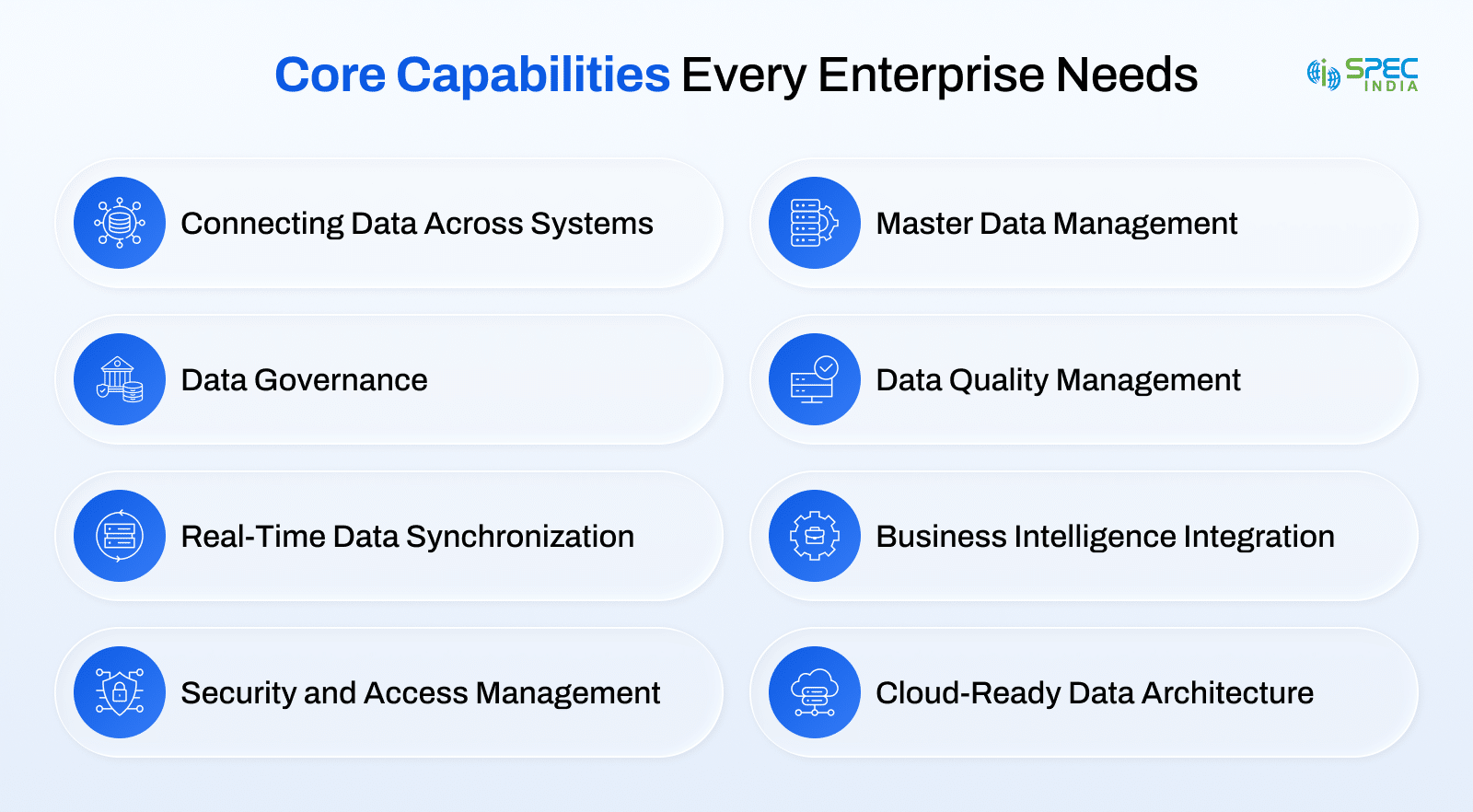
Connecting Data Across Systems
This connects data across CRM, ERP, and other business systems into a single coherent view, closely integrated with reliable data warehouse services for long-term storage and reporting.
- Eliminates disconnected data formats
- Reduces manual data movement
- Creates consistent enterprise reporting
Better connectivity creates one reliable source for enterprise decisions.
Master Data Management
Regardless of the number of systems that handle enterprise information, a single version of records is maintained and kept up to date with the latest version and the greatest accuracy.
- Standardizes critical reference data
- Removes duplicate business records
- Improves reporting consistency
Consistent master data improves trust across every business function.
Data Governance
Governance establishes the ownership, purpose, and safeguards for data. Enterprise data governance solutions ensure ownership is legible, easily verifiable, and readily auditable through robust metadata management and active data cataloging.
- Defines clear business rules
- Strengthens regulatory compliance
- Improves data accountability
Strong governance keeps enterprise data management accurate, secure, and compliant.
Data Quality Management
It is the essence of enterprise data quality management: monitoring the accuracy, completeness, and consistency of data as it flows to business users, and tracking every change through documented data lineage.
- Detects data quality issues early
- Applies consistent data quality rules
- Helps improve data quality continuously
Reliable data quality builds confidence in every business decision.
Real-Time Data Synchronization
Modern systems feed in up-to-the-minute data, rather than yesterday’s view, and everyone works with the same numbers.
- Synchronizes updates across systems
- Reduces reporting delays
- Supports faster data operations
Current information helps teams respond without unnecessary delays.
Business Intelligence Integration
Clean data feeds directly into dashboards and reports, turning raw numbers into usable analytics for every department across the organization.
- Improves executive reporting
- Supports better business intelligence
- Delivers faster operational insights
Better business intelligence trends lead to faster and more informed business decisions.
Security and Access Management
Role-based access and strong data security protect sensitive information without slowing down daily work for the teams that need it most.
- Controls user permissions
- Protects sensitive business records
- Supports secure data storage
Secure access keeps information protected without affecting productivity.
Cloud-Ready Data Architecture
A modern cloud data platform supports steady growth, and a well-designed data lake provides teams with a single place to explore both raw and structured data together.
- Supports scalable cloud platforms
- Simplifies future expansion
- Handles structured and unstructured data
Evolvable architecture for growth-oriented organizations without disrupting existing operations. Together, these functionalities provide a holistic data fabric that leads to higher data quality, speed, and consistency across the organization.
| Capability | Business Value |
|---|---|
| Data Integration Data | One connected view across all business systems |
| Master Data Management | Accurate, consistent records across the enterprise |
| Data Governance | Clear ownership and reduced compliance risk |
| Data Quality | Reliable numbers leaders can act on confidently |
| BI Integration | Faster insight from dashboards and reports |
| Security & Compliance | Protected data that meets regulatory standards |
In addition to these fundamental tasks, an enterprise data management (EDM) system should enable real-time synchronization, access controls, and infrastructure that’s (almost) cloud-ready, with robust data engineering services in place to ensure smooth data pipelines. This method enables organizations to grow with confidence, adapt rapidly to change, and produce sustainable business benefits.
Business Benefits of Managing Enterprise Data
Enterprise data management really proves its worth when it steps out of the data department and starts driving daily business choices. Trustworthy information means less manual grunt work, faster reports, and a much better understanding of your customers. It also helps manage risk and ensures you’re getting the most out of your current tech investments. On top of that, having a solid data foundation is critical for bigger initiatives like cloud migrations, deep analytics, and digital transformation services.
1. Faster Decisions and Improved Operational Efficiency
High-quality business data can help reduce the time employees spend looking for data. It reduces time spent checking reports, reconciling, and dealing with conflicting numbers. Leaders can focus more time on analyzing their business and capitalizing on opportunities; teams can dedicate less time to repetitive data work.
Executive Takeaway:
Speed is only valuable when the underlying information can be trusted. Leaders should first set a benchmark for the time that staff members currently dedicate to finding reports, verifying information, and squandering time on doubt. This will simplify how data management positively affects operations.
- Faster decision-making across leadership teams
- Less time spent validating and reconciling reports
- Lower manual workload across business functions
- More productive collaboration between departments
2. Better Customer Insights and Reduced Operational Costs
Teams can better understand buying patterns, service needs, and performance by having a consistent view of customer and business information. This understanding can help improve expectations, enable more focused customer connection, and uncover excess operational costs early.
Business Tip:
Having a single view of the customer can uncover costs that may not show up in standalone systems. Businesses can more readily distinguish between repeated problems with customers, sales, and service, as well as opportunities to improve processes and customer segments that are not profitable.
- Better understanding of customer behavior and needs
- More accurate forecasting and business planning
- Lower costs associated with manual data handling
- More targeted customer and marketing decisions
3. Stronger Compliance and Greater Business Agility
A robust information management solution can help to meet compliance needs better and adapt to the evolving business landscape. Data issues will consume less of the team’s time in resolving and more time in fine-tuning processes, launching projects, and meeting new market needs.
Risk Perspective:
Making compliance a “year-end” activity is not appropriate. Embedding data ownership, access, lineage, and retention rules into day-to-day processes means organizations can more easily meet audits, regulatory shifts, and internal reviews.
- Lower exposure to data-related compliance risks
- Faster response to changing business requirements
- Less disruption from data-related issues
- Greater confidence during audits and regulatory reviews
4. Scalable Digital Transformation and Higher ROI
Well-managed enterprise data can help organizations get more value from the technology they already use and reduce the friction involved in future modernization projects. As business needs change, teams can build new analytics, applications, and digital initiatives on a more dependable data foundation.
CFO Perspective:
The return on data management should not be measured only by the new platform itself. Leaders should also consider existing technology investments, reduced manual effort, fewer data-related errors, faster reporting, and the ability to launch future digital initiatives without rebuilding the data foundation.
- Better return from existing enterprise technology investments
- Lower effort when scaling new digital initiatives
- Greater readiness for analytics and AI projects
- Stronger foundation for long-term business growth
The financial impact of poor data quality can be substantial. Recent IBM Institute for Business Value research found that over a quarter of organizations lose more than $5 million annually due to poor data quality, while 7% report losses exceeding $25 million. For enterprise leaders, this makes data management more than an IT concern. It becomes part of controlling operational costs, reducing risk, and protecting technology investments.
How to Build an Enterprise Data Management Strategy
Building an enterprise data management strategy requires a structured, step-by-step approach rather than a single large rollout. Rushing into technology without this groundwork is one of the most common reasons enterprise data modernization projects stall.
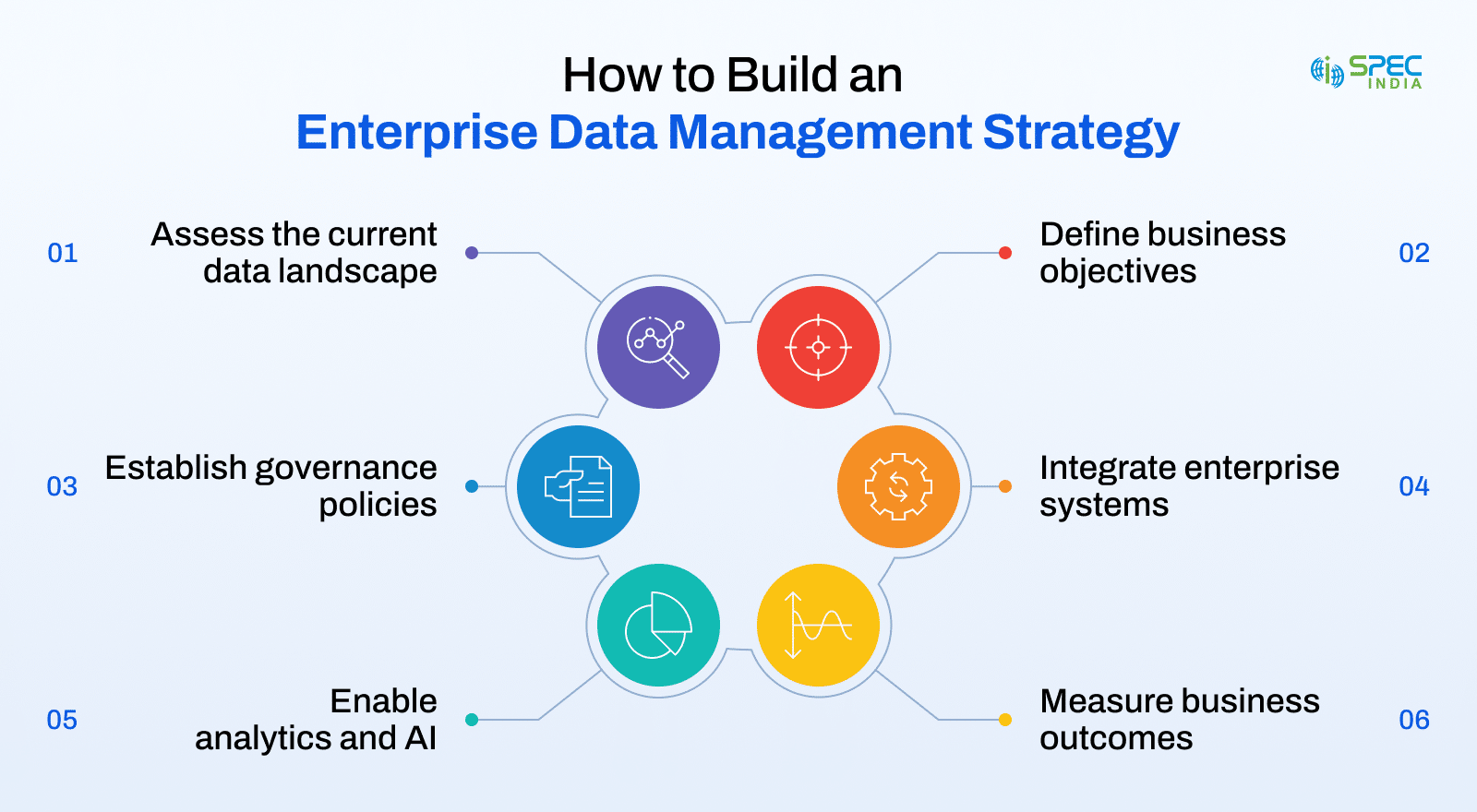
Step 1: Assess the current data landscape
Map where data lives today, who owns it, and where the biggest quality gaps sit, using a data catalog to identify gaps and inconsistencies. This audit usually reveals more duplication and risk than leaders expect.
Step 2: Define business objectives
Tie every data initiative to a clear business outcome, not just a technical upgrade for its own sake. Faster reporting, better compliance, or improved customer service are all valid, measurable goals.
Step 3: Establish governance policies
Set clear rules for data ownership, access, and quality standards across every team that touches the data. Without ownership, even good policies quietly fall apart within months.
Step 4: Integrate enterprise systems
Connect CRM, ERP, and other platforms so data flows without manual re-entry or version conflicts. This step removes much of the manual work teams handle every day.
Step 5: Enable analytics and AI
Clean, connected data enables advanced data analytics and AI development services built on trusted information. Skipping straight to AI without this foundation may cause disappointment.
Step 6: Measure business outcomes
Track how improved data quality affects speed, cost, and decision accuracy over time, and adjust the plan as priorities shift. Treat this as an ongoing cycle, not a final step.
Following these steps helps organizations build a sustainable data strategy that continues delivering business value long after implementation.
Choosing the Right Enterprise Data Management Company
Selecting the right data management partner is one of the most important technology decisions a business will make. The right partner reduces project risk and accelerates business outcomes.
What to Look for in a Partner
- Proven, multi-industry enterprise experience across similar business environments
- Strong integration capabilities across ERP, CRM, and legacy systems
- Genuine industry expertise, not just general technology knowledge
- Scalability to support growth without a costly future rebuild
- Solid security and compliance track record across regulated sectors
- Long-term support, not just a one-time implementation and exit
Industry experience matters just as much as technical expertise. Look for a team that understands your compliance requirements and supports both custom software development and enterprise data platform development. This combination reduces delivery risk while improving long-term business value.
Finding that expertise is harder than it looks. ManpowerGroup’s 2026 Global Talent Shortage Survey of over 39,000 employers found that 72% report difficulty filling skilled roles, with AI and specialized data skills among the hardest to find globally. Building an in-house team with all these capabilities can take years and a significant budget.
An experienced enterprise data management consulting provider helps businesses modernize legacy systems while protecting critical information. Expertise in legacy application modernization and enterprise data migration services ensures a smoother transition with minimal disruption to daily operations. Instead of building an in-house team, organizations gain immediate access to proven specialists and established delivery practices.
Why Choose SPEC for Enterprise Data Management?
Enterprise data management delivers the most value when aligned with business priorities. SPEC India begins by assessing the existing data landscape, system dependencies, governance requirements, and business objectives. This helps identify where integration, data engineering, BI, modernization, or custom development can address the most important gaps. A phased approach can then prioritize high-impact areas without forcing an organization into a large-scale transformation at once.
What should decision-makers look for in an enterprise data management partner?
- Enterprise experience across complex data environments and business systems
- Integration expertise across ERP, CRM, legacy, cloud, and other enterprise platforms
- Strong data governance and security to protect critical business information
- Scalable architecture that can support changing business and data requirements
- Business-focused delivery that connects technical work with measurable outcomes
SPEC India combines enterprise software development, data engineering, BI, integration, and modernization expertise to help organizations move from fragmented information toward a more dependable data environment. The focus is not simply on implementing technology, but on building a data environment that supports better decisions today and future analytics, AI, and modernization initiatives tomorrow.

SPEC INDIA is your trusted partner for AI-driven software solutions, with proven expertise in digital transformation and innovative technology services. We deliver secure, reliable, and high-quality IT solutions to clients worldwide. As an ISO/IEC 27001:2022 certified company, we follow the highest standards for data security and quality. Our team applies proven project management methods, flexible engagement models, and modern infrastructure to deliver outstanding results. With skilled professionals and years of experience, we turn ideas into impactful solutions that drive business growth.
Table of contents
- What is Enterprise Data Management
- Business Challenges Enterprise Data Management Tools Solve
- Core Capabilities Every Enterprise Needs
- Business Benefits of Managing Enterprise Data
- How to Build an Enterprise Data Management Strategy
- Choosing the Right Enterprise Data Management Company
- Why Choose SPEC for Enterprise Data Management
Delivering Digital Outcomes To Accelerate Growth
Let’s TalkTable of contents
- What is Enterprise Data Management
- Business Challenges Enterprise Data Management Tools Solve
- Core Capabilities Every Enterprise Needs
- Business Benefits of Managing Enterprise Data
- How to Build an Enterprise Data Management Strategy
- Choosing the Right Enterprise Data Management Company
- Why Choose SPEC for Enterprise Data Management
Delivering Digital Outcomes To Accelerate Growth
Let’s Talk
Let’s get in touch!
India
SPEC House, Parth Complex, Near Swastik Cross Roads, Navarangpura, Ahmedabad 380009, INDIA.
-
 +91-79-26404031, 32-33-34
 -
 [email protected]