

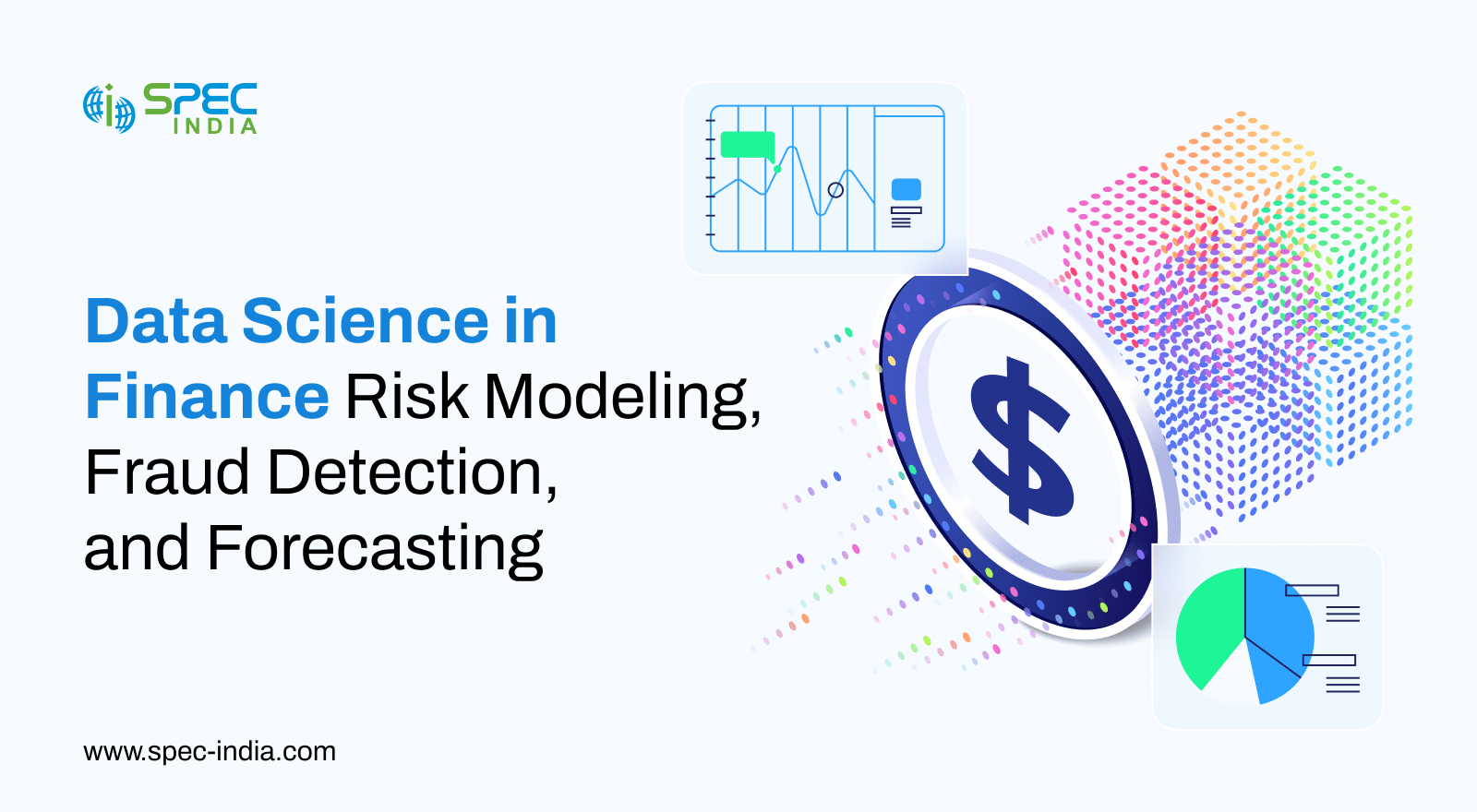
Data Science in Finance: Risk Modeling, Fraud Detection, and Forecasting
April 13, 2026
Your bank just lost $4.7 million to a fraud ring that your legacy rules engine never flagged. Your credit risk model, built on spreadsheet logic from 2014, greenlit a portfolio of loans now bleeding defaults. Your quarterly forecast — assembled by three analysts over two weeks — was off by 23%. Sound familiar? The financial world moves faster than intuition ever can. And somewhere, a competitor is already using machine learning to see what your models can’t.
The scenario above isn’t a horror story — it’s a Tuesday at too many financial institutions still running on legacy infrastructure and intuition-based decisions. The good news? Data science in finance has matured from buzzword to backbone. From Wall Street trading floors to community banks in the Midwest, data science and finance are now inseparable, and institutions that bridge this gap are outperforming those that don’t by significant margins.
This deep dive unpacks how data science in the finance industry is transforming three mission-critical domains: risk modeling, fraud detection, and financial forecasting. Whether you’re a data scientist in finance, a CTO at a fintech, or an executive evaluating your next technology investment, this is the map you need. What you can get with Data Science –
- AI in Finance market projected to hit $190.33B by 2030 at 30.6% CAGR
- AI expected to boost investment banking productivity by 27% by 2026
- ML models can prevent up to 67.6% of cases leading to financial losses
- $25.5B in fraud losses prevented globally by AI systems in 2025
Why Data Science in Financial Services Is No Longer Optional
The financial impacts of digital transformation are no longer theoretical. The convergence of cloud computing, open banking APIs, and an explosion of alternative data sources has created both opportunity and urgency. Every transaction, every click, every market tick — these generate data. The question is no longer whether to use it, but how fast you can turn it into an edge.
Traditional financial analytics relied on backward-looking reports, static scorecards, and rules-based systems. Big data science in finance flips the script. Predictive models trained on millions of data points replace gut-feel underwriting. Real-time streaming pipelines replace nightly batch reports. And adaptive machine learning systems replace brittle rule engines that criminals have long since learned to game.
“In the finance industry, the difference between a good data science team and a great one isn’t the algorithm — it’s the speed at which they translate uncertainty into confident, actionable decisions.”
From data science in banking and finance to data science in investment banking and insurance, every vertical is feeling the seismic shift. Let’s go sector by sector.
Risk Modeling: From Static Scorecards to Dynamic Intelligence
Ask any senior credit officer what keeps them up at night, and risk mismeasurement is near the top. Traditional credit scoring — FICO and its relatives — was revolutionary in its day. But in a world where a gig economy worker has irregular income, a student has thin credit history, and macroeconomic conditions can shift in a quarter, static scorecards are dangerously blunt instruments.
How Machine Learning Transforms Credit Risk
Modern financial data science projects in risk management leverage gradient boosting models, neural networks, and ensemble methods that ingest thousands of variables simultaneously — payment patterns, spending velocity, device fingerprints, even psychographic signals from consented behavioral data. The result is a credit risk picture that’s richer, faster, and more accurate than any analyst team could produce manually.
Credit Underwriting
ML models assess thin-file applicants using alternative data (utilities, rent, subscriptions), expanding credit access while controlling default rates.
Early Warning Systems
Behavioral anomaly detection flags borrowers showing distress signals 60–90 days before a missed payment, enabling proactive intervention.
Macroeconomic Stress Testing
Scenario simulation models stress-test portfolios against GDP shocks, rate spikes, and sector-specific downturns — far faster than legacy spreadsheet models.
Market Risk & VaR
Deep learning models estimate Value-at-Risk with higher accuracy across tail events that traditional Gaussian models systematically underestimate.
Pro Tip: Risk Teams
“ Don’t build your risk model in isolation from your collections and servicing teams. The best-performing risk models at digital-first lenders are trained on full lifecycle data; from application through recovery, not just origination signals. Closing this feedback loop dramatically improves model accuracy over time. ”
Fraud Detection: Beating Criminals at Their Own Game
Fraud is an arms race, and for much of the last decade, the criminals were winning. Rule-based fraud engines — “flag transactions over $10,000 from new devices” — are static, transparent, and easily circumvented. Fraud rings share notes. They probe systems. They adapt. Data analytics in the financial sector is now the primary weapon for fighting back.
The applications of data science in finance for fraud detection span multiple attack vectors — card-not-present fraud, account takeover, synthetic identity fraud, money laundering, and first-party fraud. Each requires a different modeling approach, but the underlying toolkit is consistent: anomaly detection, graph analytics, and supervised classification models trained on labeled fraud data.
Graph Analytics: The Fraud Network Destroyer
One of the most powerful, and underutilized tools in financial fraud detection is graph network analysis. Traditional fraud models evaluate each transaction in isolation. Graph models map the relationships between accounts, devices, IP addresses, and behavioral signatures. A single fraudulent node can illuminate an entire ring of connected accounts that would each appear legitimate in isolation.
Legacy Rule Engines
- Static velocity rules
- High false-positive rates
- Slow rule update cycles
- Easily reverse-engineered
- No behavioral context
ML-Powered Fraud Systems
- Real-time anomaly scoring
- Adaptive to new attack patterns
- Graph-based ring detection
- Behavioral biometrics integration
- Explainable AI for compliance
Critical Consideration
The single biggest mistake financial institutions make in fraud ML is training models on biased labels. If your historical fraud labels only reflect what your old rules engine caught, your new model will inherit those blind spots. Invest in a robust, independently audited labeling pipeline before you touch model architecture.
Data science in financial markets also addresses a growing threat: market manipulation and insider trading detection. Natural language processing (NLP) models now scan communications, news feeds, and trading patterns simultaneously; flagging suspicious correlations in milliseconds that no human surveillance team could match.
Pro Tip: Fraud Teams
“ Balance precision with customer experience. A fraud model that flags 0.1% false positives sounds impressive; until you realize that’s thousands of legitimate customers getting their cards declined at checkout. Optimize your models with a customer-friction cost function, not just detection accuracy metrics. ”
The Real Competitive Moat Isn’t Your Algorithm
It’s your data infrastructure. Institutions with real-time, well-governed data pipelines consistently outperform those with better models but messier data. Invest in your data foundation first.
Financial Forecasting: From Rearview Mirror to Crystal Ball
The CFO’s office has traditionally been where data goes to die — locked in spreadsheets, reconciled manually, and delivered as a narrative about what already happened. Modern business intelligence in finance is fundamentally changing this. Forecasting is no longer a quarterly ritual; it’s a continuous, self-updating process powered by machine learning models that ingest live signals and revise predictions in real time.
The Three Forecasting Frontiers
Revenue & Demand Forecasting
Time-series models (Prophet, LSTM networks, Temporal Fusion Transformers) forecast product revenue, loan origination volumes, and fee income with far greater accuracy than linear regression models. These models incorporate seasonality, macro signals, and competitor data automatically.
Liquidity & Cash Flow Modeling
Banks and corporates now use ML-driven cash flow forecasting that dynamically adjusts to real-time payment data, reducing idle cash positions and improving treasury efficiency by 15–30% at leading institutions.
Market & Asset Price Forecasting
In data science in investment banking, quantitative models trained on price action, order flow, sentiment data, and satellite imagery (for commodities) generate alpha signals that inform trading strategies and asset allocation decisions.
Data science finance projects in forecasting increasingly leverage alternative data sources that incumbents have been slow to adopt: web scraping consumer sentiment, satellite data to track retail foot traffic, credit card aggregates to nowcast GDP, and earnings call transcript NLP to gauge management confidence. The competitive intelligence embedded in these signals is extraordinary.
Pro Tip: Finance Leaders
“ The biggest ROI unlock in financial forecasting isn’t building a fancier model; it’s creating a single source of truth for your financial data. Fragmented data across ERPs, CRMs, and spreadsheets is the enemy of accurate forecasting. Prioritize data unification through a modern cloud data warehouse before layering ML on top. ”
Financial Software Development Services: Building the Stack That Scales
All of this is only possible with the right technical foundation. Financial software development services have evolved dramatically — modern fintech stacks are cloud-native, API-first, and built for real-time data processing at scale. Legacy monolith architectures simply cannot support the latency requirements of modern fraud detection or the throughput demands of market data pipelines.
Key architectural components for a production-grade financial data science platform include:
- Cloud Data Warehouse: Snowflake, BigQuery, or Redshift as the unified analytical layer — enabling both historical analysis and near-real-time model scoring.
- Stream Processing: Apache Kafka or Flink for real-time event ingestion — critical for fraud detection systems requiring sub-100ms decision latency.
- MLOps Platform: MLflow, Vertex AI, or SageMaker for model versioning, monitoring, and automated retraining pipelines that keep models current as data distributions shift.
- Data Governance Layer: Collibra, Alation, or dbt for lineage, quality, and compliance controls — non-negotiable in regulated financial environments.
Regulatory Reality Check
Explain ability isn’t optional. Regulators in the US (SR 11-7), EU (GDPR, AI Act), and UK (SS1/23) require that model decisions affecting consumers can be explained in plain language. Before deploying any black-box model in consumer credit or insurance, ensure your explain ability framework — SHAP, LIME, or counterfactual methods — is production-ready and auditable.
Starting Your Data Science Journey in Finance: A Practical Roadmap
Whether you’re a startup building your first risk model or an established bank modernizing legacy infrastructure, the path forward follows a consistent progression. Here’s a battle-tested framework:
Audit your data landscape
Before writing a single line of model code, understand what data you have, where it lives, how clean it is, and what’s missing. Data quality issues sink more ML projects than algorithm choices.
Start with high-ROI, well-scoped problems
Don’t try to boil the ocean. Fraud detection on a specific channel, a single credit product, or one forecasting metric — pick something where success is measurable and the business impact is clear.
Build MLOps from day one
A model that can’t be monitored, retrained, and rolled back safely is a liability, not an asset. Invest in your model lifecycle infrastructure early, even if your first model is simple.
Hire interdisciplinary talent
The best data scientists in finance roles blend domain expertise with technical skill. A data scientist who doesn’t understand credit cycles, or a quant who can’t communicate to a risk committee, creates blind spots. Build teams, not silos.
Final Tip: Decision Makers
“ The ROI of data science in finance isn’t just in the models you build; it’s in the decisions you stop making badly. Quantify the cost of your current false negatives in fraud, your current model errors in credit, and your current forecast inaccuracies in planning. That’s your baseline. That’s the number that justifies the investment. ”
The Window Is Open — But Not Forever
Data science in finance isn’t the future. It’s the present competitive baseline. The institutions that move now — with clean data, thoughtful model governance, and the right technical partnerships — are building moats that will be very difficult to replicate in three years.
The question isn’t whether your organization needs to invest in data science for finance. It’s whether you’ll invest before or after your competitors make it irreversible.
The data already exists. The only variable is the will to use it wisely.
Contact us today for Data science services.

SPEC INDIA is your trusted partner for AI-driven software solutions, with proven expertise in digital transformation and innovative technology services. We deliver secure, reliable, and high-quality IT solutions to clients worldwide. As an ISO/IEC 27001:2022 certified company, we follow the highest standards for data security and quality. Our team applies proven project management methods, flexible engagement models, and modern infrastructure to deliver outstanding results. With skilled professionals and years of experience, we turn ideas into impactful solutions that drive business growth.
Table of contents
Delivering Digital Outcomes To Accelerate Growth
Let’s TalkTable of contents
Delivering Digital Outcomes To Accelerate Growth
Let’s TalkRelated Blogs
Let’s get in touch!
India
SPEC House, Parth Complex, Near Swastik Cross Roads, Navarangpura, Ahmedabad 380009, INDIA.
-
 +91-79-26404031, 32-33-34
 -
 [email protected]