

Why Financial Institutions Use Databricks for Fraud Detection and Risk Analytics
January 15, 2026
Fraud detection in financial services is increasing at a rapid rate. According to industry research, financial institutions are losing billions of dollars annually to fraud, and one of the largest platforms targeted by digital payments includes it. Fraud does not occur every now and then anymore, with instant payments being the norm, mobile banking being the norm, and online transactions being the norm; it occurs every second, sometimes in milliseconds. What is more difficult is that most fraudulent transactions appear as real transactions until it is too late.
Simultaneously, banks and other financial institutions are handling millions of transactions daily, dealing with data from various sources, and are subject to the heavy burden of regulatory pressure. The customers require quick approvals, zero delays, and safe experiences simultaneously. Older fraud systems, typically based on batch processing or predefined rules, are unable to match this pace and complexity. They either detect the fraud too late or block the real customers by accident.
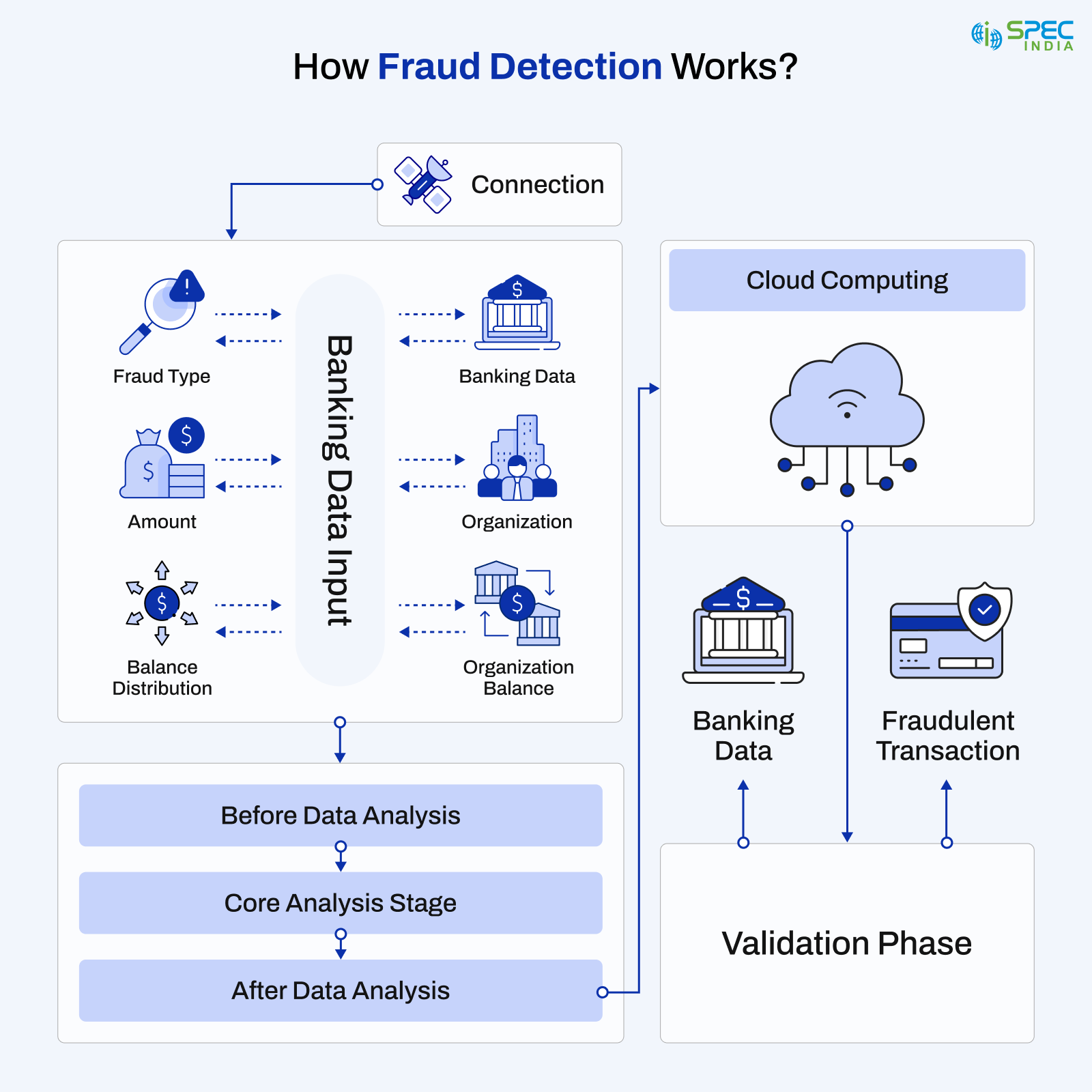
This is one of the reasons why most financial organizations are gravitating towards Databricks. In Databricks, fraud detection and risk analytics occur in real time, on large and vast data volumes, and based on advanced machine learning. It unites the data on transactions, customer behaviour, and risk indicators on one platform. More to the point, it does so without compromising security, governance, or compliance- keeping institutions secure, compliant, and customer-friendly in a rapidly changing digital environment.
In this blog, we are going to discuss risk analytics in finance and how financial institutions deal with it.
How Financial Institutions Use Databricks for Financial Fraud Detection and Risk Analytics
The financial institutions deal with large amounts of transactional data, as well as customer data, and fraud detection and risk analysis become complicated. Databricks is a platform that offers a single platform to analyze this data in real-time, model machine learning, and reveal risk patterns more quickly. It allows organizations to detect fraud earlier, minimize false positives, and make more precise, data-driven risk-taking decisions at scale with the assistance of modern data engineering and high-quality analytics. The following are some tips that have been proven for how Databricks is applied in risk analytics in finance.
Databricks Solves the Core Problem
It is not the lack of data that financial institutions are troubled by; it is the problem of fragmentation and latency of data. Risk analytics and fraud detection rely on the correlation of transaction behavior, customer history, and real-time signals. Fraud teams must respond slowly to these data sources when they are stored in different systems, further exposing the company to financial losses and customer frustration. Databricks handles this fundamental issue by integrating data and permitting more intelligent and quicker fraud detection.
Disconnected Data Limits Fraud Visibility
- Isolated transaction, customer, and behavioral anomaly detection does not provide a complete view of fraud risk.
- The chances of missed fraud signals can occur as the system can lose the capability to correlate activity across channels.
- Delayed information results in reactive decision-making and the loss of more money in fraud cases.
Databricks Unifies all financial fraud detection and Data risk activities
- Combine structured, semi-structured, and streaming data into one platform.
- Provides a single trusted centralized view of transactions, customers, and risk indicators.
- Allow cross-channel analysis, which is useful to teams that identify complicated fraud patterns at an early stage.
Read More: Real-World Databricks Use Cases Across Industries
Real-Time Fraud Detection That Matches Transaction Speed
Financial frauds occur in seconds, not hours, in the modern world. Most of the traditional systems that operate in batches usually detect fraud when it is too late. By deploying Databricks, financial institutions can replace delayed detection with real-time fraud detection so that, as transactions are processed, risky activities can be flagged without disrupting day-to-day legitimate customer activity.
Streaming Analytics for Instant Fraud Signals
- It helps in processing a large volume of data in real time, and you can access it anytime, anywhere.
- Suspicious activity detection during an ongoing transaction is possible with Databricks.
- Supports card fraud, electronic payments, account takeover, and identity fraud.
Reduced False Positives With Contextual Financial Data Intelligence
- It combines transaction data with historical and behavioral data, which helps in predictive risk modeling.
- Moreover, it distinguishes between unusual and truly fraudulent activity.
- It reduces unnecessary refusals that irritate the customers.
Advanced Machine Learning for Smarter Risk Analytics in Finance
AI fraud detection in banking has become critical as fraud systems based on rules are no longer sufficient. The patterns of fraud keep changing, and the reason is that the rules do not stand up to scrutiny. Databricks makes it possible for financial institutions to develop, train, and deploy sophisticated machine learning models to adjust to new fraud patterns and enhance risk accuracy over time.
ML Models Built on Large-Scale Financial Data
- Train models on years of history of transactions and customer data.
- Uncovers hidden and sophisticated forms of fraud that are very difficult to identify by humans
- Enhances performance in terms of fraud, credit default prediction, and operational risk use cases.
Continuous Learning Keeps Risk Models Relevant
- Models are automatically retrained with new data.
- Risk scores increase as the number of transactions increases.
- Enables proactive risk management instead of reactive responses
Integrated Fraud and Risk Decision-Making amongst Teams
Fraud detection, risk management, and compliance usually work on different tools and reports, and thus, the decisions are not consistent. Databricks unites these teams on a data and analytics platform that makes them align quickly and have more assured decision-making.
Databricks is a single Platform for Fraud, Risk, and Compliance Teams.
- Removes data redundancy between departments.
- Ensures uniformity in risk signals channel-wise and product-wise.
- Allows analysts, engineers, and data scientists to collaborate.
Faster, More Confident Risk Decisions
- Real-time risk scoring for transactions and customer profiles.
- Good understanding of the reasons behind flagging a transaction.
- It helps you make strong decisions for your business.
Governance and Compliance Built for Financial Institutions
Financial institutions should be able to be innovative without interfering with compliance. Databricks is built to be compatible with advanced analytics and also has high governance, security, and regulatory controls, which is why this cloud can be used in highly regulated environments.
Business Grade Security and Data Management.
- Cryptographic fine-grained access control and encryption.
- Full transparency through end-to-end data lineage.
- Internal and external audit-ready analytics.
- Cloud data platform modernization is something you can take advantage of here.
Governance without Retarding Innovation
- AML, KYC, GDPR, PCI DSS compliant.
- Provides interpretable fraud and risk models.
- Balances control of regulatory compliance with the speed of analysis.
Scalable Fraud and Risk Analytics Without Performance Trade-Offs
The volume of fraud is high during peak hours, seasonal occasions, and surges in digital payments. Databricks enables financial institutions to use analytics on scale without impacting performance or incurring costly re-architecture.
Built to Handle Peak Transaction Volumes
- Scales automatically when a high load is experienced.
- Retains the same performance with increasing data.
- Enables future cases of fraud without system redesign.
Scalable Analytics with Low Cost
- Enhanced computing saves on unnecessary infrastructure expenses.
- Pay-by-use model aligns price with the demand in business.
- Eliminates several old systems and replaces them with one.
Databricks enables financial institutions to spot fraud sooner, evaluate risk more precisely, and respond to emerging threats more effectively by uniting data, enhanced analytics, and machine learning on one platform so they can operate with confidence. These outcomes can be attained, though, only with a good database. This is where data engineering services play a critical role.
It helps to make sure that data is quality, scalable, controlled, and prepared to be utilized in real-time analytics. Having the appropriate data engineering capabilities will enable the banks and financial institutions to realize the full benefit of Databricks to detect fraud more intelligently and perform risk analytics.
How Databricks Delivers Real Business Impact for Financial Institutions
Financial institutions do not invest in fraud and risk platforms just to be able to continue using technology, but rather to achieve quantifiable business results. Databricks for financial services makes a lot of tasks easier as it has a direct impact on the rate of fraud detection, the effectiveness of risk evaluation, and the certainty in making decisions throughout the organization. Databricks provides financial institutions with an opportunity to transition from responsive loss management to predictive capability, machine learning, and data to risk management that safeguards revenue, reputation, and customer confidence.
Less Fraud Losses With Early Detection
Early detection of fraud assists financial institutions in preventing losses even before they occur. Risky behavior can be identified by verifying the transactions that are made and detecting any differences in transactions with previous activity. It is also a system that learns from past fraud cases, and this would prevent the occurrence of the same form of fraud in the future. This minimizes losses in cards, electronic payments, and internet transactions.
Lower False Positives and Better Customer Experience
Numerous fraud prevention mechanisms are preventing honest customers unintentionally. Databricks mitigates this issue with the help of customer behavior analysis rather than preset rules. It knows the way a customer spends and behaves in a normal way. This assists in preventing unnecessary declines in transactions or blockage of accounts. Consequently, customers will be able to utilize the banking services easily, and they will still have a sense of trust in the institution.
Faster and More Accurate Risk Decisions
Real-time fraud detection is possible with Databricks. Risk decisions must be fast and accurate. Databricks offers a real-time risk score on transactions and customers. This assists the teams in making immediate decisions on whether an activity is risky or safe. Due to the utilization of the same data in other systems, decisions remain the same in products and channels. There is also a clear ability for teams to know why a transaction was flagged.
Greater Regulatory Confidence and Audit Readiness
Regulatory reporting automation becomes easier when data is traceable and clear, making it simpler to meet regulatory rules. When data is traceable and clear, it becomes easier to meet the regulatory rules. Databricks tracked the origin of data and its utilization. This will assist financial institutions in complying with AML, KYC, GDPR, and PCI DSS. In the event of an audit or investigation, the teams can exchange correct information in a short time, which saves time and stress.
Scalable Growth Without Rising Risk Exposure
The level of fraud risk tends to increase as the number of transactions increases. Databricks enables systems to cope sluggishly with more transactions. It is able to adapt rapidly to new fraud procedures and regulations. This simplifies the process of financial institutions introducing new digital banking and payment services while maintaining risk at check.
In addition to analytics and insights, Databricks assists financial institutions in transforming data into quantifiable business results, such as faster fraud detection, less operational risk, better compliance, and better decision-making at scale. To achieve this maximum effect, organizations have a tendency to integrate the Databricks platform with custom financial software development services that align technology with actual banking processes.
This will see analytics-based solutions effectively integrated within the current systems, which in turn helps the institutions to create long-term value, efficiency, and resiliency in their operation.
Closing Thought
It is not that financial institutions select Databricks because they need to process data; they select it because they want to develop confidence in all fraud and risk determinations. Speed, scale, intelligence, and trust are all needed to work together in an environment where transactions occur in milliseconds, and patterns of fraud change at any given time.
The Databricks platform gives this ground by consolidating the data, facilitating real-time analytics, and driving adaptive machine learning models. It resolves your day-to-day operational challenges, which involve data fraud, and reduces the risk of losing data to a great extent. That’s why most financial institutions prefer data bricks over other technologies.
Do not think much, just connect with us for fraud detection software development and explore how we can help you build a secure, scalable, and future-ready platform.
Frequently Asked Questions
Databricks is used by financial institutions due to the fact that it combines data engineering, analytics, and machine learning within a single platform. It assists teams in analyzing transaction data almost in real time, identifying suspicious activities early, and constantly training fraud models with AI and ML. This centralized solution is less time-consuming and enhances the accuracy of fraud detection.
Yes. Databricks is developed based on Apache Spark, which is developed to manage huge amounts of data effectively. It has a capacity of processing millions of transactions per second, so it is useful in fraud analytics where speed, scalability, and precision are vital, particularly during high transaction rates.
The conventional data warehouses are primarily intended for historical reporting and batch analytics. Databricks, in its turn, is compatible with real-time data processing, advanced analytics, and machine learning. This makes Databricks more applicable to fraud detection applications where institutions require better insights and dynamic fraud models.
Databricks is a pay-as-you-use service, meaning that institutions do not pay to use the entire amount of compute and storage units that they provision. It also removes the necessity to use several tools in the process of data processing, analytics, and ML being executed on the same platform- this will aid in minimizing the cost of infrastructure and operation.
Databricks will help institutions shift to predictive risk modeling as opposed to a reactive one. Its combination of historical data and real-time data can assist in detecting early indicators of fraud, anomalies, and patterns of risk, based on this, by enabling the team to intervene before the losses are incurred.
Absolutely. Databricks is very scalable and adaptable, and therefore is well-suited to the NBFCs and FinTechs where data and trends of fraud are rapidly increasing. It enables fast innovation, fast model development, and data processing that is ready to comply, without investing heavily in infrastructure development.

SPEC INDIA is your trusted partner for AI-driven software solutions, with proven expertise in digital transformation and innovative technology services. We deliver secure, reliable, and high-quality IT solutions to clients worldwide. As an ISO/IEC 27001:2022 certified company, we follow the highest standards for data security and quality. Our team applies proven project management methods, flexible engagement models, and modern infrastructure to deliver outstanding results. With skilled professionals and years of experience, we turn ideas into impactful solutions that drive business growth.
Table of contents
- How Financial Institutions Use Databricks for Fraud Detection & Risk Analytics
- Real-Time Fraud Detection That Matches Transaction Speed
- Advanced Machine Learning for Smarter Risk Analytics in Finance
- Integrated Fraud and Risk Decision-Making amongst Teams
- Governance and Compliance Built for Financial Institutions
- Scalable Fraud and Risk Analytics Without Performance Trade-Offs
- How Databricks Delivers Real Business Impact for Financial Institutions
- Closing Thought
Delivering Digital Outcomes To Accelerate Growth
Let’s TalkTable of contents
- How Financial Institutions Use Databricks for Fraud Detection & Risk Analytics
- Real-Time Fraud Detection That Matches Transaction Speed
- Advanced Machine Learning for Smarter Risk Analytics in Finance
- Integrated Fraud and Risk Decision-Making amongst Teams
- Governance and Compliance Built for Financial Institutions
- Scalable Fraud and Risk Analytics Without Performance Trade-Offs
- How Databricks Delivers Real Business Impact for Financial Institutions
- Closing Thought
Delivering Digital Outcomes To Accelerate Growth
Let’s TalkRelated Blogs


Let’s get in touch!
India
SPEC House, Parth Complex, Near Swastik Cross Roads, Navarangpura, Ahmedabad 380009, INDIA.
-
 +91-79-26404031, 32-33-34
 -
 [email protected]