

How Manufacturers Use Data Analytics to Reduce Downtime and Improve Throughput
February 25, 2026
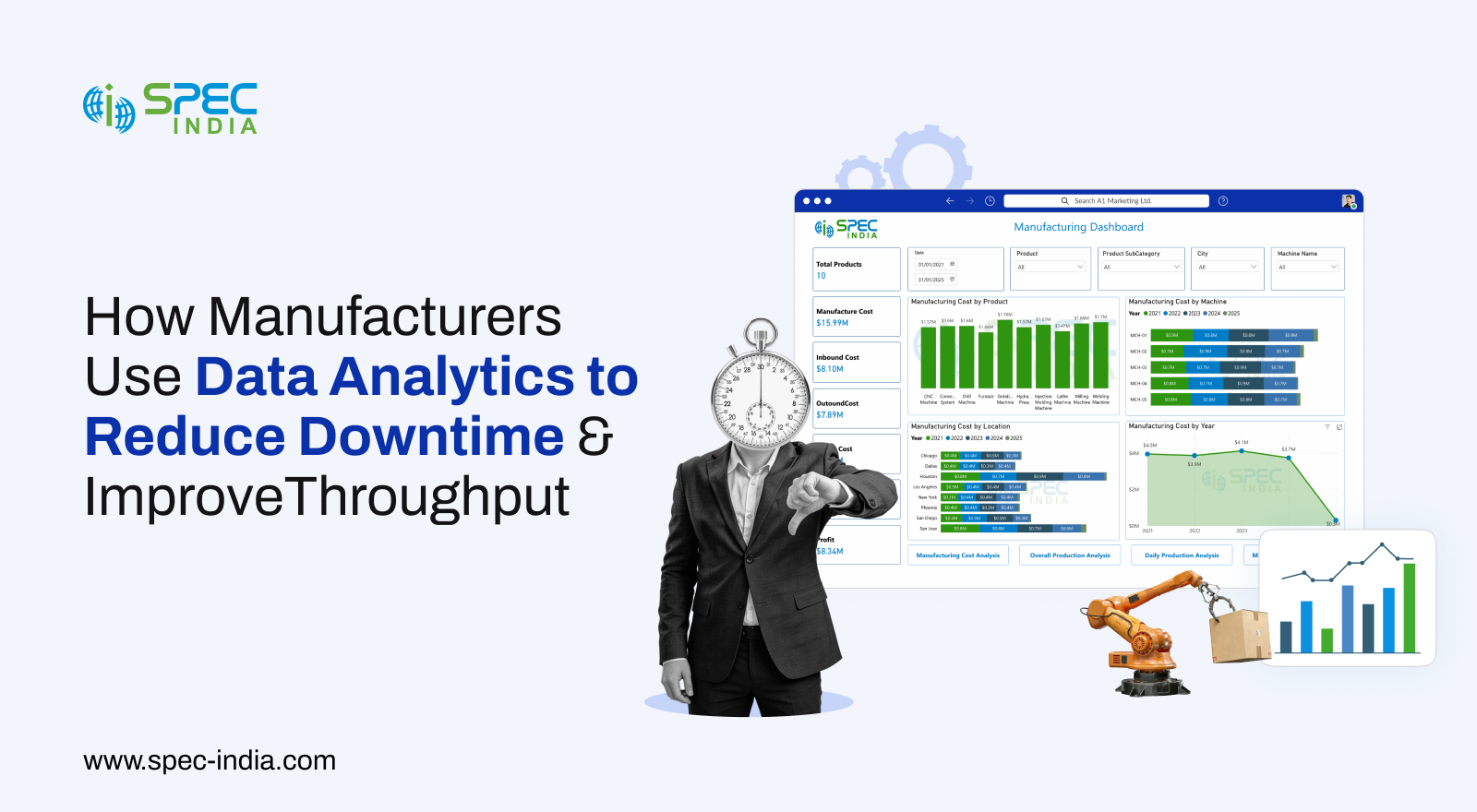
Downtime in manufacturing rarely comes with a warning siren. It creeps in – through small delays, frequent machine suspensions, prolonged changeovers, or even running equipment at slightly below its best speed. Individually, these problems appear to be manageable. Together, they significantly affect profitability, disrupting delivery promises and eroding consumer confidence.
What most manufacturers fail to recognize is the real costs of these inefficiencies in daily operations:
- Unplanned downtime costs industrial manufacturers almost 50 billion annually, and equipment failure is the leading cause. Siemens
- Unplanned downtime occurs in 82% of companies, yet most continue to use reactive maintenance methods. Aberdeen Research
- Deloitte claims that predictive maintenance can help organizations to avoid breakdowns by 70% and save on maintenance expenses by 25%. Deloitte
It is not the absence of information but the timing of the realization that is problematic. Manual logs, shift reports, and post-incident reviews describe what went wrong when production is already damaged. The losses are irrecoverable before the root cause is detected.
Here, manufacturing data analytics comes into play. Not as a buzzword or a next-generation program, but as a working tool. Utilized correctly, analytics can support manufacturers in identifying risk at an early stage, learning how failures happen and/or should happen in advance, before downtime becomes missed production hours.
What “Downtime” and “Throughput” Really Mean on the Shop Floor
Downtime is the period when a machine, line, or process is not producing as it should. This may involve planned downtime, including scheduled maintenance, changeovers, or inspections, as well as unplanned downtime due to equipment failures, material shortages, quality issues, or operator-related issues. Here, you need to check the overall equipment effectiveness. Although scheduled downtime is manageable, unscheduled downtime usually disrupts schedules, increases expenses, and strains teams.
Throughput, on the other hand, refers to the amount you produce in a given period. Not only speed, but also consistency. A fast line that frequently halts may not deliver as much throughput as a slow, stable line. A high-speed production line with many stops and restarts can produce less than a slow-speed production line with smooth operations and fewer stops and restarts. Flow and stability are of great importance to sustainable throughput workers.
The real challenge? You can’t improve throughput sustainably unless you control downtime. And that’s where data plays a crucial role. This is where the information becomes important. When appropriate, manufacturing downtime analytics are established, manufacturers can gain explicit insight into the timing, causes, and nature of downtime; as a result, they can enhance throughput without affecting quality or reliability.
The Role of Data Analytics in Modern Manufacturing
Analytics enables manufacturers to transition from firefighting to proactive decision-making. Rather than peer at each other all day long about why this machine broke down yesterday, teams can begin asking: what signals are telling us this machine is about to fail—and how soon? The change in that alone transforms the way the maintenance, production, and operations teams collaborate. You can even make better decisions through manufacturing operations analytics available within your system.
In a modern manufacturing setup, manufacturing data analytics links data that has always existed in silos. Data from machine utilization analysis, production output, maintenance reports, quality documentation, and even operator feedback are combined to produce a single, trustworthy picture of what is really happening on the shop floor. This integrated visibility enables manufacturers to leave behind the shallow reporting and concentrate on what affects performance.
At a practical level, data analytics in manufacturing enables teams to:
- Detect early warning signs of equipment failure before breakdowns occur.
- Prioritize maintenance activities based on risk and impact.
- Identify recurring issues across machines, shifts, or production lines.
- Understand how machine performance affects quality and throughput.
This will come in the form of fewer surprises and greater control for plant managers and leadership. Decisions are no longer made on assumptions, gut feel, or after-the-fact reports. They are rather supported by real-time and past-based insights that indicate real-life operating conditions.
Over time, production performance analytics evolves from a reporting tool to an integral part of daily operations. It enables proactive maintenance, improves team coordination, and helps manufacturers run production environments that are more stable, predictable, and efficient.
Turn Manufacturing Data into Measurable Performance Gains
Unplanned downtime and throughput bottlenecks can quietly impact productivity and margins. Our experts help manufacturers unlock the full value of their data—by building analytics solutions that improve visibility, predict issues early, and optimize production performance. Speak with our team to understand how data analytics can be applied to your specific manufacturing challenges.
Key Data Sources That Help Identify Downtime Issues
Most manufacturers already have the information that they require to develop insight into downtime. The actual issue is not data availability but fragmentation. Machines, maintenance reports, production systems, and quality reports often contain critical information scattered across them, making it hard to get the full picture.
Once these data sources are linked and processed simultaneously, manufacturing downtime analytics ensures that downtime ceases to be a puzzle and becomes measurable and predictable. Key data sources include:
- Machine and sensor data from PLCs and IoT devices that capture real-time conditions. Such as temperature, speed, and load.
- Maintenance records include historical failures, repair times, frequencies, downtime durations, and root causes, all of which are important.
- Production data, including cycle time, shift-wise performance, line utilization, and planned vs actual output.
- Then comes the Quality data. It covers defects, rework levels, scrap rates, and inspection results, all of which are important to the production team.
Each data source alone reveals only part of the story. However, a closer look reveals that specific trends emerge when considered side by side. One example is that an increase in defects could be related to machine wear or to frequent machine breakdowns during a particular shift or batch production.
This integrated perspective, powered by downtime reduction analytics, assists manufacturers in leaving assumptions behind and looking at the actual causes of downtimes; information that cannot be readily identified with spreadsheets or isolated system reports.
How Manufacturing Data Analytics Helps Reduce Downtime
Downtime not only halts production but also affects revenue, the delivery schedule, and the overall efficiency of the operation. Even a brief, unplanned shutdown can lead to significant losses in the long run. Data analytics enable manufacturers to abandon reactive firefighting and gain greater visibility into equipment performance and operational trends. With ERP Analytics integration, this operational data can be connected directly to planning, inventory, and maintenance workflows for faster decision-making.
Manufacturing analytics enables teams to detect early indicators of potential failures by analyzing historical and real-time data from machines, sensors, maintenance systems, and other sources. This will enable maintenance teams to intervene before small problems escalate into major breakdowns. In case of downtime, analytics can also be used to identify root causes more quickly, shorten the time to restore operations, and avoid recurring problems.
Here’s how it works:
1. Predictive maintenance
Rather than having a fixed maintenance schedule, predictive data analytics keeps an eye on the watches to machines. It examines such things as vibration, heat, or abnormal performance. When something begins to behave differently, maintenance teams may correct it before the machine fails. This reduces unexpected halts and extends machine operating time.
2. Root cause analysis
Patterns of failures can be demonstrated through manufacturing analytics. For example, a machine may stop functioning after a predetermined number of uses, during a particular shift, or when producing a certain product. By understanding these, the teams can address the actual issue rather than repeatedly repairing the machine.
3. Faster response times
In the event of an issue, real-time alerts and dashboards help teams respond immediately. This reduces the time required to repair the machine (MTTR) and minimizes the production impact.
Tip: Even cutting downtime by a few percent can save a lot of money every year and make production more reliable.
4. Improving Throughput with Data-Driven Insights
Now, once downtime is under control, you will see that analytics helps unlock higher throughput.
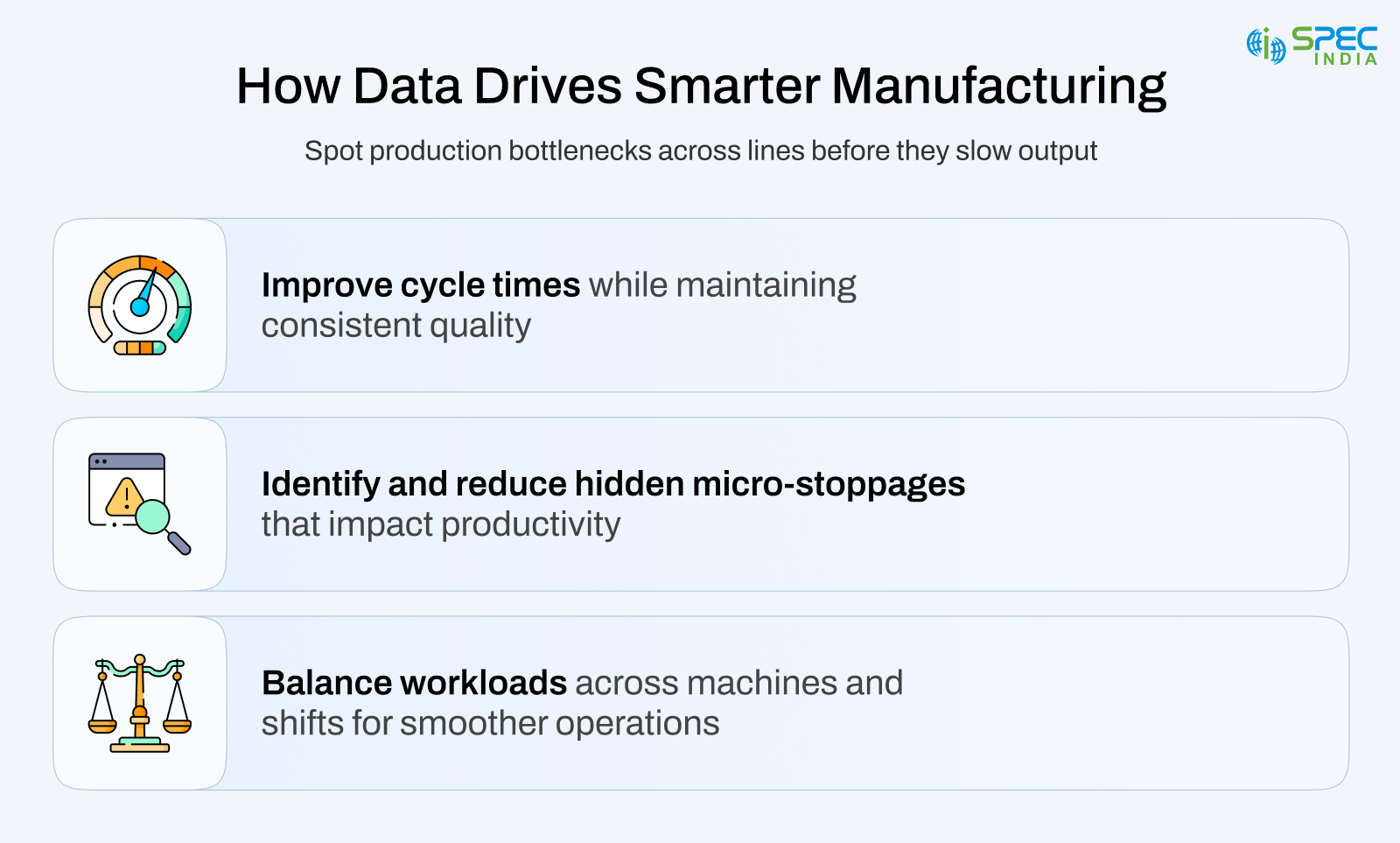
Manufacturers use data to:
- Identify bottlenecks across production lines.
- Optimize cycle times without compromising quality.
- Reduce micro-stoppages that often go unnoticed.
- Balance workloads between machines and shifts
Knowing the location and cause of delays, the teams can boost flow rather than overworking machines and creating additional failures.
Real-World Manufacturing Use Cases
Downtime, delays, and non-productive production are issues that any manufacturer is aware of. But the good news here is that data analytics are already assisting companies to resolve these issues- not in the future, but in the present.
Here’s how:
-
Preventing unexpected stops in discrete manufacturing
Think of a manufacturing plant where machines just break down within a working shift. It is irritating, expensive, and pressurizing to the team. Using predictive data analytics, a single discrete manufacturer can identify tool wear before stopping a line. This implies fewer surprises, smoother operations, and less stress for the maintenance team.
-
Stabilizing production in process manufacturing
In process industries, even minor differences between batches can lead to defects or rework, wasting time and money. A single plant began analyzing batch data in real time, identifying trends that caused discrepancies. The result? A more consistent production, better quality, and reduced rework- so employees do not need to work on fixing, but on producing.
-
Replicating success across multiple plants
When organizations have multiple plants, performance can vary widely. One multi-plant manufacturer began comparing metrics across locations. By recognizing the best-performing plants and exchanging best practices, they reduced inefficiencies, increased total throughput, and established a culture of continuous improvement.
These cases demonstrate the following simple fact: existing data can help you resolve real pain points, increase productivity, and reduce stress among your teams. Analytics is not merely a tool; it is the key to smooth, clever, and predictable operations.
Let’s accelerate our tasks and stay aligned to meet the deadline.
Common Challenges Manufacturers Face (and How to Overcome Them)
The same ruthless problems are common to manufacturers worldwide: machine malfunctions, slow production lines, the inability to guarantee quality, and resource waste. Such issues not only damage the bottom line but also dishearten teams, slow down the delivery, and complicate the ability to match customer expectations. The distinction between underperforming plants and successful operations is frequently determined by data utilization efficiency.
By tapping into data already gathered from machines, production logs, and quality checks, manufacturers can uncover previously invisible patterns and even foresee failures before they occur, making wiser decisions on the fly. Data analytics in manufacturing is not merely insightful, but it is also controlling. It enables teams to stop responding to issues and begin preventing them, and to turn downtime from an unforeseen threat into a challenge to manage. The outcomes are concrete: the operations are streamlined, throughput is increased, products are improved, and everybody on the floor is less stressed.
Key Examples:
- Preventing unexpected stops in discrete manufacturing – Tracking of tool wear and machine condition to prevent unexpected line breakages.
- Stabilizing production in process manufacturing – Examining batch data to maintain quality and reduce rework.
- Replicating success across multiple plants – Using performance measures to find out the best practices and remove inefficiencies.
Getting Started with Data Analytics in Manufacturing
Beginning with data analytics in manufacturing is more about taking the right steps than making major technological changes. To start with, manufacturers can strive to customize their operations and operational problems to understand how downtime, throughput, and overall performance are reflected in available data. A step-by-step, use-case-based methodology can help teams realize value sooner and establish momentum for larger analytics projects.
-
Identify High-Impact Business Problems
The first is to identify where analytics can have the greatest impact. Typical starting points are constant machine failures, constant production delays, quality problems, or underutilized equipment. When focusing on manufacturing analytics, prioritizing problems that directly impact downtime and throughput is essential to ensure business performance aligns with the analytics efforts.
-
Assess Existing Data and Systems
Most manufacturers already generate large amounts of data across machines, sensors, maintenance, ERP, MES, and quality systems. This measure entails assessing the available data, their location, and their reliability. The early identification of information gaps and inconsistencies will prevent complications during implementation.
-
Build a Strong Data Foundation
Data must be integrated, cleaned, and standardized before advanced analytics can provide value. Linking information across various sources into a single central platform serves as a source of truth for reporting and analysis. An effective database will guarantee that information is precise, timely, and reliable to operational teams.
-
Start with Focused Analytics Use Cases
Once the analytics are tested successfully, they can be applied to production lines, plants, and business functions. Advanced analytics and automation can support an endless cycle of improvement, proactive decision-making, and the long-term, efficient operation of manufacturers.
-
Scale Analytics Across Operations
After successful initial use cases, analytics can be extended to production lines, plants, and business functions. In the long run, manufacturers can use advanced analytics and automation to facilitate continuous improvement, proactive decision-making, and long-term efficient operations.
How SPEC India Can Help
SPEC India helps manufacturers convert raw production data into intelligible, actionable insights that improve operational performance. Our collaboration with operations, IT, and leadership teams helps us understand plant-level challenges and develop manufacturing analytics solutions that deliver tangible results on the shop floor.
SPEC India supports manufacturers by:
- Combining machine, sensor, ERP, MES, and quality statistics into a single analytics system.
- Scalable and reliable sources of real-time and historical data analysis.
- Allowing predictive maintenance to minimize unplanned downtime.
- Designing plant manager, maintenance teams, and leadership role-based dashboards.
- Enhancing the transparency of OEE, throughput, and production bottlenecks.
We also create real-time dashboards and predictive models that help our team make better maintenance plans, optimize throughput, and monitor performance. Whether manufacturers are just beginning to enter the analytics field or expanding to several plants, SPEC India offers a full range of data analytics consulting services & support, including strategy and data architecture, implementation, and continuous process optimization.
Final Thoughts: Turning Data into Daily Operational Wins
Data analytics is no longer a nice-to-have or something applicable only to future-oriented factories; it is a current requirement for manufacturers to achieve more straightforward, predictable delivery in the industry. Using data to make daily decisions will minimize downtime, make throughput more predictable, and allow teams to feel confident enough to focus on growth rather than firefighting.
The true power of data lies in its transition beyond reports and dashboards into the hands of individuals on the shop floor. When managers, engineers, and operators can see what is happening in real time, they no longer react to issues once they occur but rather prevent them before they affect production. It is the reactive-to-proactive shift that allows manufacturers to unlock operational wins: increased efficiency, reduced costs, and improved product quality.
Explore how our business Intelligence services and Manufacturing analytics solutions can help your factory transform downtime into productivity and turn everyday data into measurable results.
Frequently Asked Questions
Downtime will come to a stop in production, and the waste of material and costs will increase. Even temporary interruptions will influence the delivery timeframes and team performance. Effective management of downtime is a major issue to sustained operations and profitability.
Manufacturers are examining machines, sensors, maintenance logs, production measures, and quality audits. A combination of these data points shows trends that create delays and inefficiencies. This data is useful in enhancing uptime and throughput.
Analytics anticipates equipment breakdowns, pinpoints problems that occur over time, and responds more quickly. The maintenance process can be planned of time as opposed to being reactive. This minimizes unexpected stoppages and maintains the production process.
Analytics determines bottlenecks, streamlines cycle times, and equalizes line workloads. It minimizes micro-stalls and enhances the overall production. The outcome is an increase in throughput without machine overworking.
Yes, analytics may compare the performance measures across locations to understand the best practices. The information of one plant can be copied to another. This assists in the standardization of processes and enhances efficiency within the organization.
ERP systems consolidate inventory, manufacturing, and maintenance information. They are used as the basis of analytics by offering real-time and correct information. Combining ERP and analytics assists manufacturers in making

SPEC INDIA is your trusted partner for AI-driven software solutions, with proven expertise in digital transformation and innovative technology services. We deliver secure, reliable, and high-quality IT solutions to clients worldwide. As an ISO/IEC 27001:2022 certified company, we follow the highest standards for data security and quality. Our team applies proven project management methods, flexible engagement models, and modern infrastructure to deliver outstanding results. With skilled professionals and years of experience, we turn ideas into impactful solutions that drive business growth.
Table of contents
- What “Downtime” and “Throughput” Really Mean on the Shop Floor
- The Role of Data Analytics in Modern Manufacturing
- Key Data Sources That Help Identify Downtime Issues
- How Manufacturing Data Analytics Helps Reduce Downtime
- Real-World Manufacturing Use Cases
- Common Challenges Manufacturers Face (and How to Overcome Them)
- Getting Started with Data Analytics in Manufacturing
- How SPEC India Can Help
- Final Thoughts: Turning Data into Daily Operational Wins
Delivering Digital Outcomes To Accelerate Growth
Let’s TalkTable of contents
- What “Downtime” and “Throughput” Really Mean on the Shop Floor
- The Role of Data Analytics in Modern Manufacturing
- Key Data Sources That Help Identify Downtime Issues
- How Manufacturing Data Analytics Helps Reduce Downtime
- Real-World Manufacturing Use Cases
- Common Challenges Manufacturers Face (and How to Overcome Them)
- Getting Started with Data Analytics in Manufacturing
- How SPEC India Can Help
- Final Thoughts: Turning Data into Daily Operational Wins
Delivering Digital Outcomes To Accelerate Growth
Let’s Talk


Let’s get in touch!
India
SPEC House, Parth Complex, Near Swastik Cross Roads, Navarangpura, Ahmedabad 380009, INDIA.
-
 +91-79-26404031, 32-33-34
 -
 [email protected]