

Top Real-World Databricks Use Cases Across Industries
December 23, 2025

Have you ever thought about the fact that more than 2.5 quintillion bytes of data are created each and every day, and most organizations face challenges in properly using their data to get something out of it? This can be a drag to businesses experiencing the pain of data silos, slow analytics, and missed opportunities that can negatively affect business growth, customer satisfaction, and innovation.
Here, Databricks comes into the picture. Being a monolithic data analytics and AI platform, Databricks removes the barriers between data, uniting data engineering, machine learning, and analytics in one scalable platform.
The result?
Well the benefit of using Databricks is that teams now get to spend more time on strategic decisions because of its abilities to automate repetitive activities related to collecting and reporting on data.
Databricks is allowing organizations to utilize their data better through various ways – predicting what a patient’s outcome will be in the healthcare industry through the use of predictive analytics; providing more personalized shopping experiences for customers in retail by creating an individualized shopping experience; improving the management of financial risks in the financial sector; and optimizing the performance of athletes in the sports sector.
In the blog, we are going to explore some real-life Databricks use cases in different industries and how companies are transforming massive amounts of data into measurable business value. All companies today are looking for ways to make better use of their data, and Databricks provides an effective way to achieve this goal.
What is Databricks?
Databricks provides a single, unified platform that allows organizations to collect, store, analyze, process, and visualize all of their data using just one platform. It allows teams to collaborate more efficiently by providing them with all the tools they need for data engineering, machine learning, and analysis in one platform.
With Databricks, businesses can:
- Have huge datasets stored and processed in a short time without the fear of slow systems.
- Build machine learning models to predict future outcomes or current trends.
- Analyze data in real time to make fast, informed decisions.
- Collaborate across teams, from data engineers to business analysts, all in a single workspace.
- Work as a one team, from data engineers to business analysts. All in one workspace.
In simple words, Databricks transforms raw data into insights. It is a high-powered toolkit that enables businesses to know their data, make better decisions, and solve complex problems faster.
Example: Databricks can be used to track patient vitals in real time and identify potential health risks to a hospital. A retailer is able to analyze the data on customers to offer personalized suggestions.
Real-World Databricks Use Cases Across Industries
Databricks is being used by many companies in various industries to help streamline the way that they manage their data, analyze their data, and use the insights generated from that analysis in order to make better business decisions in real-time. From daily reporting to advanced data intelligence and machine learning, Databricks supports each one of them and fulfills business needs to the best.
Below are some Databricks use cases by industry that show how they use Databricks applications in real life.
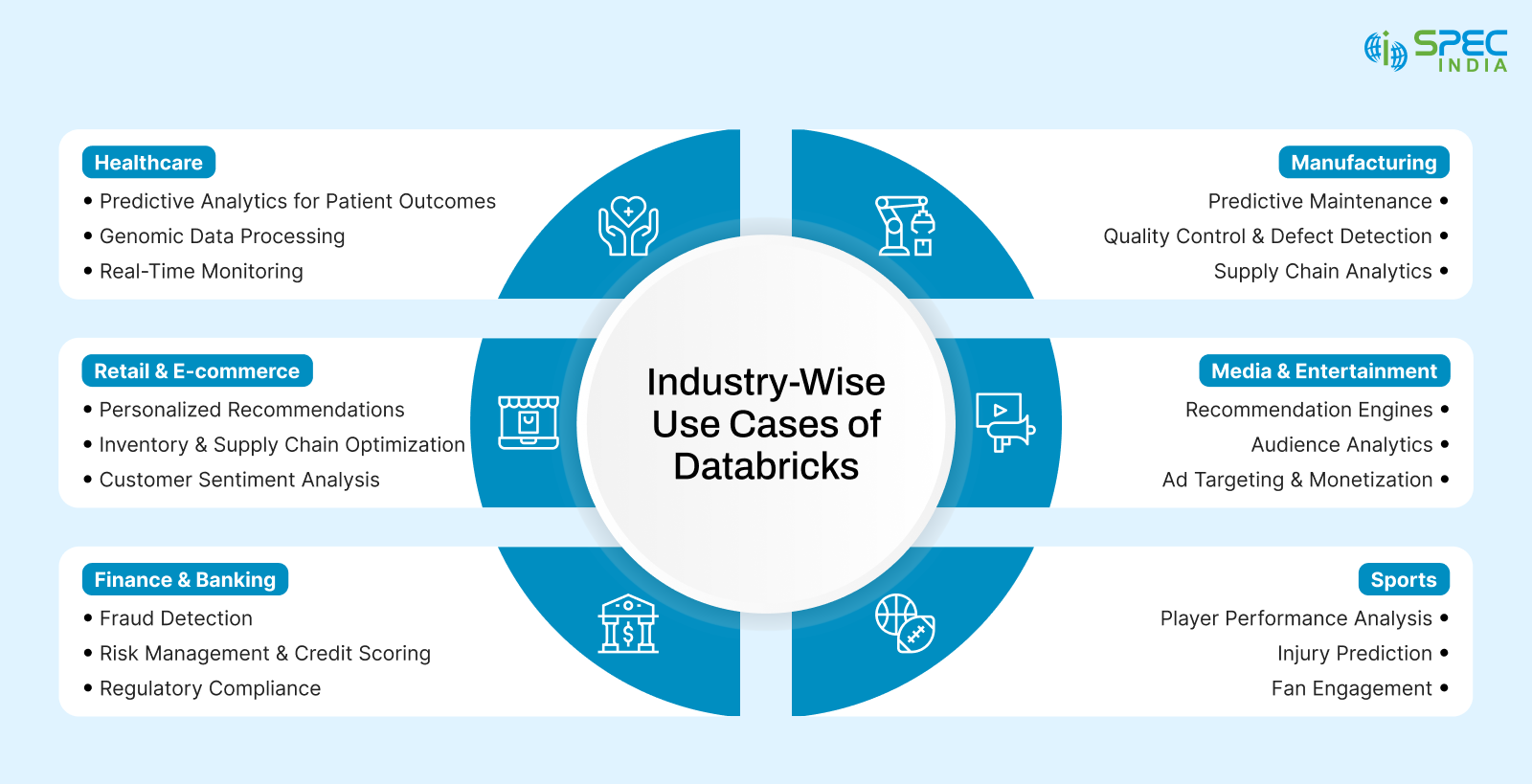
Databricks Use Cases in Healthcare
Healthcare generates vast amounts of data daily. From patient records to genomic data, it covers all. This data has tremendous potential, and it is very important for healthcare companies, but it is usually difficult to analyze it quickly and accurately. Databricks assists in converting this data into actionable insights and improves patient care and operational efficiency.
- Predictive Analytics for Patient Outcomes: Machine learning models examine the history of patients and risk factors to forecast either complications or readmissions, which facilitates timely intervention and improved care.
- Genomic Data Processing: Databricks is an efficient, large-scale genomic processing system that is used to support personalized treatment plans, based on the individual’s genomic profile.
- Real-Time Monitoring: Patient vitals can also be monitored in real time, and alerts about possible emergencies are offered to hospitals, enabling the personnel to respond before things get out of control.
Using Databricks can help healthcare providers process large volumes of data to gain real insights. It can help in improving patient outcomes.
Databricks Use Cases in Retail & E-commerce
Sellers have a goldmine of information at their fingertips, including online purchases and store buys, customer reviews, and social media presence. The viability is how to transform this massive data into valuable information that will push sales and enhance customer experience. Databricks assists retailers in combining and processing information effectively. This can also be achieved using Databricks on AWS, which provides scalable and secure data processing for retail analytics.
- Personalized Recommendations: ML models can propose products that customers will have a higher chance of purchasing by examining their behavior, browsing history, and purchasing patterns. This promotes increased participation and boosts the rates of conversion.
- Inventory & Supply Chain Optimization: Predictive analytics predict the demand patterns, and therefore, it helps retailers to hold the correct stock levels, decrease overstock, and eliminate stockouts. This saves expenditure and increases the efficiency of operations.
- Customer Sentiment Analysis: Through reviewing social media comments, reviews, and feedback, retailers can understand what customers like and dislike, pinpoint areas of pain, and make evidence-based product and service improvements.
Databricks is used by leading retailers to develop real-time dashboards to monitor sales trends and customer behavior, make fast decisions, and improve customer satisfaction.
Databricks Use Cases in Finance & Banking
The financial industry handles large amounts of sensitive and complicated information every single day. Government agencies require rapid and precise perceptions in order to
detect fraud or handle risk and comply with regulations. Databricks is a platform that enables banks and other financial institutions to handle and process large volumes of data without compromising their security or regulatory capabilities.
- Fraud Detection: Anomalies are detected in real time, and this assists in avoiding losses of money before it gets out of hand.
- Risk Management & Credit Scoring: Predictive models analyze the creditworthiness of customers, enabling banks to make sound lending decisions and manage portfolios.
- Regulatory Compliance: Databricks simplifies the process of aggregating data and reporting, making it simpler to comply with regulations and create audit-ready reports by using Databricks.
These were some of the Databricks use cases in finance. Databricks enables financial institutions to achieve a competitive advantage and minimise the risk of operations by delivering speed, security, and analytics.
Databricks Use Cases in Manufacturing
The process of manufacturing is becoming more data-intensive as sensors, IoT devices, and production systems produce voluminous amounts of data. Databricks can enable manufacturers to use this data to create insights to optimize operations, cut costs, and deliver high-quality products. These capabilities are often implemented using Databricks on Azure, which supports large-scale industrial data processing and analytics.
- Predictive Maintenance: ML models can use sensor data to determine when equipment is likely to fail so that it can be maintained in time and minimize expensive downtime.
- Quality Control & Defect Detection: Visual inspection systems are AI-based and identify defects throughout the production process, which leads to uniform product quality.
- Supply Chain Analytics: Databricks is used to streamline production schedules, logistics, and foresee changes in demand to enhance efficiency and minimize waste.
Databricks is used by automotive and electronics companies to track assembly lines, eliminate delays, and automate operations to be more productive.
Databricks Use Cases in Media & Entertainment
The media and entertainment industry relies heavily on understanding the preferences of its audiences and then providing them with content that will keep them engaged. Media companies that use Databricks are acknowledging and capitalizing on the opportunity to make informed and timely business decisions based on their data.
- Recommendation Engines: By analyzing a large volume of streaming and audience-engagement-related data, media companies can utilize machine learning to provide more relevant and engaging content recommendations to users.
- Audience Analytics: Using audience analytics, media companies can analyse user behaviour in real time, allow content creators to understand audience preferences and trends, and help with marketing strategy preparation.
- Ad Targeting & Monetization: Using predictive analytics, media companies have the ability to serve targeted advertisements in real-time, providing the greatest opportunity for maximizing ad revenues as well as the relevance of an audience to advertisers.
Databricks enables media companies to take actionable insight derived from their data to enhance the user experience and increase revenues generated from the ad inventory they possess.
Databricks Use Cases in Sports
The sports industry creates a huge amount of data every day. From player performance stats and wearable devices to match videos, ticket sales, and fan activity, you get tons of data on a daily basis. With data analytics consulting and Databricks, sports organizations can bring all this data together and use analytics and AI to make better and faster decisions, both on the field and behind the scenes.
- Player Performance Analysis: ML Models can identify patterns and other behavioral characteristics of users through analyzing their viewings and preferences, allowing Players to be suggested personalized content to increase user engagement and retention.
- Injury Prediction: Through Databricks you can combine data from wearables, training and other matches through which you can analyze the player physique and fatigue scale. You can even track their medical records which helps in taking proactove actions.
- Fan Engagement: The data generated by live events can enhance the user experience with apps, live events, and social media platforms, allowing them to build greater loyalty and revenue potential.
Professional sports teams are able to leverage the capabilities of Databricks to track their players’ performances, to identify the necessary adjustments in training and to create interactive experiences for fans to engage with their athletes on the playing field.
Key Benefits of Databricks Across Industries
Businesses in every sector have to contend with high volumes of intricate data, which is distributed among various systems continuously. Databricks is a centralized platform that can be used to transform all this overwhelming data into actionable insights. Let’s break down the most important benefits one at a time and find out how they influence the actual business:
1. Unified Platform for Data and AI
The majority of organizations have a hard time with a series of disparate analytics, data engineering, and machine learning tools. All these can be united on a single platform by Databricks. This implies that your data engineers, data scientists, and analysts can work together cohesively without the delays brought about by data silos.
Step by step:
- Gather information from various sources- databases, IoT devices, and cloud storage.
- Keep it in a centralized and secure system.
- Create ML models, run analytics, and create reports without changing tools.
Picture your retail team, a finance team, and operations team all operating on the same single source of truth and being able to make decisions more quickly and confidently.
2. Scalability for Large Datasets
Data increases with the growth of your business. The traditional systems are not usually able to deal with terabytes or petabytes of information. Databricks is designed to scale without issue, and therefore, you can run massive datasets with no performance choke points.
Step by step:
- Raw data enters Databricks via various sources.
- Auto-scaling clusters process the load dynamically.
- Data is processed, converted, and sent for actionable insights in real time.
Consider a hospital that tracks the vitals of thousands of patients in real time – Databricks will make sure vital information is delivered to doctors in real time, potentially saving lives.
3. Faster Insights and Decision-Making
The difference between taking an opportunity and missing it is often time. Using Databricks, companies can process data and extract insights within a short time, transforming raw data into actions that drive their outcomes.
Step by step:
- Collect and clean raw data in real time.
- Use machine learning or artificial intelligence models to forecast trends.
- Visualize outcomes using dashboards or reports to take immediate action.
Think of a retailer being able to change stock amounts or run a campaign, hours later, rather than weeks later, just because the insight was available when it was needed.
4. Enhanced Collaboration Across Teams
The failure of data projects is not necessarily due to technology, but rather due to loss of coordination. Databricks can enable data engineers, analysts, and scientists to collaborate within the same environment.
Step by step:
- Notebooks, models, and pipelines are shared by teams within a single workspace.
- Effective Collaboration features keep all members focused on objectives and information.
- Model or report updates are disseminated immediately throughout teams.
Imagine a finance team, marketing team, and operations team viewing the same data in real-time; thus, there would be no delays in strategies and easy execution.
5. Secure and Compliant Data Handling
In the healthcare sector, the finance sector, and even the manufacturing sectors, data security and data compliance are not a bargain. Databricks also has strong security, encryption, and compliance capabilities that enable organizations to analyze sensitive data without issues.
Step by step:
- Through data encryption, data remains confidential during the entire lifecycle of its usage, including both at rest and in transit.
- By implementing access controls, only those who meet specific criteria are given access to sensitive information.
- Regulatory compliance tools provide guidance for organisations on how to comply with their respective industry’s regulations (i.e. HIPAA and GDPR), ensuring compliance with minimum requirements.
For example, when an organisation is a bank or a healthcare provider, it provides peace of mind for these organisations because they know they can use the power of their data without having to deal with the worry of a data breach or being fined.
Conclusion
As we have thoroughly discussed the Databricks use cases by industry, it is clear that Databricks has emerged as an influential tool for businesses across all verticals. It assists the business in making sense out of its data, making faster decisions, and improving operations. It is helping companies transform data into tangible outcomes in healthcare, forecasting patient outcomes, to retailers designing customized shopping experiences, in banks identifying signs of fraud, and in manufacturers streamlining their production. Databricks helps businesses get value from their data, which can help them grow in the future.
With Databricks, the teams are able to collaborate, minimize mistakes, save time, and make wiser decisions. It is not limited to processing data, but rather the use of data to develop your business and provide more positive experiences to your customers.
Ready to get more from your data?
Start using Databricks today and turn your data into insights that can improve decisions, drive growth, and create real value for your business.
Frequently Asked Questions
Databricks is an integrated data and analytics tool that is deployed to process large amounts of data, execute sophisticated analytics, and create data-driven apps. It assists organizations to unify data engineering and analytics, as well as machine learning, on the same platform, and, therefore, convert raw data into insights more easily.
Common uses of Databricks include real-time analytics, modernizing data lakes, predictive analytics, customer behavior analytics, fraud detection, recommendation systems, and processing IoT data. It is used by business enterprises to scale both structured and unstructured data.
Databricks is used by enterprises to combine data across various sources, create automated data pipelines, and make faster analytics available across teams. It favors the massive reporting, data intelligence, and AI projects and enhances the cooperation of data engineers, analysts, and data scientists.
Yes, Databricks is popular for machine learning. It has an in-built ML workflow, model training, experimentation, and deportation. Databricks is used by teams to design, test, and grow machine learning models based on real-time and historical data.
Structured reporting and historical analysis are the most common Databricks applications of traditional data warehouses. However, Databricks is more adaptable to the current data requirements since it supports more applications like big data processing, real-time analytics, machine learning, and unstructured data analysis.
Businesses prefer Databricks due to its capability to handle different data workloads on one platform, its performance, and scalability. It minimizes data silos, drives analytics, aids AI efforts, and assists teams in transforming data into insights more quickly, without operating complicated infrastructure.

SPEC INDIA is your trusted partner for AI-driven software solutions, with proven expertise in digital transformation and innovative technology services. We deliver secure, reliable, and high-quality IT solutions to clients worldwide. As an ISO/IEC 27001:2022 certified company, we follow the highest standards for data security and quality. Our team applies proven project management methods, flexible engagement models, and modern infrastructure to deliver outstanding results. With skilled professionals and years of experience, we turn ideas into impactful solutions that drive business growth.
Table of contents
Delivering Digital Outcomes To Accelerate Growth
Let’s TalkTable of contents
Delivering Digital Outcomes To Accelerate Growth
Let’s TalkRelated Blogs
Let’s get in touch!
India
SPEC House, Parth Complex, Near Swastik Cross Roads, Navarangpura, Ahmedabad 380009, INDIA.
-
 +91-79-26404031, 32-33-34
 -
 [email protected]