

Top Data Integration Challenges and How to Solve Them
With strong optimism, you kick-start a data project that includes dashboards, real-time insights, and automated workflows. However, you get a reality check soon enough.
A few simple integrations at the beginning now show up like misaligned APIs, unrecognized data dependencies, and unpredictable systems. You may even receive out-of-sync data; formats may not align, and error logs can accumulate within seconds.
According to CIO Review, 89% of organizations struggle with data and system integration backlogs, which means your work continually accumulates.
As a result, it affects product adoption rates among end users, uneven revenue cycles, and poor decision-making. Even projects face buyout issues, increased spending, and directionless internal teams.
It might look like a simple data movement is challenging, but if we go deeper, it demands schema predictability, lets integrations handle discrepancies effortlessly, and makes integrations work and adapt to the changes.
Therefore, we have prepared a list of challenges, along with effective solutions that provide practical pathways.
8 Common Data Integrations Challenges and Solutions
When discussing integration failures, specific challenges must be addressed promptly. A set of challenges, such as inconsistent schemas, unreliable APIs, and scaling and change-management issues, slows data projects and prevents them from realizing value.
So, let’s understand these challenges.
Poor Data Quality and Consistency
Challenge: Sensor data or streams, operational data often contain missing values, noise, duplicates, and inconsistent formats, making downstream data analytics and reporting unreliable.
Why It Fails: There is data that demands attention, evaluation, and validation. Without such a thing, you may end up with faulty insights and automation errors.
Solution:
- Start by implementing data cleansing and profiling as soon as data enters your pipeline.
- Standardize formats at ingestion.
- Use sensor calibration and metadata to ensure consistency.
Data Silos and Incompatible Systems
Challenge: Sensor data is frequently stored in silos, isolated from ERP, CRM, and analytics platforms—highlighting the need for Enterprise Application Integration.
Why It Fails: Teams often struggle because they lack complete access or a full view of the data. As a result, actionable insights remain locked in isolated systems.
Solution
- Use of middleware or integration platforms that normalize formats and protocols
- Interconnect disparate systems using APIs and ESBs
- Adopt central data lakes or warehouses with unified schemas
Lack of Interoperability and Standards
Problem: Sensors and devices often use different communication protocols (e.g., MQTT, Zigbee, CoAP) and data formats, causing interoperability challenges.
Why It Fails: Several custom integrations are fragile, costly, and lack scalability.
Solution:
- Adopt and implement standard-backed protocols
- Use of open platforms and frameworks to handle multiple standards
- Use IoT gateways to translate between device and system protocols.
Real-time Data Latency and Volumes
Problem: Several systems are designed to handle batch processing, not sensor streams. When there is high-frequency data, it can overload networks and processing engines.
Why It Fails: Latency increases, real-time alerts fail, and time-sensitive decisions are delayed.
Solution:
- Ensure you deploy edge computing for local data preprocessing and filtering.
- Use event-driven architectures and streaming platforms such as Kafka.
- Make use of micro-batch processing as an alternative to true real-time
Scalability Bottlenecks
Problem: Systems that work at a small scale often fail at enterprise volume without a cloud-based integration architecture.
Why It Fails: Ingestion pipelines, storage, or analytics platforms become performance bottlenecks.
Solution:
- Use of cloud-based architecture to overcome scalability issues.
- Adopt distributed computing frameworks.
- Make a future-ready plan for autoscaling ingestion and processing layers
Security and Compliance Risks
Problem: With each new sensor or integration, there is a risk of increased attack surface. IoT devices often lack robust security and move data across jurisdictions that require compliance, such as GDPR and HIPAA.
Why It Fails: Weak security controls can lead to data breaches, data loss, or non-compliance with regulations such as GDPR or HIPAA.
Solution:
- Make sure to encrypt data at rest and during transit.
- Implement access control and authentication on every layer.
- Conduct security audits at regular intervals and adopt governance frameworks.
Integration Complexity and Skills Gaps
Problem: Integrating sensors into existing IT systems requires cross-domain expertise, including networking, cloud, and analytics. Here, many teams fall short, and integrations become burdens, slowing project development.
Why It Fails: Projects stall due to misconfiguration, poor architectural decisions, or reliance on manual processes.
Solution:
- Get your teams trained for the same.
- Use low-code/plug-and-play integration tools.
- Collaborate with external integration experts for planning and execution.
Organization Misalignment
Problem: Businesses collect sensor data without clearly defining the support of its use towards achieving business goals.
Why It Fails: Teams gather massive volumes of data but struggle to justify ROI or prioritize integration efforts.
Solution:
- Determine clear business results before gathering data.
- Foster collaboration right from the beginning between technical and business stakeholders
- Establish metrics that tie sensor integration to real ROI.
Understanding challenges and solutions is one measure, but knowing how to proactively catch them is where your business scales. These flaws show early warning signs and repeatedly surface; all you need is attention to detail. The next section discusses the methods for detecting and identifying.
How to Spot Integration Issues Early?
Integration challenges always lie in the systems; it only requires spotting those signs. Here is the compiled list of integration issues that will help you take proactive steps.
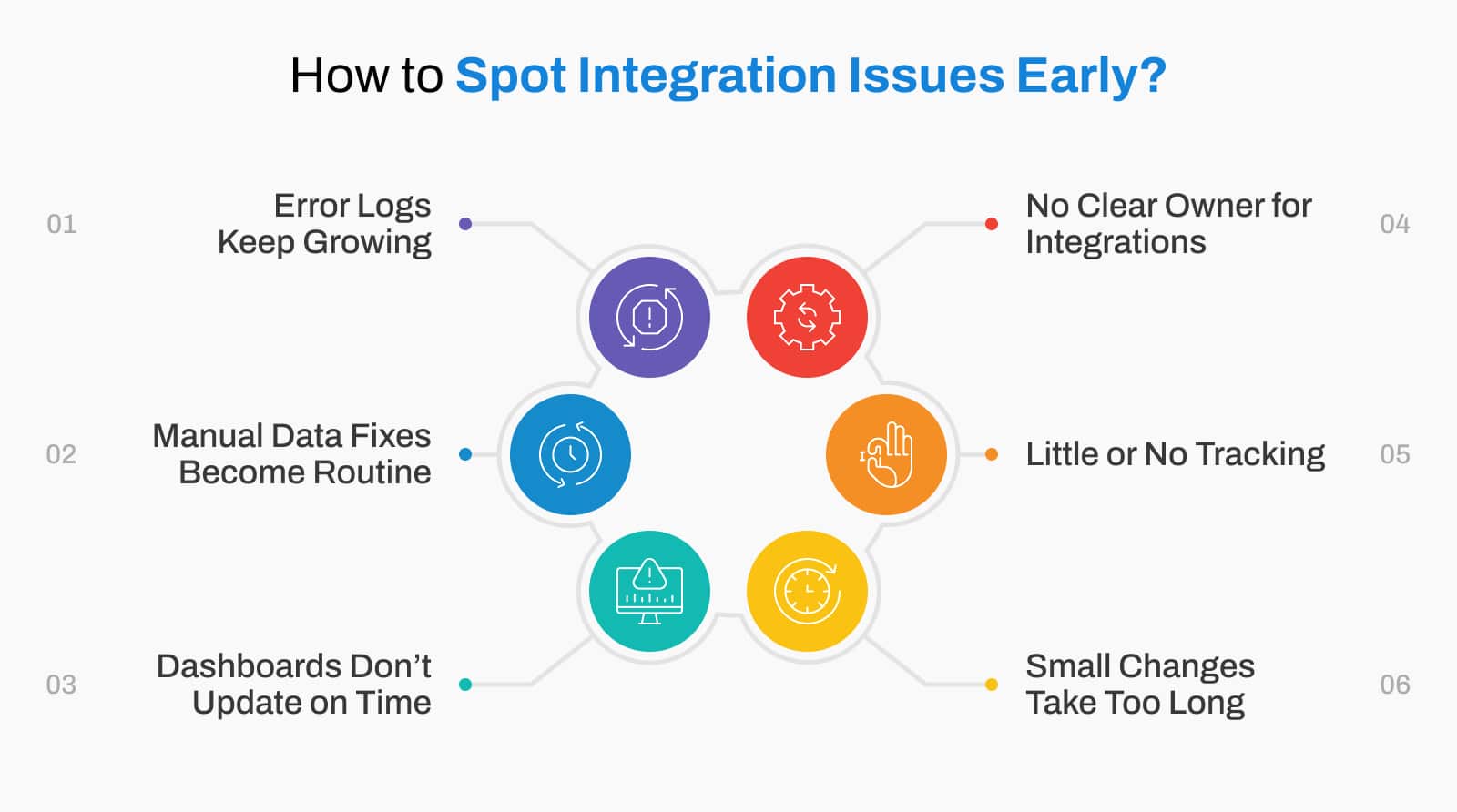
- Error Logs Keep Growing: Monitor error logs, as they can accumulate with more failures, silent errors, or retries than usual.
- Manual Data Fixes Become Routine: Teams must manually correct dashboards, rerun jobs, and patch records to verify stability and ensure smooth operations.
- Dashboards Don’t Update on Time: Delays in reporting, missing data, or no matches across systems are early signs of integration issues or failures.
- No Clear Owner for Integrations: Another major challenge is that integration issues persist or become rigid due to insufficient manpower to resolve them on time.
- Little or No Tracking: Sometimes users report issues, and only then is it highlighted.
- Small Changes Take Too Long: Sometimes, integration challenges stem from adding integrations that take longer than expected.
Conclusion
Data integration challenges are not short-term issues; they are long-term structural problems that can derail business intelligence initiatives if left unchecked.
By applying a resilient data integration architecture, spotting early warning signs, and aligning integrations with business goals, organizations can build systems that remain reliable as they scale, migrate, and change.
If you’re facing growing integration backlogs or delayed insights, explore our Data Integration Services and Business Intelligence Services to build a future-ready data foundation.

SPEC INDIA is your trusted partner for AI-driven software solutions, with proven expertise in digital transformation and innovative technology services. We deliver secure, reliable, and high-quality IT solutions to clients worldwide. As an ISO/IEC 27001:2022 certified company, we follow the highest standards for data security and quality. Our team applies proven project management methods, flexible engagement models, and modern infrastructure to deliver outstanding results. With skilled professionals and years of experience, we turn ideas into impactful solutions that drive business growth.
Table of contents
Delivering Digital Outcomes To Accelerate Growth
Let’s TalkTable of contents
Delivering Digital Outcomes To Accelerate Growth
Let’s TalkRelated Blogs

Let’s get in touch!
India
SPEC House, Parth Complex, Near Swastik Cross Roads, Navarangpura, Ahmedabad 380009, INDIA.
-
 +91-79-26404031, 32-33-34
 -
 [email protected]