| Business Intelligence | Data Science |
|---|---|
| Focuses on descriptive insights | Focuses on prediction and optimization |
| Uses structured, historical data | Works with structured and unstructured data |
| Delivers dashboards, reports, and KPIs | Builds models and algorithms |
| Supports operational and tactical decisions | Supports strategic and forward-looking decisions |
| Relies on roles like business intelligence analyst | Relies on data science professionals |


Loading...
Data Science vs Business Intelligence: When Do You Need Which?
Posted
January 22, 2026
Category Business Intelligence
Data-driven decision making has moved from a competitive advantage to a baseline requirement for modern enterprises. According to Statista, the analytics-as-a-service (AaaS) market is projected to reach $132.9 billion by 2032, driven by growing demand for faster, more accurate business insights across industries such as retail, manufacturing, healthcare, and logistics.
Data science is widely used across many industries to develop new products, understand customer preferences, and predict market trends. Smart organizations are using data to see what’s coming. Whether it’s healthcare or the automotive sector, they aren’t just reacting to the market; they’re forecasting it. This keeps them a step ahead of the competition.
But there’s a problem. Despite all the tech adoption, many senior leaders are stuck on one question: Data Science vs. Business Intelligence, which one do we need right now?
The confusion is real. You’ll hear terms like “BI vs. Analytics” or “Data Science vs. BI” thrown around in vendor pitches and strategy meetings like they mean the same thing. They don’t. And using them interchangeably makes it impossible to build a clear roadmap. The problem is not terminology alone. Choosing the wrong approach can lead to wasted budgets, delayed insights, and unrealistic expectations from data teams.
At a leadership level, the difference matters. Business intelligence focuses on understanding what has happened and what is happening now. Data science focuses on predicting what will happen next and on optimizing outcomes. Both rely on business intelligence and data, but they solve very different business problems.
This guide breaks down the difference between business intelligence and data science in practical, executive terms. It will help you decide when BI is sufficient, when data science becomes necessary, and how both can work together as your organization matures.
Why Business Leaders Confuse Business Intelligence and Data Science?
Global investment in data continues to accelerate, but clarity has not kept pace. Gartner points out a harsh reality: if you can’t tell the difference between your analytics tools, you’re probably wasting your data platform. Many companies spend big on a major investment only to underutilize it because they don’t know what the tool does.
Usually, this confusion stems from three main sources:
1. Overlapping Language
Modern tools try to do everything. They pack reporting, dashboards, and advanced analytics into one box. This blurs the line.
The result? Executives aren’t sure what outcomes to expect.
- Business Intelligence (BI) is about visibility and structured reporting.
- Data Science is about experimentation and predictive models.
When you group these under the same label, your expectations will eventually drift.
2. The “Vendor Promise” Trap
We’ve all seen the pitches. Platforms promise “predictive insights” but ignore the basics, such as data integration and data integrity. Leaders end up expecting high-level forecasting from a system that was built for simple reporting and visualization.
When those predictions don’t happen, confidence in the whole project drops. Fast.
3. Different Teams, Different Views
Your teams aren’t always speaking the same language:
- BI Analysts care about KPIs, dashboards, and making things usable for the average business user.
- Data Scientists care about statistical validity, model accuracy, and testing.
Without a shared framework, leadership gets mixed messages. One team says it’s possible; the other says it’s not. It’s hard to move forward when everyone has a different perspective. The result is not just confusion; it is delayed decisions, misaligned hiring, and analytics programs that fail to deliver the expected ROI.
Pro Tip: Before buying a new tool, define the specific “win” you want. Is it a cleaner dashboard (BI) or a predictive model (Data Science)? Knowing the difference saves you a fortune in the long run.
What is Business Intelligence?
A CIO at a global manufacturing firm once summarized their challenge simply: “We had data everywhere, but no agreement on which numbers were correct.”
That situation changed after implementing a structured business intelligence framework.
Business intelligence and data work together to deliver a single, trusted view of organizational performance. Think of a BI system as your business’s single source of truth. It pulls data from across your company, cleans it, and puts it into a dashboard you can trust. No more guessing. No more digging through five different spreadsheets to find one number.
The demand for this “real-time visibility” is massive. In fact, reports show the business intelligence market is set to explode to over $74 billion by 2033. Why? Because companies are tired of flying blind. They need consistent reporting across every department so they can make decisions based on facts, not gut feelings.
At its core, business intelligence answers three executive-level questions:
- What happened?
- What is happening now?
- Where are we underperforming or overperforming?
BI is for your day-to-day operations. It’s what you use to track KPIs, manage your inventory, and get your financial reporting right.
The most important thing to remember? BI does not attempt to predict the future. Its real value isn’t in a crystal ball; it’s in clarity, speed, and trust. It tells you exactly where you stand right now so you can move forward with confidence.
Core Capabilities of Business Intelligence
When implemented correctly, business intelligence delivers measurable operational value.
Key BI Capabilities
- Data visualization through dashboards and scorecards for leadership teams
- Standardized reporting across finance, operations, and IT
- Strong data integration across ERP, CRM, and operational systems
- High data integrity, ensuring one version of the truth
- Self-service reporting for business users without heavy IT dependency
- Online analytical processing (OLAP) for fast, multidimensional analysis of historical data,
- supporting operational reporting, trend identification, and strategic decision-making
These capabilities help organizations move from raw data to actionable insights, reducing reporting friction and improving decision confidence.
Much global research has consistently proven that organizations with mature BI practices reduce decision latency because leaders no longer debate data accuracy during reviews. Instead, conversations shift to action.
When Business Intelligence Is the Right Choice?
Business intelligence is the right investment when your organization needs visibility, not prediction. BI tools are designed to support business decision-making by providing fact-based insights from historical and current data. This enables enterprises to translate data analysis into actionable decisions that directly influence strategic business choices.
Business intelligence provides a snapshot of where a business has been and where it stands.
BI is the Right Fit If
Leadership needs reliable performance tracking
Decisions are operational or compliance-driven
Teams require standardized metrics across regions
Reporting speed matters more than forecasting complexity.
Let’s understand it by looking at examples from different industries.
Industry Examples
These scenarios illustrate when business intelligence is the right choice and delivers immediate value.
Retail
A multi-region retailer consolidates point-of-sale, inventory, and finance data into a unified BI platform. Executives access real-time dashboards showing daily sales, margin performance, and stock levels.
This business intelligence and data foundation eliminates manual reporting and ensures that every department uses the same numbers. Decisions about promotions and replenishment are faster and more consistent.
Manufacturing
Imagine a manufacturing firm with plants in Germany and the UK. Instead of waiting for a messy end-of-month report, they integrate production, quality, and downtime data into one dashboard.
The Result: Leadership doesn’t have to guess which plant is lagging. With solid data integration and data integrity, they can spot an underperforming facility and fix the issue before it ruins the monthly review. It’s about being proactive, not reactive.
Healthcare
In a healthcare setting, things move fast. Providers use BI dashboards to monitor patient wait times, bed availability, and compliance.
The Key Benefit: This supports daily decisions without needing a PhD in data modelling. A standard business intelligence analyst can easily manage these dashboards. It gives the team the visibility they need for regulatory reporting without the “complex” data science headache.
Logistics
For a freight forwarding company, visibility is everything. They build dashboards to track shipments, delivery speed, and cost-per-route.
The Edge: Executives get a clear view of every region and client in one place. If performance drops on a specific route, they see it immediately. It builds accountability and enables swift corrective action before a minor delay becomes a major loss.
What is Data Science? (Looking Forward, Not Backward)
If Business Intelligence is your rearview mirror, Data Science is your high-beam headlights. Most organizations make the shift to Data Science when they realize that knowing what happened isn’t enough anymore. To stay competitive, you need to anticipate demand, cut risks, and make decisions before the problem even hits your desk.
According to Gartner’s 2024 data and analytics leadership research, companies using advanced predictive techniques are far more likely to beat their peers in both revenue and efficiency. This isn’t just a trend; it’s becoming the standard for survival.
The Core Difference: The Questions You Ask
At the end of the day, the “Data Science vs. BI” debate comes down to the questions you’re asking your team:
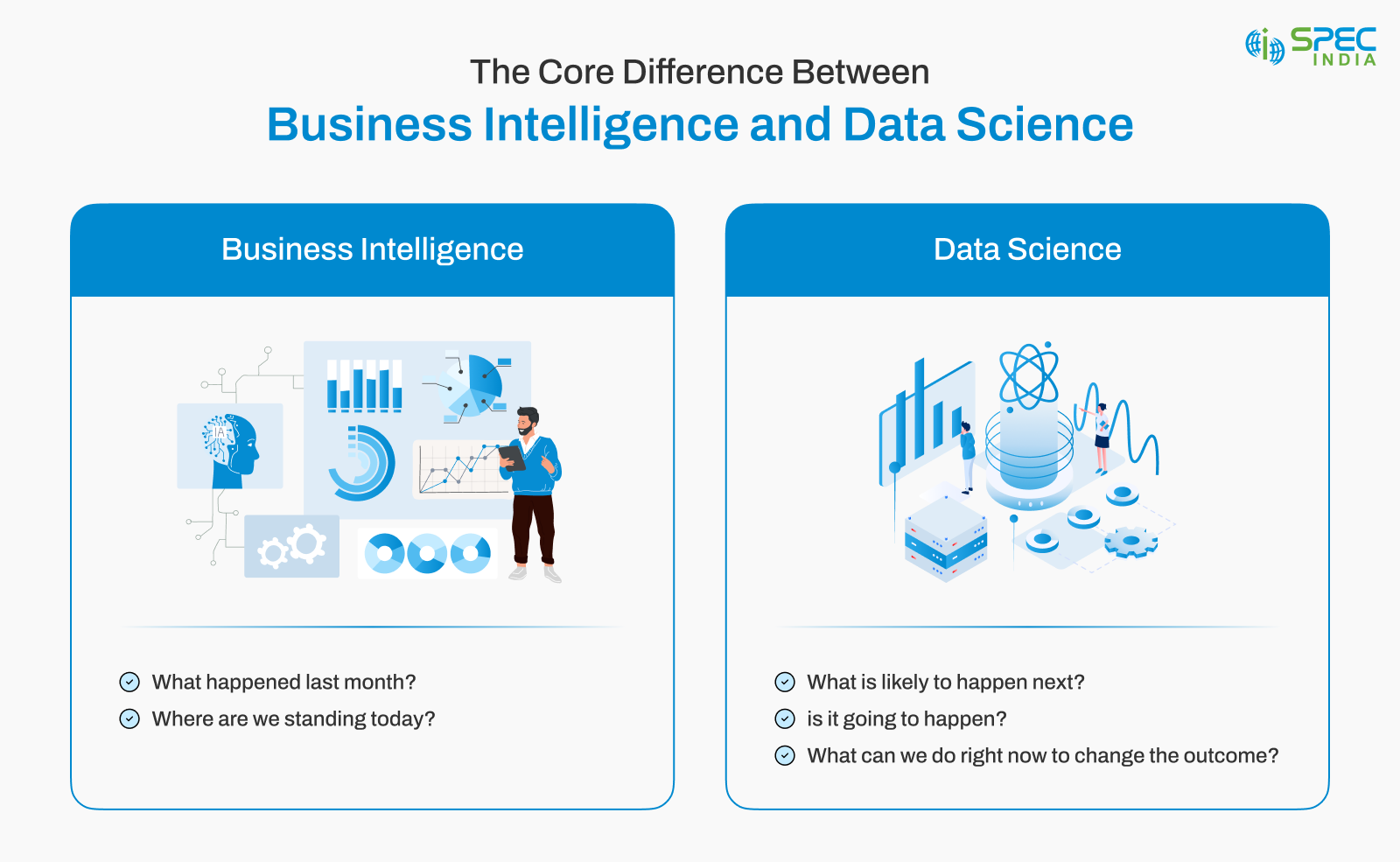
Business Intelligence asks:
- What happened last month?
- Where are we standing today?
Data Science asks:
- What is likely to happen next?
- Why is it going to happen?
- What can we do right now to change the outcome?
How It Works
Data Science doesn’t just look at clean spreadsheets. It digs into messy, “unstructured” data like emails, documents, and complex patterns that a standard dashboard would miss. It’s built to handle uncertainty.
While a BI analyst keeps your reports running, a Data Science professional (including data scientists and engineers) builds the “pipelines” and models that predict the future.
What Data Science Delivers to Your Business?
- Predictive Analytics: Forecasting trends before they go mainstream.
- Risk Estimations: Calculating the likelihood of a customer leaving or a system failing.
- Scenario Planning: Testing “What if?” before you spend a single dollar.
- Pattern Detection: Finding hidden opportunities in massive datasets that no human could spot manually.
The Bottom Line: According to McKinsey’s 2024 analytics insights, companies that get this right make decisions faster and forecast with way more accuracy across their entire supply chain. It moves you from reacting to the market to leading it.
When Do You Actually Need Data Science?
Let’s be clear: Data science isn’t a replacement for BI. It’s an evolution. You don’t swap one for the other; you add Data Science when your questions shift from “What happened?” to “How do we optimize for what’s next?” It’s the difference between reviewing a performance report and shaping a future strategy.
4 Signs You’ve Outgrown Simple Dashboards
You’ll know it’s time to move beyond BI when:
- You need to forecast, not just review. If your leadership team is tired of looking in the rearview mirror, you need predictive tools.
- The risk is high. When a wrong move costs millions, you can’t rely on a “gut feeling” or a static chart.
- The data is too big. If your current tools are lagging or crashing under the weight of your data, you’ve hit a ceiling.
- Speed is your only edge. If your competitors are reacting faster than you, it’s because they’re seeing the patterns before you are.
Industry-Specific Examples
These scenarios show when data science becomes necessary and why traditional reporting alone is not enough.
Retail
A retail chain in the USA or the UK can easily check its daily sales. But dashboards won’t tell them why they keep running out of stock or why they have too much inventory sitting in a warehouse.
The Data Science Fix: By using predictive analytics and predictive models, the retailer can forecast demand by region and season. They can adjust inventory before the rush hits, cutting costs and keeping customers happy. You can’t get that foresight from a standard BI report.
Manufacturing
Most manufacturers track machine uptime through BI reports. They know when a machine fails, but they don’t know why until it’s too late.
The Data Science Fix: Predictive analysis of sensor data from equipment identifies early warning signs of failure. The company can spot early warning signs of a breakdown. They schedule maintenance on their own terms, not when the machine decides to quit. This moves the data science professionals’ team from reactive repairs to proactive growth.
Logistics and Freight Forwarding
In logistics, everyone tracks delivery times and fuel costs. But seeing a delay on a map doesn’t help you prevent it next time.
The Data Science Fix: Using data analytics tools combined with predictive analytics, the company models route performance and forecasts delays before shipments are dispatched. This allows teams to reroute shipments in real time across regions such as the Middle East or Australia, saving both time and fuel.
Healthcare
A healthcare network reviews patient outcomes and operational metrics through BI dashboards. Patterns are visible only after issues occur.
With predictive models, patient data is analysed to identify individuals at higher risk of readmission. Care teams intervene earlier, improving outcomes and reducing costs. This use case depends on data science vs business intelligence capabilities working together, not reporting alone.
Energy and Utilities
An energy provider tracks asset performance through historical reports. Equipment failures still result in outages and regulatory penalties.
By applying natural language processing to maintenance logs and combining it with sensor data, data science models predict asset degradation. This enables proactive maintenance scheduling and improves service reliability across the distributed infrastructure.
Confused Between Data Science and Business Intelligence? Choose What Drives Results.
Business Intelligence explains the past. Data Science helps you prepare for what’s next. The real value lies in knowing when to use each—based on your goals, data readiness, and decision timelines. Let’s help you choose with clarity, not assumptions.
Business Intelligence vs Data Science
When you look at business intelligence and data science side-by-side, the choice becomes much simpler. BI tells you where you’ve been; Data Science tells you where you’re going. Both are essential, but they serve different masters within your organization.
The bottom line: BI is about understanding your performance today. Data Science is about shaping your outcomes for tomorrow.
According to Forbes technology research published in 2025, organizations that clearly separate BI and data science responsibilities see higher adoption and better ROI from both functions.
Do You Need Business Intelligence, Data Science, or Both
For most businesses, it’s not an “either/or” situation. The real challenge is knowing which one will give you the highest value right now.
If you try to jump straight into complex Data Science without a solid BI foundation, you’ll likely struggle with trust and adoption. You can’t predict the future if you don’t even trust your current sales reports.
A Practical Decision Framework
Before you invest, ask yourself these three questions:
- Is your data “clean” and organized? If your data is scattered across spreadsheets and WhatsApp, start with BI. You need a single source of truth before you can do anything else.
- Are you trying to fix a current process or invent a new one? If you need to speed up monthly reporting, choose BI. If you want to automate a complex decision, such as personalized pricing for every customer, you need Data Science.
- Does your team have the right skills? BI tools are more user-friendly and can be handled by your existing analysts. Data Science requires a more specialized technical setup. Don’t buy a Ferrari if you don’t have a driver.
According to Gartner’s 2024 analytics leadership research, organizations that align analytics investments with business maturity are far more likely to see measurable ROI. Those who skip foundational capabilities often struggle with adoption, trust, and outcomes.
Key Factors That Should Guide Your Decision
Choosing between business intelligence, data science, or a combination of both should never be driven by trends or tooling hype. It should be guided by how your organization makes decisions today and where it wants to go next.
Below are the four most important factors leaders should evaluate, explained with context.
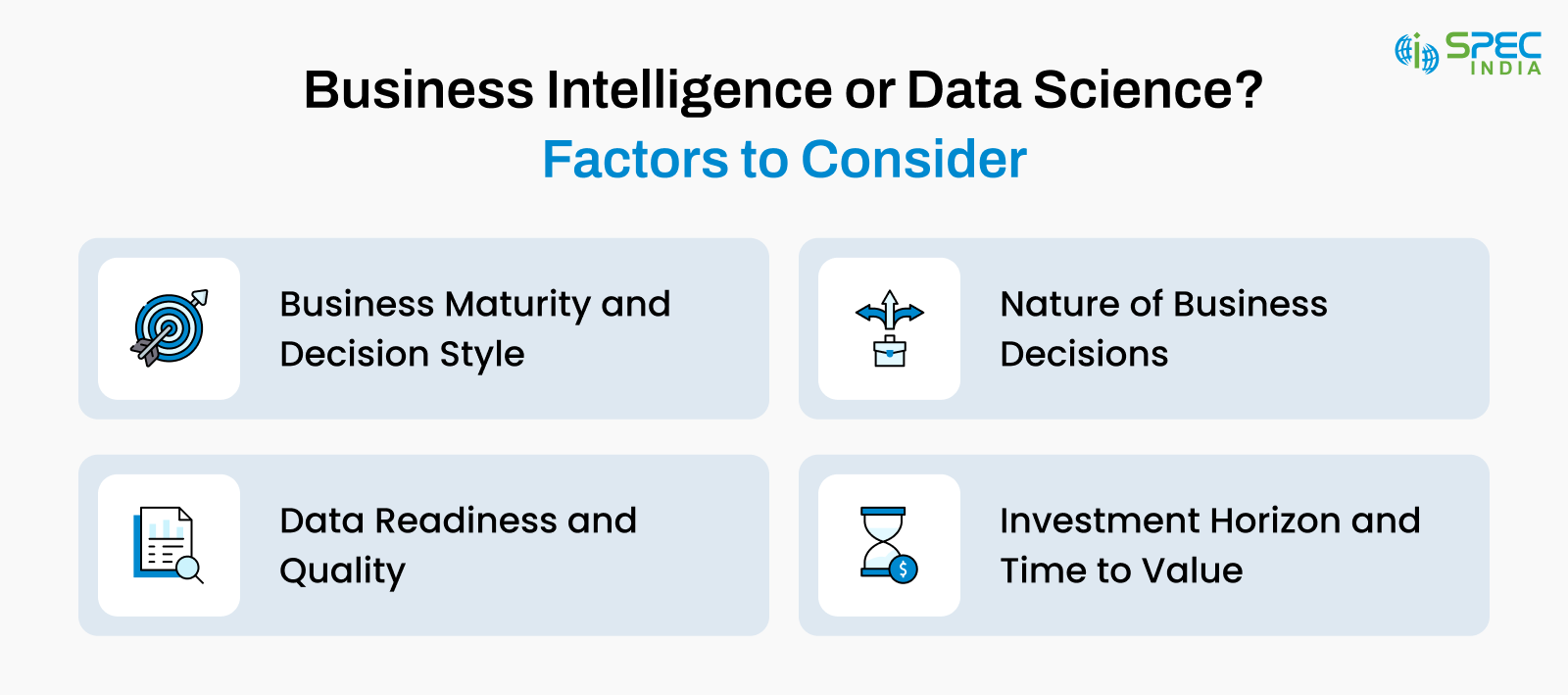
1. Business Maturity and Decision Style
The first question to ask is how structured your decision-making currently is.
Here is a simple litmus test: If your leadership meetings are still spent arguing over whose spreadsheet is correct, you aren’t ready for Data Science yet.
If you are still reconciling reports, validating basic numbers, or debating whether the data is even accurate, advanced modeling will only confuse things further. In this scenario, Business Intelligence is your priority. BI provides the immediate value you need: a single, trusted version of the truth. Once everyone in the room agrees on the “what,” then and only then can you start using Data Science to figure out the “what’s next.”
If your organization already trusts its dashboards and KPIs, discussions naturally shift toward forecasting, optimization, and scenario planning. This is where data science becomes relevant.
In short:
- Low maturity favors business intelligence
- High maturity enables data science vs business intelligence to work together
2. Nature of Business Decisions
Different analytics approaches support different types of decisions.
Operational and compliance-driven decisions require visibility and consistency. Examples include cost control, SLA monitoring, and regulatory reporting. These decisions benefit most from business intelligence and strong data visualization.
Strategic decisions involve uncertainty. At the end of the day, your choice depends on the direction you’re looking.
- If most of your decisions look backward, you need BI. It delivers a faster ROI by cleaning up your reporting and giving you a clear view of where your money is going right now.
- If your decisions look forward: You need Data Science. When you’re ready for demand forecasting, risk mitigation, and capacity planning, you need the predictive models that only data science professionals can build.
These aren’t just “nice-to-have” features. They are the tools that allow you to experiment with different scenarios and choose the path with the least risk.
3. Data Readiness and Quality
Advanced analytics cannot compensate for poor data foundations.
According to McKinsey’s 2024 data transformation research, organizations frequently fail with advanced analytics because they underestimate the importance of data integration and data integrity.
If your data is fragmented across systems or lacks standard definitions, BI helps stabilize and govern it. Once data is consistent, reliable, and accessible, data science initiatives can scale with confidence.
This sequencing matters more than tool choice.
4. Investment Horizon and Time to Value
One thing leaders often overlook is how quickly they’ll see a return on their investment. If you need results yesterday, your choice changes.
- BI delivers impact in months. By automating your reports and standardizing your KPIs, you see an almost immediate jump in efficiency. The confusion clears up, decisions happen faster, and the “manual headache” disappears.
- Data Science is a long-game investment. You can’t rush it. It requires experimentation, constant iteration, and a highly specialized team. While the eventual payoff is much higher, you need patience and strong executive support to see it through.
The Bottom Line: If you expect immediate results from a predictive project but don’t have a mature BI foundation yet, you’re going to struggle. Build the foundation first, then reach for the future.
| Maturity Stage | Organizational Characteristics | Primary Focus | Best Fit Capabilities | Business Outcomes |
|---|---|---|---|---|
| Stage 1: BI First Organizations | Fragmented reporting, inconsistent metrics, and manual spreadsheets | Visibility and trust | Business intelligence tools, standardized dashboards, data visualization, and strong data integration | Faster reporting, single source of truth, improved confidence |
| Stage 2: BI with Advanced Analytics | Trusted KPIs, growing data volume, demand for deeper insights | Diagnostic understanding | BI platforms with advanced analytics, predictive analysis, and trend exploration | Better root cause analysis, improved planning |
| Stage 3: Data Science Led Organizations | Mature data foundation, clear business questions, executive sponsorship | Prediction and optimization | Data science professionals, predictive analytics, predictive models, automation | Forecast-driven decisions, reduced risk, competitive advantage |
According to Forbes analytics research published in 2024, organizations operating at the third stage consistently outperform peers in efficiency, innovation, and responsiveness.
How Business Intelligence and Data Science Work Together
The most successful organizations do not treat this as an either-or decision.
Business intelligence and data science serve complementary yet distinct roles.
- BI creates visibility into performance
- Data science creates foresight into outcomes
- BI builds trust in data
- Data science builds an advantage from data
Strong BI foundations accelerate the success of data science vs business intelligence initiatives. Without reliable reporting, predictive insights struggle to gain adoption.
This is why many enterprises invest in both capabilities as part of a unified analytics strategy.
Common Mistakes Companies Make When Choosing Between BI and Data Science
Even with the best intentions, many analytics projects fall flat. It usually isn’t the technology’s fault; it’s the strategy. Here are the most common traps we see leaders fall into:
1. Hiring Scientists Before Fixing the Foundation
This is the #1 mistake. Many companies hire expensive data scientists before they’ve fixed their basic data issues. Without “clean” data and solid integration, your predictive models will produce misleading results. These kids trust fast.
The Rule: Use BI to establish trusted reporting first. Only then should you scale into Data Science.
2. Expecting Dashboards to Predict the Future
Modern business intelligence tools are great, but they aren’t magic. They can show you trends, but they aren’t designed for complex optimization. If you try to stretch a BI tool beyond its purpose, you’ll end up with disappointing results. Know the difference so you don’t misplace your investment.
3. Treating Analytics as a “One-Time” Project
You don’t just “finish” digital transformation. Many organizations launch a dashboard and then walk away. Real value comes from continuous improvement, constant governance, and evolving your models as your business grows. It’s a capability, not a milestone.
4. Forgetting the “People” Element
The best data in the world is useless if your team doesn’t use it. Moving from “gut feeling” decisions to data-driven ones is a major cultural shift. Without training and clear ownership, those expensive dashboards will just sit there gathering digital dust.
5. Investment Horizon and Time to Value
Technology should follow strategy, never the other way around. Don’t buy a tool because it’s popular. Start with a business question and let that question tell you whether you need BI, Data Science, or both.
How SPEC INDIA Supports BI and Data Science Initiatives
Choosing between BI and Data Science isn’t a coin flip. It’s about aligning your goals with your data readiness.
At SPEC INDIA, we don’t believe in one-size-fits-all solutions. We help you build a roadmap that grows with you. Whether you’re in retail, healthcare, or logistics, we focus on measurable outcomes.
How We Create Value:
- Strategy-led analytics roadmaps aligned to business maturity
- Scalable business intelligence tools implementation for fast visibility
- Expert Power BI consulting services for executive dashboards and reporting
- Advanced predictive analytics services for forecasting and optimization
- Industry-focused data visualization consulting services to drive adoption
According to Forbes’ 2025 enterprise analytics insights, companies that align their analytics strategy with business goals are significantly more likely to sustain long-term value. This alignment is at the core of how SPEC INDIA approaches BI and data science initiatives.
Final Takeaway
The “Data Science vs. BI” choice isn’t binary.
BI gives you clarity, consistency, and confidence.
Data Science gives you foresight and a strategic edge.
The most successful companies understand how to use both. They build a foundation of trust with BI, then use Data Science to scale their ambition.
Frequently Asked Questions
Not exactly. One isn't "better" than the other; they just solve different problems. BI is your tool for clarity. It tells you exactly where you stand right now. Data Science is your tool for foresight; it helps you predict where you’re going. The real question isn't which is better, but which insight your business needs at this moment.
Start with BI if you need consistency and transparency. If your leadership team is still struggling with fragmented data or can't agree on the "correct" version of a KPI, you need a solid BI foundation first. As Gartner often points out, you can't build a reliable predictive model on top of messy, unorganized data.
Business Intelligence is almost always faster and easier to implement. You’re essentially connecting your existing systems to create a dashboard. You can usually see a measurable impact within a few months. Data Science is much more complex; it requires specialized talent, long experimentation cycles, and a "clean" data environment. Most businesses find it best to start with BI and move into Data Science as they mature.
Most businesses rely on tools designed for reporting and scannable dashboards. The big players are Microsoft Power BI, Tableau, Qlik, and Looker. At SPEC INDIA, we often see the best results with Power BI because of its scalability and ease of adoption across teams.
Data Science requires a much more technical toolkit. Professionals typically use programming languages like Python and R, along with platforms that support machine learning and natural language processing. These tools allow for deep experimentation and the creation of custom predictive models that standard BI tools just can't handle.

SPEC INDIA is your trusted partner for AI-driven software solutions, with proven expertise in digital transformation and innovative technology services. We deliver secure, reliable, and high-quality IT solutions to clients worldwide. As an ISO/IEC 27001:2022 certified company, we follow the highest standards for data security and quality. Our team applies proven project management methods, flexible engagement models, and modern infrastructure to deliver outstanding results. With skilled professionals and years of experience, we turn ideas into impactful solutions that drive business growth.
Table of contents
- Why Business Leaders Confuse Business Intelligence and Data Science?
- What is Business Intelligence?
- What is Data Science? (Looking Forward, Not Backward)
- What Data Science Delivers to Your Business?
- 4 Signs You’ve Outgrown Simple Dashboards
- Business Intelligence vs Data Science
- Key Factors That Should Guide Your Decision
- How Business Intelligence and Data Science Work Together
- Common Mistakes Companies Make When Choosing Between BI and Data Science
- How SPEC INDIA Supports BI and Data Science Initiatives
- Final Takeaway
Delivering Digital Outcomes To Accelerate Growth
Let’s TalkTable of contents
- Why Business Leaders Confuse Business Intelligence and Data Science?
- What is Business Intelligence?
- What is Data Science? (Looking Forward, Not Backward)
- What Data Science Delivers to Your Business?
- 4 Signs You’ve Outgrown Simple Dashboards
- Business Intelligence vs Data Science
- Key Factors That Should Guide Your Decision
- How Business Intelligence and Data Science Work Together
- Common Mistakes Companies Make When Choosing Between BI and Data Science
- How SPEC INDIA Supports BI and Data Science Initiatives
- Final Takeaway
Delivering Digital Outcomes To Accelerate Growth
Let’s Talk

Let’s get in touch!
India
SPEC House, Parth Complex, Near Swastik Cross Roads, Navarangpura, Ahmedabad 380009, INDIA.
-
 +91-79-26404031, 32-33-34
 -
 [email protected]