| Category | API-First approach | Reactive API Approach | Business Impact |
|---|---|---|---|
| Strategy | APIs are planned from the start | APIs are added later as needed | Lack of planning leads to inconsistent interfaces |
| Development Cost | Costs are predictable and controlled | The initial cost may seem lower | Retrofitting APIs becomes expensive over time |
| Integration | Easy to integrate with other systems | Integration is complex and ad-hoc | Increased time and effort for system integrations |
| Business Agility | Supports fast business decisions | Slows down changes due to technical debt | Decisions are delayed by slow system updates |
| Risk | Lower risk to live systems | Higher risk when modifying running systems | Fixes in live environments can cause downtime or errors |
| Long-term Impact | Scales smoothly as the system grows | Accumulates technical debt | Short-term speed creates long-term drag |


Loading...
How API-First Architecture Enables Digital Freight Forwarding Platforms
Posted
March 7, 2026
Category Logistics & Freight
At launch, everything looked solid.
Bookings are getting confirmed easily with just a few taps. Real-time freight tracking was going as planned, and mergers were also easy. The product roadmap was going perfectly, and people were also liking it.
Then the scale happened.
New generation customers began to demand more integrations. Enterprise customers desired access to real-time data between systems. Internal teams required faster releases to meet market needs. What used to take weeks was now stretching to months. Instead of creating new capabilities, engineering teams spent their time repairing fragile integrations and handling workarounds. Every small change carries risk. Each deployment had to be careful.
It is the point at which numerous emerging digital platforms, across logistics, retail, healthcare, and finance, hit an invisible wall.
According to McKinsey & Company, fewer than 30% of digital transformations succeed; more than 70% do not achieve their intended targets, and in most industries, the success rate is even lower, particularly when aiming for long-term sustainability of improvements.
And decision-makers realize their mistakes, and they eventually come to:
This isn’t a product problem.
Digital Freight Forwarding Isn’t Just Software—It’s an Ecosystem
Modern freight forwarding software no longer operates in isolation. It sits at the centre of complex, high-stakes digital ecosystems where every system must talk, respond, and adapt in real time.
They must seamlessly connect with:
- Daily changing retail demand systems.
- Production-related manufacturing ERPs.
- Healthcare compliance tools where there is no such thing as delays or errors.
- Energy and utilities supply chains require resilience and reliability.
What breaks most platforms isn’t the absence of features.
It lacks connectivity and flexibility, as well as real-time synchronisation within this ecosystem.
Operational efficiency gets wiped out when systems can no longer reliably communicate with each other, regardless of how well the UI looks.
Why Traditional System Design is Holding Freight Businesses Back
Many digital freight platforms started strong. Their systems had classic monolithic architectures- everything is closely related; everything is under one roof. At first, it worked. There were no operational issues, logistics API integrations weren’t complex, and early growth never became a bottleneck.
Then the scale happened. And then the design that had once been a blessing became a pain.
Decision-makers face familiar frustrations:
- Systems that are hard to change: Each module is closely related to the others, making even a slight adjustment potentially destroy the others.
- Teams blocked by dependencies: Systems that are hard to change: Each module is closely related to the others, making even slight adjustments potentially destroy the others.
- Integrations that feel like rebuilding: When engaging a new logistics provider or enterprise client, you may need to rebuild the whole, rather than merely connect.
It may not be as obvious to the business, but it exists- and it is expensive:
- Innovation grinds to a halt: Your product team is more of a firefighting team than an innovation creation team.
- Roadmap slip: Features that are supposed to be developed in weeks become months.
- Leadership hesitates: Processes involving new partnerships, markets, or business opportunities grind to a halt, not out of strategy but out of systems that cannot process them.
This is a risky stance when it comes to expanding platforms. It is not only a technical constraint; it is a strategic bottleneck. Your architecture must make your business run faster, not slower.
What is API-First Architecture?
When traditional systems slow innovation, the solution isn’t just “new tech.” It is redefining the way your systems are built at the bottom. That is where API-first architecture comes into play, a notion that makes platforms not rigid and reactive, but flexible, scalable, and future-ready.
Here is the API-first approach you need to follow:
- APIs are developed as reusable, stable building blocks.
- All applications, integrations, or partner connections are dependent on such APIs.
- Teams are not reconsidering the wheel with every new feature or integration.
APIs should be thought of less like plumbing and more like products by themselves:
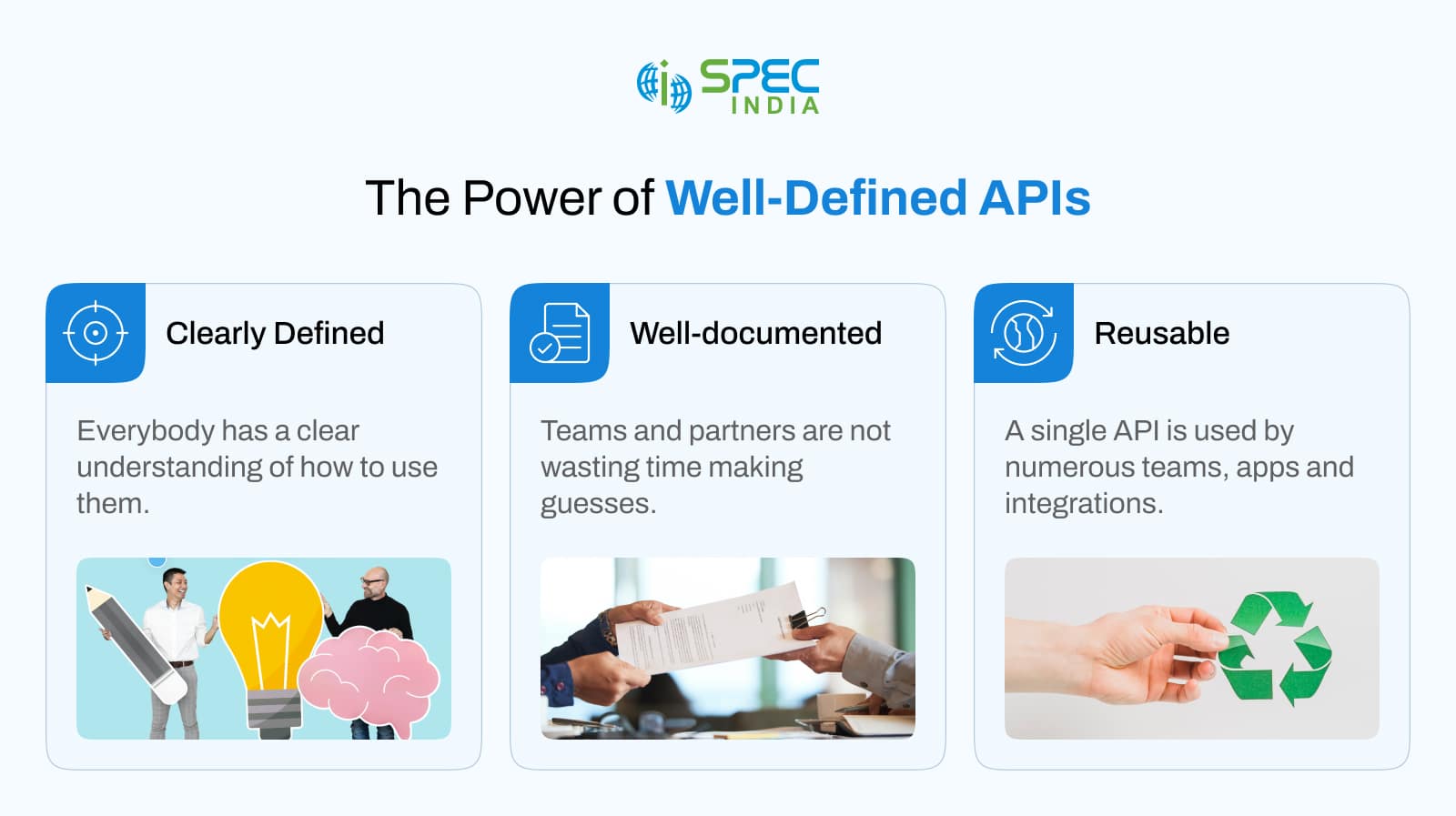
Now the systems that support business growth, not slow it down.
Why Leadership Should Care
The API-first architecture is not a technology choice, but a strategic business enabler:
- Faster go-to-market: Instead of being dependent on each other, teams can work in parallel.
- Predictable scaling: New markets, features, or partners can be introduced without jeopardising the platform.
- Lower long-term risk: Changes don’t ripple unpredictably through tightly coupled systems
- Improved innovation: The engineering teams are not wasting time untangling the spaghetti of the past.
To decision-makers, API-first does not mean you have to write code; it is about ensuring your Freight management platform is future-proof and that all growth opportunities are realised.
The Real Reason API-First Works for Digital Freight Forwarding
Freight forwarding is a fast-moving business—and your shipment management software must keep up. Rates fluctuate hourly. Goods are shipped across borders. Documentation is shifted halfway along. Partners upgrade systems on an ongoing basis. Any delay or disconnect may disrupt all operations, incurring inefficiencies, customer frustration, or lost income.
This is where API-first architecture becomes a game-changer.
With an API-first approach, integrations aren’t an afterthought—they’re part of the foundation. APIs form the connective layer of digital freight platforms that connect:
- Internal systems: From order management to billing to warehouse operations
- External partners: Carriers, brokers, customs agents, and enterprise clients
- Third-party platforms: Analytics dashboards, compliance tools, Real-time freight tracking services
The beauty of this method is adaptability. The system is not meant to oppose change; it is meant to adapt to it. Viability of integrating a new carrier? Add a compliance tool?
More importantly, integrate a new analytics platform without slowing down operations.
To executives, it is not merely a technical advantage but a strategic one. API-first architecture platforms do not simply support existing functions but also enable future growth, strengthen relationships, and make it easier to expand into new markets.
Tip for Decision-Makers:
When evaluating your platform’s architecture, ask: “Could we onboard a new partner or implement a critical system update in days, or would it take months?”
How API-First Reduces Risk for Decision-Makers
Risk in technology isn’t always obvious. It is not merely about crashing systems and downtimes being featured in the headlines. Risk is more frequently lurking in rigidity – systems that are brittle, hard to alter, and slow to react when business needs change.
That’s where API-first architecture changes the game.
Think of it like building with Lego blocks instead of cement walls. Each block—each API—is a separate, reusable piece. You can swap one part, add a new one, or fix something without breaking the whole system.
Here’s how that plays out for decision-makers:
- Lower vendor lock-in: You are not tied to a single service provider. Need a new analytics tool or partner? Swap it in without disrupting your entire platform.
- Incremental upgrades: No, there are no longer gigantic or dangerous rewrites. Here, reforms occur in small and manageable stages.
- Better data ownership and security controls: Each system has defined limits, making it easier to defend sensitive data and follow specific rules.
- Clear governance: You know exactly who accesses what and why, reducing compliance risks and internal confusion.
For tech leaders and decision makers, this means fewer sleepless nights worrying about surprises in production. They must deal with the risks anyhow.
Put simply: API-first doesn’t just make your technology safer—it makes your business safer.
What This Means for Different Leaders Inside the Organization
Let’s be honest—when most people hear “API-first architecture,” their eyes glaze over. It sounds technical, abstract, and “someone else’s problem. Here is the point, though: this strategy affects all decision-makers in your organization, and it goes to the bottom line.
-
For CEOs
Consider that you need to introduce a new service or collaborate with a large client, and you run headfirst into a wall because your system cannot communicate with other systems. Frustrating, right? Those roadblocks are eliminated with API-first. Growth plans are accelerated due to the flexibility and adaptability of your systems. What took weeks to come to pass in the past now occurs in days. You can pursue new markets or partnerships with confidence without wondering if the tech can keep up.
-
For CTOs and CIOs
You have experienced the suffering of technical debt. Every upgrade feels risky. Any integration is like a Pandora’s box. API-first changes that. Systems are articulate and systematic. Work groups can be creative without worrying about destroying anything essential. Alterations, additions, or even completely new platforms can be introduced gradually, which minimises risk and allows your engineers to create value rather than fix bugs.
-
For Project Managers
Deadlines seem realistic rather than unattainable. Dependencies are more evident, surprises are minimal, and integrations do not run over schedules. Your projects work more efficiently, teams achieve their milestones, and the stakeholders, both internal and external, really believe in the delivery plan.
-
For Operations Leaders
Live information turns into reality rather than an illusion. No longer any manual checks or use of multiple dashboards. Orders, compliance notices, and partner activities move smoothly across systems. You can be aware of what is occurring in real time and take action, rather than responding to it.
The common thread? Everyone wins, but in ways that directly impact what they care about most. CEOs see faster growth, CTOs and CIOs see manageable and future-ready systems, project managers get predictable delivery, and operations leaders gain clarity and control.
When your teams are always fighting fires, fixing integrations, and postponing new projects because the system can’t handle them, this will be your warning. An API-first, modular framework doesn’t just solve the technology challenge – it frees your people to focus on business priorities that matter, which is exactly how SPEC India delivers logistics software development services.
API-First vs “We’ll Fix It Later” Architecture
Delaying API strategy often feels practical until it isn’t.
Without a clear API foundation, what seems like a simple shortcut can quickly turn into a tangled web of costly fixes and slow integrations. Every system change becomes harder, every integration more painful, and business decisions slower to execute. Planning APIs from the start isn’t just a technical choice; it’s a strategy to keep your systems flexible and ready for growth.
Tip: Thinking API-first may feel like extra work upfront, but it saves time, money, and headaches as your system and business grow.
Building an API-First Digital Freight Platform: What Leaders Should Ask
To plan a digital freight platform, it is easy to fall into the trap of focusing on immediate features or quick wins. The APIs and architecture, however, should be looked at to sustain long-term growth and flexibility. Here are the following steps you can follow on the same.
Step 1: Think Reuse and Scale
Now, whenever you think of committing to a Freight management platform roadmap, ask yourself:
Are the APIs reusable in other applications and can be scaled as the business grows?
Why it matters:
When APIs are created ad hoc, every new feature or partner integration must be rebuilt or patched, which delays expansion and adds extra cost. Scalable, reusable APIs turn your Digital logistics platform into a foundation that grows with your business.
When APIs are built ad hoc, ad hoc patching is required whenever a feature is added or a new partner is integrated. This, in turn, slows growth and affects revenues. Reusable, scalable APIs make your platform more like a foundation that expands alongside your business.
Step 2: Make Partner Integrations Seamless
Ask yourself:
Will the platform enable other partners or services to integrate without communicating with the core system?
Why it matters:
Integrations with the real API-first platform are straightforward. Employees can seamlessly connect, share data, or automate workflows without endangering your live system. This maintains operational stability and collaboration.
Step 3: Future-Proof with AI and Automation
Ask yourself:
Does the platform support AI, automation, and predictive analytics?
Why it matters:
Freight is going digital. The AI-based optimisation of routes, proactive load management, and automated billing are no longer optional; they are expected. With an API-first strategy, your platform can accommodate such innovations without expensive rewrites.
Step 4: Take API Decisions to a Board Level.
Whether you plan to grow, pursue partnerships, or automate logistics, an API-first architecture is not a developer choice. It is a strategic move at the board level that affects the entire business.
Key takeaway:
By putting API-first thinking at the forefront, you can make your Digital logistics platform flexible, scalable, and ready to manage the complexity of modern digital freight. All this can be achieved without causing technical debt.
Closing: Why the Future of Digital Freight Forwarding is Built on APIs
Digital freight forwarding is growing fast, and so is the complexity around it. There are more partners, more systems, and higher expectations for real-time updates. The old bolt-on approach simply can’t keep up anymore.
The platforms that will dominate tomorrow will not be determined by the number of features they deliver. They will win because they are so easily connected, scaled, and evolved. Their API-first architecture silently performs the heavy lifting, making Freight data integration easier, data flow quicker, and expansion much less painful.
API-first is not a transient technology trend. It forms the foundation of advanced freight systems that desire to remain flexible as the market, customers, and technologies evolve.
If you’re questioning how future-ready your freight platform really is, this is the right moment to step back and look at the foundation. The correct architectural choices today may save several years of rework, money, and frustration later.
Want to explore how an API-first approach could shape your freight platform’s future? Reach out to us today to get Logistics technology solutions for your business.
Frequently Asked Questions
API-first architecture ensures that all systems are designed for seamless integration from the start. It enables freight forwarders to connect services fast, scale work, and share real-time information between partners, and operations are more efficient and responsive.
Using an API-first experience, end-to-end processes such as booking, tracking, and invoicing can be automated. This reduces human effort, minimizes errors and accelerates processes, enabling teams to work on more valuable activities than on repetitive processes.
Yes, APIs facilitate real-time transfer of data between carriers, warehouses, and customers, and allow users to see the status of shipments. Live visibility assists in proactive decision making, faster exception handling and better customer satisfaction.
The API-first platforms are standardized interfaces to third-party systems such as TMS, WMS, or custom Freight forwarding software. This will guarantee clear data interchange and the eradication of silos and end-to-end coordination of all logistics partners.

SPEC INDIA is your trusted partner for AI-driven software solutions, with proven expertise in digital transformation and innovative technology services. We deliver secure, reliable, and high-quality IT solutions to clients worldwide. As an ISO/IEC 27001:2022 certified company, we follow the highest standards for data security and quality. Our team applies proven project management methods, flexible engagement models, and modern infrastructure to deliver outstanding results. With skilled professionals and years of experience, we turn ideas into impactful solutions that drive business growth.
Table of contents
- Digital Freight Forwarding Isn’t Just Software—It’s an Ecosystem
- Why Traditional System Design is Holding Freight Businesses Back
- What is API-First Architecture?
- The Real Reason API-First Works for Digital Freight Forwarding
- How API-First Reduces Risk for Decision-Makers
- What This Means for Different Leaders Inside the Organization
- API-First vs “We’ll Fix It Later” Architecture
- Building an API-First Digital Freight Platform: What Leaders Should Ask
- Closing: Why the Future of Digital Freight Forwarding is Built on APIs
Delivering Digital Outcomes To Accelerate Growth
Let’s TalkTable of contents
- Digital Freight Forwarding Isn’t Just Software—It’s an Ecosystem
- Why Traditional System Design is Holding Freight Businesses Back
- What is API-First Architecture?
- The Real Reason API-First Works for Digital Freight Forwarding
- How API-First Reduces Risk for Decision-Makers
- What This Means for Different Leaders Inside the Organization
- API-First vs “We’ll Fix It Later” Architecture
- Building an API-First Digital Freight Platform: What Leaders Should Ask
- Closing: Why the Future of Digital Freight Forwarding is Built on APIs
Delivering Digital Outcomes To Accelerate Growth
Let’s Talk


Let’s get in touch!
India
SPEC House, Parth Complex, Near Swastik Cross Roads, Navarangpura, Ahmedabad 380009, INDIA.
-
 +91-79-26404031, 32-33-34
 -
 [email protected]