| Setup Time | Months of hardware procurement, installation, and configuration | Days to weeks — most cloud BI platforms are live almost immediately |
| Cost Structure | High upfront capital expenditure on servers, licenses, and infrastructure | Subscription-based operational expenditure — pay for what you use |
| Scalability | Scaling up means buying more hardware; scaling down means wasted capacity | Elastic scaling on demand — spin resources up or down in minutes |
| Maintenance | Your IT team handles patches, upgrades, and hardware failures | Managed entirely by the vendor — updates happen automatically |
| Accessibility | Typically limited to office networks or requires complex VPN setups | Accessible from anywhere with a browser and internet connection |
| Data Governance | Full control over data location and security policies | Requires careful vendor evaluation, but modern platforms offer robust compliance support |
| Disaster Recovery | Requires separate investment in backup infrastructure | Built-in redundancy and failover managed by the cloud provider |
| Time to Insight | Slow — bottlenecked by infrastructure and IT queues | Fast — analysts can connect data sources and start building dashboards quickly |
| Ideal For | Large enterprises with strict on-premises data residency requirements | Businesses of any size looking for speed, flexibility, and lower operational overhead |


Loading...
Cloud Business Intelligence: Benefits, Architecture, and Use Cases
Posted
April 17, 2026
Category Cloud

Every day, the world generates approximately 2.5 quintillion bytes of data. Yet a staggering number of businesses are still making critical decisions based on last quarter’s spreadsheet — or worse, gut feeling.
That gap between data available and data used is quietly costing companies their competitive edge. Traditional BI setups demanded expensive server purchases, months-long implementations, a dedicated IT team to manage the infrastructure, and a level of patience that modern markets simply do not reward. By the time a report landed on an executive’s desk, the window to act on it had already closed.
That world still exists in some corners of the enterprise, but it is shrinking fast. Cloud business intelligence has fundamentally changed the economics and pace of data-driven decision-making. Instead of managing infrastructure, teams now focus on asking better questions of their data. Instead of waiting for a quarterly report, executives pull up a live dashboard from their phone while boarding a flight. This shift is not just about convenience — it is about competitive survival in a market where the speed and accuracy of your decisions matter more than the size of your budget.
The numbers make a compelling case. The global cloud analytics market, valued at $35.39 billion in 2024, is projected to reach $130.63 billion by 2030 — growing at a CAGR of 25.5%. Cloud deployment already commands 66% of the overall BI market share.
And according to McKinsey Global Institute, data-driven organizations are 23 times more likely to acquire customers and 19 times more likely to be profitable than those that are not. Cloud business intelligence is not a trend businesses are chasing. It is the foundation that competitive businesses are already building on.
What Exactly is Cloud Business Intelligence?
At its core, cloud business intelligence refers to BI tools, platforms, and processes that are hosted and delivered over the internet rather than on-premises hardware. The data processing, storage, and visualization happen on remote servers managed by a cloud provider or a SaaS vendor, and users access everything through a browser or a lightweight application.
This is distinct from traditional BI in one fundamental way: you are not responsible for the pipes. The infrastructure — the compute, the storage, the security patching, the scaling — is someone else’s problem. Your team focuses on the analysis, the insights, and the decisions.
Cloud BI is often delivered as a SaaS business intelligence product, meaning you pay a subscription to access a fully managed platform. Think tools like Tableau Cloud, Microsoft Power BI (hosted), Looker, or Domo. These platforms handle everything behind the scenes while giving your analysts a polished interface to work with.
How the Cloud Architecture Works
Most people do not think about architecture until something breaks. But understanding how cloud BI is structured — even at a high level — helps explain why it handles scale so gracefully and why it feels so different from the on-premises setups that preceded it. Think of it less like a single piece of software and more like a well-organized relay race, where data gets passed from one layer to the next, each doing its specific job before handing off to the next.
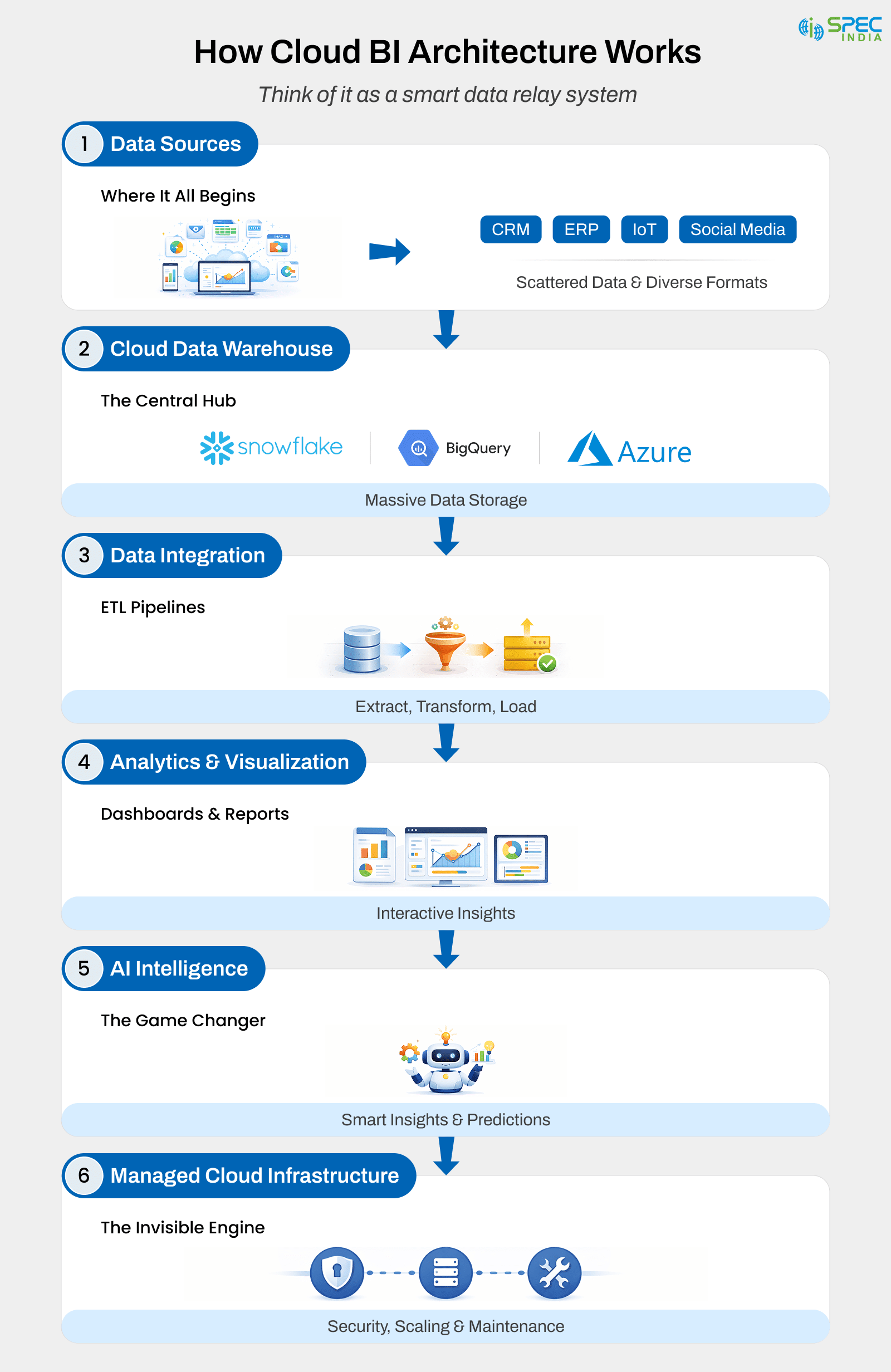
- It starts with your data sources. And honestly, this is where most organizations realize just how scattered their data is. Your CRM sitting in one corner, your ERP in another, marketing platforms, transactional databases, IoT sensors on the factory floor, social media feeds — all of it generating data constantly, rarely in the same format, rarely talking to each other. In a cloud BI setup, all these sources eventually feed into a central cloud data warehouse BI environment. Platforms like Snowflake, Google BigQuery, Amazon Redshift, and Azure Synapse do the heavy lifting here — storing massive volumes of data and making it available for fast querying without you having to manage a single physical server.
- Then comes the layer most people overlook — data integration. Raw data from a dozen different sources does not magically arrive clean and analysis-ready. ETL pipelines — Extract, Transform, Load — sit between your sources and your warehouse, doing the unglamorous work of pulling data in, reshaping it into consistent formats, and loading it somewhere useful. Many cloud BI platforms come with native connectors that handle a lot of this automatically, which is a genuine time-saver for teams that previously spent weeks just getting data into the right shape.
- Once the data is clean and centralized, the analytics and visualization layer takes over. This is the part your analysts and business users see and interact with every day. Cloud reporting tools, interactive dashboards, drag-and-drop report builders — this is where data visualization in cloud environments becomes a practical business tool rather than a technical concept. A sales manager can filter pipeline data by region without writing a single line of code. A finance team can build a live P&L view that refreshes every hour. The barrier between having a question and getting an answer gets remarkably thin.
- What is increasingly exciting — and genuinely useful — is the AI layer being woven into all of this. Modern AI-powered BI tools do not just display data; they actively help you understand it. They flag anomalies before you notice them, generate plain-language summaries of complex trends, and surface patterns that a human analyst might take days to find manually. The line between business intelligence and predictive analytics is blurring, and cloud platforms are largely responsible for that shift.
- Underneath all of this runs the managed cloud infrastructure — the part you rarely see but always depend on. Authentication, access control, uptime guarantees, automatic scaling, security patching — the cloud provider handles it all. For most teams, this invisible layer is one of the biggest value additions of the entire setup. Not because infrastructure is unimportant, but because it finally stops being your problem
Cloud BI vs Traditional BI: A Practical Comparison
If your organization has ever managed an on-premises BI setup, you know the pain points intimately. Hardware procurement cycles that drag on for months. Licensing costs that need three rounds of budget approval. Capacity planning that is either too conservative—leaving your analysts waiting —or wildly optimistic —leaving expensive servers sitting half-idle.
Cloud BI vs traditional BI is not a subtle debate. The operational differences are stark, and they show up in your costs, your timelines, and your team’s day-to-day experience.
Key Benefits of Cloud Business Intelligence
Adopting cloud business intelligence is not just an IT decision — it is a business strategy decision. Organizations that make the switch consistently report faster reporting cycles, lower infrastructure costs, and analyst teams that spend more time on actual analysis and less time waiting on systems. Whether you are a mid-sized company trying to compete with larger players or an enterprise looking to shed the weight of legacy infrastructure, the benefits of moving to cloud BI tend to show up quickly and compound over time. Here is a closer look at what makes it worth the shift.
- Cost efficiency – How much you can save is usually the first thing organizations notice. The shift from capital expenditure to operational expenditure frees up budget that was previously locked in hardware cycles. There is no upfront investment in servers, and maintenance costs collapse significantly.
- Speed of deployment – These two are another major advantage. Cloud-based business intelligence platforms can go from contract signing to a working dashboard in days or weeks, not months. This matters enormously for teams that need insights now, not after a procurement process.
- Accessibility – The accessibility sounds basic until you have worked somewhere that required a VPN, a specific laptop, and IT approval just to pull a report. When your BI lives in the cloud, your analyst in Bangalore, your sales lead in a client meeting, and your CFO checking numbers from an airport lounge are all looking at the same data in real time. No versions, no delays, no “I’ll send it when I’m back at my desk.”
- Scalability – It stops being a talking point the moment your team tries to run a complex query across three years of transaction data, and the platform does not flinch. Cloud data analytics infrastructure is built for exactly this — handling demand spikes, large datasets, and growing user bases without someone having to pre-provision anything or file a capacity request.
- Collaboration – The collaboration improves in ways that are hard to fully appreciate until you have experienced the alternative. No more “final_report_v3_ACTUAL_FINAL.xlsx” being emailed around. Everyone works from the same dashboards, the same datasets, the same definitions. When a number changes, it changes everywhere — and everyone sees it.
- Automatic updates – It might be the most quietly valuable benefit on this list. Business intelligence cloud service providers continuously push feature updates, security patches, and performance improvements. Your team wakes up to a better platform without anyone having to schedule a maintenance window or test a version upgrade over a weekend.
Real-World Use Cases
Cloud BI sounds compelling in theory. Where it gets interesting is in practice, because the industries using it are not all tech companies with unlimited engineering budgets. They are retailers, hospitals, manufacturers, and financial institutions solving very specific, very real problems.
- Retail and e-commerce – Here, teams were among the earliest to see the value. When you are running physical stores alongside an online channel and trying to manage a supply chain that spans multiple countries, having all of that data siloed is genuinely dangerous. Cloud-based BI brings it together into a single view. Data visualization services help merchandising teams see in real time which products are moving, which are sitting, and where inventory needs to move before a shelf goes empty on a busy weekend.
- Healthcare – It is an industry where slow reporting has consequences beyond missed revenue targets. Hospitals and healthcare networks use business intelligence in the cloud to track patient outcomes, monitor readmission rates, and allocate staff and resources more effectively across facilities — all while keeping patient data compliant with privacy regulations. A dashboard that flags rising readmission rates in a particular ward is not just a reporting tool; it is a prompt for clinical intervention.
- Financial services – These firms deal with transaction volumes that would have brought on-premises infrastructure to its knees a decade ago. Today, cloud BI lets risk and compliance teams run complex queries across millions of records in near real time — catching fraud patterns, flagging anomalies, and generating regulatory reports without a week-long data pull.
- Manufacturing – It is one of the more exciting use cases because of what happens when cloud BI connects to IoT sensor data from the production floor. Downtime tracking becomes predictive rather than reactive. Instead of discovering that a machine failed and calculating the cost after the fact, operations teams get early signals that something is likely to go wrong — and can act before production stops.
- Marketing teams – Across virtually every industry have a data problem that cloud BI solves well: too many channels, too many platforms, and no clear picture of what is working. Consolidating paid search, organic, email, and social data into a unified attribution model — and being able to slice it any way you want — changes how marketing budgets get allocated. Less guesswork, more evidence.
- SaaS companies – They are perhaps the most natural fit of all. When your product, your customers, and your entire operation already live in the cloud, using on-premises BI never made much sense. Business intelligence services built for SaaS help product and growth teams track engagement metrics, spot churn signals early, and understand revenue patterns at a granularity that informs decisions — not just slides in a board deck.
A Quick Note on Related Fields
People throw around terms like data science, business intelligence, and data analytics interchangeably — and while they are related, mixing them up can lead to the wrong hiring decisions, the wrong tool choices, and the wrong expectations.
Data science vs business intelligence comes down to this: BI tells you what happened and helps you understand why. It is structured, tied to known business questions, and lives in dashboards and reports. Data science goes a step further — it uses statistical models and machine learning to predict what will happen next and recommend how to respond. Both matter, both are valuable, but they require different skills and different tools. Cloud platforms are increasingly capable of supporting both under one roof, which is convenient, but the disciplines themselves remain distinct.
Business intelligence vs data analytics is a softer distinction. BI typically refers to formal, structured reporting built around recurring business questions. Data analytics is broader — it includes exploratory analysis, ad-hoc queries, and statistical deep dives that do not always fit neatly into a dashboard. Good cloud BI platforms accommodate both without forcing your team to choose.
Choosing the Right Cloud BI Partner
There is no shortage of business intelligence companies building cloud platforms right now, and the options can genuinely feel overwhelming. The truth is that there is no universally “best” platform — there is only the right fit for your specific situation.
A few questions worth sitting with before you commit: Does it connect natively to the data sources you already use, or will integration be a project in itself? How does it handle user permissions and row-level security — especially if sensitive data is involved? Is the pricing model transparent enough to predict your bill as usage grows? And does it support real-time data, or are you working with reports that refresh once a day?
These are not exciting questions, but getting them right up front saves a painful migration down the road.
Closing Thoughts
Moving to cloud business intelligence is not just a technology upgrade. It changes how your organization relates to its own data — how quickly people can get answers, how confident they feel acting on them, and how much time gets spent waiting versus deciding.
Organizations that approach this transition thoughtfully — picking the right architecture, choosing tools their teams will use, and building genuine data habits — tend to pull ahead of those still stuck in slow reporting cycles. The infrastructure has never been more accessible, the tools have never been more capable, and the cost of entry has never been lower.
If your organization is still on the fence, the real question is not whether to move to cloud BI. It is whether you can afford to keep waiting.

SPEC INDIA is your trusted partner for AI-driven software solutions, with proven expertise in digital transformation and innovative technology services. We deliver secure, reliable, and high-quality IT solutions to clients worldwide. As an ISO/IEC 27001:2022 certified company, we follow the highest standards for data security and quality. Our team applies proven project management methods, flexible engagement models, and modern infrastructure to deliver outstanding results. With skilled professionals and years of experience, we turn ideas into impactful solutions that drive business growth.
Table of contents
Delivering Digital Outcomes To Accelerate Growth
Let’s TalkTable of contents
Delivering Digital Outcomes To Accelerate Growth
Let’s Talk

Let’s get in touch!
India
SPEC House, Parth Complex, Near Swastik Cross Roads, Navarangpura, Ahmedabad 380009, INDIA.
-
 +91-79-26404031, 32-33-34
 -
 [email protected]