

Cloud Migration in Healthcare Without Data Exposure
March 11, 2026
The pressure on healthcare IT teams has reached a boiling point. Between the explosion of telehealth platforms and the endless stream of data from connected medical devices, traditional on-premise servers are simply gasping for air. These old-school systems were never built to handle the sheer volume or the speed required for modern interoperability. This is exactly why cloud migration in healthcare has moved from the “future project” list to an immediate operational must-have.
But moving the “brain” of a hospital isn’t like moving a standard office. The stakes are much higher. We’re talking about clinical histories and diagnostic reports, the kind of information that demands total privacy. A single slip-up during healthcare data migration doesn’t just mean a fine; it means a total collapse of patient trust. For leadership, the debate isn’t about whether they should move, but how to execute a healthcare cloud migration that keeps patient data security locked down tight.
The sector is also wrapped in a thick layer of regulatory compliance. Rules around data privacy in healthcare, audit trails, and encryption and access control make this transition much thornier than in any other industry. Moving to cloud-based healthcare systems requires a “security-by-design” mindset that satisfies regulators before the first byte of data even moves.
Why is Cloud Adoption Now Critical for Modern Healthcare Providers?
Modern care delivery is now a digital-first game. From AI consulting in healthcare to high-speed predictive analytics in healthcare, the infrastructure needs to be as agile as the doctors. Legacy data centers just can’t keep up, which is why we’re seeing a massive wave of healthcare cloud adoption across the board.
The drivers are impossible to ignore:
- EHR and imaging data are growing at an exponential rate.
- Patients now demand “anywhere, anytime” access to their records.
- Healthcare software development services are increasingly building tools that live exclusively in the cloud.
- The cost of “babysitting” old hardware is eating up budgets that should be spent on care.
Switching to cloud-based healthcare systems gives you the elasticity and redundancy you need, but it’s not a “set it and forget it” task. You have to balance the urge to modernize with the absolute obligation to protect the person behind the data.
What are the Most Common Security Risks During Data Migration?
Breaches usually don’t happen because the cloud itself is weak; they happen because the “bridge” between the old world and the new world has a hole in it. During healthcare data migration, we see four main danger zones:
- Data in Transit: If your encryption and access control protocols aren’t perfect while data is moving to the cloud, it’s like leaving an armored truck door unlocked.
- The “Open Door” Policy: Simple human errors in storage configuration can accidentally leave thousands of patient files exposed to the public internet.
- Identity Mess: If you don’t have a strict “who-can-see-what” policy, internal exposure risks skyrocket.
- The Third-Party Weak Link: Healthcare CRM development and billing integrations often use APIs. If those endpoints aren’t vetted, they become an open invitation for hackers.
How Do You Maintain Regulatory Compliance During a Cloud Move?
Cloud initiatives in this space are only as good as their regulatory compliance status. For those in the U.S., a HIPAA-compliant cloud migration is the gold standard. It’s a rigorous checklist that includes:
- High-level encryption for every single patient file.
- Constant monitoring and deep-dive audit logs.
- Signing a solid Business Associate Agreement (BAA) with your cloud provider.
This isn’t just a checklist; it’s the blueprint for healthcare cloud consulting. You have to embed these rules into the very architecture of your cloud migration for healthcare industry projects.
What Security Frameworks Best Protect Cloud-Based Healthcare Systems?
Building a security framework for cloud migration in healthcare isn’t about ticking boxes; it’s about building a digital fortress that doesn’t slow down the doctors. In a field where lives are literally on the line, you can’t afford a single “weak link.”
At the heart of any solid plan is a rigorous approach to encryption and access control. You have to treat data like it’s under constant threat, whether it’s sitting on a server or moving across the wire. This means managing your encryption keys like they are the crown jewels and sticking to “least-privilege” rules. If a staff member doesn’t need to see a file to do their job, they shouldn’t have the keys to the door.
We also advocate for a “Zero-Trust” mindset. In 2026, you can’t assume a request is safe just because it’s coming from inside the building. Every single login and data pull has to be verified. When you combine this with real-time monitoring and deep-dive audit logs, you’re not just following regulatory compliance; you’re building a culture of patient data security that can actually survive a modern cyber-attack.
And remember: your backup and disaster recovery plans are your ultimate safety net. Cloud adoption should make your hospital more resilient, not leave it vulnerable to a single point of failure.
What is the Safest Roadmap for a Phased Healthcare Cloud Migration?
If you try a “big bang” approach to healthcare cloud migration, you’re asking for a disaster. We’ve seen that the most successful healthcare technology trends favor a phased, risk-aware journey.
- The “Hard Truth” Audit: Before you move a single byte, you need a brutal risk assessment. Where is the PHI actually hiding? How does it flow through your healthcare CRM development tools?
- Sort the Critical from the Common: Not all data is created equal. A patient’s heart rate history needs a much higher level of protection than the cafeteria’s inventory list. Classifying your data allows you to apply the right encryption and access control without over-complicating the simple stuff.
- Build the Safe House: Your cloud architecture needs to be a “mirror” of your highest security standards, featuring encrypted channels and airtight storage.
- The Slow Roll: Migrate in waves. Start with non-critical apps, audit them, and then move to the heavy hitters. This is how you catch a misconfiguration before it becomes a headline.
- The Final Stress Test: Once you’re moved, you’re not done. You need penetration testing and compliance audits to prove that your HIPAA-compliant cloud migration actually holds water.
How Does a Specialized Consultant Help With Clinical Data Integration?
Let’s be real: general cloud guys are great, but they often don’t “speak” healthcare. They don’t understand how a clinical workflow can be derailed by a 2-second lag in data retrieval. This is where specialized healthcare cloud consulting earns its keep.
A healthcare-focused expert understands the “Grit” of the industry, the EHR integrations, the laboratory feeds, and the billing nightmares. They help you build an architecture that respects data privacy in healthcare while actually making the system faster for the clinicians. This kind of healthcare cloud migration services expertise ensures that your governance isn’t just a pile of paperwork, but a living part of your IT stack.
What Should You Look for in a Healthcare Cloud Migration Partner?
Choosing a partner for healthcare data migration is a high-stakes decision. You aren’t just looking for an engineer; you’re looking for a guardian of patient trust. A generic provider might know how to move a database, but do they understand the nuances of digital transformation trends in healthcare?
The right partner, often one rooted in healthcare software development services, will align your infrastructure with your clinical goals. They won’t just “move” your CRM; they’ll optimize your healthcare CRM development for better patient engagement. They’ll ensure your stack is ready for AI consulting in healthcare and predictive analytics in healthcare down the road.
Ultimately, cloud migration for healthcare industry projects is about one thing: modernizing securely. You want a partner who treats your regulatory compliance as a floor, not a ceiling, and who understands that in this industry, data security is synonymous with patient care.
How Does the Cloud Drive Future Innovation in Medical Technology?
Let’s be clear: a secure approach to healthcare cloud adoption isn’t just about cleaning up your IT basement. It’s about building a launchpad. When you get a cloud migration for a healthcare industry project right, you aren’t just modernizing, you’re opening the door to things that were technically impossible on old-school servers.
Think about the high-level stuff. We’re talking about a world where predictive analytics in healthcare actually helps you get ahead of patient crises before they happen. We’re talking about AI consulting in healthcare that feels like a native part of your workflow, not a bolted-on experiment. A solid, HIPAA-compliant cloud migration gives you the “digital muscles” to scale telehealth overnight, share data across provider networks without a hitch, and finally make interoperability more than just a buzzword. It’s about moving from “keeping the lights on” to leading the charge in healthcare technology trends.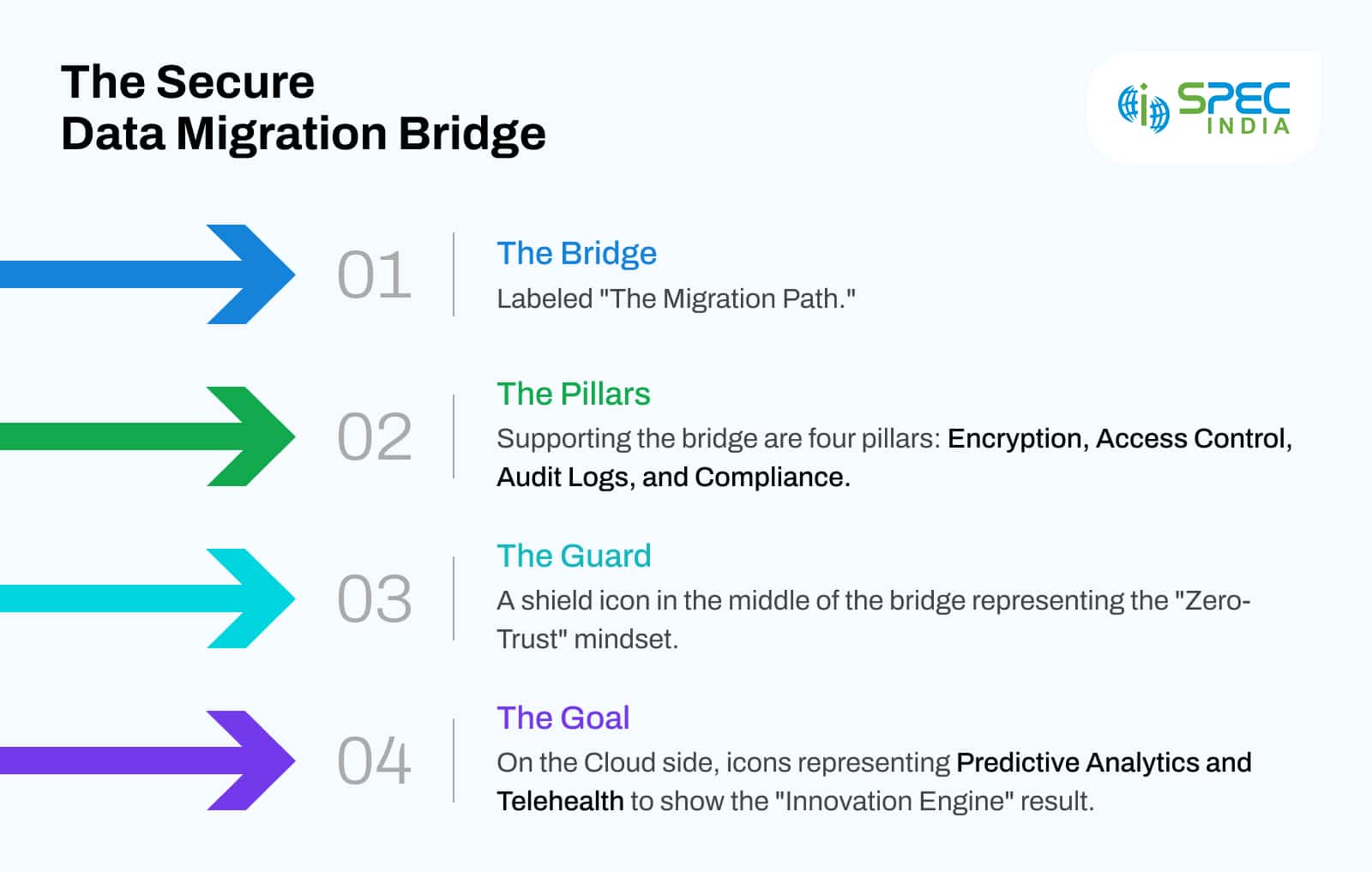
Conclusion: Is Your Healthcare Cloud Strategy Focused on Long-Term Security?
Healthcare leaders are past the point where they can wait out the modernization wave. Between the mountain of incoming patient data and the tightening grip of regulatory compliance, legacy hardware is fast becoming a liability. But jumping into a healthcare cloud migration without a battle-tested security plan is like performing surgery without a sterilized room; the risks will almost certainly swallow the rewards.
Successful cloud migration in healthcare isn’t about just picking a vendor and hitting “upload.” It’s about a precise, layered strategy where patient data security is the baseline, not an afterthought. You need a framework where encryption and access control are built into the very DNA of your cloud-based healthcare systems. This is the only way to ensure that as you move, store, and process sensitive files, you aren’t leaving a trail of breadcrumbs for hackers.
When you prioritize security architecture and a phased roadmap, you aren’t just moving files; you’re building a fortress. This is where specialized healthcare cloud consulting and healthcare software development services earn their keep; they help you bridge the gap between “going live” and “staying secure.”
In the end, the goal isn’t just to be “in the cloud.” It’s about a secure, compliant, and actually sustainable digital transformation trend in healthcare. With a solid roadmap and the right specialized expertise, healthcare cloud migration services transform your infrastructure from a maintenance headache into your biggest strategic advantage. You protect the data, you preserve the trust, and you finally free your team to focus on what matters most: the patient.
Frequently Asked Questions
You don't just "flip a switch," it requires a "security-by-design" approach. Lock down encryption and access control before moving a single byte, and run constant risk assessments. It's about building a digital fortress where every access point is monitored 24/7 during your cloud migration in healthcare.
The cloud isn’t compliant by default; you make it that way. For a HIPAA-compliant cloud migration, you need a solid BAA, rigorous audit trails, and "least-privilege" access. Compliance is a living, breathing process, not a one-time "check-the-box" exercise.
Everything is a high-value target: EHRs, diagnostic images, and clinical notes. Any piece of data that can be traced to a person, known as PHI, demands maximum protection during healthcare data migration to prevent a total collapse of patient trust.
The biggest danger is human error, like misconfigured storage or unsecured APIs. Without a team that understands healthcare cloud consulting, these small cracks can turn into a regulatory and reputational nightmare for cloud migration in healthcare projects.
You need a "Zero-Trust" mindset: multi-factor authentication, ironclad encryption and access control, and continuous logging. These aren't just IT suggestions; they are the foundational walls that protect data privacy in healthcare.
Moving to cloud-based healthcare systems lets you scale telehealth instantly and run predictive analytics in healthcare to save lives. It gives you "digital muscles," allowing you to focus on the patient instead of babysitting a server room.

SPEC INDIA is your trusted partner for AI-driven software solutions, with proven expertise in digital transformation and innovative technology services. We deliver secure, reliable, and high-quality IT solutions to clients worldwide. As an ISO/IEC 27001:2022 certified company, we follow the highest standards for data security and quality. Our team applies proven project management methods, flexible engagement models, and modern infrastructure to deliver outstanding results. With skilled professionals and years of experience, we turn ideas into impactful solutions that drive business growth.
Table of contents
Delivering Digital Outcomes To Accelerate Growth
Let’s TalkTable of contents
Delivering Digital Outcomes To Accelerate Growth
Let’s Talk

Let’s get in touch!
India
SPEC House, Parth Complex, Near Swastik Cross Roads, Navarangpura, Ahmedabad 380009, INDIA.
-
 +91-79-26404031, 32-33-34
 -
 [email protected]