| Architecture Model | What It Is | When to Use It |
|---|---|---|
| Hybrid Cloud | Mixing your own servers with cloud services | When you need to move old systems slowly |
| Multi-Cloud | Using several cloud providers at once | When you want to avoid being locked into one vendor |
| Cloud-Native | Apps built specifically for the cloud | For modern platforms that need to scale fast |


Loading...
Cloud Migration Strategy for Sydney-Based Enterprises with Legacy Systems
Posted
April 6, 2026
Category Cloud
Many Sydney-based enterprises are still tethered to IT setups built for a different era. These legacy systems in manufacturing, retail, and healthcare think that aging ERPs and specialized operational tools were never meant for the internet age. While they’ve kept the lights on for years, they’re now hitting a wall when it comes to things like AI or real-time data crunching.
The problem is that these “workhorses” just aren’t flexible enough for today’s market. This is driving a massive push for a smarter cloud migration strategy. Instead of a risky “rip and replace” of everything at once, local enterprises are choosing to migrate to cloud platforms to gain the speed and power they’ve been missing, without disrupting their core business.
Sydney isn’t alone in this, but the pressure here is unique. As we move deeper into a digital-first economy, the goal for any local business is clear: Modernize the foundation without losing the reliability that took decades to build. We’re moving toward a future where cloud transformation isn’t just a project, it’s the new baseline for staying relevant.
Why Sydney-Based Enterprises Are Accelerating Cloud Migration
The rush to the cloud across Sydney isn’t just about following a trend; it’s about survival in a city where operational costs and competition are notoriously high.
Increasing Demand for Scalable Infrastructure
Traditional servers just can’t keep up with the data explosion. By embracing enterprise cloud migration, Sydney businesses can ditch the heavy hardware and scale their power up or down instantly. It’s about being lean and only paying for what you actually use.
Data-Driven Decision Making
Cloud platforms offer the heavy-duty computing needed to actually use your data. Through cloud transformation, you can finally hook your old records into modern analytics to see what’s actually happening in your business, rather than guessing.
Supporting Enterprise Digital Transformation
Moving your enterprise systems to the cloud opens the door to better teamwork and faster innovation. It’s a pathway to enterprise system modernization that lets you focus on growth instead of babysitting a server room.
Key Challenges in Migrating Legacy Systems to the Cloud
Let’s be honest: moving old tech to the cloud is a headache if you don’t have a plan. It’s a delicate balancing act to ensure the transition doesn’t shut down your operations.
Migrating Mission-Critical Systems
Most legacy apps are mission-critical systems; if they go down, the business stops. Migrating mission-critical systems takes more than a “lift and shift”; it requires deep testing and a safety-first mindset to ensure they run just as well (or better) in the cloud.
Compatibility with Modern Cloud Architectures
Older apps weren’t built for the cloud’s architecture. During enterprise application migration, you’ll often find that the old code and new cloud environments speak different languages. You might need to add “bridge” layers or retool the app entirely to make it work.
Security, Compliance, and Data Governance
Security is the biggest hurdle. A solid cloud data migration strategy has to prioritize data protection and local compliance from day one. You need ironclad encryption and strict access controls to ensure your data stays secure and your business stays on the right side of Australian regulations throughout the move.
Cloud Migration Strategy Framework for Enterprises
A successful cloud migration strategy isn’t something you can just wing. You can’t just pick up an app and drop it into a new environment without understanding how it’s wired. Without a solid plan, you’re looking at broken connections and unexpected downtime.
A structured framework is what keeps the lights on while you handle the heavy lifting of an enterprise cloud migration. It’s about knowing exactly what you’re moving and why, so the business doesn’t skip a beat.
Assessing Existing IT Infrastructure
The first move is taking a hard, honest look at what you’ve already got. You need to map out every app, database, and server to see how they lean on each other. This isn’t just a list; it’s about figuring out:
- Which old apps are actually worth modernizing as a legacy system?
- Which mission-critical systems need a “white glove” move to stay safe?
- How your data actually flows between different departments.
Once you have this map, you can build a cloud data migration strategy that actually makes sense for your specific business goals.
Defining a Cloud Migration Roadmap
After the audit, you need a timeline. You can’t move everything at once, so you have to prioritize. A smart roadmap prioritizes the “quick wins” to build momentum, sets clear deadlines, and includes a plan for when things go sideways. Moving in phases is the best way to migrate to cloud setups without causing a total company blackout.
Choosing the Right Cloud Platform
Picking your provider is a major fork in the road. Each of the big players has a different “flavor” that might suit your tech better than others.
- You might look at AWS migration services if you need massive, proven scale.
- Or Azure cloud migration services if you’re already deep in the Microsoft ecosystem and need tight enterprise system integration.
- Some choose a Google Cloud migration strategy when their future is all about heavy data crunching and AI. The right choice depends on where you want your business to be in five years, not just where it is today.
Designing Integration and Data Migration Plans
The reality is that even after you move, your new cloud tools will still need to “talk” to the stuff you left behind. This is where API system integration and middleware come in. You need to build digital bridges so your data continues to flow smoothly between your new cloud home and your remaining internal systems.
Cloud Migration Approaches for Legacy Enterprise Systems
There’s no “one-size-fits-all” way to move an old system. You have to choose your battle based on how much time and money you want to invest in the change.
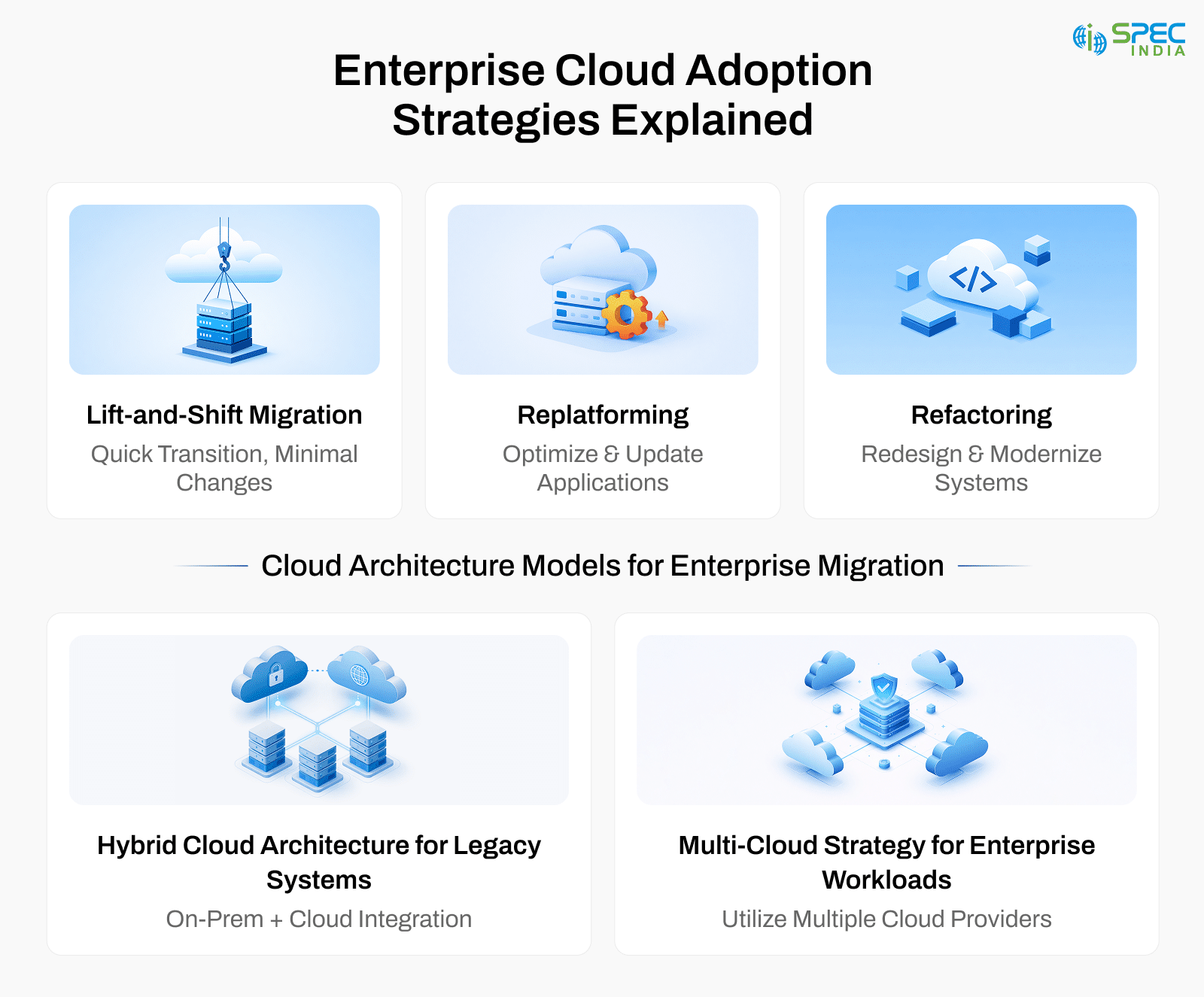
Lift-and-Shift Migration
This is the “moving truck” approach. You take the app exactly as it is and drop it into the cloud. It’s the fastest way to migrate to the cloud, and it works well for apps that are already stable but just need more room to breathe. The downside? You aren’t necessarily making the app “smarter,” just changing its address.
Re-Platforming
Think of this as a “tweak and move.” You aren’t rebuilding the whole thing, but you’re making enough changes so the app can use cloud-native features like auto-scaling. It’s a middle ground for an enterprise application migration where you want better performance without a massive rewrite.
Refactoring and Application Modernization
This is the most intense path. You’re essentially taking the engine apart and rebuilding it for a modern world. It usually involves breaking down a giant, clunky system into smaller, faster pieces. It’s a bigger investment, but it’s the only true way to achieve enterprise system modernization and fully unlock the cloud’s potential.
Cloud Architecture Models for Enterprise Migration
Picking the right architecture is a massive part of any cloud migration strategy. Once you’ve figured out how to move your apps, you have to decide how the whole environment will actually be built. It’s not just about storage; it’s about making sure your setup is fast, secure, and ready to grow when you are.
The right model lets you manage risk while making your cloud transformation as smooth as possible.
Hybrid Cloud Architecture for Legacy Systems
A hybrid setup is essentially a “best of both worlds” approach. You keep some of your gear in your own office while moving other parts to the cloud. This is a lifesaver for migrating a legacy system to the cloud because it doesn’t force you to change everything at once.
- Keep the sensitive stuff close: You can hold onto your regulated data on your own servers.
- Move at your own pace: You can slowly transition your enterprise applications without breaking them.
- Lower the stakes: You aren’t gambling the whole business on a single weekend move.
For many Sydney firms, this is the most realistic way to migrate enterprise systems to the cloud without the “all-or-nothing” stress.
Multi-Cloud Strategy for Enterprise Workloads
A multi-cloud plan means you aren’t putting all your eggs in one basket. Instead of sticking with just one provider, you use a few. You might use one for your basic servers and another for high-end data tools or AI.
- Better Safety Net: If one provider has a bad day, your whole business doesn’t go dark.
- Pick and Choose: You can grab the best tools from each provider rather than settling for “average” across the board.
- No Vendor Trap: You aren’t stuck with one company’s price hikes or technical limits.
This is becoming the go-to for serious enterprise cloud migration projects where staying flexible is the top priority.
Comparison of Cloud Architecture Models
Every model has its place in a cloud transformation journey. The key is to pick the one that fits your current reality while leaving the door open to where you want to be in five years.
Benefits of Cloud Migration for Sydney Enterprises
Building a solid cloud migration strategy isn’t just about moving files; it’s about giving your business the room to breathe and grow.
Improved Scalability and Performance
Traditional servers are a trap when your data starts to explode. With enterprise cloud migration, you can turn up your computing power the second you need it. It’s about having a system that keeps up with your growth without forcing you to write a massive check for new hardware every six months.
Enhanced Security and Compliance
Big cloud players spend billions on security, so you don’t have to. By moving to cloud-based enterprise systems, you’re getting built-in encryption and 24/7 monitoring that’s often far more advanced than what most companies can manage on-site.
Cost Optimization and Operational Efficiency
Managing your own gear is a massive “time tax.” Moving to the cloud shifts that burden to the providers. This cloud transformation lets your team stop fixing broken fans and start focusing on the projects that actually move the needle for the business.
Cloud Compliance and Data Regulations for Australian Enterprises
If you’re building a cloud migration strategy for a business in Sydney, you can’t just think about the tech; you have to think about the rules. While moving to the cloud is a huge win for how you work, it also means you’re responsible for keeping sensitive customer and business data safe during every step of the journey.
Australia doesn’t mess around when it comes to privacy and security. These legal frameworks aren’t just suggestions; they are the boundaries for any cloud migration in an enterprise systems project.
Data Residency and Privacy Regulations in Australia
For any local business handling personal info, the Privacy Act and the Australian Privacy Principles (APPs) are the big ones to watch. They dictate exactly how you’re allowed to collect and store data.
When you decide to migrate to cloud platforms, you need to be 100% sure your provider has the right controls in place. For many industries here, that means the data must stay on Australian soil. Most reputable teams offering cloud migration services in Sydney use local data centers specifically to help you check these boxes while still giving you the power and scale of the cloud.
Security Requirements for Enterprise Cloud Platforms
Security is the biggest “what-if” in any enterprise cloud migration. You aren’t just moving files; you’re moving the engine of your business. That requires a setup that protects both the data and the digital walls around it.
When you’re looking at different platforms, you need to look for the “must-haves”:
- Heavy-duty encryption for data, whether it’s sitting still or moving.
- Strict “least-privilege” access so only the right people can see the data.
- Constant, automated monitoring to catch threats before they become breaches.
Having these in place ensures your security stays tight even as you leave your old office servers behind.
Compliance Planning During Enterprise Cloud Migration
You can’t treat compliance as an afterthought. It has to be baked into your plan from day one. You need a clear set of rules for who can see what and how that data is audited.
A smart plan usually covers:
- Deciding which data is most sensitive and needs the most protection.
- Setting up ironclad rules for who can log into your enterprise applications.
- Keeping a digital paper trail so you’re always ready for an audit.
By making these rules part of your enterprise cloud data migration strategy, you ensure that your upgrade doesn’t accidentally land you in legal hot water. For Sydney firms, it’s all about finding that balance using an IT infrastructure transformation to move faster, while keeping your data protection standards as high as they’ve ever been.
For a deeper perspective, refer to CIO’s Guide to Enterprise Cloud Migration Strategy, designed to help CIOs and enterprise leaders navigate secure and compliant cloud transitions.
Choosing the Right Cloud Migration Partner
Let’s be honest: moving a decades-old system to the cloud is a high-stakes job. You can’t just wing it. Migrating mission-critical systems, the ones your business literally can’t live without, demands a level of expertise that most internal teams just don’t have.
Expertise in Legacy System Modernization
Most legacy apps are deeply tangled in how you do business. A partner who knows the ins and outs of legacy system modernization can tell you whether an app should be moved as-is or if it needs a total rebuild to work in the cloud.
Designing Secure and Scalable Migration Architectures
You need an architecture that doesn’t just work, but stays locked down. Whether you’re leaning on AWS migration services, looking at Azure cloud migration services, or following a Google Cloud migration strategy, an expert partner ensures your data stays protected and your systems stay up.
Supporting Enterprise Cloud Transformation
It’s about the long game. Partners like SPEC India act as a bridge for cloud migration services in Sydney, helping you navigate the mess of API system integration and infrastructure planning. Having that outside perspective helps you sidestep common pitfalls and reach a modern setup much faster.
Move Beyond Legacy Limits
Outdated systems slow you down more than you realize. Migrate to the cloud with a clear strategy, stronger security, and the flexibility to scale as your business grows.
Conclusion
For plenty of Sydney businesses, those old-school servers and “dinosaur” databases are still the backbone of the daily grind. Whether you’re in retail, healthcare, or logistics, these legacy systems in manufacturing and beyond are doing the heavy lifting. But let’s be real: as we move toward a more digital world, the cracks in that old infrastructure are starting to show.
Building a solid cloud migration strategy is the way to bridge that gap. It’s not about throwing away what works; it’s about giving your business the room it needs to breathe and grow. When you migrate to cloud platforms properly, you stop fighting with hardware and start using your data to actually move the needle.
Success here isn’t just about the tech, it’s about the plan. By picking the right migration path and a partner who knows the local landscape, you can handle a massive enterprise cloud migration without the “all-or-nothing” risk. It’s the only way to build a resilient, modern business that’s ready for whatever comes next.
Frequently Asked Questions
It’s basically your battle plan. It’s a step-by-step guide for moving your apps and data from your own office servers to the cloud without breaking anything or losing your mind in the process.
You have options. You can "Lift-and-Shift" (move it as-is), "Replatform" (tweak it slightly), or "Refactor" (rebuild it from scratch). It all depends on how old the system is and how much you want it to do once it's in the cloud.
The main worries are usually downtime, data loss during the move, or discovering your old software won't talk to the new cloud home. That’s why migrating mission-critical systems requires so much testing before you flip the switch. For a more detailed breakdown, refer to Cloud Migration Risks and How Enterprises Can Mitigate Them, which outlines practical ways enterprises can identify and reduce these risks effectively.
It depends on what you need. You might look at AWS migration services for pure scale, Azure cloud migration services if you love Microsoft tools, or a Google Cloud migration strategy if you're all about big data and AI.
There’s no "quick fix" here. Depending on how much data you have and how messy your old systems are, a solid enterprise cloud migration can take anywhere from a few months to over a year.

SPEC INDIA is your trusted partner for AI-driven software solutions, with proven expertise in digital transformation and innovative technology services. We deliver secure, reliable, and high-quality IT solutions to clients worldwide. As an ISO/IEC 27001:2022 certified company, we follow the highest standards for data security and quality. Our team applies proven project management methods, flexible engagement models, and modern infrastructure to deliver outstanding results. With skilled professionals and years of experience, we turn ideas into impactful solutions that drive business growth.
Table of contents
- Why Sydney-Based Enterprises Are Accelerating Cloud Migration
- Key Challenges in Migrating Legacy Systems to the Cloud
- Cloud Migration Strategy Framework for Enterprises
- Cloud Migration Approaches for Legacy Enterprise Systems
- Comparison of Cloud Architecture Models
- Benefits of Cloud Migration for Sydney Enterprises
- Cloud Compliance and Data Regulations for Australian Enterprises
- Choosing the Right Cloud Migration Partner
- Conclusion
Delivering Digital Outcomes To Accelerate Growth
Let’s TalkTable of contents
- Why Sydney-Based Enterprises Are Accelerating Cloud Migration
- Key Challenges in Migrating Legacy Systems to the Cloud
- Cloud Migration Strategy Framework for Enterprises
- Cloud Migration Approaches for Legacy Enterprise Systems
- Comparison of Cloud Architecture Models
- Benefits of Cloud Migration for Sydney Enterprises
- Cloud Compliance and Data Regulations for Australian Enterprises
- Choosing the Right Cloud Migration Partner
- Conclusion
Delivering Digital Outcomes To Accelerate Growth
Let’s Talk
Let’s get in touch!
India
SPEC House, Parth Complex, Near Swastik Cross Roads, Navarangpura, Ahmedabad 380009, INDIA.
-
 +91-79-26404031, 32-33-34
 -
 [email protected]