

Cloud-Based Logistics Software: Benefits, Architecture, and ROI
February 20, 2026
Late deliveries, Missing shipments, Inventory that appears good on paper, but is not really there.
This is not a one-time problem for most logistics crews, but the order of the day. Managers waste hours seeking updates, reconciling various systems, and acting on customer complaints that might have been prevented. When a problem has become noticeable, it is already losing time, money, and trust.
That’s where the shift begins.
The operation of the logistics teams is being transformed by cloud-based logistics software, driving digital transformation in logistics. Businesses can no longer wait to respond to issues once they occur, but can now actually view what is occurring in warehouses, vehicles, and shipments in real-time. Decision-making is quicker, data is regular, and teams are always on track without long calls and spreadsheets.
With an increasing number of logistics companies switching to the cloud, the industry is abandoning firefighting mode and entering proactive management. Your whole supply chain, inventory to last-mile delivery, is all available on a single dashboard on your laptop or phone, no matter where you are. No guesswork. No delays in information. Just clarity and control.
And that is the actual strength of logistics and supply chain software. In this blog, we will discuss the benefits, architecture, and ROIs.
Let’s start by understanding what cloud-based logistics software is.
What Exactly is Cloud-Based Logistics Software?
Cloud-based logistics software is a system that assists businesses in the online management of their logistics work. All data is stored on the cloud rather than on local computers or local servers in the office. This implies that you can have access to your warehouse information, shipping information, and delivery updates 24/7, regardless of location.
Cloud software means you do not have to install complex systems or maintain hardware. There’s no heavy IT setup. The system will automatically update itself, and it will expand with the expansion of your business.
The other major advantage is that it can be easily integrated with other applications, such as ERP systems, logistics and supply chain software, or accounting systems. Your information is all at a single location, and it is up to date for everybody.
In simple words, cloud-based logistics software is a control panel for your logistics processes.
It shows you what’s happening right now, helps you act faster, and reduces mistakes before they turn into bigger problems.
The Real Benefits of Choosing Cloud-Based Logistics Solutions
The cloud migration is not merely technical, but rather about overcoming the common logistical issues that should be remedied. The companies are faced with a lack of visibility, high cost, slowness of decision-making, and siloed working teams. Cloud-based logistics software helps in dealing with these issues by consolidating all of them in a single location. It makes things easy, enhances control, and allows teams to work smarter rather than harder. The following are just a few of the actual, tangible advantages of cloud-based logistics software that businesses enjoy once they take their logistics functions to the cloud.
See Everything, Anytime
Lack of knowledge on what is happening at this moment is one of the largest issues in logistics. That is different from logistics software that is implemented on the cloud. You are able to track your deliveries, inventory levels, and goods coming in and out- live. The real-time view assists you in catching problems early. Delays in delivery or stock shortages are immediately known, and you can intervene before customers get involved.
Cut Costs Without Cutting Corners
Conventional logistics systems tend to be expensive to maintain, which includes servers, hardware, IT staff, and maintenance. Most of that load is eliminated by cloud software. You do not have to pay money for specialized equipment or be concerned about system upgrades. It is just a matter of paying as you consume. This simplifies the budgeting process and saves businesses the hassles of having to save money without sacrificing performance or quality.
Grow and Adapt Fast
The need in logistics is dynamic. When there are peak seasons or unexpected growth in orders, cloud systems can easily support the additional load. New systems do not need to be installed, nor does hardware have to be upgraded. Logistics and shipping management software also integrates well with other such tools as cloud logistics ERP, CRM, and tracking devices, thus ensuring that your operations remain agile and open to change.
Teams That Actually Collaborate
In most logistics teams, data and information are used inconsistently and are often outdated. Cloud software corrects this by storing all these in a single location. All the warehouse staff, drivers and managers are updated on the same updates in real time. This minimizes confusion, enhances coordination and enables teams to work together more effectively.
Safe and Sound
Cloud providers are serious about data security in logistics. Strong security controls, such as encryption, backups, and access controls, are in place to protect your data. Your information is safe and recoverable even in case something goes wrong. At SPEC specifically take care of security with our own AI infrastructure set up, which means you don’t have to rely on any other cloud. Your data will be totally safe on our own servers. This gives businesses peace of mind and helps meet compliance requirements.
How Cloud Logistics Software Architecture Works?
Logistics software in the clouds is designed to ensure that everything is linked and operates efficiently. Whether it is warehouses, vehicles, managers, or customers, the system makes sure that data flows in real time without delays and confusion. This architecture eliminates manual operations, minimizes failure, and provides teams with an overview of daily operations.
Here are some of the Key components of cloud logistics software architecture:
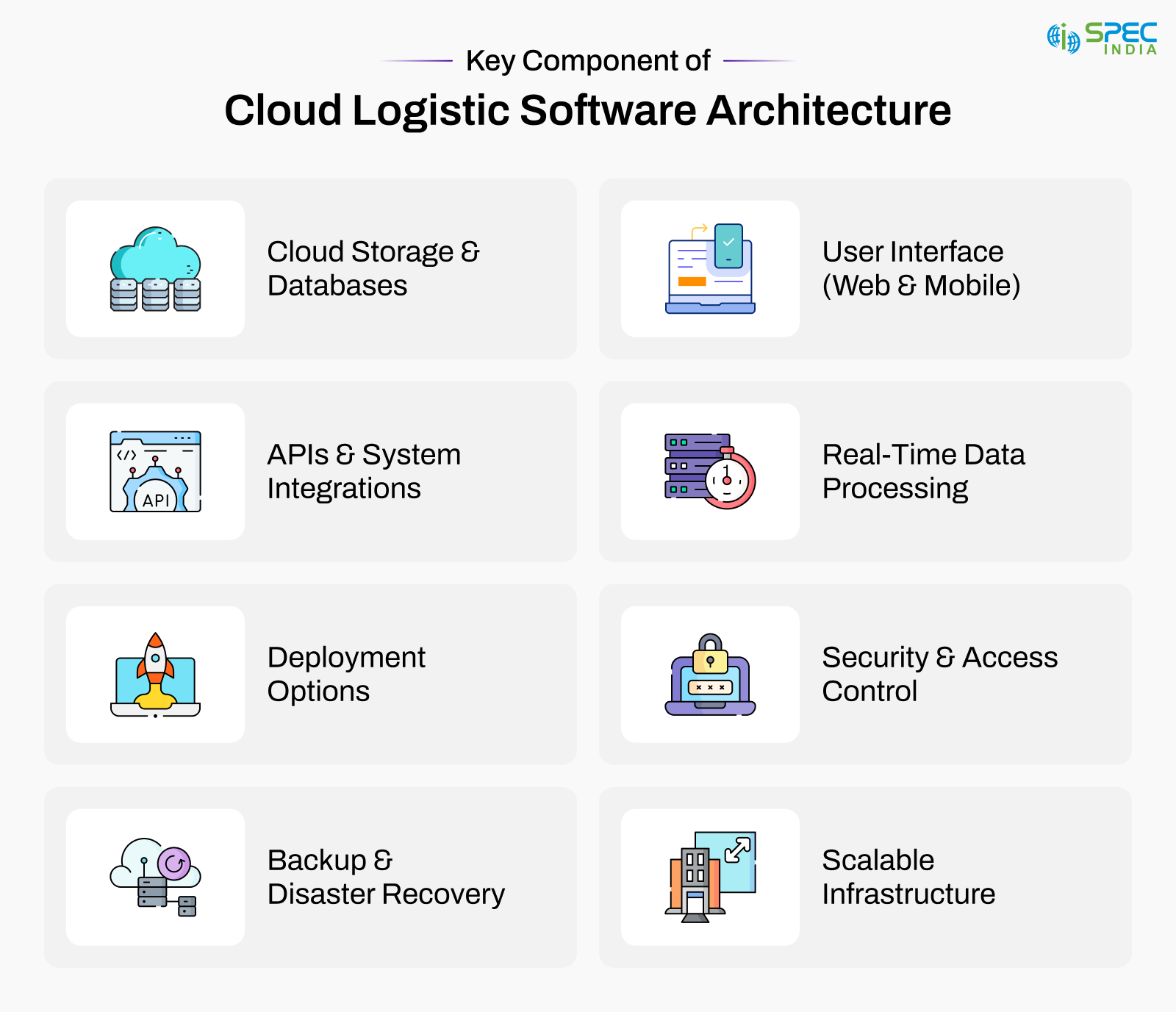
Cloud Storage & Databases
The cloud holds all the logistics information such as inventory, shipment, and delivery data, invoices and reports. This information is constantly updated and accessible to the right individuals whenever they want.
User Interface (Web & Mobile)
The software has easy-to-use dashboards via web browsers or mobile apps. The managers can monitor the performance, the warehouse teams can update the stock, and the drivers can inform the field about the delivery status.
APIs & System Integrations
Cloud logistics software will be linked to ERP, WMS, TMS, accounting, and IoT systems such as GPS tracking and a barcode scanner, for seamless logistics data integration. This ensures that systems are synchronized and that duplicate data entry is eliminated.
Real-Time Data Processing
The moment a shipment is shipped or an order is placed, the scalable logistics systems update automatically. This assists the teams with responding to events more quickly and preventing delays or stockouts.
Deployment Options
Depending on the security and compliance requirements, businesses can select a public cloud to be flexible, a private cloud to have more control, or a hybrid cloud to have both.
Security & Access Control
Encryption and role-based access are used to safeguard data. Sensitive information can be only viewed and updated only by the right individuals.
Backup & Disaster Recovery
Backups will also help in ensuring that, in case anything should go wrong, data will be restored in the quickest time possible, and operations will still go on without causing any significant disturbance.
Scalable Infrastructure
The system will automatically address the load increase as the order volume increases without slackening or hardware upgrades, making it ideal for cloud logistics software for multi-location warehouses that need to scale smoothly across locations.
Measuring the Impact: ROI You Can Actually See
Moving to cloud-based logistics software is not just about using modern technology—it’s about seeing real business results. The ROI of cloud logistics software can be clearly seen in daily operations, cost control, and customer service. Instead of waiting months to feel the impact, many businesses start noticing improvements within a short time.
Where the ROI comes from:
Cost Savings
Cloud-based logistics software eliminates the use of costly servers, hardware, and maintenance of the system. There are automatic software updates, and the cost of IT is much less. Businesses pay only for what they use, which also helps control the expenses.
Efficiency Gains
The processes are quicker and more precise. Processing of orders is made faster, deliveries are planned better, and the level of inventory is easier to manage, especially with smooth WMS and logistics integration. This minimizes mistakes, time wastage, and rework.
Customer Satisfaction
Customers receive real-time information about their deliveries and orders. Open communication creates trust and decreases complaints, resulting in improved customer relations and repeat business.
Data-Driven Decisions
Reports and analytics are available on a cloud-based logistics platform to help businesses learn about performance. Real data will allow the teams to detect slow routes, minimize wastage of inventory, and enhance overall operation.
According to McKinsey report; one mid-sized logistics firm saved 20% on its operations and 30% on its delivery efficiency in only six months of going to a cloud-based system. Through this, the logistics software ROI is reflected not only in the saved costs, but also in the improved workflow, the happier team, and more satisfied customers.
Things to Keep in Mind
Understanding why logistics companies move to cloud software is important, but a successful transition also requires proper planning. Every business already has existing systems, daily processes, and teams that need time to adapt. Being aware of possible challenges early helps avoid disruptions and makes the move to the cloud much smoother.
Key considerations before moving to the cloud:
Migration Can Take Time
The transition of data and processes to the cloud should be planned. Training may also be required to enable the teams to use the new system with confidence.
Data Privacy and Compliance
Logistics data is sensitive. You should consider using a cloud that adheres to the industry security standards as well as secures your information appropriately.
Internet Connectivity is Essential
Cloud systems are operated online; therefore, a stable and good internet connection is useful for real-time monitoring and updates.
By seeing these factors at the outset, businesses can ease their transition to cloud logistics software and reap the greatest benefits of their investments with the right logistics software development services.
Wrapping Up: Why Cloud Is the Future of Logistics
The cloud logistics software is not a technological improvement, but a total revolution in the way companies are supposed to run their supply chains. The cloud can make logistics smarter, easier, and more efficient in terms of delivered goods in real-time, quicker deliveries, and better cooperation among teams. Organizations that have implemented logistics ERP solutions can respond more quickly to market changes, minimize errors, and deliver a better client experience.
The future of logistics is obviously in the cloud. Those who adopt this change today will be the ones who will pioneer tomorrow, efficient, nimble, and customer-centered businesses.
Ready to transform your logistics operations?
Explore our Cloud-Based Logistics Solutions to see how we help businesses streamline supply chains, improve efficiency, and maximize ROI.
Frequently Asked Questions
Cloud architecture assists the logistics platforms in operating more easily and swiftly. It keeps all information under a single location, and it is updated on the fly. This implies that teams can monitor shipments and inventory control, and address problems without delay. Scalability is also simpler, and hence the system is able to accommodate additional orders or users without the need of new equipment.
Yes, cloud-based logistics software is designed with strong security measures. Data encryption, access controls, frequent backup, and standards of compliance are used by most cloud providers to safeguard information. Cloud security is in most instances, more powerful than traditional on-premise systems since it is continuously updated and monitored.
ROI can be calculated by logistics companies based on cost savings, efficiency increase, and customer satisfaction. The lower costs of IT, fewer mistakes, quicker deliveries, and inventory management are all gains that can be measured. With time, these enhancements translate into reduced cost of operation and an increase in revenue.
Yes, cloud logistics software is built to integrate easily with systems like ERP, WMS, TMS, and other business tools. These incorporations enable the data to automatically move through systems, lessen manual tasks, and make everyone operate with the current information.

SPEC INDIA is your trusted partner for AI-driven software solutions, with proven expertise in digital transformation and innovative technology services. We deliver secure, reliable, and high-quality IT solutions to clients worldwide. As an ISO/IEC 27001:2022 certified company, we follow the highest standards for data security and quality. Our team applies proven project management methods, flexible engagement models, and modern infrastructure to deliver outstanding results. With skilled professionals and years of experience, we turn ideas into impactful solutions that drive business growth.
Table of contents
Delivering Digital Outcomes To Accelerate Growth
Let’s TalkTable of contents
Delivering Digital Outcomes To Accelerate Growth
Let’s Talk
Let’s get in touch!
India
SPEC House, Parth Complex, Near Swastik Cross Roads, Navarangpura, Ahmedabad 380009, INDIA.
-
 +91-79-26404031, 32-33-34
 -
 [email protected]