

Enterprise Data Warehouse Modernization: When and Why to Move to the Cloud
January 30, 2026
When dashboards take minutes to load, and reports reflect yesterday’s reality, leadership teams are forced to make high-stakes decisions without real-time visibility. This is not just an IT concern—it is a clear business warning sign that a conventional data warehouse is no longer keeping pace with the organization’s needs.
The magnitude of the threat is increasing at a high rate. By 2025, the global data volume is estimated to hit 175 zettabytes, almost three times the volume that companies were handling a few years back.
But with all this data explosion, knowledge is frustratingly slow. According to the Salesforce State of Data & Analytics Report, 63% of business leaders believe their organizations are unable to use data effectively to make decisions, and most of them acknowledge that they cannot quickly make and act on the insights they have.
The issue is not the absence of information, but the infrastructure of the same—making data warehouse modernization critical for enterprises. Old enterprise data warehouses were meant to support a fixed reporting, predictable workload, and structured data, and slow enterprise reporting hinder day to day operations. The current business environment requires prompt analytics, readiness to work with a wide range of data, AI preparedness, and self-service among teams. Conventional EDWs were simply not designed with this amount of speed, scale, and complexity.
With the increase in the volume of data and the rise in expectations, the old-fashioned data warehouse structure silently turns out to be a bottleneck to the business, slows down innovation, makes operations more expensive, and restricts agility. In the case of modern enterprises, the question is not whether the data warehouse is working or not, but whether it is keeping the business stationary.
What is Enterprise Data Warehouse Modernization?
Enterprise Data warehouse modernization refers to the process of improving the current data warehouse of an organization to enable it to serve the current business requirements. The majority of traditional data warehouses were developed many years ago and are based on on-premise systems. Although they still store data, they are commonly slow, scaled, and inflexible.
The process of EDW modernisation is aimed at the replacement of these obsolete systems and the development of a more flexible, scalable, and cloud-oriented data platform. It enables companies to operate on vast scale data, run analytics more rapidly, and allows it to support the latest use cases such as real-time reporting and AI.
Modernization does not simply imply the process of transferring data from one place to another. It is not as simple as copying an old data warehouse to the cloud to resolve deeper issues. True EDW modernization and data warehouse transformation mean rethinking how data is stored, processed, and accessed across the organization.
Key parts of EDW modernization include:
- Migrating data to cloud-native platforms
- Redesigning data models for analytics and AI
- Allowing real-time and self-service analytics.
- Enhancing cost, security, and performance.
EDW modernization is primarily aimed at transforming the data warehouse into a fast, data-driven system, rather than a reporting-only solution. A modern EDW does not merely store data but helps to make better decisions, obtain insights more quickly, and ensure long-term business growth.
How Traditional EDWs Are Failing Modern Enterprises
The majority of classic enterprise data warehouses were developed during an era when business data was smaller, more structured, and more manageable. At the time, reports were generated daily, there were few users, and the systems lack of real time analytics. That was effective until the business requirements shifted.
The modern-day businesses are fast-moving and digital. Information is available everywhere, consumers demand real-time response, and solutions cannot be delayed. The problem is that traditional EDWs were never built to be this fast and flexible, and the difference is beginning to be noticed. Here’s where legacy data warehouses are falling short:
They can’t scale when the business needs them most: Performance tends to decrease with the size of the data or the activity of the user. There is slower report processing during the peak time, delayed dashboards, and teams are pushed to wait, particularly at critical times of the business.
- They are expensive to maintain but deliver limited value: On-premise infrastructure needs a routine investment in equipment, upgrades, and expert support. It is very expensive, but businesses tend not to receive timely insights or meaningful returns.
- Data updates are slow and delayed: A lot of the classical EDWs are based on the concept of batch processing, i.e., data is changed after specific times. Reports are already outdated by the time they are ready, making it more difficult to respond to the current trends or issues.
- They struggle with modern data types: The modern data is not merely the rows and the tables. It contains logs, data on customer behaviour, files, and semi-structured forms. The variety cannot be easily handled by legacy EDWs, and this reduces the number of things that teams can analyze.
- Business teams depend heavily on IT for simple requests: Want a new report or data view? It usually involves IT. This brings about delays, technical teams’ workload, and deprives business users of the opportunity to explore data independently.
The decisions that are made by leaders are usually based on incomplete or irrelevant information due to these limitations. Meanwhile, data and analytics departments spend more time on system repair than on providing insights. The data warehouse, instead of facilitating growth, ends up becoming a bottleneck, slowing down the whole organization.
That is why lots of companies are reconsidering their database and seeking more transparent and flexible enterprise cloud solutions, which will be offered on clouds and be more appropriate to modern business situations.
Why Enterprises Are Moving Their Data Warehouses to the Cloud
The larger the business, the larger the data gets. Regrettably, the standard data warehouse was not designed to accommodate the current speed, scale and complexity. This is among the primary reasons why businesses are migrating their data warehouses to the cloud.
Enterprise data warehouses based on the cloud are created to address most of the issues experienced in legacy systems. They are agile, quicker and simpler to handle. More to the point, they enable businesses to concentrate on data usage rather than infrastructure maintenance.
Here’s why enterprises are choosing cloud data warehouse modernization:
- They scale easily as the business grows: In the cloud, storage and computing power can increase or decrease whenever needed. One does not need to purchase new hardware or schedule months. The system automatically adapts whether data doubles or the usage skyrockets.
- Costs are more predictable and easier to control: Cloud platforms are of the pay-as-you-go model. Companies are not charged a fixed rate. This eliminates major initial investments and lowers maintenance costs incurred in the long run, and budgeting becomes easier and more transparent.
- Queries run faster and more smoothly: Cloud data warehouses are developed with the capacity to handle high volumes of data in a short time span. Reports are quicker, dashboards are immediate, and teams do not waste time waiting for results.
- They support modern analytics, AI, and machine learning: Cloud data warehouse modernization solutions integrate well with advanced analytics solutions, AI models, and machine learning services. It is now more convenient to transition between basic reporting, predictive insights, and intelligent decision-making.
- Data is accessible from anywhere, securely: Cloud EDWs enable teams to access data in multiple locations and yet have a high level of security controls. Intrinsic compliance, encryption, and access control assist in securing data.
To leadership teams, legacy data warehouse modernization through the transition to the cloud eliminates many of the restrictions posed by physical infrastructure. It is possible to make decisions faster, gain more reliable insights, and make the organization more agile. Leaders can focus their attention on leveraging data to promote growth and innovation instead of raising the question of whether systems can handle the load.
When is the Right Time to Modernize? Key Triggers Leaders Shouldn’t Ignore
Most of the organizations still use their current data warehouse since it has been there over the years and still seems to work. Reports are made, data is stored, and day-to-day business goes on. Nevertheless, as the business expands and information is increasingly centralized in making decisions, faults start to form. What once supported the business now starts holding it back, often highlighting the need for modern data warehousing services.
These challenges often show up gradually. Teams experience minor delays, performance problems or increased costs that can be difficult to spot initially. These issues then start influencing the responsiveness of leaders to market changes and customer requirements. A data warehouse that fails to deliver speed, scale, or new projects is a liability, not an asset.
Modernization becomes necessary when the data platform no longer matches how the business operates today or where it plans to go next. Leaders who recognize these warning signs early can take action before the impact becomes costly and widespread. While enterprise modernization is inevitable, certain signals indicate urgency:
- Reports and dashboards are taking longer to generate.
- Infrastructure Costs are rising with flat business value.
- Data teams are wasting time just to maintain systems, rather than analysing data.
- Business users require self-service analytics, but they encounter technical obstacles.
- New initiatives like AI, personalization, or real-time analytics are blocked.
When these challenges become frequent, EDW modernization shifts from a technical upgrade to a strategic necessity.
What Cloud EDW Modernization Delivers to Leadership
This is not only a technology upgrade but a business enabler to leadership teams in the case of cloud EDW modernization. It alters the process of decision making, the speed with which teams can respond, and the confidence with which leaders can make future decisions. Instead of waiting for reports or questioning data accuracy, executives gain timely access to reliable insights.
A modern data warehouse on the cloud eliminates most of the shortcomings of the old systems. It gives the leaders a clear, real-time picture of the business and allows them to respond more quickly to challenges and opportunities. It is not just the efficiency of the IT, but the value that directly influences the growth, cost management, and innovation.
From a leadership perspective, cloud EDW modernization delivers several key benefits:
- Faster, data-driven decisions: The leaders can no longer use the old reports since now they have access to near-real-time data and faster analytics. Decisions are made on what is going on today, not what happened days ago.
- Greater operational agility: Teams are able to adapt rapidly to any change in the market, customer behaviour or internal priorities. The business is made more receptive and less limiting based on system constraints.
- Better visibility into costs and spending: Cloud platforms provide transparent usage-based pricing that allows leaders to know where money is going and better manage costs.
- Stronger data governance and compliance: There are inbuilt security, access controls, and compliance provisions that guarantee that data is reliable, secure, and utilized responsibly throughout the organization.
- Readiness for future initiatives: A modern EDW is also capable of using advanced analytics, AI, and machine learning, which means that the leaders can proceed with innovation without re-innovating the data basis once again.
In general, up-to-date cloud data platforms enable executives to have faith in their data. Rather than slow or irregular reports, leaders obtain reliable information that can help in making smarter decisions and long-term business development.
Key Considerations Before Moving EDW to the Cloud
A large-scale cloud data migration is a significant undertaking that should be thoroughly planned. Although cloud platforms are associated with numerous advantages, a hasty or unplanned migration may introduce several issues. This is why you should not only look at the technical side of technology, but also analyze how the change will affect data, people, and day-to-day operations.
Before starting cloud EDW modernization, enterprises should take time to assess the following areas:
- Data security and compliance requirements: Organizations should make sure that sensitive information is secure, and it is up to industry standards. This involves access control, encryption, and laws that apply to the business.
- Migration complexity and business impact: Migration can be complicated by large amounts of data, systems and legacy dependencies. It is important to plan to maintain minimum downtime and disruption of the business.
- Need for data architecture redesign: Modern data models are compatible with cloud platforms. The current designs might require reengineering in order to enhance performance, scalability and analytics.
- Integration with current applications and tools: The new cloud EDW should be integrated with the current business systems, BI tools, and analytics platforms to prevent data silos in enterprise organizations.
- Skill readiness of internal teams: The staff might require training or assistance to collaborate with cloud technologies, new tools, and new data practices.
A well-defined enterprise modernization plan can be used to handle risks and expectations. By adequately planning, businesses are able to upgrade their EDW without a hitch – gaining the benefits of the cloud without disrupting business and losing data credibility.
What Top Enterprises Are Doing Differently
Top enterprises approach data warehouse modernization with a clear business mindset. They are not in a hurry to go to the cloud in order to upgrade the old systems. Instead, they can take time to learn how information helps make a decision, grow, and be strategic. To them, modernization is not an IT upgrade but a business transformation.
These agencies work on creating a robust database that is scalable to the business and meets future requirements. These include engaging business leaders in the initial stages, having a long-term plan, and not focusing on short-term wins. Through this, they manage to evade the pitfalls of project stalling, lack of adoption, or insufficient business impact.
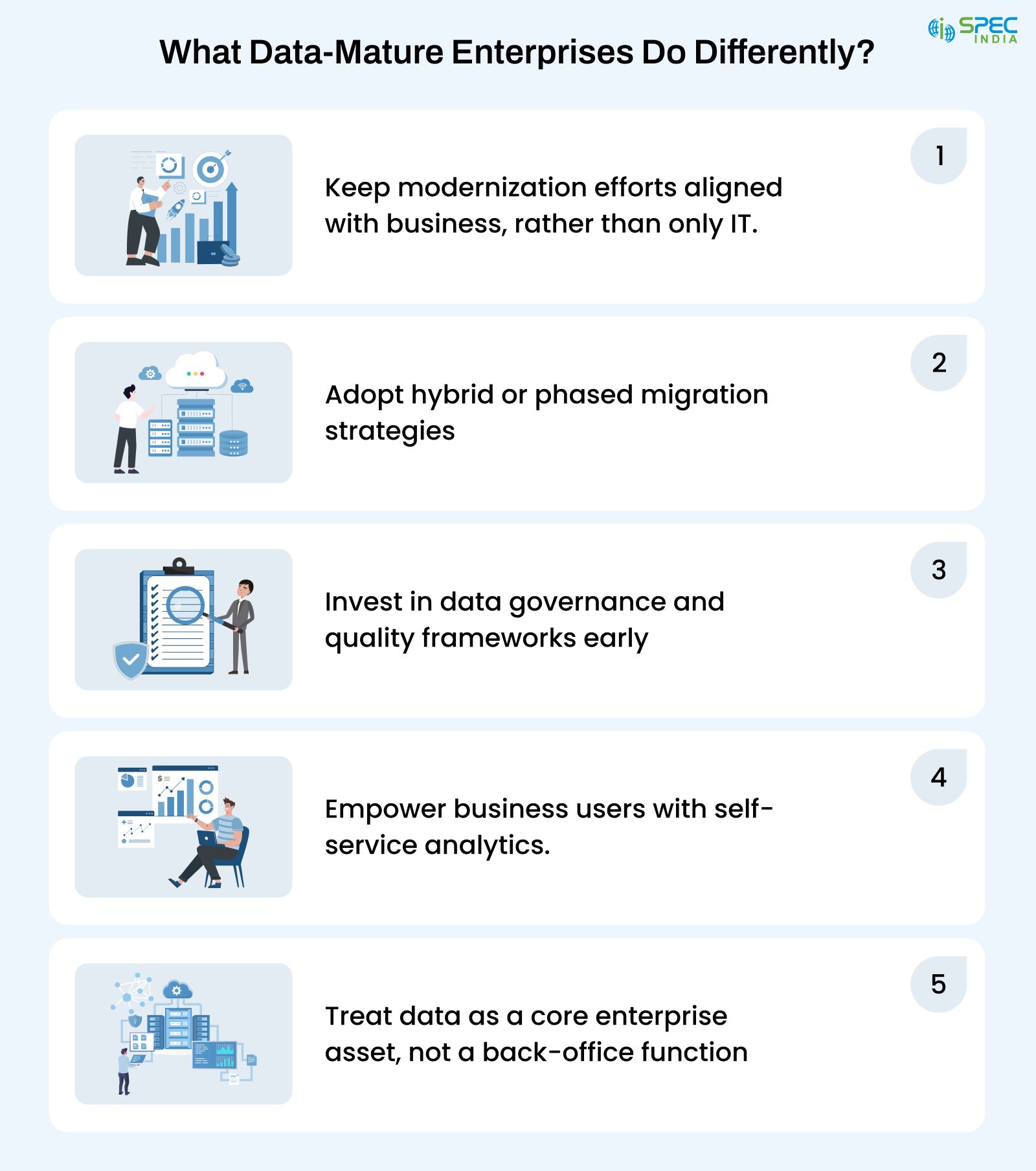
It is this strategic approach that enables successful and sustainable modernization of leading enterprises and enables them to transform data into real business value. The major organizations treat the modernization of EDW as a strategic, not a tactical, move. They:
- Keep modernization efforts aligned with business, rather than only IT.
- Adopt hybrid or phased migration strategies
- Invest in data governance and quality frameworks early
- Empower business users with self-service analytics.
- Treat data as a core enterprise asset, not a back-office function
This mindset shift is what separates successful modernization from stalled data warehouse transformation efforts.
Popular Cloud Platforms for Enterprise Data Warehousing
Since businesses are shifting their data warehouses into the cloud, it is important to select the appropriate platform. Each cloud data warehouse platform possesses its own strengths and does not have a universal solution. The most suitable platform will rely on the presence of cloud investments, volume of data, analytics requirements, and future strategies.
Leading cloud providers have built scalable data warehouse platforms that are designed for scale, performance, and advanced analytics. These platforms reduce infrastructure complexity and allow organizations to focus on extracting insights from data, a key objective of enterprise digital transformation services. A lot of enterprises also prefer to use platforms that are well compatible with their existing technology ecosystem to facilitate enhancement or quicker adaptation.
Some of the most popular cloud platforms in enterprise data warehousing, which have been trusted by organizations of various industries in terms of reliability and performance, are as follows:
- Snowflake data warehouse: Scalable, performance and user-friendly.
- Google BigQuery: this is optimized to handle large-scale analytics and machine learning workloads.
- Amazon Redshift: Intensive integration with AWS.
- Azure Synapse analytics: good match with Microsoft-centric organizations.
Each platform has its own strengths based on enterprise requirements and available technology stacks.
Final Thought
The enterprise data warehouse has transformed its role. It is no longer simply a data storage system in the background; it is now a driving force behind business speed, insight and innovation. With data playing a larger role in all strategic decisions, leaders will need to ensure their database is robust enough to withstand current needs and future possibilities.
Cloud EDW modernization enables organizations to be faster, more adaptable, and to make decisions confidently. It eliminates the constraints of the old infrastructure and substitutes it with scalability, flexibility, and the ability to support high-order analytics and AI. Those who act today are positioning themselves to succeed in the long run, and those who delay end up being limited by systems that may no longer be appropriate to their business reality.
Want to understand how to modernize your EDW the right way?
Dive deeper into our cloud data warehouse modernization approach to see how data warehouse modernization services can help you build a future-ready data platform with clarity and confidence.
Frequently Asked Questions
It is the process of upgrading legacy data warehouses to modern, cloud-ready architectures for better scalability, performance, and analytics.
Enterprises are moving to a data warehouse to reduce costs, scale on demand, improve performance, and enable faster advanced analytics. These things are crucial for businesses looking to grow in this tough competition.
Some common challenges that enterprises face include limited scalability, high maintenance costs, slow queries, and a lack of support for modern data needs.
Yes. Cloud platforms provide enterprise-grade security, compliance, and data protection controls.
Yes. With phased and parallel migration strategies, modernization can be done with minimal or no downtime.

SPEC INDIA is your trusted partner for AI-driven software solutions, with proven expertise in digital transformation and innovative technology services. We deliver secure, reliable, and high-quality IT solutions to clients worldwide. As an ISO/IEC 27001:2022 certified company, we follow the highest standards for data security and quality. Our team applies proven project management methods, flexible engagement models, and modern infrastructure to deliver outstanding results. With skilled professionals and years of experience, we turn ideas into impactful solutions that drive business growth.
Table of contents
- What is Enterprise Data Warehouse Modernization
- How Traditional EDWs Are Failing Modern Enterprises
- Why Enterprises Are Moving Their Data Warehouses to the Cloud
- When is the Right Time to Modernize
- What Cloud EDW Modernization Delivers to Leadership
- Key Considerations Before Moving EDW to the Cloud
- What Top Enterprises Are Doing Differently
- Popular Cloud Platforms for Enterprise Data Warehousing
- Final Thought
Delivering Digital Outcomes To Accelerate Growth
Let’s TalkTable of contents
- What is Enterprise Data Warehouse Modernization
- How Traditional EDWs Are Failing Modern Enterprises
- Why Enterprises Are Moving Their Data Warehouses to the Cloud
- When is the Right Time to Modernize
- What Cloud EDW Modernization Delivers to Leadership
- Key Considerations Before Moving EDW to the Cloud
- What Top Enterprises Are Doing Differently
- Popular Cloud Platforms for Enterprise Data Warehousing
- Final Thought
Delivering Digital Outcomes To Accelerate Growth
Let’s Talk
Let’s get in touch!
India
SPEC House, Parth Complex, Near Swastik Cross Roads, Navarangpura, Ahmedabad 380009, INDIA.
-
 +91-79-26404031, 32-33-34
 -
 [email protected]