

Why Cloud Data Warehouses Are the Foundation of Modern Analytics Architecture
Many businesses do not fail because they lack data; they fail because their data is slow, scattered, and unreliable.
Reports are made in hours rather than minutes. Dashboards present varying figures of the same measure. Teams spend more time repairing data than using insights. According to industry studies, data professionals spend 60-70% of their time preparing and managing data, leaving little to no time for analysis. It is a costly issue in a world where decisions are expected to be immediate, making enterprise data engineering critical for modern organizations.
With the increasing volume of data and the emergence of advanced analytics applications such as real-time dashboards and self-service BI, traditional analytics systems are beginning to crack. Architectures designed to support yesterday’s workloads have simply failed to meet today’s scale, performance, and demands.
This change is compelling organizations to re-architect their analytics from the ground up. The cloud data warehouse is a vital element in this transformation. Not only a storage solution, but it has also now become the centerpiece of modern analytics, uniting performance, scalability, and reliability in a single place so businesses can turn their data into action without delay.
This blog will discuss cloud data warehouses: their role in current analytics architectures, the problems they address, and why they have become a fundamental component of scalable, future-proof analytics infrastructures.
What is a Cloud Data Warehouse?
A cloud data warehouse is a centralized analytics platform built on cloud infrastructure that manages, processes, and analyzes large volumes of data to support reporting, business intelligence, and advanced analytics. It is particularly effective for heavy workloads in analytics applications, enabling companies to run complex queries on large datasets without significant performance issues.
Cloud data warehouses are designed to be scalable and flexible, unlike traditional on-premises data warehouses, which require fixed infrastructure and ongoing maintenance. They use cloud computing platforms to decouple storage and compute, allowing organizations to scale resources on demand without overprovisioning or system downtime.
Unlike conventional on-premises data warehouses, Cloud data warehouses:
- Operate entirely in the cloud and do not rely on physical infrastructures.
- Independently store scales and compute, to meet varying workloads.
- Eliminate the hard work of hardware, upgrades, and maintenance.
- Support structured and semi-structured data, including logs and JSON.
- Support more rapid query processing in analyzing and reporting applications.
The most popular cloud data warehousing systems are Snowflake, Google BigQuery, Amazon Redshift, and Azure Synapse Analytics. These platforms are cloud-native and are well known for their performance and security.
The Role of Cloud Data Warehouses in Modern Analytics Architecture
Consider how data actually moves within your business. Customer, sales, marketing, and product data are stored in separate systems.
Suppose you must respond to a simple query, such as: What is driving our revenue this quarter? –and you discover that the data required to respond to this query is all over the place.
That is precisely where cloud data warehousing comes in.
A cloud data warehouse is like a hub where all your information gets together. With cloud data warehouse services, businesses can integrate data from multiple systems into a centralized cloud analytics platform. Rather than teams grabbing numbers from various tools and producing inconsistent responses, all responses are consolidated in a single place. Once everybody sees the data, they will see the same version of the truth.
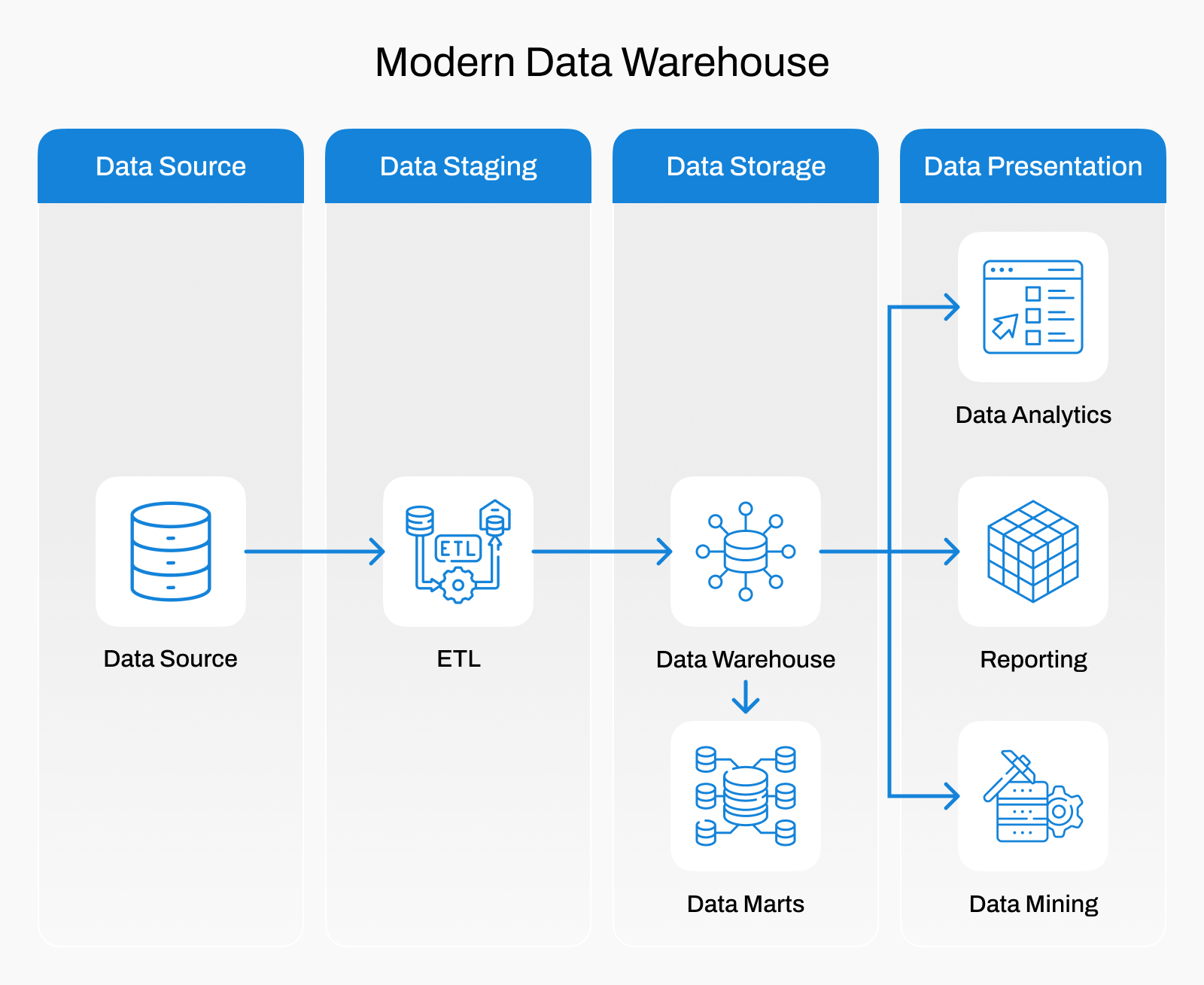
The cloud computing data warehouse is at the center of a modern analytics architecture. It gathers information at multiple levels, structures it logically, and presents it through dashboards, reports, and further analysis. It may be leadership, KPI tracking, marketing and campaign performance, or product and user behavior, but they all operate on the same platform.
The ease with which it facilitates growth makes this even more powerful. The system does not slow down as data sources increase or more individuals begin using analytics. The teams can run their reports simultaneously, investigate data independently, and receive answers when required, not hours later.
Simply put, cloud data warehouses transform analytics from a slow, IT-intensive process into something teams can rely on every day. They simplify data, making it more accessible, understandable, and useful for real-world business decisions.
How Cloud Data Warehouses Are the Foundation of Modern Analytics
Once analytics becomes slow, unreliable, or has scaling issues, it is unlikely the dashboard or reporting tool can address them. In most cases, the actual problem lies somewhere down below, the database itself.
Cloud data warehouses address the fundamental problem of modern analytics. They are designed to support large data volumes, multiple users, and complex queries simultaneously. This is why they are at the core of cloud-based analytics systems, application development, and contemporary data structures.
Let’s break down what makes them such a strong foundation.
-
Elastic Scalability
Data never stays the same size. Applications are added, customer-generated data volume increases, and analytics use is distributed across teams. Cloud data warehouses automatically scale storage and compute resources in response to demand, ensuring consistent performance as data volumes grow. This implies there is no need to speculate on future capacity or to make initial infrastructure investments. You can be running one or hundreds of dashboards, and the system scales without interruption.
-
High-Performance Analytics
In modern analytics, it is common to query millions (or even billions) of records with complex queries. Cloud data warehouses are created to do this. They can handle large analytics workloads in a short period, so what would have taken hours to deliver insights can now be delivered in seconds. For business teams, this translates into faster decisions. For data teams, this translates into fewer performance complaints and less firefighting around query optimization.
-
Cost Efficiency
The conventional analytics are capital-intensive and expensive to maintain. Cloud data warehouses are different. You only pay for the storage and computing you use, making costs more predictable for organizations investing in BI and analytics solutions. This elasticity enables businesses to scale analytics without wasting money, while still achieving high performance during peak hours.
-
Seamless Integration
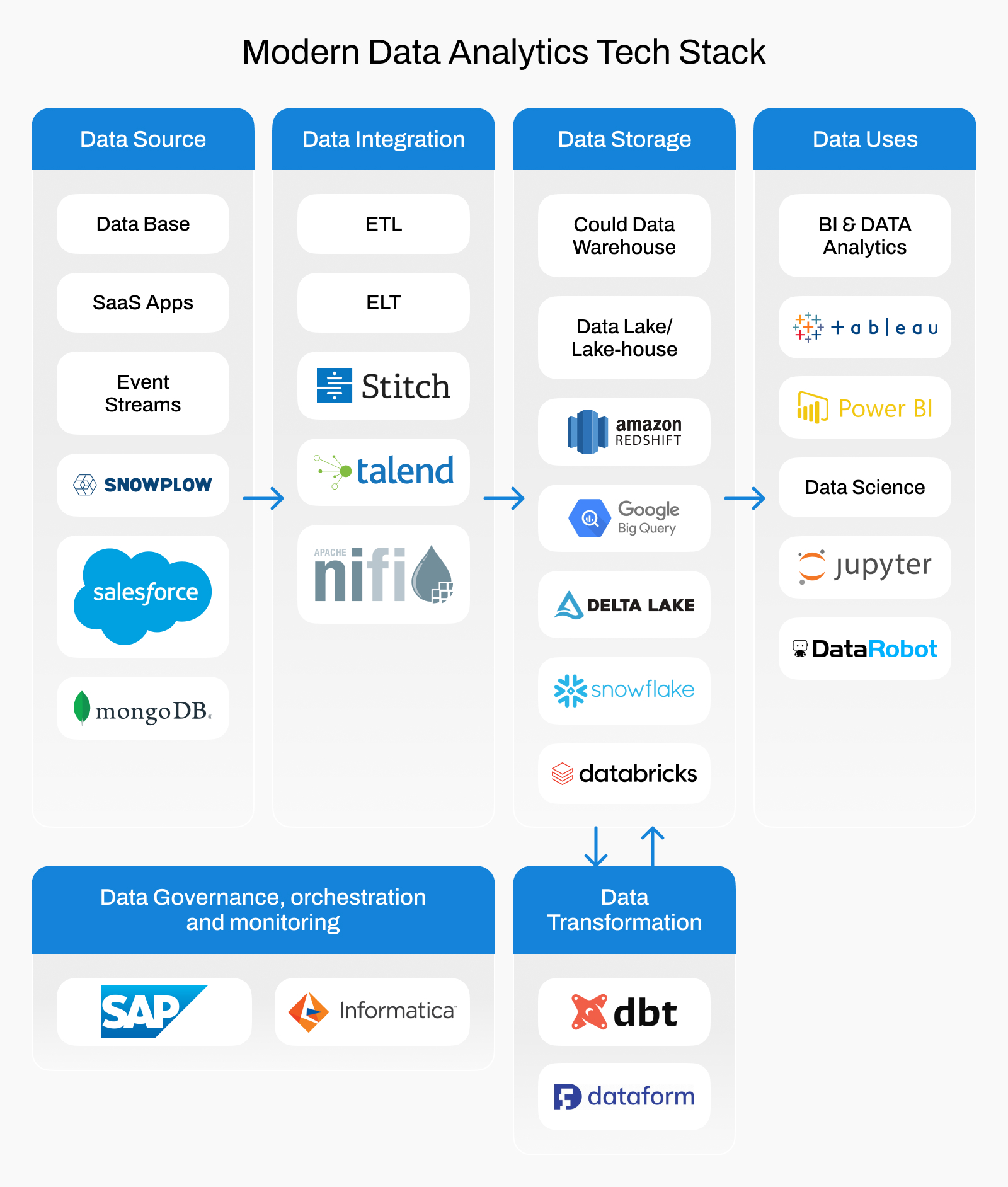
In contemporary analytics, there is no tool. Cloud data warehouses are compatible with BI platforms, ELT tools, data science frameworks, and cloud data warehouse services. This simplifies the development of a unified analytics ecosystem in which information moves freely from the source to insight. Consequently, teams can adopt emerging tools or analytics use cases without re-architecting the entire system.
-
Security and Compliance
Data security and compliance are no longer a luxury. Cloud data warehouses also offer built-in capabilities for encryption, role-based access control, audit logging, and compliance certifications. These functions can help businesses secure sensitive information and comply with industry and regulatory standards.
-
Real-World Use Case
Consider a healthcare provider that manages electronic health records, appointment systems, and operational systems. With cloud data warehousing, they can analyze patient patterns, streamline scheduling, and track operational performance without violating healthcare data regulations.
Key Challenges with Traditional Analytics Architectures
Historical analytics designs were developed when analytics was primarily about periodic reporting and limited data sources. At that time, systems were designed to respond to a predetermined number of questions, accommodate a limited number of users, and handle a predictable volume of data.
There is data everywhere, business questions are dynamic, and analytics will be used to make real-time decisions at the team level. As expectations rise, traditional architectures are increasingly seen as inflexible and difficult to change. Things that were once reliable and dependable now require workarounds, manual effort, and ongoing tuning just to get things going.
Most organizations spend more time managing analytics systems than using them. Simple reporting becomes complex, and responding to emerging business demands takes unnecessary time. This increasing disconnect between the expectations of the analytics business and what traditional systems can provide creates constant tension. Common challenges with Traditional Analytics Architectures include:
- Limits of scalability as data volumes grow.
- Poor query response during peak hours.
- Infrastructure and maintenance are high.
- Interdepartmental data silos.
- Lack of sufficient support for advanced analytics and AI.
But you don’t have to worry about the challenges when we are here to help you deploy a cloud data warehouse aligned with a Modern BI architecture at each step. We are among the best cloud data warehouse providers in the market, providing IT services for more than 36+ years. We have cloud data experts who understand your data needs and develop solutions that meet your basic requirements.
Best Practices for Building a Cloud-First Analytics Architecture
The migration of analytics to the cloud is not merely a technical paradigm but a paradigm shift in how data is collected, processed, and consumed throughout the organization. The real value of cloud analytics lies in having a flexible, scalable cloud data warehouse architecture that supports long-term business growth. Here are some of the best practices for building a cloud-first analytics architecture.
-
Design Data Models Optimized for Analytics Use Cases
Analytics systems are effective when data is in analytical form rather than transactional. The clean, well-organized data model helps teams to explore the data, create dashboards, and answer business questions without any confusion. Quality data modeling also enhances query performance and eliminates reliance on technical teams.
-
Use ELT Pipelines to Leverage Warehouse Compute Power
ELT (Extract, Load, Transform) works better in a cloud environment than a traditional ETL pipeline. Businesses can leverage a cloud-based data warehouse’s processing capabilities to import raw data and transform it into actionable insights. This streamlines pipelines and ensures scalability. It is easy to accommodate changes when analytics need to be altered.
-
Implement Data Governance and Access Controls Early
As more users access analytics, governance becomes essential. Defining data ownership, access permissions, and usage policies early helps maintain trust in data while preventing misuse. Cloud data warehouses have built-in role-based access control, auditing, and security tools, making governance at scale easier to manage.
-
Monitor Usage and Costs Continuously
Flexibility is one of the largest benefits of cloud analytics, but when costs are not monitored, they may skyrocket. Applying usage patterns, query performance, and storage consumption enables teams to optimize their workloads and costs. Consistent performance also requires regular monitoring as analytics usage continues to grow.
-
Enable Self-Service Analytics Without Compromising Data Quality
Business users should be able to discover data through cloud-first analytics. Self-service is, however, recommended when it is based on well-managed, trusted information. By providing curated datasets and clear definitions, teams can move quickly while maintaining report consistency and accuracy.

Conclusion
Modern analytics in data warehouse modernization is not merely the gathering of data anymore, but the use of it with speed, confidence, and purpose. The shortcomings of classic analytics systems generally become difficult to ignore as data volumes increase and business questions become more complex.
Cloud data warehouses are now the core of modern analytics architectures, eliminating these constraints. They combine scalability, performance, and flexibility, enabling data teams and business users to operate from a single, reliable source of truth. More to the point, they enable advanced analytics use cases, including real-time insights, for AI and machine learning, without introducing unnecessary complexity.
For companies willing to develop analytics that can keep pace with the business and deliver real results, moving to a cloud data warehouse is not merely a technology refresh; it is a business strategy.
Explore how a cloud-first architecture can help you move faster and unlock the true value of your data.

SPEC INDIA is your trusted partner for AI-driven software solutions, with proven expertise in digital transformation and innovative technology services. We deliver secure, reliable, and high-quality IT solutions to clients worldwide. As an ISO/IEC 27001:2022 certified company, we follow the highest standards for data security and quality. Our team applies proven project management methods, flexible engagement models, and modern infrastructure to deliver outstanding results. With skilled professionals and years of experience, we turn ideas into impactful solutions that drive business growth.
Table of contents
Delivering Digital Outcomes To Accelerate Growth
Let’s TalkTable of contents
Delivering Digital Outcomes To Accelerate Growth
Let’s Talk
Let’s get in touch!
India
SPEC House, Parth Complex, Near Swastik Cross Roads, Navarangpura, Ahmedabad 380009, INDIA.
-
 +91-79-26404031, 32-33-34
 -
 [email protected]