

How ERP for Renewable Energy Supports Multi-Site and Multi-Project Operations
February 27, 2026
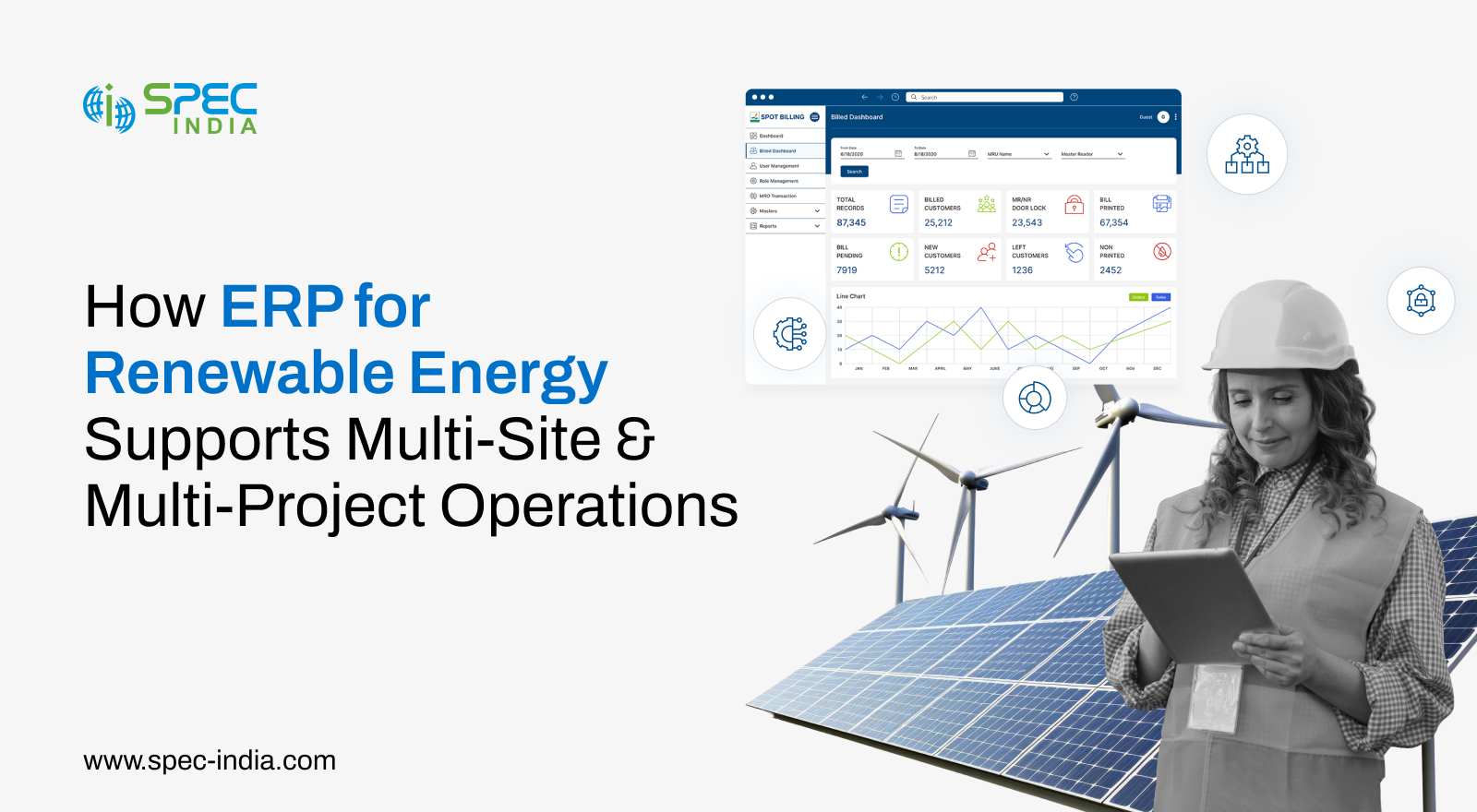
In the world of renewables, nothing happens in a vacuum. You aren’t managing a single factory floor; you’re juggling solar parks in the desert, wind farms on remote ridges, and hydro plants in the mountains all at the same time. Each site is its own beast, with unique local laws, environmental quirks, and grid connections. As your portfolio grows, that “spreadsheet-and-prayer” method starts to crumble. This is exactly where an ERP for renewable energy stops being a “nice-to-have” and becomes the literal digital spine of your entire operation.
Unlike the old-school utility models, renewable energy companies live and die by their projects. You’re constantly adding new sites, running five different builds in parallel, and watching your performance swing wildly based on a cloud bank or a grid hiccup. If you try to manage this chaos with disconnected systems or a “one-size-fits-none” generic setup, you’re basically flying blind. You’ll miss the warning signs in your energy project cost control, your assets will underperform, and your team will spend more time chasing data than actually managing it.
Most renewable energy firms get stuck in a “data trap.” Finance is in one silo, O&M is in another, and the C-suite is left trying to piece together a puzzle with missing parts. Without a purpose-built renewable energy ERP system, you aren’t scaling, you’re just multiplying your risks. You need a platform that lets you pivot from reactive fire-fighting to proactive strategy.
In this guide, we’re diving into why an ERP for renewable energy firms is the secret sauce for multi-site success. We’ll look at why the “big box” ERPs usually fall flat on their face and why a centralized, renewable energy ERP platform is the only way to build a resilient, future-proof operation.
What ERP for Renewable Energy Really Means
Let’s be clear: a true ERP for renewable energy isn’t just a generic software package with a few “green” labels slapped on it. It’s a dedicated digital backbone. We’re talking about an integrated ecosystem that pulls your projects, assets, and finances into one room so they can finally start talking to each other.
At its heart, a high-performing renewable energy ERP platform is built to juggle three or four balls at once:
Project portfolio management that handles both the “next big build” and the sites already spinning.
Deep-dive asset lifecycle management for infrastructure that needs to survive decades of wear and tear.
Financial tracking that actually mirrors your operational reality, not just your bank statement.
A way to handle the “Compliance Maze” across different borders and regulators without losing your mind.
Instead of forcing your unique energy workflows into a rigid, old-school box, this approach bends the system to fit how you actually work. When your software understands the energy business, you get a much cleaner line between your boardroom plans and your field execution.
Check out Real Life Examples of Digital Transformation in Energy and Utilities.
The Limits of Traditional ERP Systems in Renewable Energy
Most of the “legacy” ERP giants were built for a world of factories and warehouses. They’re great at counting widgets and managing payroll, but they tend to choke on the messy, real-world variables of the energy sector.
Here’s why they usually fail:
- They don’t “get” projects: Most are built for steady-state production, not high-speed energy project management.
- Regional Blindness: They struggle to pull data from fifty remote sites into one coherent view.
- Rigid DNA: Their data models are too stiff for the fluid nature of green energy workflows.
- The Financial Gap: They can’t easily link a turbine’s health directly to your bottom-line profit.
This is why so many firms end up in “Excel Hell,” layering manual workarounds on top of a multi-million dollar renewable energy enterprise systems project. A generic system simply can’t handle the high-speed ERP adoption trends we’re seeing in 2026. You don’t need a generic tool; you need custom ERP solutions that understand that in this industry, data is your most valuable asset.
Managing Multi-Site Operations with ERP
If you’re running one of today’s renewable energy companies, you know the “Multi-Site Headache” all too well. Every solar park or wind farm is a data island, generating its own costs, its own drama, and its own performance spikes. Without a way to bridge those islands, your data just rots in silos.
This is where multi site ERP software changes the game. It allows for a centralized operations management hub where the home office sees the big picture, but the local site teams still have the boots-on-the-ground freedom they need to fix problems.
A few things this makes possible:
Executive dashboards that let you “roll up” data from a hundred sites with one click.
Standardized playbooks so every site isn’t “doing its own thing.”
Enterprise ERP software with inventory management that lets you see where a critical spare part is located across your entire regional network.
Real-time renewable energy operations visibility that tells you exactly what a site is costing you right now.
ERP Support for Multi-Project Energy Portfolios
Rarely is a firm in this space focused on just one project. You’re likely spinning plates. Some sites are in the permit phase, some are under construction, and others are already feeding the grid. Trying to track all that in a spreadsheet is a recipe for a meltdown.
A purpose-built renewable energy ERP system pulls your energy project management and your broader project portfolio management into a single “Command Center.”
In short this means:
You can track shared resources across five different builds without double-booking your best engineers.
You can see exactly where a project sits on the timeline from “Groundbreak” to “Grid Connection.”
You can map out your project milestones alongside your cash flow forecasts, so you aren’t surprised by a sudden funding gap.
By looking at your projects as a connected portfolio rather than a series of one-offs, you can stop “guessing” on your resource allocation and start moving with much more confidence.
Asset Lifecycle Management for Renewable Energy
When you drop millions on solar arrays or wind turbines, you aren’t just buying gear; you’re making a quarter-century commitment. You need to know that these assets will still be humming in 2050. That requires a level of oversight that goes way beyond a simple “maintenance calendar.”
Through ERP-driven asset lifecycle management, you can track an asset from the day it’s ordered to the day it’s decommissioned. This is one of the most significant ERP adoption trends we see: moving from “fixing things when they break” to “knowing when they might break.”
Energy ERP solutions help you manage the full journey:
The initial commissioning and “birth” of the asset.
The shift from reactive repairs to predictive, preventive care.
Monitoring performance over time to spot the “slow decline” before it becomes a total failure.
Planning for the eventual end-of-life and replacement.
By tying your asset health directly to your financial records, you finally understand the “True Cost” of your infrastructure and exactly what kind of return you’re getting on your investment.
Cost Control and Financial Visibility Across Energy Projects
If there is one thing that keeps energy executives up at night, it’s the dreaded cost overrun. In the world of renewables, budgets can leak from a dozen different places, such as unforeseen site delays, contractor disputes, or supply chain hiccups. Managing this across a dozen different locations without a centralized system is essentially like trying to catch rain in a sieve.
This is where a dedicated ERP for renewable energy stops being a luxury and becomes a financial shield. These platforms drive energy project cost control by finally linking your bank account to your field operations. You stop guessing where the money went and start seeing it in real-time.
A few ways this changes the game for renewable energy companies:
- CAPEX vs. OPEX Clarity: You can track every dollar at both the project and site levels without digging through piles of receipts.
- Live Budget Tracking: You see exactly how much of your budget is left before you commit to the next milestone.
- The “Reality Check”: You get a constant comparison of planned versus actual costs, so you aren’t surprised by the final bill.
- Spotting Red Flags: You can identify what is actually driving your costs up early enough to actually do something about it.
When your financials are tied to real-world progress, leadership doesn’t have to wait for the end-of-month report to see a disaster coming. You can pivot, intervene, and protect your margins while there is still time.
Did you know that energy companies can achieve up to 30% cost reduction by streamlining their billing operations?
Here’s how modern software makes it possible.

Achieving Renewable Energy Operations Visibility
In this business, if you don’t have visibility, you don’t have control. You can’t manage a hundred distributed energy assets spread across the map if you’re relying on fragmented, delayed reports. You need to know what’s happening right now, not what happened two weeks ago.
A purpose-built renewable energy ERP system pulls all those scattered data points into one clear “Source of Truth.” This is the foundation of renewable energy operations visibility. It’s about moving from a reactive “firefighting” mode to a proactive strategic posture.
What this looks like in a modern renewable energy ERP platform:
- Site-Level KPIs: Performance metrics that tell you exactly how each asset is humming.
- Financial Health Dashboards: A quick glance that shows both project progress and the “burn rate.”
- Smart Alerts: Instant notifications the moment your output drops or your costs spike.
- The Big Picture: High-level executive views that still let you drill down into the smallest operational detail.
Using ERP Data for Forecasting and Operational Planning
Operational visibility is just the starting point. The real “Aha!” moment happens when you start using that data to predict the future. Forecasting in the energy sector is notoriously difficult, but it gets a lot easier when your energy project management and your financials are living in the same house.
Instead of wrestling with a dozen disconnected spreadsheets, your team can finally base its plans on a single, trusted data source. This is one of the most significant ERP adoption trends we’re seeing: the move toward integrated, scenario-based planning.
With a solid renewable energy enterprise systems foundation, you can:
Predict your energy output based on how your sites have actually performed in the past.
Time your maintenance windows perfectly so you aren’t taking assets offline during peak generation.
Align your field plans with your CFO’s cash flow projections.
Actually prepare for the “mood swings” of the weather instead of just reacting to them.
Over time, this kind of foresight turns into a massive strategic advantage. You gain the ability to test different scenarios like “Should we upgrade this asset or expand that site?” and understand the financial trade-offs before you spend a single cent.
When Custom ERP Solutions Make Sense for Renewable Energy
Let’s be honest: a “one-size-fits-all” software package rarely fits anyone perfectly in this industry. While a basic, off-the-shelf setup might handle your payroll and basic buying, it usually chokes the moment you try to map it to the messy reality of the field. This is where custom ERP solutions stop being a luxury and start being a necessity.
You know you’ve reached that “customization” tipping point when:
You’re juggling a mix of solar, wind, and storage, and the data formats look like alphabet soup.
Your project timelines in Europe look nothing like your builds in Asia.
You’re drowning in regional “red tape” and specific reporting rules that your current software has never heard of.
You need your ERP to talk to a very specific, niche monitoring platform that doesn’t have a standard “plug-and-play” connector.
But here is the warning: don’t overdo it. If you customize every single button, you’ll end up with a “zombie system” that you can never upgrade. The goal of a modern renewable energy ERP platform is to bend the software to fit your energy workflows without breaking the foundation that allows you to scale.
How ERP Enables Scalable Growth for Renewable Energy Firms
Growth in the green energy world is almost never a slow, steady climb. It’s a series of explosions, new project wins, sudden acquisitions, or a fast move into a new country. Without a renewable energy enterprise systems foundation, that kind of growth introduces massive risk. You don’t want to grow so fast that you lose sight of your margins.
A solid energy erp solutions setup allows you to scale by giving you a repeatable “playbook.” It means:
You can onboard a new solar park or a wind farm in days, not months.
Your financial rules and operational habits are the same in every office.
You can see the health of your entire portfolio, even as it doubles in size.
Your CFO can actually plan for future investments because the data is grounded in reality.
For any of the top renewable energy companies, scalability is about maintaining your “grip” on the business even as the complexity hits a fever pitch.
Turning Operational Chaos into a Competitive Edge
At the end of the day, renewable operations aren’t just about power; they’re about managing a massive, moving target of scale and constant change. If you’re trying to juggle hundreds of sites and projects using disconnected, “duct-taped” systems, you aren’t just creating a mess; you’re creating operational blind spots that can sink your margins. As your portfolio expands, these data gaps stop being minor annoyances and start becoming major risks. This is precisely why an erp for renewable energy has to shift from being a “back-office tool” to the literal strategic foundation of your firm.
A dedicated renewable energy ERP system is designed to pull orders out of that chaos. By weaving together your energy project management, high-stakes asset lifecycle management, and daily financials, it creates one single, unfiltered view of your entire operation. Your team finally gets the power to watch costs as they happen, monitor how those distributed energy assets are performing over the long haul, and coordinate across regions without stepping on the toes of local site managers. This isn’t just “software,” it’s the renewable energy operations visibility you need to stay sustainable.
But the real win here is confidence. Whether your growth is coming from a fresh set of project wins, a strategic acquisition, or a fast move into new territory, a centralized operations management approach ensures that your discipline and reporting grow as fast as your footprint. Instead of burying your staff under a mountain of manual spreadsheets, you’re building a repeatable, resilient process.
For any of today’s renewable energy companies, the debate isn’t about whether you need an ERP; it’s about how fast you can get a system that actually understands the reality of multi-site, multi-project life. A platform built for this specific industry, like a high-tier renewable energy ERP platform, turns your messy complexity into your biggest advantage. It supports the kind of smart decisions and tight control that drive growth in an increasingly crowded and distributed landscape.
Frequently Asked Questions
Trying to run a dozen different sites without a central "brain" is a logistical nightmare. An ERP for renewable energy pulls scattered data into one hub, ensuring you aren't flying blind. It keeps energy project cost control tight at the home office while letting site crews handle their day-to-day without constant interference.
You’re usually spinning a lot of plates in this industry. A renewable energy ERP system acts as a command center for every timeline and budget across your portfolio. It stops you from double-booking your best engineers and shows exactly how one site's delay might wreck your project portfolio management strategy.
Basically, anything that hits your bottom line, such as solar arrays, wind turbines, inverters, and high-stakes substations. A renewable energy erp platform tracks these distributed energy assets from commissioning through a decade of maintenance until they’re finally retired.
It’s the end of "Excel Hell." Instead of waiting for a weekly report that’s already ancient, an erp for renewable energy firms feeds live data into dashboards you can actually trust. This level of renewable energy operations visibility lets you catch a performance dip or cost spike the moment it happens, not a month too late.
It moves your team from "reactive fire-fighting" to a proactive mindset. By linking asset lifecycle management to your work orders and spend data, you can actually nail your preventive maintenance windows. It’s the best way to keep hardware humming and avoid the unplanned repair bills that murder your margins.
The "Compliance Maze" is brutal, but energy ERP solutions automate the boring parts. By maintaining a clean digital paper trail for every site, the system makes audits and regulatory filings a breeze. It’s the only way to stay on the right side of ERP adoption trends and green mandates without losing your mind to manual paperwork.

SPEC INDIA is your trusted partner for AI-driven software solutions, with proven expertise in digital transformation and innovative technology services. We deliver secure, reliable, and high-quality IT solutions to clients worldwide. As an ISO/IEC 27001:2022 certified company, we follow the highest standards for data security and quality. Our team applies proven project management methods, flexible engagement models, and modern infrastructure to deliver outstanding results. With skilled professionals and years of experience, we turn ideas into impactful solutions that drive business growth.
Table of contents
- What ERP for Renewable Energy Really Means
- Asset Lifecycle Management for Renewable Energy
- Cost Control and Financial Visibility Across Energy Projects
- Achieving Renewable Energy Operations Visibility
- Using ERP Data for Forecasting and Operational Planning
- When Custom ERP Solutions Make Sense for Renewable Energy
- How ERP Enables Scalable Growth for Renewable Energy Firms
- Turning Operational Chaos into a Competitive Edge
Delivering Digital Outcomes To Accelerate Growth
Let’s TalkTable of contents
- What ERP for Renewable Energy Really Means
- Asset Lifecycle Management for Renewable Energy
- Cost Control and Financial Visibility Across Energy Projects
- Achieving Renewable Energy Operations Visibility
- Using ERP Data for Forecasting and Operational Planning
- When Custom ERP Solutions Make Sense for Renewable Energy
- How ERP Enables Scalable Growth for Renewable Energy Firms
- Turning Operational Chaos into a Competitive Edge
Delivering Digital Outcomes To Accelerate Growth
Let’s Talk
Let’s get in touch!
India
SPEC House, Parth Complex, Near Swastik Cross Roads, Navarangpura, Ahmedabad 380009, INDIA.
-
 +91-79-26404031, 32-33-34
 -
 [email protected]