| Features | Off-the-Shelf ERP | Custom ERP |
|---|---|---|
| Software Licensing | Pre-built product with tiered pricing | Development cost and no licensing cost |
| Configuration | Moderate | Aligns with custom design |
| Custom Development | Extensions increases costs | High cost including design and development effort |
| Infrastructure | Based on vendor and deployment model | Variable (cloud or on-premises) |
| Upgrade Cost | Frequent and mostly mandatory | Optional and limited |
| Support & Maintenance | Includes vendor support | Internal or partner support |
| Customization | Add-ons | Built-in and meets the needs |
| Integration | Moderate to high | Precise integration |
| Time to Value | Faster rollouts | Longer development cycles |
| Process Fit & Operational Efficiency | Standardized process | Unique workflows and competitive process |
| Scalability | Vertical scalability possible but horizontally is expensive | Easy to incorporate acquisitions and geographies |
| Risk & Compliance | Embedded regulatory updates and audit trails | Security rests on internal teams and partners |
| User Adoption | Process mismatch reduces satisfaction | Higher adoption |
| Competitive Advantage | Limited embedding capabilities | High embedding possibilities |
| Vendor Dependence | Higher vendor dependency | Lower dependency on third-party vendors |
| Analytics & Decision Intelligence | Generic to advanced | Customized to business |


Loading...
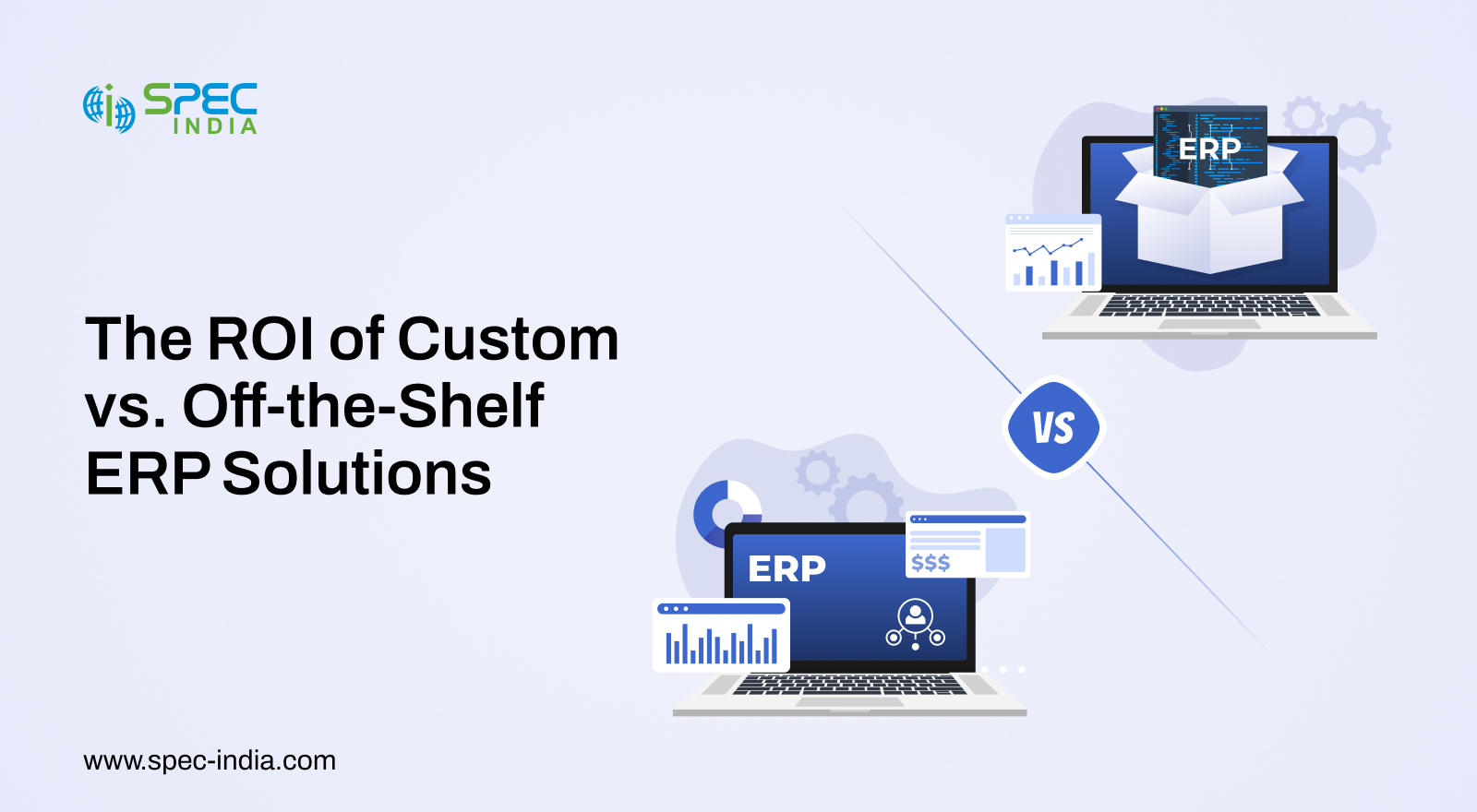
The ROI of Custom vs Off the Shelf ERP Solutions: A CEO’s Guide
Traditionally, Enterprise Resource Planning (ERP) systems were viewed as back-office utilities focused on record-keeping and operational control. Today, they have evolved into strategic platforms that directly influence scalability, efficiency, and competitiveness. Industry reports show that 95% of organizations observed improvements in business processes after ERP implementation
For C-suite decision-makers, ERP is no longer a technology upgrade—it is a capital investment decision. Deloitte reports that organizations using ERP as a strategic enabler (rather than just an operational tool) are 2.5x more likely to achieve their expected ROI, with most realizing measurable returns within 24–36 months. In fact, industry studies indicate that over 83% of enterprises that align ERP initiatives with business objectives meet or exceed ROI expectations.
However, one critical question continues to dominate boardroom discussions—and is frequently raised in conversations with ERP software development companies:
Should we invest in a custom-built ERP solution or adopt an off-the-shelf ERP product?
This differentiator guide elaborates on the realistic ROI of custom vs. off-the-shelf ERP solutions. It will help C-suite leaders to make an informed, data-driven decision.
Understanding Enterprise Resources Planning ROI
ROI evolves around cost reduction and payback periods, but there are certain more important and strategic roles it plays:
- Enabling operational efficiency gains
- Increase in revenue and rapid time to market
- Better decision-making through real-time data
- Scalability to support growth and acquisitions
- Risk reduction, compliance, and business continuity
In short, ERP ROI lets you know how effectively you would be able to execute a strategy and not how much it costs.
Here are certain ERP ROI metrics CEOs should keep in mind:
- Total Cost of Ownership: It includes licensing, upgrades, support, customization, and internal resources over 5-10 years.
- Time-to-Value: Another metric that you, as a CEO, should consider is how long ERP takes to deliver a measurable business advantage.
- Process Efficiency Gains: Automation, cycle time reduction, and productivity improvements are such gains that enterprises can gain.
- User Adoption Rates: This shows the number of users added or using your system that creates value.
- Scalability and Flexibility: This metric indicates resources required for future growth.
- Risk and Compliance Impact: There is reduced exposure to operational and regulatory risks.
When Does ERP ROI Fall Short?
You might make a heavy investment, but your ERP ROI initiatives may fall short of delivering the expected ROI when:
- Poor alignment with business processes
- Over-personalization or underutilization
- Inadequate change management
- Treating ERP as an IT project instead of a business transformation.
- These pitfalls are critical when evaluating the core comparison between ERP options.
Off the Shelf ERP Solutions
This ready-made solution caters to a large group of industries with organized processes. Several common examples include SAP, Oracle, NetSuite, and Microsoft Dynamics.
Such systems are developed after undertaking industry best practices and deployed using configuration rather than full-scale deployment.
Here is the breakdown of the cost structure of Off-the-shelf ERP:
- Licensing or subscription fees
- Implementation and integration costs
- Personalization expenses
- Ongoing maintenance, support, and upgrade fees
These upfront costs may seem predictable, but the long-term expenses can increase as you personalize according to your business requirements.
ROI Benefits of Off-the-Shelf ERP
Off-the-shelf ERP systems offer a strong ROI in the right context, which is as follows:
- Rapid Development: It consists of built-in functionalities that offer rapid implementation and faster time-to-value.
- Lower Initial Capital: Unlike custom development that demands higher upfront costs, in off-the-shelf ERP, the costs are much lower.
- Proven Industry Practices: Since there are already standardized workflows set up, there will be no major efforts or implementation risks.
- Vendor Ecosystem and Support: Another major benefit would be access to third-party systems, compliance features, and updates. Implementing them would help you scale your business.
Along with the pros, there are certain limitations that need to be understood before investing.
Organizations with highly standardized workflows benefit more from packaged ERP. However, enterprises with industry-specific, complex, or evolving processes often see higher ROI from custom ERP due to reduced workarounds and manual effort.
ROI Limitations of Off-the-Shelf ERP
- Process Compromise: Businesses are required to inculcate a process to accommodate the software while reducing operational efficiency.
- Vendor Lock-in: Another major challenge and high-end cost-draining could be due to switching platforms.
- Personalization Constraints: Cost increases due to personalization, freedom, and compliance upgrades.
- Scaling Costs: Licensing and infrastructure costs rise significantly as the enterprises grow.
Custom Enterprise Resources Planning Solutions
A custom ERP solution is built and designed particularly around an organization’s processes, database, and strategic goals. They are developed using modern architectures that support flexibility and long-term modification.
Cost Structure of Custom ERP
Here are the requirements of custom ERP investments:
- Development and testing
- Requirement evaluation and system design
- Infrastructure and hosting
- Ongoing maintenance, support, and enhancements
While initial investments are higher, long-term financial dynamics differ significantly from packaged ERP.
ROI Advantages of Custom ERP
When discussing ROI, custom ERP software provides strategic benefits:
- Higher user adoption: Since the custom ERP consists of role-based workflows, it becomes easier to use, which is why it has a higher adoption rate.
- Less long-term dependency: Since it is specifically built for your company, the entire ownership would be in-house, which is why you do not need to depend on third-party licensing models and forced upgrades.
- Exact process alignment: Such a custom ERP shows how the business functions and drives productivity and performance.
- Competitive differentiation: Since it is custom-built, you can modify it as per your business requirements, which is challenging with an off-the-shelf ERP platform. Moreover, even competitors cannot replicate what you experiment with or implement.
- Scalability and flexibility: Another major benefit custom ERP brings to the table is building and implementing new features, capturing newer markets, and acquisitions without any re-platforming.
Amidst being perfect in every aspect, a custom ERP also consists of fewer challenges, which are as follows:
- Higher upfront costs
- Lengthy development cycles
- Dependence on development partners
- Requirement for strong governance and roadmap planning
- Such risks are manageable when it comes to disciplined execution.
Though custom ERPs provide long-term strategic value, their ROI seems measurable when compared against off-the-shelf alternatives. Below is a detailed comparison of both models across cost, flexibility, and total return.
91% of companies report optimized inventory levels after ERP adoption
Custom vs Off the Shelf ERP: ROI Comparison
The CEO’s Decision Framework: Choosing the Right ERP for Maximum ROI
When the decision stage arrives, ERP selection becomes a leadership and strategic decision and not a technology discussion. In this phase, it is important to understand how each ERP option effectively helps in achieving long-term business objectives.
This framework helps C-suite professionals analyze ERP choices with sustained return on investment. Now, let us look at the core calculation of ERP ROI.
78% of organizations experience measurable productivity gains after implementing an ERP system, largely due to process automation, reduced manual effort, and improved cross-department collaboration.
How to Calculate ERP ROI?
Calculating ERP ROI requires more than comparing costs and licenses; it demands a structured view of how the system will create value over time. A practical ROI model helps leaders move beyond assumptions and build a defensible business case by linking ERP investment to measurable business outcomes, total cost of ownership, and risk exposure. The following approach outlines how CEOs can evaluate ERP ROI with clarity and confidence.
Defining Clear Business Objectives
ERP ROI’s measurement depends on a clear definition of success. It defines how and what outcomes a business would receive based on its investment.
Here are the primary and secondary objectives that C-suite decision-makers should keep in mind:
- Cost Reduction: Lower operational overhead, reduced manual work, fewer errors, and optimized inventory
- Revenue Growth: Rapid order execution, better customer satisfaction, better pricing, and demand visibility
- Rapid Decision-Making: Real-time reporting, better forecasting, and cross-functional visibility
- Risk Mitigation: Stronger compliance, better data security, and reduced operational risk
Quantify Total Costs
Once you define the objectives, the next step is to consider the total cost of ownership over a period of 5-10 years.
Costs should include:
- Software licensing or subscription fees
- Implementation, configuration, and customization costs
- Integration with existing systems
- Infrastructure and hosting
- Ongoing maintenance, support, and upgrades
- Internal costs like IT staff time, business user involvement, and change management
Many ERP ROI models fail due to a shortage of internal team efforts and long-term expenses. A complete cost picture restricts high ROI projections and allows you to offer an accurate comparison between custom and off-the-shelf ERP choices.
Quantify Tangible and Intangible Returns
This one is a crucial phase that aims at translating ERP benefits into financial and strategic value.
Here are the tangible outcomes to expect:
- Minimal operational errors and rework
- Lesser inventory carrying expenses
- Reduced system and IT expenses
- High-end productivity from automation
- Here are some intangible returns:
- Greater organizational agility
- Improved customer satisfaction and retention
- Enablement of new business models and services
- Improved data quality and decision-making
Stress Test Assumptions
ERP ROI models are developed on assumptions and should be tested.
- Best case scenarios: Rapid adoption and higher efficiency gains
- Expected scenarios: Realistic adoption and benefit realization
- Worst-case scenarios: Delays and increased costs
Such a test helps decision-makers acknowledge the risk exposure, negative scenarios, and break-even points. It also supports stronger board-level discussions by showcasing the ROI case to be analyzed under various conditions.
Common ERP ROI Mistakes CEOs Should Avoid
Despite spending heavily, ERP may fail to offer expected results, and that is not due to the use of poor technology but mainly because of strategic missteps at the core level. If you understand these pitfalls in a timely manner, it helps you mitigate risks, strengthen the business case, and ensure ERP investments generate sustained value.
Choosing Price Over Value
One of the common mistakes that happens is choosing a system based on the upfront cost and not considering the overall long-term cost. The primary upfront cost may be lower and attractive, but the long-term cost would burn more than expected.
ERP ROI should be analyzed considering the overall expenses. A solution that may seem economical today may make you spend more overall. Therefore, it becomes your priority to evaluate the total economic impact.
Underestimating Change Movement
ERP systems evolve how people operate. Not considering change management as a priority makes user adoption suffer, eventually jeopardizing ROI.
Here are the common consequences:
- Resistance to new workflows
- Workarounds that undermine data integrity
- Delayed realization of productivity gains
A successful ERP implementation invests in effective communications, user training, leadership, and customer engagement.
Ignoring Scalability Costs
Many ERP ROI models aim at the current requirements and underestimate the cost of future growth. As the user base grows, new markets are added, or acquisitions happen, scalability limitations surface quickly, in the form of licensing fees, performance constraints, or expensive system extensions.
The CEO must undertake evaluating ERP’s performance both today and in the long term. Ignoring scalability costs can erode ROI and enable premature system replacement.
Treating ERP as an IT Project Instead of a Business Transformation
ERP initiatives frequently fail when ownership is delegated solely to IT. While technology execution is significant, ERP is fundamentally a business transformation program that boosts operations, finance, sales, and leadership decision-making.
When ERP is positioned as an IT project:
- Business goals become secondary.
- Process redesign is minimal.
- Strategic value is underleveraged.
High ROI ERP programs are initiated by the business, promoted by executive leadership, and aligned with organizational strategy. IT enables transformation but should not define it.
Conclusion
ERP ROI is a strategic fit. Off-the-shelf ERP offers considerable value when agility and standardization matter. Custom ERP offers a stronger long-term ROI when complexity, scalability, and differentiation are significant. The suitable option is based on how well the system supports the business’s future, not just its existing requirements. For CEOs, maximizing ERP ROI means selecting the option that allows sustained growth, control, and competitive advantage.

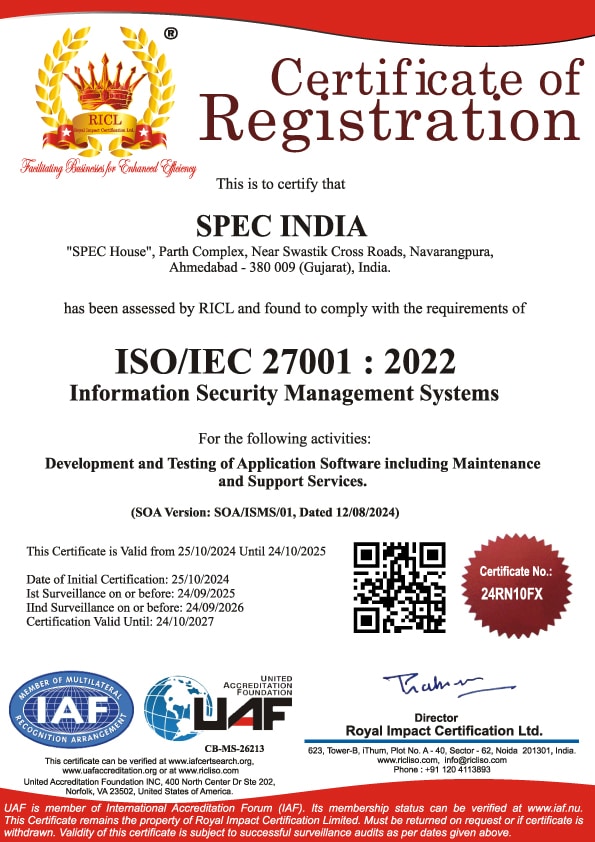
SPEC INDIA is your trusted partner for AI-driven software solutions, with proven expertise in digital transformation and innovative technology services. We deliver secure, reliable, and high-quality IT solutions to clients worldwide. As an ISO/IEC 27001:2022 certified company, we follow the highest standards for data security and quality. Our team applies proven project management methods, flexible engagement models, and modern infrastructure to deliver outstanding results. With skilled professionals and years of experience, we turn ideas into impactful solutions that drive business growth.
Table of contents
Delivering Digital Outcomes To Accelerate Growth
Let’s TalkTable of contents
Delivering Digital Outcomes To Accelerate Growth
Let’s Talk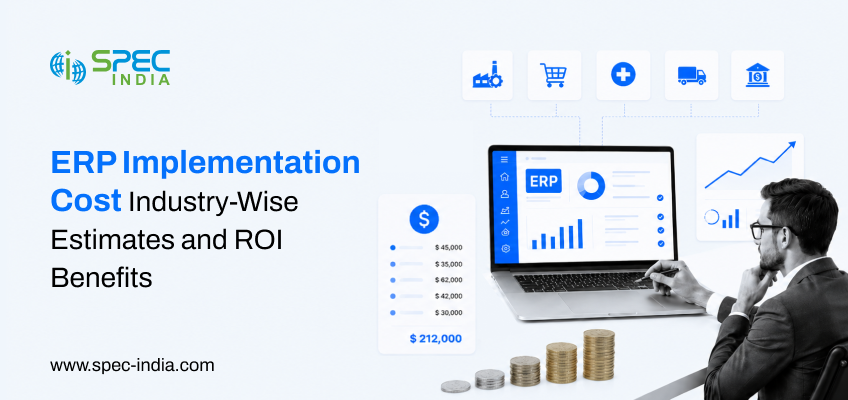
Let’s get in touch!
India
SPEC House, Parth Complex, Near Swastik Cross Roads, Navarangpura, Ahmedabad 380009, INDIA.
-
 +91-79-26404031, 32-33-34
 -
 [email protected]