
Cloud Migration Strategy: A CIO’s Guide to Moving Enterprise Systems to the Cloud
February 9, 2026
For many organizations, moving to the cloud used to be just about upgrading servers or keeping up with technology. However, nowadays it is much more than that.
Moving to the cloud is a strategic decision, one that determines the speed with which your teams can develop, the security of your data flow, the certainty of your costs, and how prepared your business is to whatever the next day brings.
This is why IT leaders cannot treat it like another IT project. Decisions made here spread throughout the organization.
This guide is for decision-makers who care not just about technology, but about real business outcomes. It covers every essential element of a cloud migration strategy. From CIO strategy planning and risk assessment to architecture choices, security considerations, and execution best practices, everything will be covered.
Cloud Migration is No Longer Just an IT Initiative
It is a common challenge to every organization. On the one hand, there are legacy systems, which sustain daily operations. On the other hand, there’s constant pressure to move faster, scale smarter and accept the change without slowing down the business.
Cloud migration sits right in the middle of this tension.
When done right, it becomes a true enabler:
- Faster product launches: New ideas and features reach the market more quickly.
- More resilient systems: Operations stay smooth even when unexpected issues arise.
- Better cost control: Resources are optimized, and spending becomes predictable.
- Improved collaboration: Teams can work together seamlessly, wherever they are.
When done wrong, it may result in high costs, security threats, and frustrated work teams.
The key takeaway?
Migration to the cloud is no longer about the shift of technology but about strategy, planning, and ensuring that the transition brings about value creation. Cloud migration and modernization today has become a critical approach for enterprises, and most of them have already started focusing on it.
What’s Really Driving Enterprise Cloud Migration Today
Whenever organizations mention migrating to the cloud, the first thing that occurs to most people is saving money. However, in practice, cost is merely the tip of the iceberg. The deeper, more urgent reasons are what truly push businesses toward the cloud, and they’re all about keeping pace with change, innovation, and growth.
Here’s what’s really driving the move:
Legacy systems are slowing down innovation.
Most companies remain stuck with outdated software and hardware that stopped being modern years ago. However, in modern times, such legacy systems may serve as anchors. The time spent by teams on the maintenance of old systems is higher than the time spent on the creation of new capabilities. New products, customer experiences, or even minor operational enhancements take longer, which is frustrating and can lead to lost opportunities. Cloud migration relieves these constraints on organizations allowing teams space to be creative without the restraints of outdated technology.
Infrastructure that can’t scale with demand
Conventional infrastructure is static; you purchase hardware and hope it will scale. However, in the modern world, demand may go out of control. Systems can be strained by seasonal sales, market rapid change, or unforeseen growth. Cloud infrastructure scales up or down as needed, allowing businesses to handle peak demand without over-investing in resources that sit idle during slower periods.
Rising maintenance and licensing costs
Repairing outdated systems is not cheap. Licensing charges, patching, replacement of hardware and troubleshooting may consume time and money. The increase in costs every year makes it more difficult to explain why the model should still be used. By adopting cloud computing, these unforeseeable, ongoing expenses would become a flexible, pay-as-you-go model- liberating funds to create something novel rather than to repair.
Fragmented data across departments
In many organizations, data lives in silos: sales has one set of numbers, operations another, and finance yet another. This lack of cohesion slows decision-making, as teams spend more time searching for information than taking action. Cloud platforms consolidate data into a single source of truth. Once all people are able to see the same data in real-time, the process will become more collaborative, the process of decision-making will be quicker, and information will be more actionable.
Increasing security and compliance requirements
The laws have never been tougher, and the price of a data breach can be crippling. Cloud computing service providers spend large amounts of money on security, compliance and disaster recovery, which in most cases, is way more than most organizations could afford. It is not simply about leaving the systems to run on the cloud but about safeguarding information, creating trust, and fulfilling regulatory requirements in a cost-effective manner.
The Real Challenge Isn’t Technology; it’s Purpose.
It is here that most organizations lose the boat and fail to realize that migration has not failed because the tech is bad, but the intent is not obvious.
When there’s no shared understanding of why the move matters, projects can stall, costs can escalate, and teams can become frustrated.
Now How to Approach Cloud Migration with Purpose. Let’s have a look.
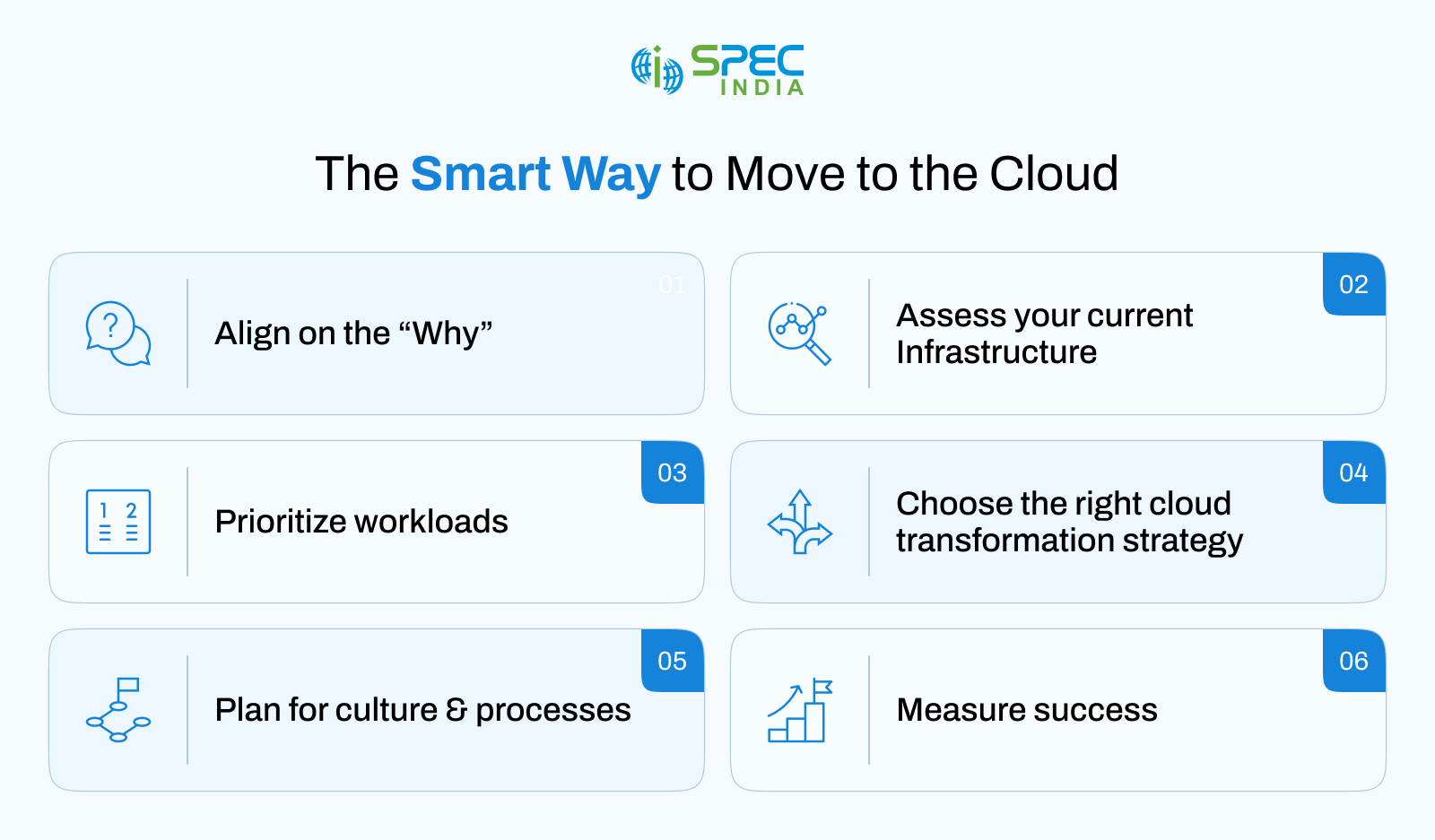
- Align on the “Why”: Leaders must know at a prior stage what they want to achieve. Is it faster innovation, Better security, or do you want to focus on Cost predictability?
- Assess your current Infrastructure: Identify which of your traditional systems are holding you back. Where your bottlenecks exist and what workloads are critical for you. Once you find these details, then think to shoft to the cloud. It is not necessary to migrate enterprise applications to the cloud immediately.
- Prioritize workloads: Some systems are easier and more valuable to move first. Start with workloads that are more important for your enterprise.
- Choose the right cloud transformation strategy: Public, private and hybrid. Each approach has its own pros and cons. Match the strategy to your business needs and choose accordingly. Do not follow what is trending.
- Plan for culture and processes: Migration is not for a one-person comfort. Your each teams need training first, and processes should be changed across departments.
- Measure success: Define metrics for speed, cost, reliability, and security. Monitor progress continuously to ensure the move delivers real value.
When organizations follow this approach, they get the best. It is because cloud migration is not a waterfall project but a growth, agile and long-term winning strategy that the organization pursues.
Cloud Migration Models: Finding the Best Fit
Migration to the cloud is not a one-size-fits-all process. Each system, application, or workload, and each organization, has its own needs and its own priorities, which could be speed, cost, scalability, or compliance. This is also where enterprise application modernization plays a critical role alongside cloud migration. That is why it is important to learn the various cloud migration models. The selection of appropriate approaches during the first phase may save time, risk and also make your cloud investment worth as much as possible
Here’s a clear breakdown:
1. Rehosting (Lift and Shift)
Think of this as “picking up what you have and moving it to the cloud.”
- What it is: Applications that are already present are migrated to cloud infrastructure with minimal alterations.
- Why it works: It is fast and straightforward, perfect for tight deadlines or for organizations making their own cloud migration strategy.
- When to use it: It is best suited to workloads that require rapid availability or those that are just beginning with the cloud.
- Trade-off: You will not yet enjoy the full capabilities of cloud-native, such as auto-scaling or serverless computing. It is quick, but it is more of a tactical, not a strategic step.
2. Replatforming
Here, you do minor optimization as you move to the cloud.
- What it is: Applications are not fully redesigned, but only minor modifications are made to take advantage of certain cloud capabilities.
- Why it works: Improves performance, efficiency and cost-effectiveness and keeps migration as a rather low-risk venture.
- When to use it: Applicable to businesses that require speed (migrate faster than a complete redesign) and some cloud-native benefits.
- Trade-off: You will have greater advantages than rehosting, yet not the complete flexibility of a cloud-native architecture.
3. Refactoring (Re-architecting)
This is the deep-dive approach.
Applications are redeveloped and re-architected to run on the cloud. They become cloud-native and support such features as serverless functions, microservices, and auto-scaling.
- Why it works: The most long-run efficient, scalable and flexible.
- When to use it: Useable in the most critical applications in which future growth, performance, and innovation are most important.
- Trade-off: It is costlier and more costly up-front, but the payoff is a future-proof system that is modern.
4. Hybrid and Multi-Cloud
It is not necessary that everything has to be in a single cloud; sometimes it is the most clever to combine it.
- What it is: A premise system which is interconnected with multiple cloud systems.
- Why it works: Empower your organization to comply with regulatory needs, run legacy systems and yet take advantage of the flexibility of the clouds.
- When to use it: Best suited where the industry has a very high compliance level or a transfer of not all systems can be made easily.
- Trade-off: Needs robust governance and a cautious cloud migration plan to prevent complexity or information silos.
The Key Takeaways
There’s no one best model. The right approach depends on your business priorities, not what’s trending in the market. Ask yourself:
- Do you need speed or long-term flexibility?
- Are there compliance or legacy system constraints?
- How much innovation and scalability do you want from the cloud?
The answers will focus your migration process and make sure that each step produces value, not only technical change.
A Step-by-Step Framework for Successful Enterprise Cloud Migration
A shift to the cloud is not only a technological issue, but a strategic, performance, and planning matter. An effective migration is performed in a systematic manner that is balanced in terms of speed, security and business value. Here are some of the enterprise cloud migration best practices that should be followed:
1. Assess What You Have and What Matters
First, make a clean assessment of what you have. Make a clear and full-fledged cloud migration roadmap.
- Applications and their dependencies (if you have any)
- Which systems are business-critical for you
- Security and compliance requirements of your business
- Performance expectations and bottlenecks
Not all systems have to be moved, and it is possible to introduce a lot of risk when everything is moved simultaneously. Knowing what is important aids in prioritization of workloads and concentration on areas that contribute the greatest value.
2. Define Business Outcomes Early
Migration of a cloud is successful only when it is in tune with actual business goals. Ask questions like:
- What do you think will improve after migration?
- How will teams work differently or more efficiently?
- Where do we expect measurable ROI or impact?
A clear definition of end results at the beginning avoids scope creep, keeps everybody focused and assures the migration results in concrete changes, not merely technical change.
3. Choose the Right Cloud Strategy
Cloud isn’t one-size-fits-all. Select the most appropriate public, private, hybrid and multi-cloud that best satisfies your requirements and consider:
- Cost: Spend efficiently without making any tradeoffs.
- Control: Have a balance between autonomy and centralized governance.
- Compliance: Adhere to regulatory and industry requirements appropriately.
- Scalability: Be sure that the infrastructure is scalable.
The strategy should be suitable and must align to the business imperatives and should not be a surprise towards the later stages of the migration process.
4. Build Security and Compliance Into the Plan
Consider security in priority. Do not take it lightly, as your business must fulfil all the compliance criteria.
- Consider Identity and access management.
- You also have to focus on Data encryption and protection.
- Make sure to do Compliance mapping to industry regulations, as they must match.
- Disaster recovery and business continuity planning also need to be considered.
These choices will enable your cloud-based environment to be resilient and trustworthy in the future and minimize risks that are likely to appear in the future.
5. Execute in Phases, Not a Big Bang
A steady and well-planned cloud migration has several benefits which you can consider. Like –
- Migrating to the cloud reduces operational risk.
- It Minimizes downtime for users at large scale.
- It even builds internal confidence as teams see early successes.
Start with the systems that are not so critical, or at least pilot projects and move on. First wins generate momentum and make the transition process painless to all.
6. Optimize After Migration
Migration is only the start. The constant optimization of your cloud environment ensures future benefits:
- Cut down on control expenses and eradicate wasteful expenditure.
- Optimize performance in terms of tuning.
- Use continuous enhancement as an adaptation to the evolving requirements.
A post-migration focus is what turns the cloud into something more than a new infrastructure, but a place of innovation and agility as well.
Common Cloud Migration Challenges (and How Leaders Avoid Them)
Even well-planned cloud migrations can face challenges. The relocation of systems to the cloud is not merely a question of technologies, but it reaches in processes, people, and business priorities. What appears to be a complex system, a lack of skills in the teams, and unplanned downtime can cause disruption in the day-to-day running of a business, especially legacy systems. Without governance, costs rise and resistance builds. Clear leadership and communication help turn friction into progress.
Here are some of the most common risks and challenges of cloud migration and ways to address them:
- Perform the full evaluation and develop extensive clear toad maps to learn the interrelation and prevent surprises.
- Deploy gradual rollouts, pilot projects, and fallback strategies to reduce disruption.
- Create cost management report, monitor utilization, and introduce monitoring at the beginning to control costs.
- Fill the knowledge gaps by combining internal ownership and external expertise, or enterprise cloud consulting.
- Confidence and buy-in are built by clearly communicating the benefits, engaging teams early, and providing proper training.
There is often a fine line between the migration that stalls and one that drives real value, and in this case, the difference is often the leadership involvement steering the strategy, assisting teams and ensuring the focus on the business outcomes.
Security, Compliance, and Data Governance: The Leadership View
Security has always been on the mind of all, and it is not in vain when it comes to the migration to the cloud. These are not merely technical problems that result in data breaches,
compliance risks, and downtime, but those that affect trust, reputation and business continuity. The good news? Contemporary cloud systems are developed to be safe, but not until you manage them in the proper manner.
This is taken seriously at SPEC India. Our AI infrastructure is ground-up secure and reliable. All the layers, including cloud deployment, AI workloads, and access controls, are strongly secured by encryption and constant monitoring. Our cloud services are of the highest industry standards, and the organizations have trust that their data is secure at any point in time.
But security is not about technology alone, it is about people, processes and a sense of responsibility.
Here’s what really makes a difference:
- Everyone knows their role: Security gaps normally occur when the roles are vague. Each member of the team is fully aware of what he or she owns and what he/she is responsible for.
- Access based on need, not convenience: Role-based access guarantees that sensitive data is not seen by the wrong individuals without shortcuts, without any loopholes.
- Rules that actually stick: Data handling, retention, and sharing policies are implemented on a regular basis. Automation assists in minimizing the amount of human error and makes systems safe.
- Backups that actually work: Errors occur, systems fail, threats develop. Tested backup and disaster recovery plans help you to recover fast without panicking.
When it comes to regulated industries, cloud migration does not necessarily need to complicate compliance; on the contrary, it can simplify and make it more transparent. With our secure cloud setup, AI workloads, and adherence to strict standards, you get both innovation and peace of mind.
Measuring Cloud Migration Success
Moving to the cloud isn’t just about lifting workloads off on-premises servers—it’s about achieving real business outcomes. Paying attention to technical measures such as server uptime or the speed of migration does not paint the full picture. The real success is realized when the cloud makes the organization work more effectively, be more responsive to change, and provide superior customer and team experiences. The leadership must have measures that indicate that the migration is not a technical process, but a strategic initiative that creates quantifiable value throughout the business.
Some of the key indicators to track include:
- Reduction in infrastructure costs: Are we spending less and saving more while maintaining or improving performance?
- Improved application performance: Are applications becoming faster and more reliable?
- Faster deployment cycles: Are teams able to release features or updates faster?
- Higher system availability: Does it lessen the time of downtime and make the operations more resilient?
- Increased business agility: Are your teams responding to market changes or internal needs more efficiently?
Once the measures of success become directly connected to the business results, cloud migration ceases to be IT only, but becomes a manifested source of growth, efficiency, and competitive advantages of the whole company.
Cloud Migration Strategy Looks Different Across Industries
The cloud migration scalability, reliability, and cost-efficiency principles are the same, yet priorities and focus areas vary according to the industry. A powerful cloud transformation strategy understands that people are different and that one should not make everyone the same.
Here’s how cloud needs vary across sectors:
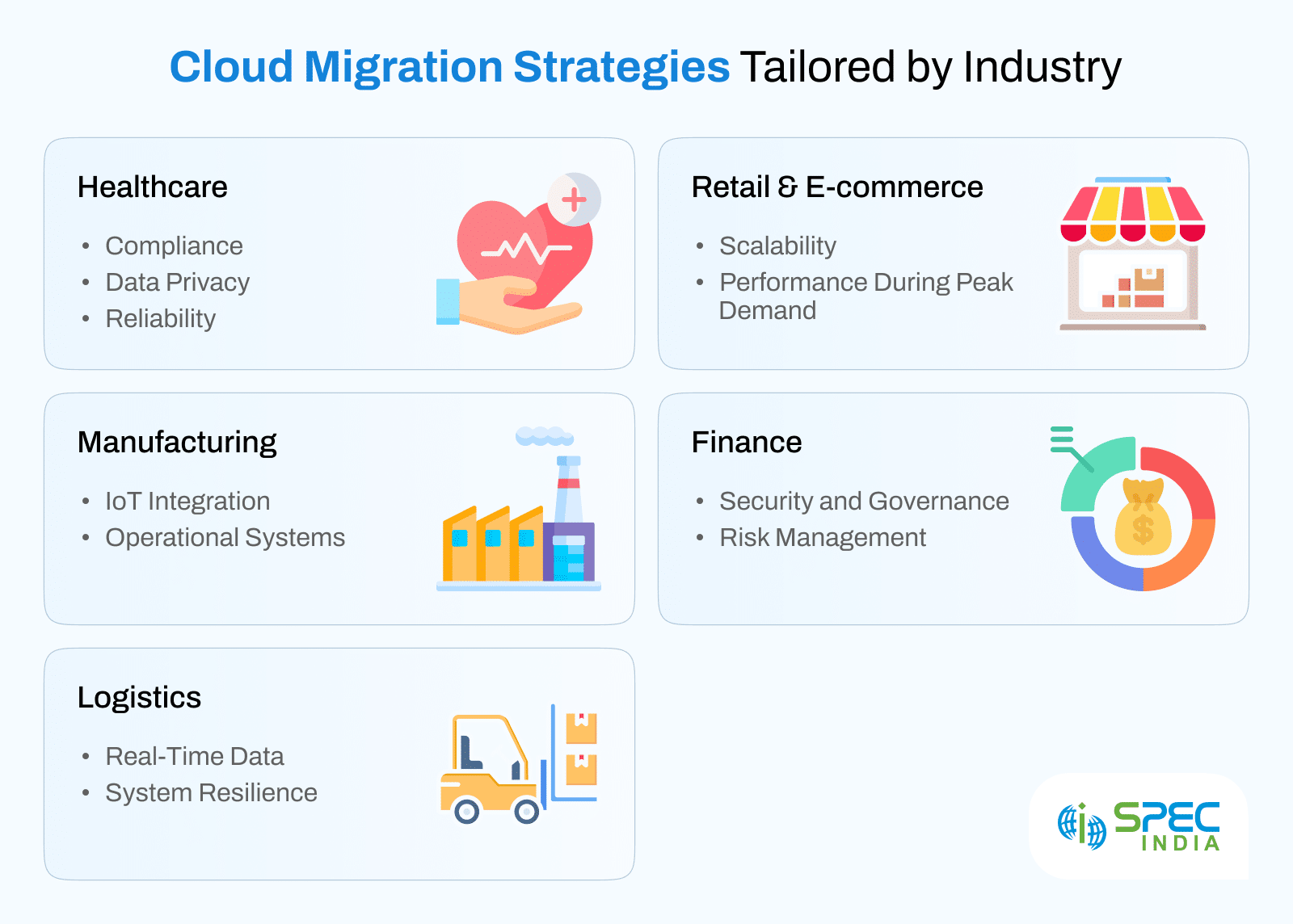
Healthcare: Compliance, data privacy, reliability
The information about patients is extremely sensitive, and rules such as HIPAA in the U.S. or GDPR in Europe should be followed rigidly. To illustrate this, a hospital that has been moving its electronic health record system to the cloud requires secure access, an encrypted storage, and a disaster recovery plan to ensure the care to patients is not affected.
Retail & eCommerce: Scalability, performance during peak demand
Retailers experience huge surges when it comes to selling products during a holiday or launching new products. Cloud infrastructure also enables an online store to scale automatically when the traffic becomes heavy. As an example, millions of visitors can access an eCommerce platform simultaneously during Black Friday, and the platform will not slow down or crash, making the experience smooth.
Manufacturing: Integration with IoT and operational systems
The modern-day factories rely on interconnected machines and sensors to monitor production in real time. Through the migration of manufacturing systems to the cloud, it is possible to easily integrate with IoT devices, predictive maintenance, and data analytics to become smarter in its functioning. An example is that a car manufacturer can track the condition of equipment and supply chain performance in real-time in many plants at once.
Finance: Security, governance, risk management
Banks and other financial institutions deal with very sensitive financial information that is highly regulated. Encryption, stringent access control, audit trail, and adherence to regulatory requirements such as PCI DSS should be the key concerns of cloud usage. When a bank is migrating its core banking system to the cloud, a security and audit of all transactions should be in place.
Logistics: Real-time data and system resilience
The supply chains require real-time information that is precise and timely to coordinate shipments, inventory and deliveries. Logistics platforms run on clouds offer real-time tracking, predictive analytics and redundancy in the system in order to ensure that the operations proceed even in the event one system fails.
The Takeaway: a one-size-fits-all cloud strategy doesn’t work. Every industry has its priorities, which are most important, and a wise cloud strategy would not ignore the differences but still be able to take advantage of the flexibility, scalability, and efficiency of the cloud.
Choosing the Right Cloud Migration Partner
Going to the cloud is not only a matter of moving workloads but also the right choice at each point. The correct partner is not one who simply performs some sort of migration, but one that leads strategy, solves problems and makes the cloud a platform to grow the business and not another headache.
We offer an end-to-end cloud migration experience, enabling businesses to strategize, implement, and streamline the process and keep business outcomes a priority. Our team of seasoned cloud experts knows the best cloud migration strategy for enterprises, and considering it, we help you in all steps of migration. Based on this, we support you through every stage of migration—from evaluating your current infrastructure to adopting cloud-native solutions. We help you build AI-ready and robust infrastructure while ensuring security and compliance throughout the process.
As the best cloud service provider –
- We have experience in dealing with complicated migrations within various industries that will produce foreseeable outcomes.
- We assist organizations in creating secure cloud infrastructures, implementing control, and addressing regulatory needs without interruption.
- SPEC India provides solutions to the specific requirements of individual industries, whether it is healthcare, finance, retail or logistics.
- Migration is not the end; systems remain efficient and reliable through continuous monitoring, optimization of costs, and performance tuning.
- Clear and transparent communication makes sure that all stakeholders are aware of progress, risks, and outcomes.
The right partner doesn’t add complexity; they reduce uncertainty and make the cloud a true business enabler. Under the guidance of SPEC India, organizations will have no doubts about the migration process and can get all the excellent opportunities of cloud technology.
Final Thought: Cloud Migration is a Leadership Decision
Migration to the cloud does not concern the location of your servers.
It is about your ability to adapt to your business, the speed at which your company can scale, and how safe it can be in the changing digital world.
It is not only about migrating systems but also about establishing a platform for what your business will require tomorrow. A clear cloud migration plan can save your rework for tomorrow.
Ready to see how a structured cloud migration can transform your business?
Explore our Cloud Migration Services to learn how SPEC India guides organizations from planning to optimization.
Frequently Asked Questions
Cloud migration has an effect on operation, costs and security. Lack of strategy means organizations will encounter downtime, overruns in budgets, and a lack of alignment. An obvious plan will help to align priorities, expect difficulties, and the migration will bring the actual business value.
Companies tend to begin with less risky systems such as email, collaboration tools, test/dev environments, or analytics platforms. This will enable them to practice and be assured before proceeding with mission-critical systems such as ERP or finance.
The major threats are unforeseen downtime, increased expenses, lack of security, interteam resistance, and the legacy system complexity. This can be curbed by gradual implementation, effective communication and robust oversight by leaders.
The migration of core systems and ERP can enhance the system scalability, performance and data accessibility. It lowers maintenance and allows responding faster to change; however, without proper planning, operations can get disrupted, and this is why gradual migration and testing are necessary.
Public cloud is inexpensive and scalable, private cloud is controllable and secure, and hybrid is a combination of the two. The decision relies on prioritizing cost, compliance, control and business.
Cloud costs can be managed by monitoring usage, right-sizing resources, enforcing governance, and optimizing continuously. Proactive cost management ensures efficiency without overspending.
Governance defines responsibilities, enforces policies, and reduces risks. It keeps cloud operations secure, compliant, and aligned with business goals, preventing chaos and uncontrolled costs.

SPEC INDIA is your trusted partner for AI-driven software solutions, with proven expertise in digital transformation and innovative technology services. We deliver secure, reliable, and high-quality IT solutions to clients worldwide. As an ISO/IEC 27001:2022 certified company, we follow the highest standards for data security and quality. Our team applies proven project management methods, flexible engagement models, and modern infrastructure to deliver outstanding results. With skilled professionals and years of experience, we turn ideas into impactful solutions that drive business growth.
Table of contents
- Cloud Migration is No Longer Just an IT Initiative
- What’s Really Driving Enterprise Cloud Migration Today
- The Real Challenges
- Cloud Migration Models
- A Step-by-Step Framework for Successful Enterprise Cloud Migration
- Common Cloud Migration Challenges & How to Avoid
- Security, Compliance, and Data Governance
- Measuring Cloud Migration Success
- Cloud Migration Strategy Across the Industries
- Choosing the Right Cloud Migration Partner
- Final Thought
Delivering Digital Outcomes To Accelerate Growth
Let’s TalkTable of contents
- Cloud Migration is No Longer Just an IT Initiative
- What’s Really Driving Enterprise Cloud Migration Today
- The Real Challenges
- Cloud Migration Models
- A Step-by-Step Framework for Successful Enterprise Cloud Migration
- Common Cloud Migration Challenges & How to Avoid
- Security, Compliance, and Data Governance
- Measuring Cloud Migration Success
- Cloud Migration Strategy Across the Industries
- Choosing the Right Cloud Migration Partner
- Final Thought
Delivering Digital Outcomes To Accelerate Growth
Let’s Talk
Let’s get in touch!
India
SPEC House, Parth Complex, Near Swastik Cross Roads, Navarangpura, Ahmedabad 380009, INDIA.
-
 +91-79-26404031, 32-33-34
 -
 [email protected]