| Feature | CRM (The Front Office) | ERP (The Back Office) |
|---|---|---|
| Primary Focus | Customer Acquisition & Retention | Operations, Finance & Supply Chain |
| Data Types | Leads, Emails, Meetings, Support Tickets | Orders, Invoices, Inventory, Payroll |
| Goal | Drive Intent and Engagement | Drive Execution and Compliance |


Loading...
CRM Integration with ERP: Creating a Unified View of Customers
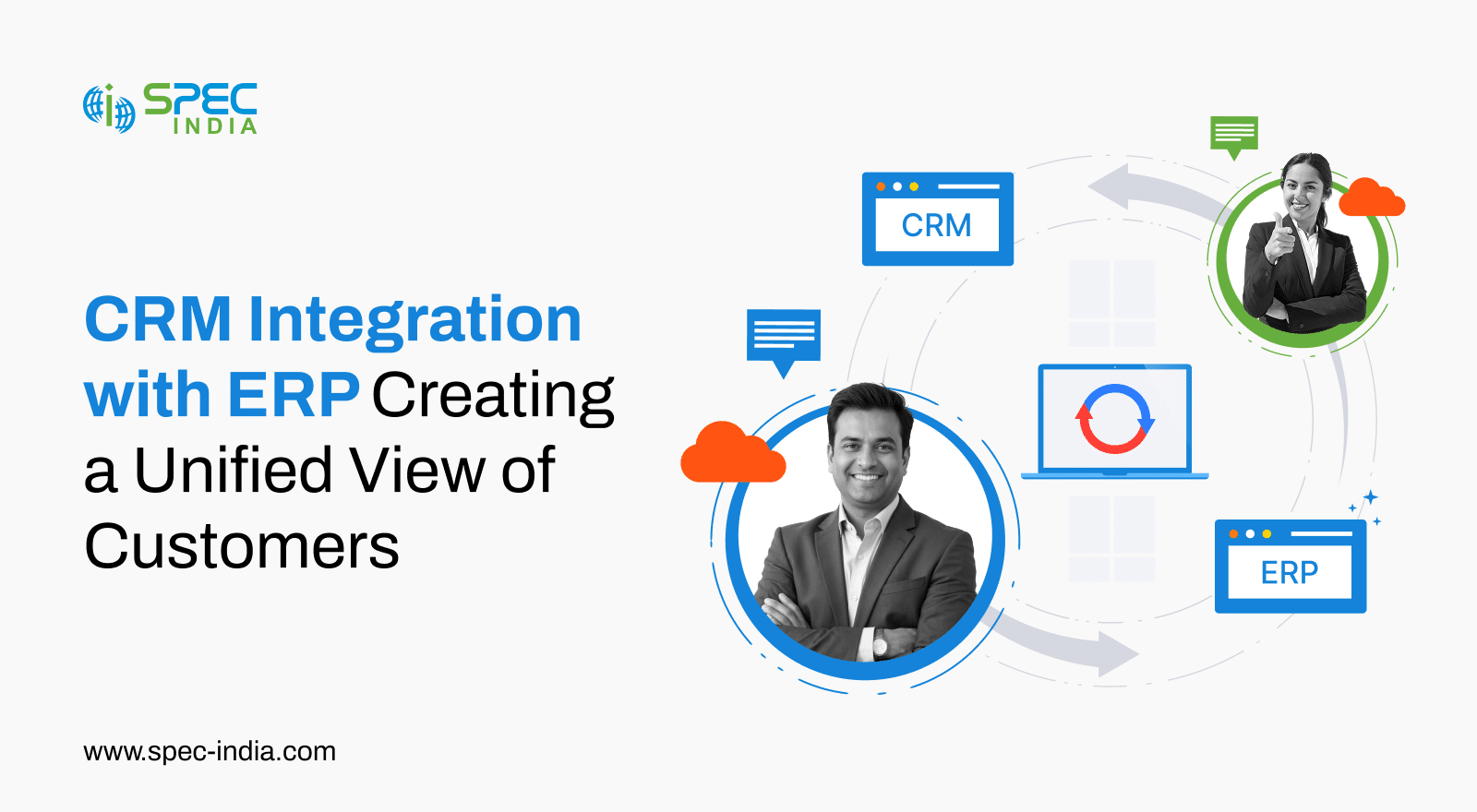
Every business decision starts with data, yet in most companies, that data is split in half. Sales teams live in the CRM to track leads and relationships. Finance and operations live in the ERP to manage billing and fulfilment.
When these two worlds don’t talk, you lose the “Big Picture.” You might know what a customer wants (CRM), but you don’t know if you’ve actually delivered it profitably (ERP). That is why CRM and ERP integration has moved from a “nice-to-have” to a survival requirement for growing enterprises.
Why the Silos Still Exist (And Why They’re Costing You)
Even in 2026, most large organizations still struggle with data silos. It usually comes down to two things: History and Complexity.
- The Ownership Gap: Traditionally, CRM was “owned” by Sales for pipeline management. ERP was “owned” by Finance to manage the books. They grew up on two different islands, each with a different language.
- The Reconciliation Trap: Without integration, teams spend hours manually matching spreadsheets. CRM shows the “Intent” (the signed contract), while ERP shows the “Execution” (the actual invoice). If these aren’t connected, you’re flying blind.
According to Gartner, businesses with disconnected front and back offices face slower decisions and higher overhead. As you scale into new regions, these gaps don’t just stay annoying; they become expensive.
The Unified View:
When you integrate them, you stop seeing “leads” and “orders” as separate things. You see a Unified Customer View. You can see that a high-value lead in your CRM is the same customer with three overdue invoices in your ERP.
According to McKinsey, companies that bridge this gap achieve higher customer satisfaction and far better revenue predictability. You aren’t just moving data; you’re creating a scalable foundation for growth.
The CRM: Managing the Relationship (The “Promise”)
Think of the CRM as your System of Engagement. It is the digital home for your sales, marketing, and service teams. This is where you track every handshake, every email, and every “almost” deal.
What your CRM tells you:
- Lead Tracking: Who are the prospects, and how did they find us?
- Engagement History: What was said in the last meeting?
- Intent: What is the customer looking for right now?
Pipeline Visibility: Where are the bottlenecks in our sales process?
The Gap: The CRM is great at showing you what was promised. But it can’t tell you if that promise was kept. It doesn’t know whether the warehouse shipped the product or whether the customer paid the invoice. For that, you need the ERP.
The ERP: Managing the Operations (The “Delivery”)
If the CRM is about the promise, the ERP modernization is the backbone of the delivery. It is your system of record for everything that happens after a deal is signed. It’s built for accuracy, compliance, and execution.
What your ERP tells you:
- Order Fulfillment: Did the product leave the warehouse?
- Inventory Levels: Do we actually have what the customer just bought?
- Invoicing & Payments: Is the customer’s account in good standing?
- Financial Compliance: Is the transaction recorded correctly for the tax man?
The Gap: The ERP excels at execution but lacks context. An operations team might see an order in the ERP and fulfill it without realizing that the customer in the CRM is currently furious about a previous service delay. Without that context, you risk fulfilling an order only to lose a customer.
The Bottom Line: Moving from “Half-Truths” to Full Visibility
Without CRM and ERP integration, you are forced to manage your business through two disconnected lenses:
- Sales (CRM) sees the relationship but misses the reality of fulfillment.
- The Operations (ERP) system sees the transaction but misses the relationship history.
Integrating these two doesn’t just “link software,” it connects your team’s intent with your company’s execution. It ensures that when Sales makes a promise, Operations has the customer master data needed to deliver on it.
What CRM ERP Integration Actually Means?
In a growing enterprise, customer data integration isn’t just a technical “bridge” between two apps. It’s about ensuring your Sales Intent and Operational Reality are always aligned.
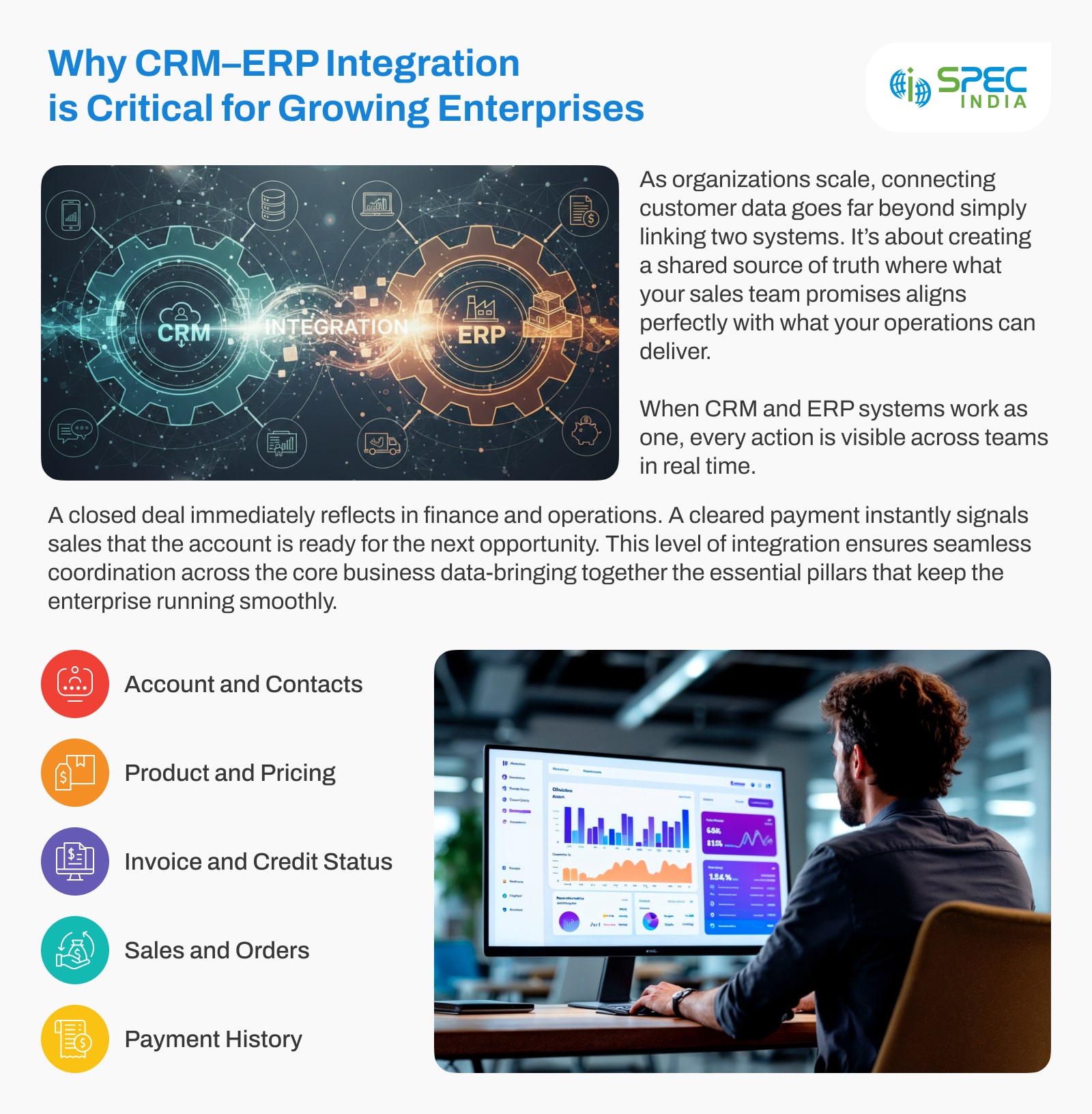
True CRM-ERP integration means that when a salesperson closes a deal, the finance team sees the order instantly. When a customer pays an invoice, the sales team knows they are eligible for upselling. It’s about synchronizing the “Big Five”:
- Accounts & Contacts
- Products & Pricing
- Sales Orders
- Invoices & Credit Status
- Payment History
One of the biggest mistakes is blurring the lines. In a healthy customer data integration, the CRM owns the relationship (the “Who”), while the ERP owns the transaction (the “What”). Integration links these two without creating a mess of accountability.
Why a “Unified Customer View” is Your Growth Engine
A unified view means you no longer see customers as “Leads” in one tab and “Invoices” in another. You see them as a complete relationship.
When your teams share a common view, you get Revenue Predictability. You aren’t guessing who will pay or when you need to restock. According to McKinsey, this level of visibility is the #1 driver of customer satisfaction. If you can’t see the full story, you can’t provide a premium experience.
1. Retail Industry
In retail, customers don’t care about your internal silos. They expect you to know their history, their preferences, and their order status instantly. Without enterprise system integration, you are essentially flying blind.
A unified view in Retail allows you to:
- Connect Behavior to Inventory: If a promotion goes viral in your CRM (Marketing), your ERP (Inventory) needs to be ready.
- Personalize the Fulfillment: Knowing a customer’s purchase history enables you to offer smarter returns and more personalized shipping updates.
- Kill the “Where is my order?” headache: Your support team can view the shipping status directly in the CRM from the ERP, resolving issues in one phone call instead of four.
2. Manufacturing
In manufacturing, a “sale” is rarely just a transaction; it’s a long-term contract with complex pricing and production schedules. If your Sales team is promising delivery dates without seeing your actual production capacity, you’re setting yourself up for failure.
With CRM-ERP synchronization, you gain:
- Production Visibility: Sales teams can view the real-time status of orders on the factory floor.
- Accurate Forecasts: When your CRM pipeline integrates with your ERP, production planning becomes proactive rather than reactive.
- Consistent Pricing: No more “special deals” that the finance team can’t support or bill correctly.
3. Logistics & Freight Forwarding
In logistics, your service is the product. Customers aren’t just paying you to move a box; they’re paying for the peace of mind that comes with knowing exactly where that box is and what the final bill will look like.
When your CRM and ERP are disconnected, that transparency disappears. With a custom mobile ERP in place, here’s how bringing them together kills the friction:
- Lead-to-Order Speed: Once a quote is approved in your CRM, it should be recorded in the ERP as an active shipment. No manual re-entry, no “waiting for the email to be seen,” and no data entry errors. It’s a seamless handoff from the sales rep to the operations team.
- Ending the Billing Wars: Most billing disputes in logistics arise when field shipment data doesn’t match the office invoice. By syncing these systems, you stop the endless “back-and-forth” emails. The invoice is based on the actual shipment data for the period.
- The “One-Window” Reality: Your support team shouldn’t have to play detective. With an integrated view, they can see shipment status, payment history, and past invoices on one screen. They can answer a customer’s question in 30 seconds rather than 30 minutes.
4. Healthcare
In healthcare, fragmented data does more than just slow you down; it erodes patient trust. While your CRM is busy managing appointments and patient outreach, your ERP is handling the complex, high-stakes world of medical billing and procurement. If they aren’t in sync, the patient experience falls apart.
Integration creates a “Single Source of Truth”:
- One Record, One Team: Your patient service team and your billing department are finally looking at the same thing. No more “I don’t see that on my end” conversations.
- Accuracy by Default: By eliminating “Double-Entry,” you eliminate manual errors that lead to billing delays or, worse, compliance headaches.
- The Seamless Journey: Patients have a consistent experience from booking their first appointment in the CRM to paying their final bill in the ERP.
5. Energy & Utilities
Utility providers manage significant spikes in data usage, service outages, and massive regulatory billing cycles. Without integration, your customer support team is essentially working in the dark, reacting to problems after customers have already called to complain.
With an integrated CRM-ERP foundation, you move from reactive to proactive:
- The “Check-in” Advantage: If the ERP detects a sudden spike in usage or a billing anomaly, it can trigger a “Check-in” email through the CRM. You solve the problem before the customer even gets their bill.
- Killing “Bill Shock”: When a service request (such as a meter change) is logged in the CRM, it is instantly synced to the ERP. This ensures the next bill is accurate, reducing complaints and the high cost of manual adjustments.
- Regulatory Peace of Mind: You get a single, audited trail of every interaction and transaction. When it’s time for a regulatory check, you’re pulling customer master data from one clean source, not five different silos.
How Integration Powers “RevOps” (Your Revenue Engine)
In 2026, growth isn’t just about selling more; it’s about Revenue Operations (RevOps), the art of making your Sales, Finance, and Operations teams pull in the same direction. When your CRM and ERP are siloed, your revenue leaks through the cracks of manual handoffs and “guesswork” billing.
Integration turns your RevOps from reactive to proactive:
- Lead-to-Invoice Visibility: You can finally track the exact ROI of a lead from the first marketing click all the way to the final paid invoice. No more “I think this campaign worked” conversations.
- Faster Cash Flow: The moment a deal is “Won” in the CRM, it should trigger an invoice in the ERP. Why wait days for a manual handoff? Integration eliminates paperwork lag and enables faster cash deposits.
- Forecasting That Actually Works: Instead of sales reps giving you “gut feelings” about their pipeline, your forecasts are backed by real-time data from both the front office (intent) and the back office (historical payment behaviour).
The Bottom Line: Gartner predicts that 75% of high-growth companies will adopt a RevOps model by the end of 2026. They aren’t doing it to follow a trend; they’re doing it to stop “deal slippage” and cut operational waste by up to 30%.
How SPEC India Enables CRM-ERP Integration at Scale
Successful CRM-ERP integration is more than a technical handshake between two software programs. In an enterprise environment, it is a business transformation initiative. At SPEC India, we’ve seen projects fail when they focus on the “tools” before the “truth.”
If your data ownership isn’t clear, integration just creates a faster way to spread incorrect information. We approach integration by first defining how customer data should move to support your specific business goals, whether that’s shortening your “Quote-to-Cash” cycle or improving field service accuracy. This approach is central to our ERP integration services, designed to deliver accurate data flow and measurable business impact.
A Strategy-First Methodology
We don’t start with coding; we start with a Discovery and Roadmap phase.1 We map every customer touchpoint and transactional workflow to ensure the architecture supports your long-term scalability.
Our approach ensures:
- Data Sovereignty: We help you decide which system “owns” the truth for every field (e.g., CRM owns the Lead Status; ERP owns the Credit Limit).
- Process Alignment: We ensure that a “Won” deal in Sales triggers the right production or fulfillment steps in Operations without manual intervention.
- Future-Ready Architecture: We build with modular layers (such as APIs and Middleware) so you can upgrade one system without breaking the other.
Driving Adoption: Turning Tech into ROI
Let’s be honest: a perfect integration is a waste of money if your team doesn’t trust the data. If they’re keeping “private spreadsheets” on the side because they don’t trust the CRM, you’ve lost. We focus on Usability and Accuracy to make sure the system is helpful, not a chore.
The Wins You’ll Actually Feel:
- Killing the Shadow Spreadsheets: When the data is right every time, those “private trackers” disappear. Your team finally works from one source of truth.
- Closing the “Order-to-Cash” Gap: By cutting out the manual handoffs between sales and finance, you remove the friction that keeps you from getting paid. You get cash in the bank faster.
- Ending the Blame Game: When Sales and Operations view the same real-time dashboard, finger-pointing stops. Everyone is accountable because the data doesn’t lie.
The Final Step on Your Roadmap
Digital transformation isn’t some destination you eventually “reach”—it’s a muscle you build. Whether you’re just taking the first steps with Business Intelligence, scaling up with AI, or finally getting your CRM and ERP to stop fighting and start talking to each other, you aren’t just buying another piece of software. You are building a version of your company that is faster, sharper, and, frankly, much harder for your competitors to keep up with.
The real question is: Are you ready to stop managing “silos” and start managing your strategy? If you’re tired of patchwork fixes and want to see what a unified system looks like for your business, connect with our specialists here for CRM-ERP integration solutions, and let’s get a plan in motion.
Frequently Asked Questions
Without it, you’re essentially running two different companies that don't talk to each other. Your teams end up paying a "fragmentation tax," wasting half their day manually fixing data errors and chasing half-truths across disconnected spreadsheets.
It bridges the gap between customer conversations and actual bank transactions. By linking sales activity directly to financial records, every department finally sees the same "single source of truth" regarding order history and billing.
It kills off the "silent killers" of growth: duplicate records, delayed invoices, and revenue leakage. It tightens up the entire order-to-cash process so you can stop guessing your forecast accuracy and start trusting your data.
The biggest hurdle is often a data "identity crisis" where systems use different names for the same client. Success depends on deciding which system "owns" specific data points and building a solid bridge between modern cloud apps and older legacy software.
It ensures your customers never have to repeat themselves to three different departments. With synced data, your team can provide instant updates on order status or billing, leading to much faster responses and a lot less friction.
Only for the "heartbeat" data that affects a customer right now, such as inventory or credit holds. For everything else, like historical reports or address changes, a nightly batch sync keeps your systems running fast without creating unnecessary data noise.
Absolutely, if you use a modular architecture. By building flexible connections from the start, you can add new business units or higher volumes without having to rip everything out and start over.
SPEC INDIA is your trusted partner for AI-driven software solutions, with proven expertise in digital transformation and innovative technology services. We deliver secure, reliable, and high-quality IT solutions to clients worldwide. As an ISO/IEC 27001:2022 certified company, we follow the highest standards for data security and quality. Our team applies proven project management methods, flexible engagement models, and modern infrastructure to deliver outstanding results. With skilled professionals and years of experience, we turn ideas into impactful solutions that drive business growth.
Table of contents
Delivering Digital Outcomes To Accelerate Growth
Let’s TalkTable of contents
Delivering Digital Outcomes To Accelerate Growth
Let’s Talk
Let’s get in touch!
India
SPEC House, Parth Complex, Near Swastik Cross Roads, Navarangpura, Ahmedabad 380009, INDIA.
-
 +91-79-26404031, 32-33-34
 -
 [email protected]