

Cloud Migration Risks and How Enterprises Can Mitigate Them
February 12, 2026
Cloud adoption is high on the priority list for almost every enterprise right now, mostly because everyone is chasing better scalability and a leaner bottom line. But here’s the reality: once you start moving critical workloads, things usually get a lot messier than the brochure promised. What starts as a simple modernization push can spiral into a series of serious cloud migration risks if your planning and governance aren’t perfectly aligned from day one.
Gartner’s 2024 research backs this up: a huge chunk of enterprise migrations are hitting major delays, blowing past budgets, or just plain underperforming. The thing is, the tech itself is rarely the problem. These headaches usually stem from tangled legacy systems, hidden security gaps, or just not being culturally ready for the shift.
Many enterprises encounter cloud migration problems such as application downtime, data security concerns, and escalating cloud costs soon after migration begins. Without a structured approach to cloud migration risk assessment, teams often react to issues instead of preventing them. This reactive posture increases operational disruption and weakens confidence in cloud initiatives.
In this post, we’re digging into the most common migration pitfalls and the actual strategies you’ll need to keep things on track. We’ve broken down the technical, security, and business risks along with some sector-specific hurdles to give you a practical way to lower your exposure while you push toward a modern, sustainable cloud-first setup.
The High Cost of Underestimating the Cloud
Cloud migration is often sold as just another “tech upgrade,” but for a real enterprise, it’s a total shift in how you handle data and operations. A lot of teams underestimate this, assuming they can just “lift and shift” existing systems with zero changes. Honestly, that single assumption is where most cloud migration risks actually start.
One of the biggest risks of moving to the cloud is the sheer complexity of legacy systems. Most enterprise apps have been customized and tweaked for years, leaving them tightly tangled with your on-premise hardware. If you don’t fully map out those hidden connections, you’re looking at performance lags, sudden downtime, and failures that only show up once the migration is already in motion.
Another factor is organizational readiness. Cloud adoption changes operating models, security responsibilities, and cost structures. Without clear ownership and governance, enterprises face cloud migration issues that go beyond technology and affect business continuity and trust.
Understanding the Different Types of Cloud Migration Risks
To actually keep things under control, you have to realize that migration risks aren’t just tucked away in one corner of the IT department. They ripple through your strategy, your tech stack, your security, and your bank account, and each one hits the business in a different way.
Generally speaking, we group these risks into four main buckets:
- Business and strategic hurdles
- Technical and architectural roadblocks
- Security and compliance red flags
- Cost and financial surprises
If you treat every risk like a “tech problem,” your fix is going to be incomplete. A solid cloud migration risk assessment helps you figure out which fires to put out first based on how critical the workload is, what your industry regulators are looking for, and how it’s ultimately going to affect your customers.
Strategic and Business Risks
Strategic headaches usually happen when the decision to move to the cloud isn’t actually synced up with your business goals. We see plenty of companies migrate workloads without a real plan for how the cloud is going to drive growth or improve the customer experience. The end result of cloud migration problems is almost always the same: your costs go up, but the actual value to the business stays a total mystery.
Here are the typical strategic traps:
- Moving apps that don’t really move the needle for the business.
- Flying blind without a clear idea of the ROI on your cloud modernization.
- Different departments are working with totally inconsistent priorities.
If the leadership team isn’t on the same page, your cloud initiatives are going to end up fragmented. Eventually, that just kills confidence in the whole program and drags down adoption across the company. These risks of cloud migration are especially glaring in regulated industries, where even a brief outage can cause major headaches for both customers and compliance officers.
Technical Challenges in Cloud Migration
The most obvious technical challenges in cloud migration usually come down to how your apps actually behave, perform, and fit into the new architecture. Let’s be honest: most enterprise apps were built to live on-premise, and they don’t always take kindly to being shoved into cloud infrastructure.
A few of the main technical roadblocks:
- Apps that just weren’t built to scale up and down automatically.
- Noticeable lag and performance dips once the move is finished.
- Cutting corners on testing those messy, interconnected dependencies.
Another trap we see all the time is confusing a cloud app with a web app. Just because you’re hosting a web application in the cloud doesn’t mean it’s cloud-native. If you don’t redesign for actual resilience and scaling, you’re going to be fighting constant battles with performance and uptime.
If you don’t tackle these technical kinks early on, they’re going to turn into major operational disruptions and a much higher bill to fix things later.
Security and Compliance Risks
Security isn’t just a box to check; it’s probably the biggest cloud migration risk on the table. Moving your workloads to the cloud shifts the “responsibility model” overnight, often much faster than your team is ready for. A lot of organizations fall into the trap of assuming the cloud provider is handling all the heavy lifting, which leaves massive holes in configuration, access control, and monitoring.
The usual suspects in cloud migration security are things like misconfigured storage, loose identity controls, and sloppy encryption habits. These aren’t just minor bugs; they’re wide-open doors for data breaches, especially when you’re moving sensitive data. If you’re in a high-stakes field like healthcare or energy, these slips don’t just put your data at risk; they put you in the crosshairs of regulators.
If you don’t bake a solid security strategy right into your migration plan, you’re going to be chasing your tail with constant “cloud migration issues” that kill trust in the platform and bring your cloud adoption to a grinding halt.
Cost and Financial Risks
While moving to the cloud promises a lot of financial flexibility, “unmanaged” migrations almost always end up costing way more than expected. One of the most overlooked risks of cloud migration is the shift from capital expenditure to variable operating costs.
Enterprises frequently encounter:
- Overprovisioned resources
- Unexpected data transfer charges
- Licensing models that do not align with cloud usage
Without financial governance, these cloud migration problems accumulate quickly. According to Forbes 2024 cloud cost management insights, enterprises that lack cost controls during migration report budget overruns within the first year.
To keep your budget from spiraling, you have to bake cost planning directly into your initial risk assessment; otherwise, financial predictability is just wishful thinking.
Common Cloud Migration Problems Enterprises Face
As a migration picks up speed, you’ll often see operational headaches pop up that can actually threaten your business continuity. Most of these cloud migration issues aren’t actually mysterious; they usually come down to rushed timelines, cutting corners on testing, or simply not realizing how tangled your system dependencies really are.
The most common culprits include:
- Unexpected downtime while you’re trying to make the switch.
- Losing data or dealing with messy synchronization errors.
- That frustrating performance dip that hits right after the move is “finished.”
These aren’t just IT glitches; they hit your customers and your employees directly. When these things go sideways, it kills the team’s confidence in the cloud and makes everyone a lot more resistant to moving anything else in the future. Fixing these risks in cloud migration requires a phased approach and thorough validation at every step.
Industry-Specific Cloud Migration Risks
Most cloud migration risks are universal, but how hard they hit depends entirely on what you do. A “generic” solution rarely works because the stakes are different for everyone.
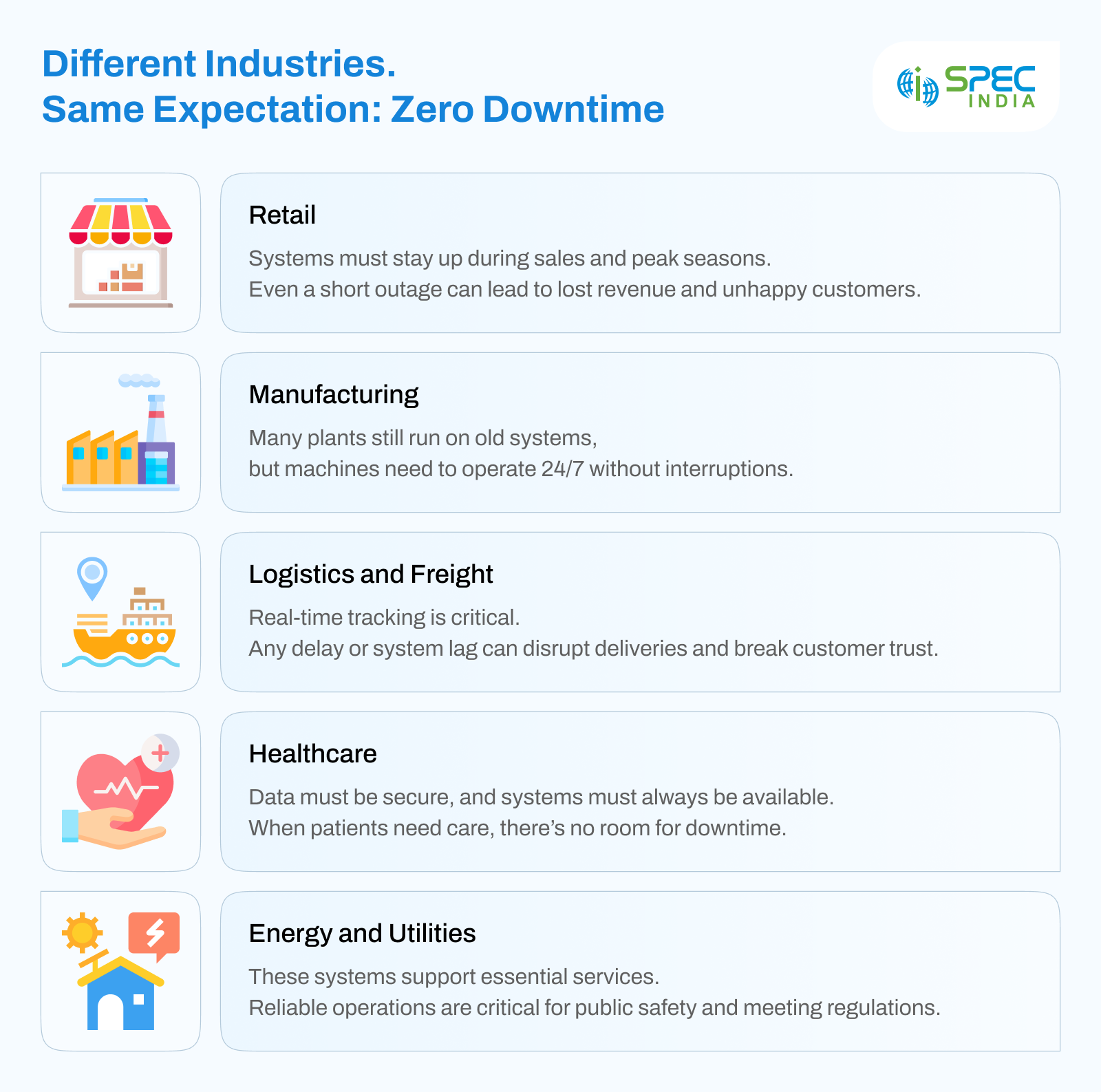
- Retail: It’s all about uptime during peak seasons; one crash during a sale can ruin a quarter.
- Manufacturing: You’re dealing with “dinosaur” legacy systems and the need for 24/7 plant-level availability.
- Logistics & Freight: Everything relies on real-time tracking. Latency isn’t just a nuisance; it’s a broken promise.
- Healthcare: There is zero room for error when it comes to data privacy and making sure clinical systems are live when a patient needs them.
- Energy & Utilities: You’re managing critical infrastructure where reliability is a matter of public safety and strict regulation.
By understanding these nuances, you can stop applying “cookie-cutter” fixes and start building a cloud migration risks and mitigation strategy that actually respects the specific pressure points of your industry.
Why Cloud-First Architecture Increases Both Opportunity and Risk
Going cloud-first architecture is a massive opportunity to modernize faster and finally ditch the “dinosaur” legacy hardware that’s holding you back. When you get it right, it’s the ultimate engine for cloud modernization. But here’s the catch: jumping into a cloud-first mindset before your team or your tech is actually ready is one of the fastest ways to invite serious cloud migration risks into your business.
The real danger is trying to force-feed workloads into the cloud before they’re operationally ready to live there. If you take a legacy app designed for a local server and shove it into a distributed cloud environment, you’re going to run into immediate issues with lag, performance, and reliability. Instead of gaining agility, you end up with a new set of cloud migration issues that can actually cancel out the very benefits you were chasing.
Enterprises that succeed with cloud-first strategies treat them as guiding principles rather than rigid mandates. They evaluate workloads individually, balancing speed with risk control.
How Enterprises Can Mitigate Cloud Migration Risks
Lowering the cloud migration risks and mitigation of a move doesn’t happen through one massive “flip-the-switch” event; it takes a proactive, phased approach. Companies that bake their mitigation strategies into the plan early on are the ones that avoid those nasty budget overruns and business disruptions.
Strategies that actually work:
- Phased Rollouts: Starting with “pilot” workloads to test the waters.
- Security-First Design: Embedding your safety controls into the architecture from day one.
- Tight Governance: Setting clear rules for who has access, how much is spent, and staying compliant.
- Constant Testing: Running checks both before and after the move to catch glitches early.
Following these practices helps you stay on top of the technical challenges in cloud migration without letting your daily operations skip a beat.
Role of Cloud Migration Services in Reducing Risk
Many companies bring in specialized cloud migration services to help untangle the complexity of a large-scale move. An experienced partner brings the kind of battle-tested frameworks and industry-specific tools that internal teams might not have developed yet.
Here’s where a partner makes a difference:
- Cloud Migration Risk Assessment: Walking you through a deep dive to find the traps you might have missed.
- Secure Architectures: Designing a setup that is both scalable and airtight from a security standpoint.
- Priority Planning: Helping you figure out which workloads to move first and how to execute.
- Proven Patterns: Using established migration methods to keep downtime as close to zero as possible.
Especially for teams managing a mess of legacy systems or strictly regulated data, having that external expertise can really speed up the move while keeping the risks of cloud migration to a minimum.
Cloud-Based Application Development vs Lift-and-Shift Migration
One of the biggest forks in the road for any enterprise is deciding whether to modernize an app first or just move it as-is. This choice is a huge deal because it dictates your long-term cloud migration risks.
Lift-and-shift is essentially moving your existing apps to the cloud with almost zero changes. It’s definitely faster and takes less effort initially, but there’s a catch: you’re carrying all your old “legacy baggage” with you. This often leads to higher monthly bills, sluggish performance, and a system that just won’t scale. Most cloud migration problems happen because an app designed for a local server is being forced to live in a world it wasn’t built for.
On the flip side, cloud-based application development is all about redesigning your apps to actually use cloud-native features like automatic scaling and self-healing resilience. Yes, it requires more cash and time upfront, but it wipes out a massive amount of future technical challenges in cloud migration and sets you up for a cloud modernization strategy that actually lasts.
When Lift-and-Shift Makes Sense
Lift-and-shift isn’t always a mistake. There are specific times when speed and playing it safe with risk are your top priorities.
It usually makes sense for:
- Legacy apps that are going to be retired in a year or two anyway.
- Low-stakes workloads where the usage is steady and predictable.
- Emergency moves when you need to get out of a physical data center fast.
Even in these cases, you shouldn’t just walk away. You’ll still want a plan to optimize those apps later to avoid long-term risks of cloud migration.
When Cloud-Based Application Development Is the Better Choice
Building specifically for the cloud is usually the right call for apps that drive your growth, keep your customers happy, or keep your core operations running smoothly.
This approach is ideal when:
- Your apps absolutely cannot afford to go down and need to scale instantly.
- The workloads are customer-facing or directly tied to your revenue.
- The goal is a true cloud-first architecture that doesn’t just “host” apps, but optimizes them.
By matching your app’s DNA to the cloud’s capabilities, you end up with far fewer cloud migration issues and a lot more agility in the long run.
Conclusion
Moving to the cloud is a massive opportunity to sharpen your infrastructure and finally move at the speed of your best ideas. But let’s be real: it also brings some heavy cloud migration risks, hitting your security, your budget, and your day-to-day operations if you aren’t careful. These headaches aren’t usually the cloud’s fault; they almost always come down to rushed planning, “who owns what” confusion, and simply not realizing how tangled enterprise systems can be.
Keeping risks of cloud migration under control isn’t just about the tech; it’s about having a solid backbone of governance and security baked in from the start, and total visibility into where your money is going. When you invest in these foundations, you don’t just avoid disruptions; you build actual confidence with your stakeholders that this move was the right call.
At the end of the day, cloud migration isn’t a “one-and-done” project; it’s a constant evolution. By getting a handle on the cloud migration risks and mitigation plan early, you can step into the cloud with a clear head and a resilient strategy, rather than spending your time chasing reactive fixes and hidden costs.
Frequently Asked Questions
The real "budget killers" are usually security misconfigurations, unexpected cost spikes, and performance lags. These risks skyrocket when you try to move complex legacy systems without a solid plan or an honest assessment of what you’re actually dealing with.
Most projects hit a wall because of poor workload planning, "who owns what" confusion, or simply underestimating how tangled those old system dependencies really are. Without a structured risk assessment, you’re looking at constant rework, delays, and a budget that won’t stop growing.
The secret is "security-by-design," meaning you bake your safety protocols into the move from day one. By tightening access controls, encrypting everything, and being crystal clear on what the cloud provider handles versus what you handle, you can stop breaches before they start.
It’s safe enough for temporary moves or low-stakes tasks, but it carries all your old inefficiencies into the new environment. For your critical systems, leaning solely on "lift-and-shift" usually leads to bloated costs and sluggish performance down the road.
Think of it as your pre-flight checklist. It lets you evaluate how ready your apps are, how sensitive your data is, and what the actual business impact will be. This allows your team to tackle the biggest risks early so they don't turn into disasters mid-migration.
If "cloud-first" becomes a blind mandate, it forces workloads into the cloud before they’re technically ready. This usually results in massive security gaps and performance issues; the architecture should guide your decisions, not ignore your technical reality.

SPEC INDIA is your trusted partner for AI-driven software solutions, with proven expertise in digital transformation and innovative technology services. We deliver secure, reliable, and high-quality IT solutions to clients worldwide. As an ISO/IEC 27001:2022 certified company, we follow the highest standards for data security and quality. Our team applies proven project management methods, flexible engagement models, and modern infrastructure to deliver outstanding results. With skilled professionals and years of experience, we turn ideas into impactful solutions that drive business growth.
Table of contents
- High Cost of Underestimating the Cloud
- Different Types of Cloud Migration Risks
- Common Cloud Migration Problems Enterprises Face
- Industry-Specific Cloud Migration Risks
- Why Cloud-First Architecture Increases Both Opportunity and Risk
- How Enterprises Can Mitigate Cloud Migration Risks
- Role of Cloud Migration Services in Reducing Risk
- Cloud-Based Application Development vs Lift-and-Shift Migration
- Conclusion
Delivering Digital Outcomes To Accelerate Growth
Let’s TalkTable of contents
- High Cost of Underestimating the Cloud
- Different Types of Cloud Migration Risks
- Common Cloud Migration Problems Enterprises Face
- Industry-Specific Cloud Migration Risks
- Why Cloud-First Architecture Increases Both Opportunity and Risk
- How Enterprises Can Mitigate Cloud Migration Risks
- Role of Cloud Migration Services in Reducing Risk
- Cloud-Based Application Development vs Lift-and-Shift Migration
- Conclusion
Delivering Digital Outcomes To Accelerate Growth
Let’s Talk
Let’s get in touch!
India
SPEC House, Parth Complex, Near Swastik Cross Roads, Navarangpura, Ahmedabad 380009, INDIA.
-
 +91-79-26404031, 32-33-34
 -
 [email protected]