

Building Scalable Data Engineering Pipelines for Retail Analytics
February 16, 2026
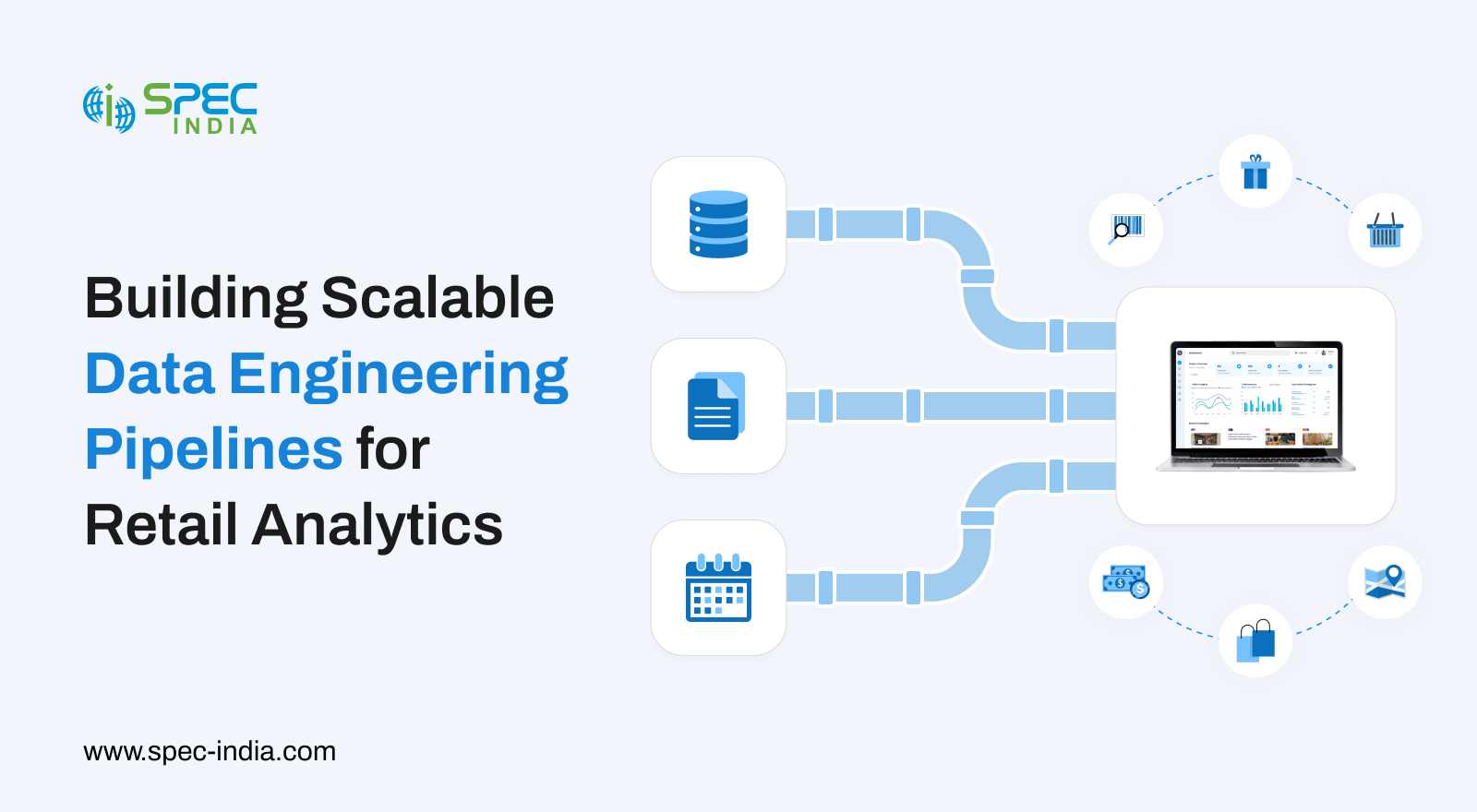
Retail leaders today are sitting on a goldmine of data—yet many struggle to turn it into timely, actionable insights. Sales data resides in POS systems; customer behavior data is generated by eCommerce systems; inventory data is stored in ERPs; and customer loyalty data is maintained in multiple tools. This is not a lack of data; the real issue is the inability to transfer, process, and scale data effectively. Retail growth is directly impacted when data pipelines fail during peak seasons, dashboards lag real-time events, or analytics teams spend more time correcting data than interpreting it.
- The stakes are high. Research indicates that information-based retailers are 23 times more likely to acquire customers and 19 times more likely to profit than other retailers.
- However, Gartner reports that more than 60% of analytics projects fail to scale due to ineffective data engineering foundations.
- Slow or unreliable data pipelines in the retail industry are a key factor in lost opportunities, wrong forecasting, and decision delays. It is due to daily shifts in demand and rapid changes in customer expectations, both of which are difficult to predict.
That is why creating an analytics pipeline that can be scaled when processing retail data has become a business priority. Current retail analytics requires a robust retail data engineering infrastructure capable of processing large volumes of data, integrating diverse sources, and delivering results in near-real time. Scalable data engineering pipelines ensure that retail analytics systems are reliable enough to handle high-traffic events, capable of handling more complex use cases, such as personalization or demand forecasting, and scalable with the business.
This blog will discuss how retailers can build and deploy scalable retail data pipelines to accelerate the adoption of modern retail analytics, remove data bottlenecks, and leverage raw data to gain a competitive advantage.
Understanding Retail Data Engineering in Modern Enterprises
Now, when you have a retail business, you can find data everywhere, inside stores, online, on apps, in warehouses, suppliers, and customer programs. It is not the difficulty of gathering such data; it is the speed and consistency of the use of such data. This is where retail data engineering plays a crucial role.
Retail data engineering focuses on ensuring the right systems are in place so raw data does not remain raw. It guarantees the seamless transfer of data from disparate retail sources into formats usable by analytics tools and business staff. When implemented appropriately, it eliminates guesswork in decision-making and provides accurate, timely, and actionable data.
Modern businesses need robust data engineering to drive daily retail analytics, monitor sales flows across channels, manage inventory, predict demand, and understand customer behavior. Having a solid retail analytics infrastructure will ensure teams do not spend time correcting spreadsheets or reconciling numbers. Instead, they have a single, trusted view of the business and focus on what truly matters: enhancing performance, customer experience, and growth.
What Are Data Engineering Pipelines in Retail Analytics?
Data engineering pipelines are the pathways that move data from sources to the tools and dashboards teams use. Retail uses various data sources, including stores, e-commerce, inventory, loyalty programs, and marketing campaigns. This information is organized in pipelines to ensure analytics teams can trust what they see.
The structure of a typical retail data pipeline consists of the following major steps:
- Data ingestion: Gathering data from multiple sources, batch and real-time.
- Validation: It is necessary to verify data quality. It is essential to ensure that there are no errors, duplicates, or missing information.
- Transformation: Standardization of formats, dataset merging, and executing business logic like SKU mapping or currency conversions.
- Storage: Processed data are stored in warehouses, lakes, or lakehouses for easy access.
- Orchestration: Designing and managing the work process so that all steps will take place adequately and in a stable sequence.
Pipelines must be fast, reliable, and flexible for retailers. They must handle significant seasonal sales spikes, real-time customer activity, and provide precise cross-store, online, and geographic intelligence. A robust pipeline not only passes data but also enables analytics departments to gain insights and make decisions without grappling with messy data.
Key Components of a Scalable Retail Data Pipeline Architecture
The retail analytics-driven data pipeline architecture needs to be robust, flexible, and scalable to handle the volume of data required by any system. An adequately designed retail data platform infrastructure architecture will ensure that information travels without collapsing under the pressure of growing data volumes and changing business needs between its source systems and analytics tools. Modern retailers benefit from modular architectures in which each layer can develop independently, rather than being constrained by the limitations of hard, monolithic systems. A scalable retail data pipeline is based on several basic layers.
- The data ingestion layer ensures data is continuously collected from internal sources (POS, ERP, and CRM systems) and external sources (marketplaces and third-party partners).
- Next, the processing and transformation layer purifies, enriches, and normalizes raw data, ensuring it is accurate, consistent, and aligned with business logic before it moves downstream.
- The consumption layer, finally, transmits this data to BI tools, dashboards, and advanced analytics applications, providing business users with real-time insights.
Investing in scalable data platforms enables retailers to handle high transaction volumes, integrate new data sources, support advanced analytics, and remain resilient during peak periods, including festive sales, promotions, and flash sales.
ETL Data Pipelines Powering Retail Data Analytics
Investing in scalable data platforms enables retailers to handle high transaction volumes, integrate new data sources, run advanced analytics, and remain resilient during peak periods such as festive sales, promotions, and flash events.
Retail organizations gather information through POS systems, eCommerce platforms, inventory applications, ERP solutions, and customer loyalty programs. With POS data integration, data is systematically extracted by ETL pipelines, transformed with business-specific operations, and loaded into centralized analytics systems, ensuring consistency, accuracy, and usability across the retail analytics ecosystem.
Key transformations performed within retail ETL data pipelines include:
- SKU normalization across online and offline sales channels
- Multi-region and cross-border retail currency conversions.
- Aggregations based on time (hourly, daily, weekly, seasonal, and promotional times).
- Segmentation of customers based on purchase behavior, purchase frequency, and value.
- Data cleansing, deduplication, and validation to maintain high data quality
- Master data enrichment, including product hierarchies and store metadata.
An optimized retail data pipeline would enable analytics teams to execute complex queries efficiently and maintain data integrity at scale. ETL pipelines can handle peak transaction volume during sales events without compromising performance at scale, thanks to incremental loading, partitioning, and parallel processing. The robust ETL foundation enables accurate reporting, supports complex analytics applications such as demand forecasting and personalization, and enhances the overall retail analytics system at the regional and channel levels.
Data Pipeline Best Practices for Scalable Retail Platforms
When you are creating analytics in retail, you know one thing: data does not stagnate. Sales is characterized by high transaction volumes, the addition of new channels, and business teams seeking faster access to insights. This is why scalability can never be a byproduct. To make retail analytics reliable and future-ready, data engineering pipeline design must follow best practices from the outset.
What works when building scalable retail data pipelines:
- Keep pipelines modular, not monolithic: Instead of creating a single, extensive, closely-knit workflow, subdivide pipelines into smaller, reusable units. If ingestion, transformation, and validation are independent, you can scale or modify one stage without jeopardizing the pipeline.
- Don’t compromise on data quality checks: Retail decisions rely heavily on clean, trusted data. The schema mismatch, missing values, duplicate records, and outliers are automatically validated to ensure analytics teams have confidence in the dashboard metrics.
- Design for failures before they happen: Delay of data and hiccups in the system are unavoidable- particularly during the busiest retail periods. Retries, checkpoints, and graceful recovery schemes in fault-tolerant pipelines ensure that data loss is eliminated and operations proceed normally.
- Plan for growth from day one: Big data increases at an unexpected pace. Incremental processing, parallel execution, and horizontal scaling should be supported by pipelines to process larger volumes without requiring constant rework or performance bottlenecks.
- Make pipelines observable, not opaque: Teams have real-time visibility into pipeline health through monitoring, logging, and automated alerts. When something goes bad, the teams are aware of the where and why – lessening downtime and firefighting.
- Build governance and security into the pipeline: As data moves across regions and teams, these considerations become critical. Clear access controls, lineage tracking, and compliance policies help protect sensitive retail data while enabling wider analytics access.
Applying these best practices consistently makes data engineering pipelines no longer a bottleneck but a competitive edge. Retail departments become more confident in their analytics, leaders receive faster insights, and the data platform remains robust as data volumes, channels, and demands continue to grow.
How Retail Data Pipelines Enable Advanced Retail Analytics
Advanced retail analytics is built on robust retail data pipelines that consistently and reliably flow data between teams and systems.
With numerous touchpoints that create data in a retail context—stores, e-commerce, supply chains, and customer interactions —customer transaction data is generated. When properly structured pipelines are in place, this raw data is converted into analytics-driven assets that decision-makers can rely on.
Well-built retail data pipelines enable advanced analytics use cases such as:
- Real-time dashboards that provide up-to-date visibility into sales, inventory, and customer behavior.
- Predictive analytics models that forecast demand, churn, and buying trends.
- Demand forecasting to maximize stock levels and minimize stockouts or overstocking.
- Personalization engines that deliver tailored product recommendations and targeted promotions.
- AI-Driven suggestions to improve customer service in online and offline environments.
Retail data pipelines enable organizations to move beyond traditional, historical reporting to proactive, prescriptive insights by delivering data at the right time, accurately, and consistently. Quality pipelines reduce data friction, enable faster experimentation, and allow analytics teams to focus on innovation rather than on data preparation. Eventually, high-quality pipelines can enable retailers to deliver quantifiable business value faster and at scale.
Common Challenges in Building Retail Data Engineering Pipelines
Retail data pipes do not tend to crash simultaneously; rather, they choke incrementally. Most challenges arise as the business expands, data sources multiply, and analytics expectations grow. Here’s how those challenges typically unfold in real retail environments:
- Data starts coming from everywhere.
There are POS systems, eCommerce systems, ERPs, warehouse systems, and loyalty apps, each generating data in a different format and structure. Without standardization, it would be cumbersome and challenging to integrate these fragmented sources into a single retail data pipeline. - Data consistency becomes hard to maintain
Product IDs don’t match across channels, customer records appear different across systems, and timestamps are in different time zones. In the absence of a solid transformation logic, analytics teams are likely to use insights to question the accuracy of reports rather than act. - Pipelines slow down during peak retail events.
Black Friday sales, end-of-season flights, and other peak periods result in significant spikes in data volume. Pipelines that perform well on routine days begin to lag, break down, or miss SLAs when performance is paramount. - Scaling adds operational complexity.
Pipelines become more difficult to monitor and maintain as additional data sources and uses are added. What began as a straightforward process becomes a series of interconnected tasks that increase the likelihood of failure and the need for human involvement. - Governance and security lag growth
As additional teams gain access to data, ownership, and access control, as well as data lineage and compliance concerns, they become vital. In the absence of effective governance, sensitive retail and customer information can be misused or shared with minimal effort. - Analytics teams spend more time fixing data than using it
In cases of unreliable pipelines, analysts and data scientists spend time validating, correcting, or reprocessing data. This slows the experimentation and insights processes and the overall impact of retail analytics.
Recognizing these challenges early and planning for them upfront helps retailers avoid constant firefighting later. When data pipelines are designed with scale, performance, and governance in mind, they remain reliable as data volumes grow and analytics requirements become more complex.
How can SPEC India help you in building Strong Data Engineering Pipelines?
At SPEC India, we help businesses turn scattered data into clean, reliable pipelines that support day-to-day decisions. We are aware that retail and enterprise data sources are numerous, including stores, websites, applications, ERPs, CRMs, and warehouses. Our task is to consolidate all this data into a smooth, orderly format that is easy to use and trustworthy.
We do not think that there is a one-size-fits-all product. The first step our team takes is to understand your business objectives, data challenges, and future strategies. To that end, we create data pipelines that scale with your business, process more data, and deliver insights on time without breaking or slowing down.
We also have AI infrastructure installed at SPEC India, enabling us to develop smarter, faster data pipelines. This helps automate data processing and improve data quality, and supports higher-order analytics and AI use cases without unnecessarily increasing complexity.
Everything we build entails data security. We adhere to rigorous security measures to protect your data throughout all processes, including ingestion, processing, storage, and access. Having the governance, access controls, and monitoring, your data remains safe, compliant, and trustworthy.
Having SPEC India as your data engineering partner means that your teams will spend less time on fixing data problems and more time on insights, innovation, and improved customer experiences.
Conclusion
The need to create scalable data pipelines for modern retail companies is extremely high. Retailers collect information across a wide range of channels, including stores, the internet, warehouses, and customer applications. This data can be messy, slow, or unreliable without good pipelines. Good pipelines ensure that data is accurate, on time, and easy to report and analyze.
By adhering to the best practices, including the modular design, fault tolerance, monitoring, and good data governance, it can be ensured that the pipelines are expanded in a smooth fashion as the business expands. This will allow analytics teams to focus on analytics and innovation rather than on data issues.
Finally, scalable retail data pipelines can help businesses make more informed decisions, enhance the customer experience, and leverage data as a competitive advantage. Explore how our data engineering services help retailers build scalable, reliable pipelines that power real-time analytics and smarter decisions.
Frequently Asked Questions
Stores, online platforms, and supply chains offer retailers enormous amounts of data. Scalable pipes can be used to process this data as fast as possible and as accurately as possible, thereby making sure that the insights are reliable and the decision-making process can be faster even at the times when the sales are at their highest point.
Retail pipelines typically combine POS system data, eCommerce platform data, inventory and sales analytics, customer loyalty program data, marketing platform data, and third-party data. Bringing these sources together provides a complete view of operations and customer behavior.
Common challenges include disconnected data across systems, divergent formats, performance problems at peak time, scaling issues in pipelines, and providing security, compliance, and data governance.
Scalable pipelines ensure that data is accurate, timely, and reliable. It enables better decision making by retailers, demand forecasting, inventory optimization, customizing customer experiences, and saving time on solving data problems. This makes data a real business benefit.

SPEC INDIA is your trusted partner for AI-driven software solutions, with proven expertise in digital transformation and innovative technology services. We deliver secure, reliable, and high-quality IT solutions to clients worldwide. As an ISO/IEC 27001:2022 certified company, we follow the highest standards for data security and quality. Our team applies proven project management methods, flexible engagement models, and modern infrastructure to deliver outstanding results. With skilled professionals and years of experience, we turn ideas into impactful solutions that drive business growth.
Table of contents
- Understanding Retail Data Engineering in Modern Enterprises
- What Are Data Engineering Pipelines in Retail Analytics?
- Key Components of a Scalable Retail Data Pipeline Architecture
- ETL Data Pipelines Powering Retail Data Analytics
- Data Pipeline Best Practices for Scalable Retail Platforms
- How Retail Data Pipelines Enable Advanced Retail Analytics
- Common Challenges in Building Retail Data Engineering Pipelines
- How can SPEC India help you in building Strong Data Engineering Pipelines?
- Conclusion
Delivering Digital Outcomes To Accelerate Growth
Let’s TalkTable of contents
- Understanding Retail Data Engineering in Modern Enterprises
- What Are Data Engineering Pipelines in Retail Analytics?
- Key Components of a Scalable Retail Data Pipeline Architecture
- ETL Data Pipelines Powering Retail Data Analytics
- Data Pipeline Best Practices for Scalable Retail Platforms
- How Retail Data Pipelines Enable Advanced Retail Analytics
- Common Challenges in Building Retail Data Engineering Pipelines
- How can SPEC India help you in building Strong Data Engineering Pipelines?
- Conclusion
Delivering Digital Outcomes To Accelerate Growth
Let’s Talk
Let’s get in touch!
India
SPEC House, Parth Complex, Near Swastik Cross Roads, Navarangpura, Ahmedabad 380009, INDIA.
-
 +91-79-26404031, 32-33-34
 -
 [email protected]