

The Great AI Debate: Point vs. Platform, Buy vs. Build
February 23, 2026
We’ve officially moved past the “experimentation” phase of AI. Today, it’s not a question of if your company should use AI; it’s an expectation. But as the hype settles, senior leaders are realizing that bringing AI into an enterprise isn’t just about picking a cool tool. It’s a strategic move that can either fuel growth or create a massive mess.
Right now, two major questions are dominating boardroom discussions:
- Build vs. Buy: Do we create our own custom AI or buy a ready-made solution?
- Point Solution vs. Platform: Do we solve one problem at a time or invest in a unified foundation?
The Strategy Gap
The stakes are high. Choosing the wrong path doesn’t just waste your budget; it creates technical debt and governance risks that can haunt you for years.
Gartner recently found that while 80% of companies are using AI, only about a third actually have a plan for it. This “ad-hoc” approach is a value-killer. In fact, McKinsey’s data shows that companies with a structured enterprise AI strategy, capture twice the value compared to those just “trying things out.”
The goal of this blog is to unpack the trade-offs. We’ll look at when it makes sense to buy a quick “Point Solution” and when you need to invest in a long-term “Platform.” Whether you are just starting or looking to scale, your choice should depend on three things: your maturity, your governance, and your long-term goals.
The AI Debate: Why It’s Happening Now
AI is no longer a science experiment. In the business world, it’s now a standard expectation. But for most leaders, the question isn’t “Should we use it?” It’s “How do we use it without creating a mess?”
The debate exists because enterprises are trying to balance two conflicting needs:
The Business Side: Wants speed, immediate ROI, and tools that solve specific headaches today (e.g., “I need an AI to summarize my meetings”).
The IT & Governance Side: Wants control, security, and a system that won’t become a “technical debt” nightmare in two years.
According to Forbes, most companies are still deploying AI in silos. One department buys a tool without telling the others. This creates “Ad-hoc AI,” where you have different systems that don’t talk to each other, creating a patchwork of disconnected data.
What Are AI Point Solutions? (The “Specialist” Approach)
Think of an AI Point Solution as a specialist. It’s a tool designed to solve one very specific problem. It doesn’t try to do everything; it just does one job really well.
Common Examples:
- HR: An AI that screens resumes for specific keywords.
- Finance: A tool that automatically extracts data from invoices.
- Marketing: A sentiment analysis tool that reads customer reviews.
- Sales: A chatbot that only handles basic FAQs on your website.
Why Leaders Love Them
For many SMEs, AI point solutions are the perfect “gateway” to AI. They are attractive because:
- They’re Fast: You can get them up and running in weeks.
- They’re Low Risk: You don’t have to overhaul your entire IT department to use one.
- They Prove Value: It’s much easier to show a “win” to the board when you can point to a 40% reduction in invoice processing time.
Why Enterprises Start with Point Solutions (The “Fast-Track” Phase)
Most businesses don’t start their AI journey with a massive, multi-year platform. They start small. Why? Because point solutions align perfectly with experimentation.
Teams can test an idea, prove it works, and show a “win” to the board without waiting for months of corporate approval. It’s about speed and agility.
- A Retail Example: Imagine a retail brand that wants to boost online sales. They deploy a specialized AI recommendation engine. It’s a point solution; it only looks at web traffic and purchase history.
- The Win: It produces an immediate uplift in conversion rates.
- The Result: It provides the proof of concept needed to justify a bigger AI budget.
This flexibility is a lifesaver when leadership is still skeptical about AI. You don’t have to commit to a massive architectural overhaul; you just fix one problem and move on.
Where the “Quick Win” Becomes a “Long-Term Headache”
The problem isn’t the first point solution; it’s the fifth, tenth, and twentieth. This is the core challenge in the debate of point AI tools vs AI platforms. As you scale, the very things that made point solutions attractive start to work against you. Each new tool brings its own set of baggage:
- Unique Data Requirements: Every tool needs its own “feed” of data.
- Inconsistent Security: Different tools mean different passwords, permissions, and security risks.
- Integration Clutter: Your IT team ends up building a “spaghetti” of connections just to keep everything running.
The Logistics Trap
We see this often in logistics and freight forwarding. One team buys a tool for route optimization. Another buys one for demand forecasting. A third buys a customer service chatbot.
While each tool works fine in its own little world, leadership is left in the dark. They can’t see the “big picture” because the data is trapped in three different boxes. You end up with duplicated work, rising costs, and a “fragmented” view of your business.
The Reality Check: Once you reach the point where you’re managing more tools than insights, you’ve outgrown AI point solutions. This is the moment most enterprises start looking toward a Platform Approach.
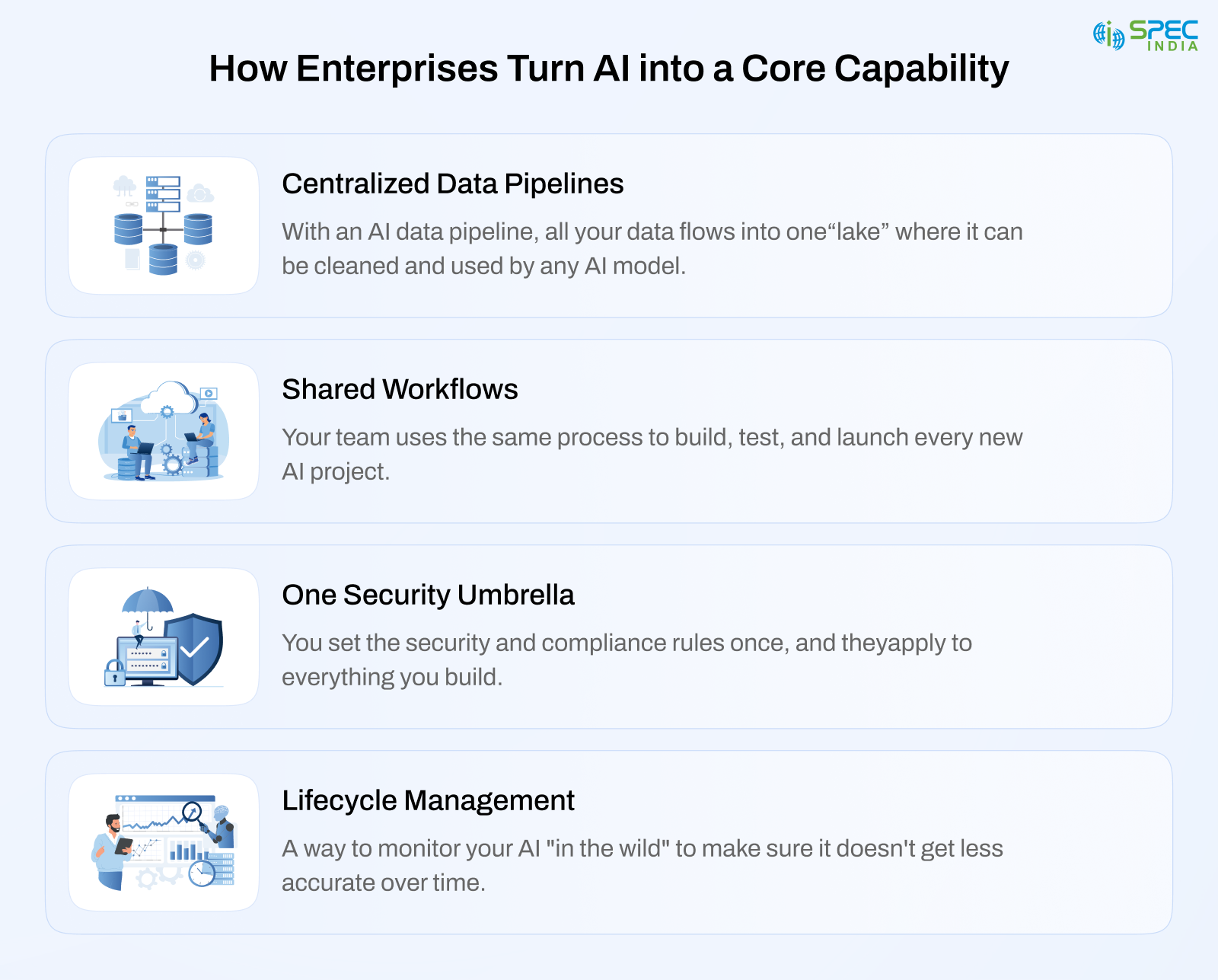
What is an AI Platform?
If a point solution is a “specialist,” think of an AI Platform as the “engine room” of your business. It isn’t designed to solve just one problem; it’s designed to provide the tools, data, and security so you can solve any problem.
Instead of buying five different tools, you build a shared infrastructure where everything is centralized.
A true Enterprise AI Platform includes:
Why Platforms Are the Secret to Scaling
As your business grows, your AI needs to grow with you. If you are operating across different regions or departments, you can’t afford to have a fragmented “patchwork” of tools. cloud-based platforms give you the consistency you need to scale responsibly.
The Energy Sector Example:
Take an energy and utilities company. They might use AI for:
- Asset Maintenance: Predicting when a transformer will fail.
- Load Forecasting: Guessing how much power people will use next Tuesday.
- Risk Management: Spotting potential safety hazards.
With a Platform Approach, all three of these tasks share the same data foundations and security policies. You don’t have to reinvent the wheel every time you want to launch a new project.
The “Build vs. Buy” Dilemma
Once you decide whether you need a single tool or a broad platform, the next big question hits: Do we build it ourselves or buy it off the shelf?
This isn’t like buying a traditional piece of software. AI maturity models are alive, they evolve, the data they use changes, and security rules get tighter every year. If you choose incorrectly, you could end up locked into an expensive, inflexible system that doesn’t grow with you.
According to McKinsey, the most successful companies don’t just pick one. They use a hybrid approach: they buy the “basics” and build the “specialties.” This balances speed with control.
What Does “Building AI” Actually Mean?
Many leaders think building AI just means “hiring a guy to train a model.” In reality, it’s much more. Building internally means you are responsible for:
- The Pipelines: Creating and maintaining the “pipes” that feed data to the AI.
- The Workflow: Making sure the AI’s answers actually show up in your team’s daily apps.
- The Monitoring: Watching for “performance drift” when the AI starts getting less accurate over time.
- The Governance: Managing who can see what and ensuring the data is used ethically.
When Should You Build?
Building makes sense when the AI is your secret sauce. If it’s tied directly to what makes you better than your competitors, you should own it.
The Manufacturing Example: A manufacturing firm might build its own Predictive Maintenance models. Why? Because their machines, their floor layout, and their historical data are 100% unique. An off-the-shelf tool would be too generic. By building, they create a proprietary asset that no competitor can simply “buy” for themselves.
When Building AI Makes Sense
Building your own AI is a power move, but it’s a commitment. It’s the right choice when the solution needs to be as unique as your business itself.
The building is for you if:
- It’s your “Secret Sauce”: You are solving a problem that is 100% specific to your company.
- You need total control: You want to customize every single layer of the model.
- You have the talent: You already have a mature team and a solid data governance plan in place.
- You’re playing the long game: You are comfortable waiting longer for a higher, proprietary ROI.
According to Gartner, only companies with high AI Maturity should attempt to build core capabilities from scratch. If you aren’t there yet, building can quickly turn into a “money pit.”
What “Buying AI” Really Delivers
Buying AI is all about velocity. When you buy, you aren’t just getting code; you’re getting a pre-tested architecture and built-in compliance. A well-planned enterprise AI adoption strategy ensures you skip the “trial and error” phase and go straight to the results.
The Healthcare Example: A hospital network doesn’t need to “build” an AI for medical coding or appointment scheduling. These are common administrative headaches, not competitive secrets. By buying a proven solution, they get immediate efficiency without having to manage the underlying technical mess.
When Buying is the Smarter Choice
In our experience at SPEC, buying is often the better path for SMEs and growing enterprises when:
- Time is of the essence: You need to solve the problem this quarter, not next year.
- Expertise is tight: You don’t have a floor full of data scientists and AI engineers.
- The problem is common: If every other company in your industry has the same problem (like HR screening or invoice processing), a vendor has likely already solved it better than you could.
- Compliance is a nightmare: If you are in a highly regulated field, it’s often safer to buy a tool that has security and regulatory standards baked in.
- The Hybrid Strategy: Most successful enterprises buy the “Foundations” (Platforms) and build the “Specialties” (Point Solutions for unique tasks). This keeps you fast but gives you control where it matters most.
AI Governance: The Secret to Scaling
Many leaders view “Governance” as a handbrake, something that slows down innovation. In reality, it’s the accelerator.
As AI moves into your core business processes (like handling customer data or financial forecasting), governance becomes non-negotiable. It’s about accountability and transparency. According to McKinsey, companies with structured governance are far more likely to scale responsibly.
The Governance Roadmap:
- Ad-hoc Oversight: Checking tools one by one as they are bought.
- Standardized Policies: Creating a “rulebook” for how your team uses AI.
- Embedded Controls: Automating your security and compliance so they are “baked into” every AI tool you use.
Following an AI governance maturity model helps organizations move from ad-hoc oversight to fully embedded controls, ensuring governance accelerates innovation rather than blocking it.
When designed correctly, governance doesn’t block innovation; it provides the “guardrails” that allow your team to move faster without fear of a security breach or a regulatory fine.
Why Platforms Win at Governance
If you have twenty different point solutions, you have twenty different security “doors” to lock. It’s a nightmare to manage. AI platforms for enterprise solve this by centralizing everything. You get:
- One View: See every AI project in the company from a single dashboard.
- Consistent Rules: Apply the same security and ethics standards to every tool.
- Audit Trails: Easily track how data is being used, which is vital for compliance.
This is why mature companies eventually consolidate. They might keep a few “specialist” tools for specific tasks, but the heavy lifting happens on a unified platform.
Explore: Build vs Buy Software: What’s Right for Your Business?
Final Takeaway: Scale Smart, Not Just Fast
The AI debate isn’t about picking a “winner” between point solutions and platforms. It’s about sequencing.
In the beginning, point solutions help you move fast and prove value. But as you grow, platforms become your backbone. Buying software helps you skip the technical “mess,” while building custom AI maturity model gives you long-term control.
The companies that win with AI aren’t necessarily the ones that move the fastest; they are the ones that scale the smartest. By aligning your investments in AI solutions with a clear roadmap, you avoid the “fragmentation trap” and build a capability that grows with your ambition.
Conclusion
At the end of the day, your enterprise AI strategy should be as unique as your business. Don’t chase trends or feel forced into extremes. Balance your need for speed with your need for control.
If you are ready to design a enterprise AI roadmap that cuts through the noise and delivers real business value, we can help. At SPEC India, we specialize in helping enterprises navigate these exact decisions, turning complex AI debates into clear, actionable growth.
Let’s jump on a call to see how we can bring that clarity to your next project. You can reach out to our team here to get started.
Frequently Asked Questions
It comes down to scope. A Point Solution is a specialist; it’s built to solve one specific problem, like a chatbot for your website or an AI that reads invoices. An AI Platform is the foundation. It provides the shared infrastructure and security needed to run many different AI tools across your entire company. While point solutions give you speed today, platforms give you the ability to scale tomorrow.
Go with a Point Solution when you need a "quick win." They are perfect for early-stage experimentation or when a specific department (like HR or Finance) needs to solve a problem without overhauling the whole company’s IT system. They are entry points, not the long-term architecture.
The biggest risk isn't the initial code; it’s the long-term maintenance. Many businesses underestimate how hard it is to keep a model accurate over time (this is called "performance drift"). You need a constant supply of clean data and a dedicated team to monitor it. Without high technical maturity, a building can quickly turn into a "money pit" of technical debt.
In the short term, buying is almost always more cost-effective. You skip the development costs and get a tool that’s already been tested and secured. However, keep an eye on long-term licensing fees. The "Buy vs. Build" decision should always look at the Total Cost of Ownership over three to five years, not just the price tag today.
Ask yourself: "Is this tool our secret sauce?" * If the AI solves a common problem (like scheduling or basic coding), buy it. It’s an enabler. If the AI is what makes you better than your competitors (like a unique manufacturing algorithm), build it. It’s a differentiator.
The best way to avoid lock-in is to focus on interoperability. Don’t get stuck in proprietary formats. Use modular data pipelines and open standards where possible. At SPEC India, we advise clients to have a clear "exit strategy" and to keep their data foundations flexible so they can move if a better tool comes along later.

SPEC INDIA is your trusted partner for AI-driven software solutions, with proven expertise in digital transformation and innovative technology services. We deliver secure, reliable, and high-quality IT solutions to clients worldwide. As an ISO/IEC 27001:2022 certified company, we follow the highest standards for data security and quality. Our team applies proven project management methods, flexible engagement models, and modern infrastructure to deliver outstanding results. With skilled professionals and years of experience, we turn ideas into impactful solutions that drive business growth.
Table of contents
Delivering Digital Outcomes To Accelerate Growth
Let’s TalkTable of contents
Delivering Digital Outcomes To Accelerate Growth
Let’s TalkRelated Blogs
Let’s get in touch!
India
SPEC House, Parth Complex, Near Swastik Cross Roads, Navarangpura, Ahmedabad 380009, INDIA.
-
 +91-79-26404031, 32-33-34
 -
 [email protected]