

How Product Engineering Drives Scalable and Market-Ready Products
January 27, 2026

The process of any product begins with a good idea. However, not all products pass through real users, real growth, and real market pressure.
Most teams are fast, release early, and celebrate the initial release, only to find that a few months later, the product cannot scale, experiences performance issues, or requires frequent fixes to remain operational. That is not a typical problem of features. It’s an engineering problem.
That is where product engineering becomes increasingly important.
Product engineering is not simply writing clean code or delivering on schedule. It is creating a product that is market-ready and is geared towards the future- more users, more data, more expectations. It combines business objectives, user experience, and technology into a single, cohesive strategy rather than treating them as separate entities.
In a market where users are swift, and competition is swifter, there is no room for a product to get a second chance. The ones that thrive are purpose-designed from the very beginning of their existence; they have been made to grow, scale, and adapt without collapsing under pressure.
That is why product engineering is no longer a nice-to-have. It is the difference between products that are launched and products that last. Let’s discuss how product Engineering Drives Scalable Products and helps companies grow in the market.
What is Product Engineering?
Product engineering is concerned with how a user or a business perceives and experiences a product, rather than just writing code and moving on.
Product engineering focuses on what must be built, why it must be built, and how it will be used when real people need it (and not on what must be built). It integrates product thinking, design, development, experimentation, and scaling into a single continuous process.
Think of it this way:
Scalable product development helps you create features.
End-to-end product engineering helps you develop a product that can grow, evolve, and survive in the market.
In product engineering, teams do not simply make an initial product and leave it there. They plan well in advance. They consider performance with more site users, updates that do not affect the functionality of current features, and how the product will be developed as the business expands. All technical decisions are taken with the long-term impact in mind, not short-term delivery.
This strategy also puts users first. Feedback is not something you accumulate once the product has been launched; it is part of the product developed from the beginning. That is what makes products more comfortable, dependable, and easier to use in the long run.
To put it in plain words, Custom product engineering is what transforms a good idea into a market-ready, durable product, something a reliable product engineering company focuses on from day one.
Due to unrealistic expectations or poor planning, 70%- 80% of digital transformation projects fail or miss targets. The success rate of digital transformation efforts is very low – just 35% of initiatives achieve desired results.
The Role of Product Engineering in Building Scalable Products
Scalability does not occur by chance. It is the outcome of choices made long before teams know it.
Product engineering is significant in this case as it compels teams to think beyond the current requirements. Product engineering questions: Will this still work as the user base and data volume grow, and as new features are added? Rather than asking, Will this work right now?
- Plans for growth from day one
Product engineering does not stop at the initial launch; it ensures the product is ready to accommodate more users, more data, and more features without breaking what already works. - Builds a strong and flexible foundation
Scalable software architecture and technology selections simplify future scaling rather than requiring re-architecting the product at high cost. - Prevents performance issues before they appear
Scalability is a requirement, not a response. It helps prevent slow loading times, crashes, and system bottlenecks as usage grows. - Makes future changes easier, not painful
There is a smooth addition of new features, integrations, or updates without disruption of existing functionality. - Reduces technical debt over time
Careful choices during the initial phases of the Software product development projects can help teams avoid numerous revisions, fixes, and rework in the future. - Supports business growth without engineering chaos
As the business scales, the product keeps up, without creating stress for teams or frustration for users.
How Product Engineering Ensures Market-Ready Healthcare Products
A healthcare product is successful only when it functions well in the actual medical context, including the roles of healthcare professionals, doctors, nurses, patients, and administrators. Product engineering helps transform an idea into a healthcare product that is safe, reliable, compliant, and ready to use on day one, backed by high-performance product development.
Here’s how Custom product engineering makes healthcare products market-ready:
1. Built with healthcare rules in mind from the start
Healthcare products handle confidential patient information. End-to-end product engineering ensures privacy, security, and compliance (such as HIPAA) are not afterthoughts. This implies that patient data remains secure and the product is fit to operate within an actual healthcare setting.
2. Designed for how healthcare teams actually work
Nurses and doctors do not have time to work with complex software. Product design and engineering are aimed at straightforward, easy, and effective design to make workflows natural. Once a product becomes part of everyday life, it is easier and quicker to adopt.
3. Ready to grow as patient data increases
Healthcare products should remain fast and reliable as the number of users increases and the volume of information grows. Product engineering creates systems that can expand incrementally, without failure or degradation, regardless of the number of patients, reports, or devices connected.
4. Easy to connect with existing healthcare systems
Healthcare products do not often act on their own. They must interface with EHRs, laboratory systems, medical devices, and insurance platforms. Product engineering ensures these integrations run smoothly, enabling an effortless flow of data and ensuring care teams have the complete picture.
5. Tested carefully before reaching the market
In the healthcare sector, even minor errors can be deadly. Digital product engineering involves intensive testing to ensure the product is precise, stable, and safe to launch, thereby building confidence among users and stakeholders.
Tip: A healthcare product that is market-ready is not manufactured to roll out; it is designed to be trusted, adopted, and used daily.
When Should Healthcare Businesses Invest in Product Engineering?
Most healthcare companies do not invest in product engineering because they are often eager to launch the product as soon as possible. Although this can be effective in the short run, it often leads to scalability issues, a poor user experience, or expensive after-hours work. When these difficulties begin to affect patient care, clinical processes, or business, it is already too late to invest in product engineering. Below are some clear situations where investing in product engineering and scalable product development becomes essential:
1. When launching a new healthcare product or platform
Whether it is a telemedicine application, EHR system, patient portal, or a remote monitoring product, early product engineering ensures the product is built right from the start. It helps shape a robust architecture, protect patient information, meet regulatory standards, and ensure easy-to-use workflows for healthcare providers.
2. When your product starts facing scalability challenges
Healthcare products must handle an increasing number of patient records, reports, appointments, and integrations as your user base grows. In case the system becomes slow or unstable, product engineering assists in redesigning the foundation to enable the product to expand without performance or reliability issues.
3. When compliance and security concerns increase
The regulations and data protection standards in healthcare continue to change. Product engineering also helps ensure your product remains compliant by enhancing security, improving data processing, and minimising risks to patient privacy, without interfering with day-to-day operations.
4. When user adoption is lower than expected
If the product is complex to operate, doctors, nurses, and patients will find it confusing. Operating it will be time-consuming, and its adoption will naturally drop. Here, modern software product development plays a crucial role, as it simplifies workflows, improves usability, and aligns the product with real healthcare day-to-day processes, which makes it easier to use and trust.
5. When planning long-term growth or expansion
Product engineering would future-proof your product in case you intend to add new functionality, connect with additional healthcare systems, or grow into new geographic markets. It makes the system flexible, adaptable, and capable of supporting long-term business objectives.
Tip: Early investment in End-to-end product engineering helps healthcare businesses reduce risk, control costs, and create digital products that deliver consistent value over time.
How the Right Product Engineering Partner Makes a Difference in Healthcare
Selecting an appropriate product engineering partner can be critical to the success of your healthcare product. We do not just develop at SPEC INDIA; we are a long-term product engineering partner, assisting healthcare businesses in creating solutions that are safe, scalable, and compatible with the real world.
With extensive experience in the engineering of healthcare products, we are aware of the complexities of clinical processes, data confidentiality, and regulatory requirements. Through telemedicine platforms and patient engagement apps, EHRs and analytics-driven healthcare products, we design products that put compliance, performance, and usability at the centre.
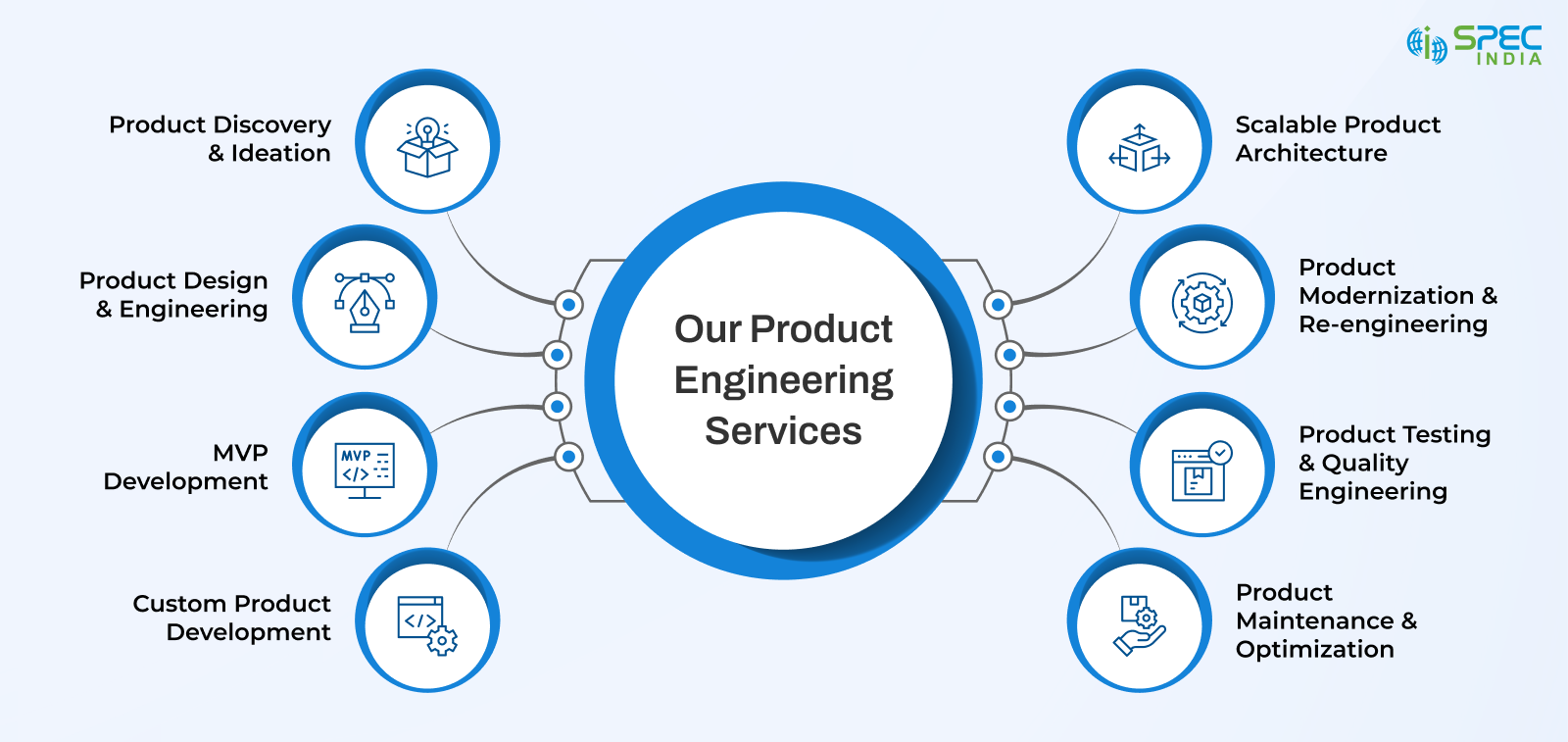
Our approach focuses on:
- Healthcare-first product thinking to align technology with real medical workflows.
- HIPAA-compliant and secure architectures to safeguard sensitive patient information.
- Technologies that are scalable to meet the needs of the patients, providers, and data.
- Seamless integrations with existing healthcare systems and devices.
At SPEC INDIA, we assist healthcare enterprises in minimising risk, enhancing adoption, and introducing products with assurance. We have the best product engineering expertise to ensure your healthcare solution is not designed to be released into the market, but to work, grow, and provide long-term value.
Tip: A trustworthy product engineering partner not only develops healthcare software but also helps you build products that healthcare professionals and patients can rely on daily.
Final Thoughts: Building Healthcare Products That Patients and Providers Trust
In healthcare, trust is not earned through features alone, but it is built through reliability, safety, simplicity, and consistency. Patients demand that their data be accessible securely, and providers require systems that support their workflow without slowing it down. This is where strong digital product engineering truly matters.
A healthcare product that is designed with compliance, scalability, and actual user needs considered is not simply effective; it becomes a reliable tool in the daily delivery of care. Product engineering can assist healthcare businesses in developing solutions that meet real-world demands, whether through higher patient satisfaction or improved clinical workflows.
At SPEC INDIA, we believe healthcare products should grow with your vision without compromising security or ease of use. Our Product engineering services aim to develop solutions that healthcare teams can rely on and that patients feel comfortable using, both now and tomorrow.
Ready to build a healthcare product that people rely on?
Let’s turn your idea into a secure, scalable, and market-ready healthcare solution—one that earns trust at every interaction. Talk to our healthcare product engineering experts today.
Frequently Asked Questions
Product engineering ensures a product is ready for real users and real conditions, not just built to work in theory. It covers the full journey from idea and design to scalability, security, and ongoing improvements. Product engineering would prevent last-minute fixes and would make sure that the product can be launched without any problems because of the planning of architecture, user experience, and compliance at an early stage.
Product development is normally concerned with feature building and product delivery. Product engineering goes one step further- it considers the lifecycle of the product. These are long-term performance, scalability, security, integrations and growth in the future. In straightforward terms, development creates the product, and engineering makes it durable, scalable and successful.
Product engineering has a lower time-to-market as it gets it right in the first place. There is clear planning, re-useable components, early testing, and clearly defined workflows, which assist teams in avoiding rework and delays. When architecture, compliance and integrations are early planned, products spend less time in the idea-to-launch cycle without any quality compromises.
Yes, product engineering is especially important for enterprise software. Enterprise products should be capable of managing a large quantity of data, multiple users, complex integrations and high security thresholds. Product engineering makes the system stable, scalable and easy to manage when the business expands.
Product engineering services add value by reducing risk, improving product quality, and supporting long-term growth. They assist businesses to develop products which are simple to adopt, less expensive to maintain and speedily scale. In the long run, it would result in increased customer satisfaction, improved market positioning, and increased returns on investment.

SPEC INDIA is your trusted partner for AI-driven software solutions, with proven expertise in digital transformation and innovative technology services. We deliver secure, reliable, and high-quality IT solutions to clients worldwide. As an ISO/IEC 27001:2022 certified company, we follow the highest standards for data security and quality. Our team applies proven project management methods, flexible engagement models, and modern infrastructure to deliver outstanding results. With skilled professionals and years of experience, we turn ideas into impactful solutions that drive business growth.
Table of contents
- What is Product Engineering?
- The Role of Product Engineering in Building Scalable Products
- How Product Engineering Ensures Market-Ready Healthcare Products
- When Should Healthcare Businesses Invest in Product Engineering?
- How the Right Product Engineering Partner Makes a Difference in Healthcare
- Final Thoughts: Building Healthcare Products That Patients and Providers Trust
Delivering Digital Outcomes To Accelerate Growth
Let’s TalkTable of contents
- What is Product Engineering?
- The Role of Product Engineering in Building Scalable Products
- How Product Engineering Ensures Market-Ready Healthcare Products
- When Should Healthcare Businesses Invest in Product Engineering?
- How the Right Product Engineering Partner Makes a Difference in Healthcare
- Final Thoughts: Building Healthcare Products That Patients and Providers Trust
Delivering Digital Outcomes To Accelerate Growth
Let’s TalkRelated Blogs
No Blog Found...
Let’s get in touch!
India
SPEC House, Parth Complex, Near Swastik Cross Roads, Navarangpura, Ahmedabad 380009, INDIA.
-
 +91-79-26404031, 32-33-34
 -
 [email protected]