

How to Build a Product Development Strategy That Scales
January 29, 2026

Have you ever launched a feature, only to watch users ignore it or worse, break something else in the process? You’re not alone. As a matter of fact, 70% of software product development projects do not meet the expectations of the teams and customers, and most do not last long enough to justify the investment.
That painful reality isn’t just anecdotal. Product and digital transformation in industries whose workflow is complex, such as logistics and freight forwarding, is even more problematic. Research by Gartner indicates that 76% of logistics transformation projects are unable to achieve key performance targets of remaining on budget, on schedule, or providing meaningful operational results.
Scaling a product does not only involve creating additional features. It is about doing what is right when you are in a tight spot, keeping to the actual user processes, and having your product development plan stand as the complexity increases. Most products don’t fail because of bad ideas. They fail because the product wasn’t built to handle what came next.
Teams are shipping with speed, users are adding features and accumulating, and all of a sudden, every new task becomes more difficult than the last. Roadmaps turn fragile. Decisions take longer. Minor fluctuations cause large-scale complications. What previously felt like momentum begins to feel like friction.
This is where product development strategies come into play. Not due to lack of demand, but because scaling was not built into the foundations.
According to industry data, most product rework occurs after an initial success, as growth exposes hidden assumptions, deep couplings, and weak ownership. This challenge is even more pronounced in operation-heavy systems like logistics, where logistics software development must account for every workflow, location, and integration. It is because a new customer process, a new hub, or a new connection can disrupt the entire system.
A scalable product development strategy does not involve the ability to forecast all future requirements. It is all about making choices today that will not restrain you tomorrow. It’s about building clarity into problems, flexibility into plans, and ownership into execution. So that growth doesn’t slow you down, it should sharpen you.
This guide will show you how to build a product development strategy that truly scales, helping your product, team, and customers grow without breaking under pressure.
What is a Product Development Strategy?
A product development strategy is more than just a plan for building features. Think of it as a map that will help guide all your decisions related to your product, including ideas and design, as well as launch and growth. Whenever we make product development strategies, we have to find answers of these questions –
- What are the problems that we should solve first?
- How should we prioritize features and improvements?
- How do we make sure our product grows with our users and business?
Simply put, a product development strategy aligns your product and the needs of the user with the business objectives. In its absence, teams can operate in silos, features can be developed without a use case, and scaling can become a chaotic process.
For industries like logistics and freight forwarding, the stakes are even higher. Your platform is not merely software, but the backbone of operations. Having an effective strategy in place as demonstrated by proven SaaS examples ensures shipments, workflows, and integrations operate smoothly, even as your business continues to expand.
Why Businesses Need a Product Development Strategy Today
Markets are changing at an unprecedented pace, customer demands evolve rapidly, and competition is becoming more challenging than ever. Products are no longer developed in isolation- they have to be continuously developed and support business development, new technologies, and changing user requirements. A lack of a defined product development strategy in this environment normally results in confusion, wastage of effort, and slow decision-making.
Developing a product strategy is important to enable teams to remain focused when priorities clash, resources are scarce, and there is high pressure to deliver. It provides the clarity of what is to be developed, why it is significant, and how it contributes to the long-term objectives. Businesses that have a defined strategy make conscious choices that safeguard the quality of their products as well as their growth, rather than responding to every request or trend.
In the dynamic modern business environment, product development strategy is no longer a choice; it is a necessity. Here’s why:
- Complex user needs: customers want products that are compatible and work with various devices, platforms, and locations. The absence of a strategy makes the meeting of these expectations chaotic.
- Rapid market changes: New technologies, competitors, and regulations emerge on a daily basis. A definite product development plan allows companies to adapt fast without disrupting current processes.
- Scaling challenges: As your product expands, so do the users, teams, and operations that it provides. A plan will make sure that growth occurs without bottlenecks or wastage of efforts.
- Efficiency and cost control: Unplanned decisions can waste your time and money. A product development growth strategy should be the priority so that errors can be minimized and ROI can be increased.
- Building trust and reliability: This is particularly essential in logistics and freight platforms. Customers and partners depend on your system to perform real operations. Consistency, accuracy, and reliability are guaranteed by a well-planned strategy.
How the Right Product Development Strategy Enables Sustainable Scaling
Scaling is not about going faster; it is about eliminating friction before it grows bigger. A scaled product does not make a subsequent decision harder but easier. This can be applied whether you are creating a SaaS dashboard or a complicated logistics and freight forwarding software. Here are a few points you need to consider to make the right product development strategy and enable sustainable scaling.
1. Start With a Problem That Exists at Scale
Most products fail due to the scaling assumptions rather than actual problems. What appears to be a little problem may develop into a big problem with the increase in the number of users, groups, or processes. The trick here is to find out what actually matters and handle it at an early stage as part of a clear digital product roadmap strategy. Begin by interviewing users, watching workflows, and confirming pain points, and then invest smartly in features. This would make sure that all decisions are based on facts and not speculation. This step is vital in some complex industries where a minor inefficiency can scale up quite rapidly.
- Validate real problems by checking across users, regions, and workflows.
- Concentrate on results by focusing on speed, visibility, cost control, and reliability.
- Eliminate inefficiencies early because even small delays or manual handoffs can scale out of control.
- Do testing before you plan to scale so that you can be sure about your product functionality.
- Revenue, operational cost, and customer trust come first, so it would be better if you prioritize business impact.
2. Design for Change, Because Scale Always Brings Variability
New users, edge cases, and requirements are introduced as products expand. What worked well in the simple phase can fail in complexity. Designing for change implies creating flexibility into roadmaps, workflows, and feature sets so the product can evolve without rework. It also makes teams more likely to foresee various situations instead of adhering to one strategy. Although this is a general rule, it is essential in some industries like logistics, retail, ecommerce, etc where the operations, rules, and client needs may change often.
- Plan for adjustments and avoid rigid timelines.
- Discuss how growth impacts workflows, partners, and users.
- Build adaptable systems as modular design reduces friction when changes happen.
- A slightly imperfect solution today can evolve efficiently tomorrow, so prioritize scalability over perfection.
- Stay aligned with your operations, as in logistics, real-world constraints guide product decisions.
3. Build the Product as a System, Not a Feature Checklist
Scaling a product does not mean to add features to it, but to create a system that works in harmony as part of product development strategies. Workflow, Modulus, and reusable thinking minimize confusion and keep the teams focused. A systems-first approach helps avoid feature sprawl and highlights new functionalities as well. The product is flexible and reliable because it puts emphasis on the way the components interact and support one another, which makes the product adaptable and reliable as it expands. In operational-heavy software, this approach helps manage multiple processes without chaos, but the principle applies to any complex product.
- Break the product into reusable parts.
- Clear systems lower coordination costs, it will help you reduce team dependencies.
- Systems-first design keeps growth manageable and helps you prevent feature sprawl.
- Plan for real operations and align modules with how logistics teams work.
- Modular architecture lets you add features safely, hence do not compromise with future scalability.
4. Use Data to Inform Decisions, Not Replace Judgment
Data is imperative in making important decisions, but it should not overrule human judgments. Select several key metrics that capture the health of a product, and supplement them with human feedback and reality checks. Observing the reality of human interaction with the product can frequently tell things that cannot be represented by raw numbers. Do not follow dashboards blindly, but use data as a guideline when focusing on improvements and predicting problems. In fields such as manufacturing, where context and data are important, a small fix can become a significant operational issue.
- Track what really shows product health. Pick meaningful metrics
- Use both numbers and user insights to combine data with feedback.
- Don’t follow dashboards blindly because data can only guide you, and decisions have to be made by yourself.
- Consider context because in logistics, small workflow details can be more important than usage stats.
- Let data support, not replace, your judgment. Make informed choices
5. Scale Ownership and Decision-Making Alongside the Product
Products slow down not because of technology, but because ownership is unclear. When your product expands, it becomes important to establish clear roles and authority, something that supports an agile product development strategy where teams can make decisions without constant approvals. Under clear ownership, there will be fewer bottlenecks, and efficient development will continue. Teams with clear decision limits can make decisions fast and still be strategic. In complex workflows, relying on a single person for key decisions can create delays.
- Give teams ownership and let them make decisions locally.
- Don’t wait for one person to approve everything.
- Define clear responsibilities because everyone should know what they own.
- Plan for growth with the team and discuss each detail so that you can have a clear view of how your product is working in the market.
- Align with operations, as in logistics, decentralized decision-making keeps shipments and tasks moving.
6. Treat Product Debt and Technical Debt as Growth Constraints
Delaying fixes or taking shortcuts might seem convenient at first, but these choices become costly as the product grows. Technical or product debt may cause inflexibility, complicate integrations, and slow down future development. Manage debt as a business risk and deal with it. Understand the times when speed is important and when long-term stability is important. It is very critical for long-term growth. In freight and logistics software products, unreliable systems can quickly erode trust, something that applies to any product where predictability and reliability are critical to users.
- Address your debt early because you don’t let small issues grow into big problems.
- Know when quick delivery is worth the trade-off.
- Make a product development plan for future flexibility and avoid shortcuts that limit integrations or scalability
- Prioritize reliability, as in logistics, stability builds customer trust.
- Treat debt as a business risk because Technical or product debt affects operations and growth.
Trends and Statistics in Product Development
The world of product development is evolving fast, and businesses are trying to keep pace with it. The following are some of the major trends and statistics that demonstrate the importance of having a strategy:
By 2028, 60 percent of supply chain digital adoption will not provide the promised value because of the skills, training, and change management gaps. This demonstrates the importance of strategic product planning and development that ensures long-term success.
It is only the case that approximately 48% of digital initiatives respond or surpass their business outcome objectives, i.e., over 50% of these initiatives fail to achieve desired outcomes, which is a reminder that strategy is a crucial part.
The success rate of software product development projects is very low at 1 out of 3, and 31% of them are described as successful, and the remaining 69 tend to be hired or even run out of business altogether. It highlights the difficulty of turning ideas into working products.
69% of product development projects experience serious difficulties or discontinuation, indicating that product-building and scaling are continuously a challenge with even seasoned teams.
40% of new products fail to make the expected sales, showing that product success is not all about focusing on features, but rather the focus should be on developing a product strategy.
72% of product launches that meet their sales targets have detailed gotomarket strategies, underscoring the importance of strategic planning beyond development.
Such numbers demonstrate one thing: non-strategic products tend to fail in their growth. Conversely, companies that create digital product with strong planning, data-driven decisions, and scalable design achieve far better results.
Keeping track of trends also matters. For example:
- Modular and scalable architecture is becoming the norm.
- Guesswork is being replaced by data-driven product decisions.
- Flexibility in workflows and features is a must, especially in industries like logistics, where operations change constantly.
- Workflow and functionality flexibility are mandatory, particularly in the logistics industry, where operations evolve at the drop of a hat.
How the Right Product Development Strategy Drives Success in Logistics & Freight
Software is not a tool in logistics and freight forwarding: we can say it is the engine that allows the movement of shipments, teams, and customers to operate without issues. Whereas a powerful product development plan can make sure that your platform evolves with your business, minimizes errors, and supports complex processes. It simplifies daily tasks and builds trust and efficiency among internal teams and clients.
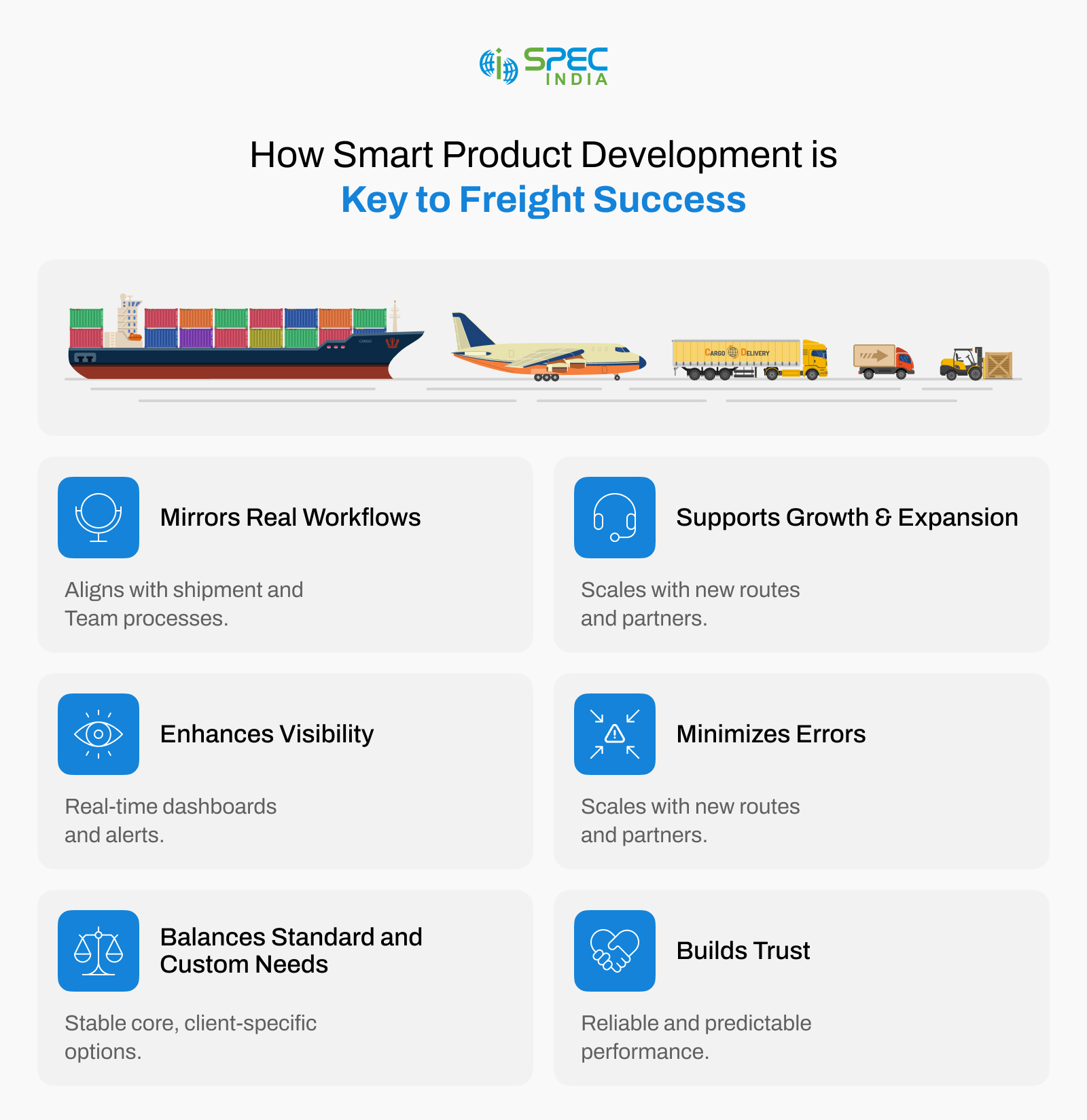
- Reflects Real Operational Workflows
An effective logistics platform adheres to how work actually happens. It maps the shipment planning, execution, tracking, and closure such that teams do not spend time correcting mismatches. Workflow in the software should match the real-world process. Through this, the coordination becomes simpler, errors get minimized, and teams will be able to work on the execution instead of spending most of their time fixing the errors.
- Supports Volume, Route, and Partner Expansion
Logistics companies expand with new routes, alliances, and areas of service. The right product strategy can see this growth coming and have the platform be able to support new users, new shipping lanes, and new partners without breaking the current operations. This will avoid reworking it all the time and will make the system scalable.
- Improves Visibility and Exception Handling
Real-time visibility of what is happening in the teams is provided by clear dashboards, shipment milestones, and automated alerts. In situations where there are problems, teams are able to react almost instantly, as compared to situations where reactions are made after delays have led to even greater problems. Visibility enhances accountability, timely delivery, and boosts customer communication.
- Reduces Errors Through Structured Yet Flexible Design
Proper logistics SaaS product development strikes the right balance between standardization and flexibility. There are no standard procedures that lead to typical human errors, and there exist flexible rules that enable teams to implement changes to the typical situations, including last-minute shipment requests or unforeseen delays. This minimizes errors without limiting operational agility.
- Balances Platform Consistency With Client-Specific Needs
Every client may have slightly different requirements, but the core platform must remain stable. A strong product strategy allows customization on top of a consistent foundation. This way, clients feel supported while the software stays reliable and easy to maintain.
- Builds Trust Through Predictability and Reliability
In logistics, reliability matters more than flashy features. Platforms that work consistently, deliver accurate information, and minimize surprises earn the trust of both internal teams and external partners. Predictability helps in gaining user trust and improves the decision-making process.
- Turns Software Into a Competitive Advantage
A well-developed product doesn’t just support operations, it drives them. The platform enables businesses to deliver faster and higher-quality service by enhancing efficiency, minimizing errors, and improving visibility. Technology is a differentiator that assists logistics companies in growing and competing well.
Closing Thought
Scaling a product doesn’t mean rushing to add features or catching up with fads. It is about making smart decisions at all levels, which means that one needs to start with real problems, architect around change, build systems rather than checklists, wisely use data, scale ownership, and thoughtfully use debt.
These principles are even more important in logistics and freight forwarding. They are complex, there are many stakeholders and expectations, so even minor errors can be costly. A planned product development strategy will make sure that your software evolves with your business, becomes more efficient, less prone to mistakes, and creates confidence with your teams and customers.
A scalable product is not a product created by accident, but rather one created decision by decision. The proper approach will ensure your platform remains flexible, reliable, and able to grow, whether you are managing hundreds of shipments or entering new areas.
Ready to build a logistics or freight platform that scales effortlessly?
Explore our Product Engineering Services and let’s turn your ideas into a system that grows with your business.
Frequently Asked Questions
The product development strategy is a plan that will guide you in making decisions as you develop and expand a product. It assists teams in prioritizing features, right problems, and aligning the product to the business objectives.
Without a strategy, teams often work on the wrong problems, waste resources, or create features users don’t need. Product development strategies guarantee that there is efficient growth of products that remain in touch with user demands and that they can be expanded without collapsing.
Start by identifying real problems that matter to your users. Validate these problems across workflows, teams, and user scenarios. Then create a Product roadmap strategy focused on outcomes, not just features.
Data helps guide decisions, but it shouldn’t replace judgment. Focus on key metrics, combine them with user feedback, and make informed choices that support growth and product quality.
Scalable products are built as systems, not just a list of features. Use modular design, flexible workflows, clear ownership, and proactive management of technical debt to ensure growth is smooth and sustainable.
Address debt early and prioritize fixes that affect reliability or flexibility. Know when speed is strategic versus when stability matters. Treat debt as a business risk that can impact growth if ignored.

SPEC INDIA is your trusted partner for AI-driven software solutions, with proven expertise in digital transformation and innovative technology services. We deliver secure, reliable, and high-quality IT solutions to clients worldwide. As an ISO/IEC 27001:2022 certified company, we follow the highest standards for data security and quality. Our team applies proven project management methods, flexible engagement models, and modern infrastructure to deliver outstanding results. With skilled professionals and years of experience, we turn ideas into impactful solutions that drive business growth.
Table of contents
Delivering Digital Outcomes To Accelerate Growth
Let’s TalkTable of contents
Delivering Digital Outcomes To Accelerate Growth
Let’s TalkRelated Blogs

Let’s get in touch!
India
SPEC House, Parth Complex, Near Swastik Cross Roads, Navarangpura, Ahmedabad 380009, INDIA.
-
 +91-79-26404031, 32-33-34
 -
 [email protected]