

Healthcare API Integration: Enabling Seamless Data Exchange Across Systems
May 7, 2026
Picture this. You’re rushed to an emergency room in a city you’ve never been to. The doctors treating you have no idea what medications you’re on, whether you’re allergic to penicillin, or that you had a cardiac procedure two years ago. They’re not incompetent. They’re just working without the information they need — because the system that holds your records is somewhere else, locked inside a different hospital’s software that this one can’t access.
This happens every day. Not occasionally. Every single day, in hospitals and clinics around the world.
We tend to think of healthcare’s biggest problems as funding shortages, staffing burnout, or access inequality. And those are real. But there’s a quieter failure running underneath all of it, one that rarely makes headlines but costs lives just the same. Healthcare systems simply don’t communicate with each other. Decades of investment in healthcare technology have produced an industry rich in data and poor in sharing it. We have more patient information than ever before, and we’ve built elaborate walls around every piece of it.
The American Journal of Managed Care found that nearly 30% of preventable medical errors trace back to poor communication and fragmented data between systems. That’s not a small footnote, that’s a structural problem. And it persists not because the technology to solve it doesn’t exist, but because building truly connected healthcare information systems is genuinely hard, politically complicated, and requires the kind of long-term commitment that doesn’t always survive budget cycles or leadership changes.
In a survey of 201 US healthcare provider executives conducted in June 2023 by Bain & Company and KLAS Research, 56% of respondents cited software and technology as one of their top three strategic priorities; from 34% in 2022.
The shift is clear; healthcare organizations are accelerating investments in connected digital ecosystems to improve care delivery, operational efficiency, and patient experiences. This is where healthcare API integration enters the picture; quietly, powerfully, and with the potential to transform how care is delivered.
But API integration in healthcare isn’t just a technical upgrade. It directly impacts patient outcomes, clinical workflows, operational efficiency, and in many cases, critical care decisions where every second matters.
What Is Healthcare API Integration and Why Should You Care?
The word “API” gets thrown around a lot, often in ways that make it sound more abstract than it is. An application programming interface is simply a way for two pieces of software to talk to each other. It’s the mechanism behind nearly every digital interaction you take for granted — when your banking app checks your balance, when a travel site pulls up flight options from a dozen airlines at once, when your email client syncs across three devices in real time. APIs are doing the work.
In healthcare, the stakes are different. When we talk about API integration in healthcare, we’re talking about enabling your primary care doctor’s system to share your test results with a specialist across town, without anyone faxing anything or re-entering data by hand. We’re talking about letting a pharmacist’s system check against your prescribing physician’s records before dispensing a medication. We’re talking about giving an emergency room physician a real picture of who you are as a patient, not just the vital signs on a monitor.
Healthcare system integration through APIs removes the human relay race of information transfer. It replaces the fax machine, the re-keyed data, the printed discharge summary that gets lost in a folder somewhere. When healthcare data integration works the way it should, the right information reaches the right clinician at the right moment without anyone having to chase it down.
That’s not a technology upgrade. That’s a patient safety upgrade.
Why We’re Still Talking About This in 2026
You’d be forgiven for wondering why this is still a problem. Healthcare has been digitizing records since the 1990s. Electronic health records became federally mandated and incentivized in the US over a decade ago. Why is healthcare data interoperability still something we’re working toward rather than something we’ve achieved?
The honest answer involves a mix of technology, economics, and institutional behavior that doesn’t reflect well on anyone.
EHR vendors built powerful systems and then had every financial incentive to keep customers locked inside their ecosystem. If your hospital runs on one vendor’s platform and the clinic down the road runs on a competitor’s, neither vendor historically had much motivation to make it easy for data to flow between them. That’s not a conspiracy it’s just the ordinary logic of market competition applied to a domain where the consequences of fragmentation are measured in patient harm.
Add to that the sheer complexity of legacy healthcare IT infrastructure. Many hospitals are running clinical systems built decades ago, layered on top of each other through mergers and acquisitions, each with its own data formats and logic. Healthcare IT modernization in that kind of environment isn’t a software update it’s an excavation.
And then there’s the regulatory maze. HIPAA in the US, GDPR in Europe, state-level privacy laws that vary enormously — every API connection in healthcare has to be built with healthcare data security at the center. One misconfigured endpoint, one gap in authorization logic, and you’re looking at a breach that affects thousands of patients and carries penalties that can reach into the millions. That pressure is real, and it makes organizations cautious in ways that sometimes tip into paralysis.
None of this excuses the status quo. But it does explain why healthcare interoperability solutions don’t appear overnight, even when the need for them is obvious.
The Core Standards Driving Healthcare Data Interoperability
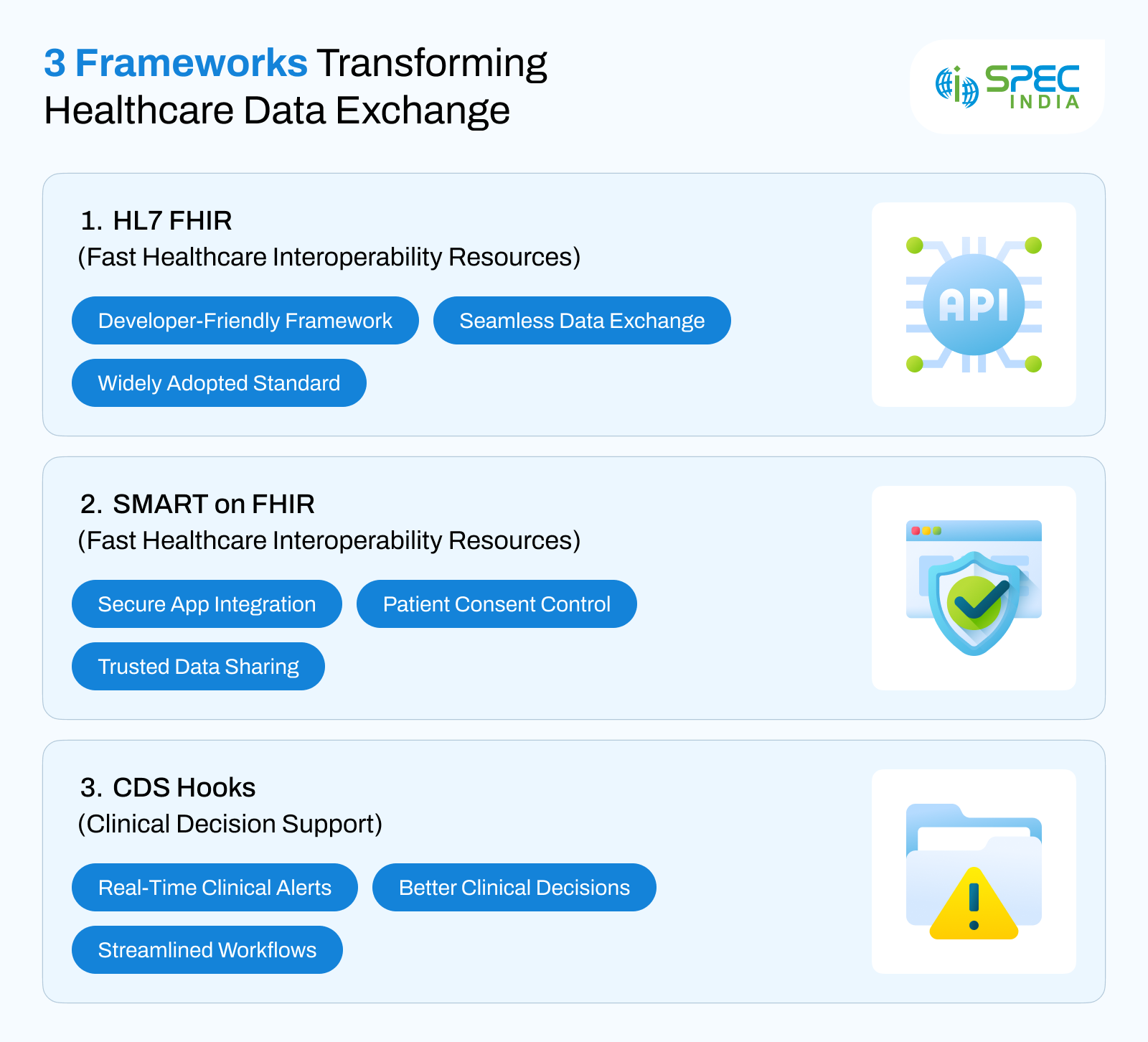
Not every API works the same way, and in healthcare, that difference really matters. Over time, a few key frameworks have risen to the top and become the foundation that modern healthcare data integration is built on.
HL7 FHIR (Fast Healthcare Interoperability Resources)
FHIR has become the go-to standard for healthcare interoperability solutions, and for good reason. Built by Health Level Seven International, it uses the same web technologies most developers already know — REST APIs, JSON, XML — which means health data can be read and moved across almost any platform without a custom translation layer. The numbers back this up: as of 2024, over 85% of US hospitals have adopted or are actively rolling out FHIR-based APIs, according to the American Hospital Association.
SMART on FHIR
If FHIR is the highway, SMART on FHIR is the toll gate that makes sure only the right vehicles get through. It wraps a security and authorization layer around FHIR, so third-party apps can access EHR data only when a patient has explicitly consented. This is what makes EHR API integration feel trustworthy rather than invasive; patients stay in control, and their privacy isn’t sacrificed just to make data flow more freely.
CDS Hooks
This one is less talked about but genuinely changes day-to-day clinical work. Clinical Decision Support Hooks push relevant alerts and recommendations straight into a clinician’s EHR screen at the exact moment they’re needed without requiring anyone to open a separate system or remember to check something. A potential drug interaction, an overdue screening, a patient whose condition has been quietly worsening — these things surface automatically, making clinical workflows sharper without adding to the cognitive load.
Together, these three standards are doing the quiet, unglamorous work of making healthcare IT integration actually function at scale and turning application integration for healthcare from a one-off engineering headache into something repeatable and sustainable.
Where This Is Actually Changing Care
The most convincing argument for healthcare API integration isn’t a statistic. It’s what happens when it works.
Patient data exchange between health systems means that when someone moves cities, changes insurers, or ends up in an unfamiliar ER, their history travels with them. Not a faxed summary an actual structured, digital record that a physician can read and act on. The result is fewer duplicate tests, fewer dangerous information gaps, and fewer decisions made without context.
For chronic disease management, the difference is even more visible. Remote monitoring devices — connected glucose meters, cardiac monitors, blood pressure cuffs — generate continuous streams of data that, through healthcare system integration, can flow directly into a care team’s platform. A patient with heart failure doesn’t need to come in for a check-up to let their cardiologist know how they’re doing. The data arrives on its own, and the cardiologist can intervene before a small problem becomes a hospitalization.
In pharmacy and medication management, application integration for healthcare has reduced prescribing errors in ways that quietly save lives. When a prescriber’s system talks to the pharmacy’s system in real time, automated checks catch interactions and contraindications before a medication ever reaches the patient. The CDC estimates that adverse drug events affect 1.3 million Americans a year. A meaningful portion of those are preventable with better information flow.
On the administrative side, connecting provider systems with payer platforms through healthcare IT integration has started to cut into one of healthcare’s most maddening inefficiencies — prior authorization. A process that routinely takes days and delays urgent care can, with proper clinical system integration and digital health infrastructure, be completed in minutes based on automatically shared clinical data.
📊 A McKinsey report found that advanced interoperability through APIs could unlock $300–$450 billion in US healthcare value annually by reducing redundant testing, streamlining care coordination, and improving administrative efficiency.
The Challenges Standing in the Way
Healthcare API integration makes a lot of sense on paper. Getting it to work in the real world is a different story, and it’s worth being honest about why.
- Legacy System Overload: A surprising number of healthcare organizations are still running healthcare information systems that were built when dial-up internet was the norm. These systems weren’t designed with modern APIs in mind, and retrofitting them is slow, costly, and technically painful. It’s one of the biggest reasons healthcare IT modernization moves at the pace it does — not a lack of willingness, but a genuinely difficult technical debt problem.
- Healthcare Data Security: The compliance landscape alone is enough to give any IT team pause. HIPAA, GDPR, state-level privacy laws that sometimes contradict each other — every API connection has to be built with healthcare data security as a first principle, not an afterthought. One exposed endpoint, one authorization gap, and you’re looking at a breach that costs millions and damages patient trust in ways that take years to repair.
- Vendor Lock-In: This one has improved, but it hasn’t gone away. EHR vendors spent years building walls around their ecosystems, and while regulations like the 21st Century Cures Act have forced more openness, some still drag their feet. Organizations trying to build real healthcare interoperability solutions often find themselves negotiating with vendors who are cooperative in writing but slow in practice.
- Lack of Standardization in Implementation: Supporting FHIR and implementing it well are two very different things. Two systems can both claim FHIR compliance and still fail to exchange data cleanly because they’ve interpreted the spec differently. Missing fields, mismatched formats, broken patient data exchange workflows — these are the kinds of problems that only surface after you’ve already started building.
- Staff Training and Change Management: New technology only works if people actually use it. Healthcare organizations often underestimate how much of an adjustment it is when clinical workflows get redesigned around new API-powered systems. The tech can be solid and the integration flawless, but if clinical staff weren’t brought along through the process, adoption stalls.
The Regulatory Push: Governments Are Getting Serious About Data Interoperability
What’s changed in recent years is that healthcare API integration services are no longer just a competitive differentiator; they’re increasingly a legal obligation. Regulators around the world have grown impatient with how slowly the industry has moved on healthcare interoperability APIs, and they’re starting to enforce.
In the US, the 21st Century Cures Act and the ONC’s Information Blocking Rule made it illegal for health IT vendors and providers to obstruct the flow of patient data. The penalties aren’t symbolic — organizations that block access to health information can face fines up to $1 million per violation. That kind of exposure has a way of accelerating healthcare IT integration roadmaps that might otherwise sit in a backlog for years.
The EU is pushing in the same direction with the European Health Data Space regulation, which is working toward giving every EU citizen the right to access and share their health records across all 27 member states. It’s an ambitious goal, but the regulatory architecture being built around it is serious.
Elsewhere, Australia’s My Health Record, Canada’s pan-Canadian Health Data Strategy, and India’s Ayushman Bharat Digital Mission are all working toward the same thing; national-level healthcare system integration that makes patient data portable by default rather than by exception.
The message for healthcare organizations is straightforward: application integration for healthcare is no longer something you do when you’re ready. It’s something you need to be doing now, because the window between “best practice” and “regulatory requirement” is closing fast.
Looking Ahead: The API-Powered Future of Healthcare
Honestly, we’re at a point where the excuses are running out. The standards exist. The regulatory pressure is real. The technology has caught up. What’s left is mostly a question of whether healthcare organizations are willing to treat data connectivity as something worth genuinely investing in — not just talking about in strategy documents.
The next wave of healthcare capability — AI tools that actually support clinical decisions, monitoring systems that catch deterioration before it becomes a crisis, care plans built around a patient’s full history rather than the last visit — none of that works without solid healthcare API integration underneath it. You can’t build intelligence on top of fragmented data. You can’t personalize care when the information is locked in silos. The infrastructure has to come first, and that infrastructure is clinical system integration and digital health done properly, not just on paper.
What’s worth remembering is that this isn’t really about technology. It’s about what happens to patients when their doctors have the full picture versus when they don’t. It’s about the difference between coordinated care and care that starts from scratch every time someone crosses a system boundary. Healthcare modernization sounds like an IT department problem, but the people who feel the gap most are patients, the ones whose records don’t follow them, whose allergies get missed, whose specialist never heard from their GP.
The organizations getting this right aren’t waiting for a perfect moment or a universal solution. They’re picking meaningful problems, building solid integrations, and expanding from there. They’re treating healthcare data integration as something that requires ongoing attention, not a box to check and forget.
The data that could genuinely change outcomes already exists somewhere in your systems. The question is just whether it can get where it needs to go, when it needs to get there. That’s what healthcare API integration is really about, and why investing in the right healthcare software development services is critical to building connected, efficient, and patient-centric healthcare ecosystems.
Frequently Asked Questions
Healthcare API integration connects separate systems — EHRs, labs, pharmacies, billing platforms, and patient apps — so they can exchange data automatically and securely. Built on standards like HL7 FHIR, APIs act as a universal bridge, eliminating manual data entry and giving clinicians a unified, real-time view of patient information regardless of which system it lives in.
Without APIs, health data is trapped in silos. A patient's records might be scattered across five systems that never talk to each other — leading to duplicate tests, missed diagnoses, and dangerous care gaps. API integration creates standardized, secure pathways for data to flow between systems and organizations, making true interoperability possible rather than just a goal on paper.
HL7 FHIR (Fast Healthcare Interoperability Resources) is the gold standard. Built on familiar web technologies like REST and JSON, FHIR makes health data portable and easy to work with. Complementary standards like SMART on FHIR (for secure app authorization) and CDS Hooks (for real-time clinical alerts) extend its capabilities further. As of 2024, over 88% of US hospitals have adopted or are implementing FHIR-based APIs.
The most common hurdles are legacy systems that were never designed for modern APIs, inconsistent FHIR implementations across vendors, strict HIPAA/GDPR compliance requirements, and vendor resistance to open data sharing. Beyond technology, cultural barriers — unclear data governance, lack of clinical buy-in, and insufficient staff training — are just as likely to slow a project down.
APIs eliminate the friction that bogs down clinicians daily. Instead of logging into multiple systems or chasing faxed records, providers get a single, complete patient view inside their EHR. Real-time decision support alerts surface at exactly the right moment. Prior authorizations that once took days can be automated to minutes. Care transition summaries flow automatically to the next provider. Studies show clinicians in API-integrated environments save up to 45 minutes per day on administrative tasks.
Absolutely. Modern FHIR-based architecture is built to scale — from a two-system clinic connection to a national network spanning hundreds of hospitals. API gateways, cloud infrastructure, and microservices allow large health systems to manage thousands of integrations without performance degradation. The VA connects over 1,200 facilities using this approach. The key to scale isn't just technology — it's governance: clear data ownership, version management, and trust frameworks established before technical rollout begins.

SPEC INDIA is your trusted partner for AI-driven software solutions, with proven expertise in digital transformation and innovative technology services. We deliver secure, reliable, and high-quality IT solutions to clients worldwide. As an ISO/IEC 27001:2022 certified company, we follow the highest standards for data security and quality. Our team applies proven project management methods, flexible engagement models, and modern infrastructure to deliver outstanding results. With skilled professionals and years of experience, we turn ideas into impactful solutions that drive business growth.
Table of contents
Delivering Digital Outcomes To Accelerate Growth
Let’s TalkTable of contents
Delivering Digital Outcomes To Accelerate Growth
Let’s Talk


Let’s get in touch!
India
SPEC House, Parth Complex, Near Swastik Cross Roads, Navarangpura, Ahmedabad 380009, INDIA.
-
 +91-79-26404031, 32-33-34
 -
 [email protected]