| Criteria | API | EDI |
|---|---|---|
| Communication Speed | It enables event-driven data exchange, meaning that as soon as an event triggers, data is exchanged between systems in real time. | In this scenario, communication initiates at a scheduled interval and not on the spot. |
| Data Format | It allows the transmission of data in any format, like JSON, XML, etc. | It has strict guidelines for standardized formats like ANSI X12 and EDIFACT. |
| Integration Style | APIs are a modern way for systems to communicate in real time and are also web-based & cloud-friendly. | Freight networks widely accept EDI as an integration style. |
| Operational Use Case | Several use cases include on-time visibility, live status, rate lookups, and exceptions. | High-volume transactions like invoices, load tenders, BOL. |
| Scalability | APIs scale when stakeholders and systems are added or removed. | It scales but requires updates to accommodate new partners. |
| Visibility Level | APIs ensure high visibility with live shipment and milestone updates. | Unlike APIs, EDI offers only moderate visibility due to its batch frequency. |
| Manual Work | Since there are live updates, no manual dependency is required. | Unlike APIs, EDI requires manual work in scheduling and tracking. |
| Error Handling | APIs are known for providing real-time updates, enabling errors to be detected in real time. | Errors identified after batch transmission, which cause slowness. |
| Customer Experience Impact | Because the API provides transparency, it has a substantial impact. | Customer visibility is limited because EDI relies on batch timing. |
| Cost Consideration | The implementation and maintenance costs are much lower for cloud systems. | EDIs demand hefty setup and operational costs for VANs/legacy systems. |
| Security | It has strengthened security by using modern encryption and token-based authentication. | EDI is a mature, highly trusted, and secure framework. |


Loading...
How EDI and API Are Redefining Global Freight Management System?
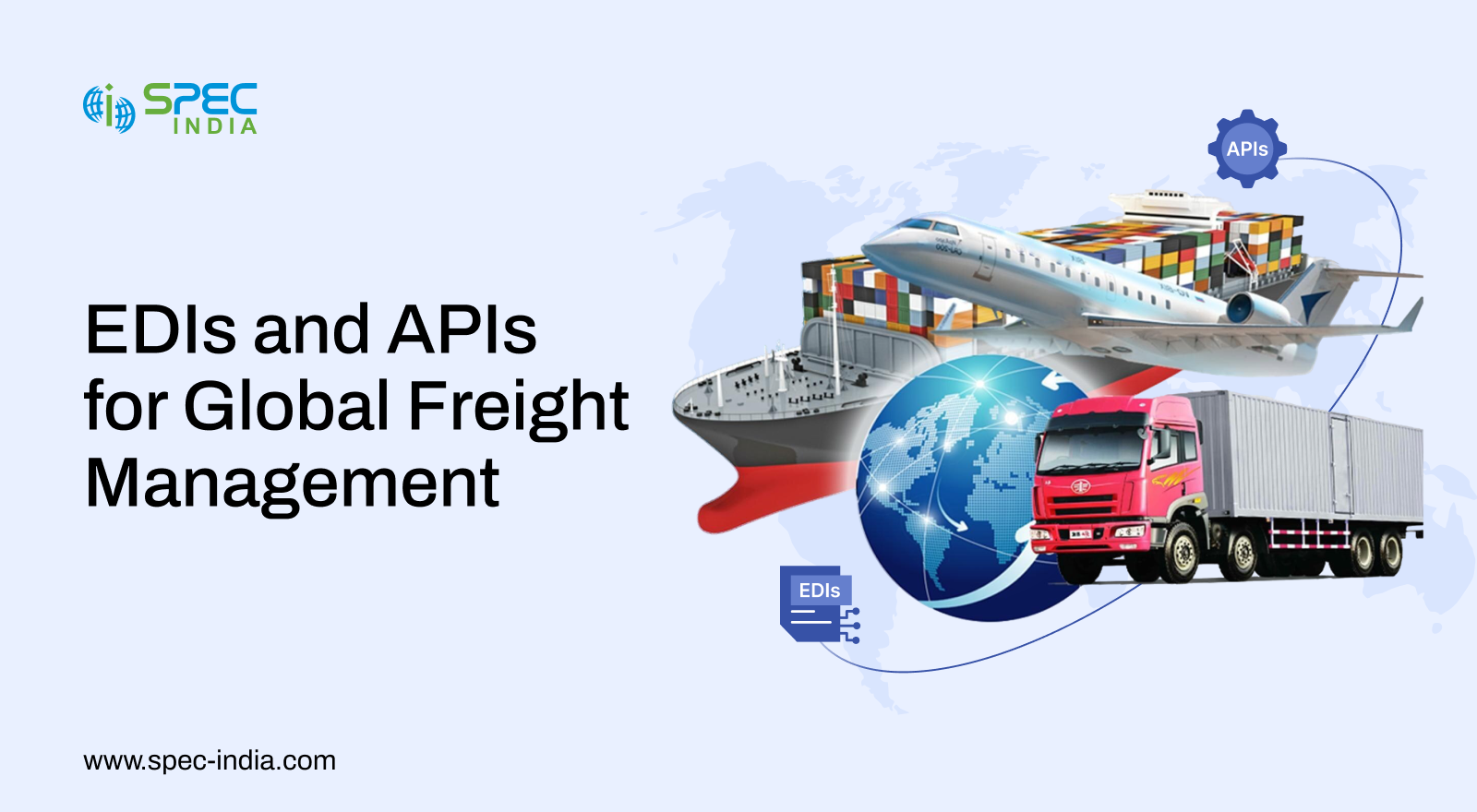
Today’s global trade environment is highly volatile, and user expectations are proliferating. For decades, Electronic Data Interchange has been the means of communication in the logistics industry. However, customers began demanding real-time updates on rate management, shipment tracking, and order status. Freight forwarding automation powered by API integration is transforming how businesses operate. But, when the customers’ demands were rising, it clearly exposed the fundamental limitations, which are as follows:
- Delayed decisions
- Increased operational costs
- Shipment visibility gaps
- Overloaded manual work
- Increased the chances of error
As per the RedCloudTechnology report, more than 85% of logistics businesses lack clear visibility into their supply chain operations. But the good news is that API-backed connectivity is overcoming all the challenges. Enterprises are heavily investing in building logistics and supply chain software with real-time data for logistics operations. Besides, there has been notable demand for cloud-based application development solutions.
Both APIs and EDI together help enterprises automate meticulously, communicate in real time, and bridge the visibility gap. When you build or integrate APIs into your new/existing system, you break down silos across carriers, TMS systems, and partners. As a result, you can expect interoperability, rapid updates, and informed decision-making.
This blog is all about guiding you to revamp your existing freight management system. It also states how implementing EDI and API benefits your digital platform and the best practices you should follow to stay competitive.
The Role of Application Programming Interface (APIs) in Global Freight Management Systems
APIs enable the swift exchange of data between systems in real-time. It is highly advanced compared to file- or batch-based communication. With logistics API integration, you would notice a massive transformation in freight pricing, monitoring, managing, and booking across global supply chains.
Here is how APIs are revamping global freight management:
-
Real-time Data Exchange Between Systems
The primary role of an API is to exchange data in real time among freight forwarders, shippers, logistics platforms, and carriers. Users will receive live updates on rates, shipment tracking, events, and capacity. Such on-time data exchange helps stakeholders make informed decisions and avoid discrepancies.
-
Eliminate Data Silos
Traditionally, freight operations manage communication through disconnected systems, including TMS platforms, ERPs, booking tools, and carrier portals. With API, all these systems are interconnected, and data moves freely. As a result, every stakeholder has access to accurate, real-time data. It also overcomes the challenges caused by outdated infrastructure. Such API implementation removes data from silos, improves collaboration between systems/vendors, and strengthens your supply chain management.
-
Streamline Complex Workflows
Another significant benefit of API integration in freight management solutions is that it automates monotonous logistics tasks. It includes shipment tracking, bookings, rate management, and document retrieval. Users do not need to enter data manually; the API does so in real time. As a result, logistics businesses do not need to invest in manpower to handle routine tasks; instead, they can involve them in strategic decision-making and let the API simplify workflows.
-
Uplift Operational Productivity
Logistic enterprises using APIs have noticed increased operational efficiency. APIs automate tasks, enabling businesses to avoid human errors, data duplication, and slower data processing, and achieve better throughput. Such implementation even allows teams to handle voluminous shipments without depending on large resources. Stakeholders can access the process performance investigation while remaining relaxed about accuracy, efficiency, and budget.
-
Deliver Premium Customer Experience
Enterprises using APIs for connectivity have achieved high customer satisfaction. Around 55% of logistics companies have reported improved customer satisfaction due to the adoption of digital platforms and APIs (Source: wifitalents). With advantages such as consistent information, tracking updates, and zero delays, APIs have a high level of dominance and adoption amongst logistics partners. Customers will easily receive updates and insights through self-service portals and communication mediums.
-
Strengthens Supply Chain Resilience
When you integrate APIs into your system, you can expect a resilient supply chain. It automatically identifies disruptions and responds on time. With real-time access to logistics operations, your teams can plan accordingly to avoid delays and discrepancies. Another significant benefit that APIs offer is data-driven coordination amongst stakeholders. It helps in shipment rerouting, optimizing, and overcoming challenges.
APIs provide connectivity for freight operations, whereas EDI significantly supports logistics flows. We will understand how EDI vs. APIs in supply chain operations help businesses drive impact, but before that, let’s know how EDI affects freight operations.
How Does Electronic Data Interchange Cater to Freight Operations?
EDI is a traditional technology that allows logistics businesses to communicate seamlessly. It will enable enterprises to exchange documents like bills of lading, purchase orders, invoices, and shipment notices. Business-to-business interactions use EDI to exchange operational data. It is essential to implement EDI modernization to ensure it meets current time expectations.
-
Supports Standardized Data Exchange
EDI is the core channel that allows communication and exchange of voluminous, standardized data. It ensures the information exchanged follows industry standards such as ANSI X12 or EDIFACT. This way, even if you use completely different internal systems, EDI still allows effortless communication between global logistics stakeholders.
-
Eliminate Manual Errors
Freight operations rely heavily on manual processing, but with EDI, you can reduce paperwork. Hence, it eliminates manual dependency and human errors. EDI automates document exchange, reducing inconsistencies that often arise from duplication, email communication, and paper trails. Such a high level of accuracy is crucial because even a minor mistake, such as an incorrect address, can affect the bottom line.
-
Streamlines Core Freight Documents & Processes
EDI streamlines freight documents and workflows like purchase orders, load tenders, invoices, and delivery confirmations. Such processes were manually intensive, but with EDI, the document moves between systems automatically. As a business owner, this is important because it will boost your turnaround times, stabilize your predictable cycles, and enable stability.
-
Uplifts Compliance & Alignment
Being compliant with formatting, data accuracy, and documentation is a core aspect of the logistics business. EDI ensures compliance with requirements and keeps the business functional as a trustworthy compliance mechanism, enabling stakeholders to synchronize and maintain procedural consistency.
-
Makes Operational Efficiency Better
Automation is the core of EDI, which improves operational efficiency. It allows freight teams to coordinate and enhance customer service, rather than chase document processing or record reconciliation. If you are dealing with high-volume carriers, EDI also offers batch processing to manage large-scale operations without disruptions or inaccuracies.
-
Long-Term Stability
Freight companies rely on EDI for its widely available communication framework. Several platforms, such as TMS, ERP, custom software, and warehouse systems, are built with EDI compatibility. Such integrations enable continuity across supply chain networks. Even as new technologies emerge, EDI remains a strong option for secure, structured data exchange.
EDI and API ensure continued operations, but their effectiveness relies on seamless data connectivity across systems. A strong data connection is essential for accurate and real-time information. It improves operational visibility, minimizes delays, and supports agile decision-making. Therefore, understanding this is necessary to decide whether to modernize your freight management operations.
-
Importance of Data Connectivity
As supply chain operations grow, they require a constant exchange of accurate, real-time data between partners, carriers, and internal systems. All of these require strong connectivity, as a lack of a bridge can dramatically disrupt your logistics operations. Therefore, let’s understand what roles data connectivity plays in freight management.
-
Supports Decision Making
Data is the crux for effortless, informed decision-making. Be it optimizing routes, allocating capacity, adjusting rates, or managing disruptions, accurate data maintains operational agility. With seamless data connectivity, you, as a decision-maker, would never be making a decision based on incomplete or inconsistent information. It also results in almost no errors and promotes responsiveness.
-
Removes Manual Dependency & Process Delays
When data connectivity is poor, manual dependency increases for mundane tasks such as copying information, reconciling sheets, or requesting status via email. Due to time-consuming tasks, the risk of errors increases while processes slow down. But when data connectivity is strong, systems interact without relying on manpower, reducing rework and speeding up workflows. As a result, there will be efficiency improvement and more time for manpower to focus on strategic tasks.
-
Strengthens Collaboration Between Stakeholders
Given the multiple stakeholders involved in freight management, strong data connectivity is essential. With strong connectivity, you can expect frictionless collaboration, zero miscommunication, and meeting expectations. It becomes vital, especially in cross-border and multimodal logistics.
-
End-to-End Data Visibility
Another significant importance of data connectivity is that every stakeholder gets access to real-time information throughout the consignment process. With such detailed visibility, logistics teams can monitor shipment progress, identify delays, and proactively avoid disruptions. Such an uncertain freight environment demands complete visibility not only to maintain service delivery quality but also to gain customer trust.
-
Uplifts Customer Experience
One significant advantage of data connectivity is that it helps you win more customers. And the reason is its real-time updates, accurate timelines, and instant access to shipment information. Data connectivity ensures meeting the user expectations by sending instant notifications, enabling system monitoring with live data, and adding data to customer interfaces. This way, the customer enjoys transparency, leading to long-term loyalty.
Strong data connectivity results from effective data exchange between systems, making data visible to stakeholders. And it’s only possible when API and EDI are used optimally. Now that you know how both benefit logistics businesses, you must also understand what sets them apart. Let’s uncover how both ensure automation and seamless data movement while enabling legacy system modernization in different ways.
While APIs enable automation and improve customer satisfaction rates, EDI manages voluminous transactions across global trading networks. Both turn out to be indispensable, which is why knowing how they work together can benefit your freight management is worth the time.
Why the Combination EDI + API is the Future of the Freight Industry?
The booming logistics business you see around does not rely solely on APIs or EDI; it leverages both, ensuring resilient, future-proof outcomes. Considering the benefits both provide when accommodated together in the freight industry, here is the list that you must deep dive into.
-
Stability with Agility
To move data swiftly across stakeholders, you will require EDI, while speed and flexibility are easily managed via APIs.
-
Meets Customer Expectations
Customer expectations are constantly evolving, and meeting them remains a top priority for any business. In the freight industry, shipment monitoring, status notifications, and instant access to documentation are among the user demands you can easily manage, while also maintaining compliance and data standards.
-
Future-Proof Digital Systems
With APIs, as a business owner, you can modernize your existing capabilities without replacing traditional EDI integrations. Therefore, you can use both APIs and EDI.
-
Faster Decision-Making & Less Delays
APIs help stakeholders stay informed about real-time updates. For example, if the ship is loaded or cleared customs, it automatically sends notifications to customers. Besides, EDI ensures that voluminous information is passed without hampering the system’s performance.
As you now know, the strategic benefits of the API and EDI combination become more evident when you witness it in real-world use cases. Several logistics enterprises use EDI and API to streamline their workflows, remove delays, and unlock real-time visibility. Let’s understand the practical impact of API-and EDI-driven connectivity.
Real-Life Use Cases of API and EDI in Freight Management Systems
Here are some real-life use cases of companies that have implemented digital transformation in logistics to reap the benefits of EDI and APIs together. Let’s have a look at it.
1. Maersk
Project Overview:
The company used EDI and API solutions for data integrations. Their platform enabled an end-to-end supply chain workflow using EDI and APIs. APIs specifically emphasize secure and fast data transmission.
Challenges:
- Client onboarding for complex EDI connections is too long.
- Complex partners’ visibility.
Solutions:
- Making use of the API for rapid integrations with less dependency on middleware
- Adopted a hybrid approach (API+EDI) for flexibility
- Prompt decision making, less manual work, and better visibility.
2. FedEx
Project Overview:
This company provides EDI solutions for its freight services. It also has a developer portal with API integration best practices, demonstrating their support for APIs.
Challenges:
- Lack of technical onboarding for integrating EDI and API.
- Relied majorly on EDI but then shifted some processes to API for better visibility.
Solutions:
- When FedEx implemented an EDI solution, its users no longer had to rely on manual processes, standardized documents, or cost inefficiencies.
- Enabled rapid, secure, and advanced integration.
Now that you know what the API and EDI combination offers, it’s time to leverage its potential. But without a proper strategy, it’s merely shooting stars in the dark. To fully leverage EDI and APIs, logistics teams should analyze several critical factors.
5 Factors to Consider for API and EDI Implementation
Not only does the right technology help implement EDI and APIs, but it also requires a strategic and operational plan. It results in future-ready and scalable data exchange. Logistics companies should consider the following factors to avoid integration gaps and ensure seamless adoption across stakeholders.
1. Existing System Compatibility
Both APIs and EDIs should be compatible with your enterprise’s TMS, WMS, ERP, and carrier platforms. For businesses seeking TMS and WMS integration services, it is essential to verify compatibility between the systems. You must also verify the following things when considering freight forwarding ERP solutions:
- Supported data formats and communication mediums.
- Evaluate middleware or integration layers.
- Identify the need for cloud vs on-premises connectivity.
2. Data Mapping and Standardization
To ensure seamless data flow, your EDI and API workflows should align with both internal and partner data structures. For which, you can:
- Determine standardized fields and formats.
- Develop robust data validation rules to avoid mismatches.
- Enable workflow mapping to remove manual dependencies.
3. Security & Compliance
Security is a top priority due to the nature of the business, which involves sensitive customer information.
- Ensuring compliance with industry regulations.
- Establish ongoing tracking for threat detection.
- Implement encryption, token-based authentication, and secure data transport.
4. Scalability for Growth
- Connectivity requirements increase as business volume, the number of carriers, networks, and shipments grow.
- Select the integration models that support voluminous transactions.
- Make sure the API rate limit, EDI VAN capacity, and infrastructure can scale.
5. Resources and Cost Planning
- Budget considerations extend beyond implementation.
Analyze licensing, VAN costs, API usage fees, and infrastructure upgrades. - Plan for ongoing maintenance and technical support
Conclusion
Connectivity is essential for integrating global freight management systems. Besides, real-time visibility and automation are what every stakeholder and client aim for when it comes to EDI vs API in supply chain management. APIs and EDIs are becoming essential and complement each other for more intelligent decision-making and real-time data in logistics operations. It even enables seamless data exchange between logistics partners, freight forwarders, carriers, and shippers. Enterprises that use a hybrid connectivity model gain a significant benefit in their operational efficiency.
If you are aiming to implement APIs and EDI, you will require strategic planning, integration expertise, and a scalable architecture. Partner with a leading API development company and unlock hidden opportunities. We help logistics businesses develop secure API integration, upgrade their legacy systems, and enable EDI-driven automation.
Frequently Asked Questions
API provides real-time data exchange that happens as soon as any event triggers. It transmits information between systems and stakeholders instantaneously. On the other hand, EDI is a batch-based data exchange solution that transmits voluminous transactions of freights at predefined intervals.
As the global trade management and clients expect personalized and real-time information, there is a surge in API demands. Its real-time updates, instant rate retrieval, automated booking, and proactive exception management is what users are expecting. With API, you eliminate several manual-dependent tasks, make informed decisions, and uplift customer satisfaction ratio. API makes sure agility, scalability, and interoperability that helps you to give tough competition to peers.
Yes, EDI plays significant role in modern logistics businesses. Its importance grows due to maintaining standardized document format and high-volume transaction processing. Besides, you can even make use of EDI integrations in manifest submissions, invoicing, and custom documentations. Therefore, EDI is essential to integrate if you are planning for custom logistics software development.
Since API provides real-time updates when you undertake digital transformation in freight forwarding operations, every operational milestone improves shipment visibility. It helps in freight monitoring, proactive issue handling, and accurate ETA predictions.
There are several challenges that companies face when shifting EDI to API-based systems, which are as follows:
- Inconsistent data format and schema
- API incompatibility in legacy systems
- Complex security and authentication
- Change management for teams and processes
Yes, most freight management systems use the combination of API and EDI. While API implement on-time data exchange and real-time visibility, EDI, on the other hand, handles large-structured transactions.
There are several technologies that support API and EDI integrations in logistics:
- Integration Platform as a Service
- API gateway and management platforms
- EDI mapping and translation tools
- Cloud-based logistics management systems
- Webhooks and event-backed middleware
- Secure connectivity protocols using REST, SOAP, AS2, SFTP, JSON, XML

SPEC INDIA is your trusted partner for AI-driven software solutions, with proven expertise in digital transformation and innovative technology services. We deliver secure, reliable, and high-quality IT solutions to clients worldwide. As an ISO/IEC 27001:2022 certified company, we follow the highest standards for data security and quality. Our team applies proven project management methods, flexible engagement models, and modern infrastructure to deliver outstanding results. With skilled professionals and years of experience, we turn ideas into impactful solutions that drive business growth.
Table of contents
- The Role of Application Programming Interface (APIs) in Global Freight Management Systems
- How Does Electronic Data Interchange Cater to Freight Operations?
- Supports Standardized Data Exchange
- Eliminate Manual Errors
- Streamlines Core Freight Documents & Processes
- Uplifts Compliance & Alignment
- Makes Operational Efficiency Better
- Long-Term Stability
- Importance of Data Connectivity
- Supports Decision Making
- Removes Manual Dependency & Process Delays
- Strengthens Collaboration Between Stakeholders
- End-to-End Data Visibility
- Uplifts Customer Experience
- Why the Combination EDI + API is the Future of the Freight Industry?
- Real-Life Use Cases of API and EDI in Freight Management Systems
- 5 Factors to Consider for API and EDI Implementation
- Conclusion
Delivering Digital Outcomes To Accelerate Growth
Let’s TalkTable of contents
- The Role of Application Programming Interface (APIs) in Global Freight Management Systems
- How Does Electronic Data Interchange Cater to Freight Operations?
- Supports Standardized Data Exchange
- Eliminate Manual Errors
- Streamlines Core Freight Documents & Processes
- Uplifts Compliance & Alignment
- Makes Operational Efficiency Better
- Long-Term Stability
- Importance of Data Connectivity
- Supports Decision Making
- Removes Manual Dependency & Process Delays
- Strengthens Collaboration Between Stakeholders
- End-to-End Data Visibility
- Uplifts Customer Experience
- Why the Combination EDI + API is the Future of the Freight Industry?
- Real-Life Use Cases of API and EDI in Freight Management Systems
- 5 Factors to Consider for API and EDI Implementation
- Conclusion
Delivering Digital Outcomes To Accelerate Growth
Let’s Talk


Let’s get in touch!
India
SPEC House, Parth Complex, Near Swastik Cross Roads, Navarangpura, Ahmedabad 380009, INDIA.
-
 +91-79-26404031, 32-33-34
 -
 [email protected]