
Freight Forwarding ERP Integration for Multimodal Logistics (Sea, Air & Land)
December 10, 2025
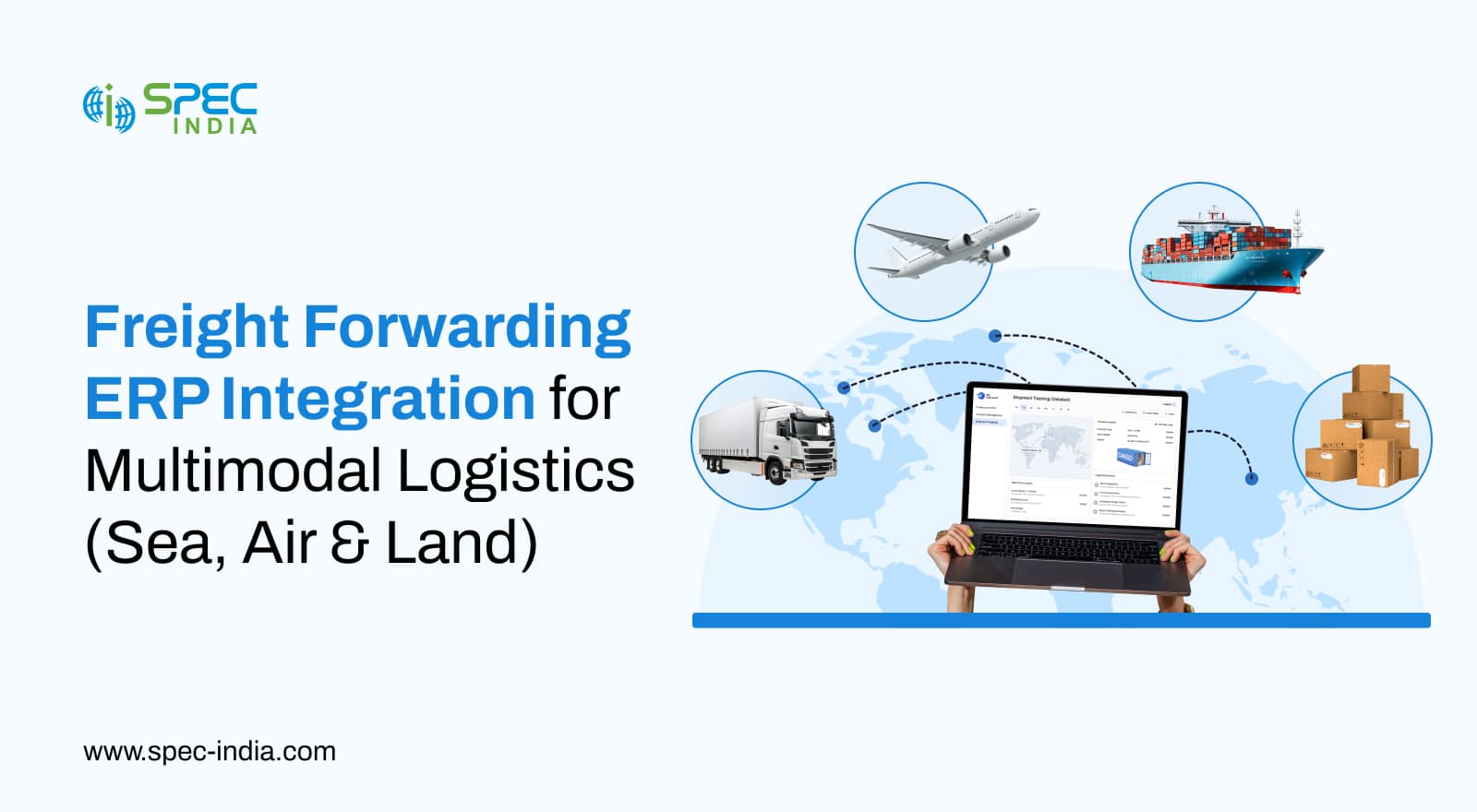
For freight forwarders, managing the movement of goods by sea, air, and land is a lot like handling flaming torches. Port delays, air cargo connections, and unforeseen road conditions can make even a well-planned shipment a nightmare for logistics.
According to the World Bank, 55% of freight forwarders accept liability and financial losses for shipment delays, while only 3% report no costs.
These challenges not only disrupt operations but also increase costs, strain resources, and frustrate clients who demand timely, efficient delivery.
This is where a freight forwarding ERP integration comes into play. ERP for freight forwarders helps them stay ahead of delays, minimize errors, and ensure consistent service quality by centralizing operations, automating workflows, and enabling visibility into events at sea, in the air, and on land.
This blog will explore practical knowledge, tips, and techniques to simplify multimodal logistics and turn complexity into efficiency.
Understanding Multimodal Logistics
Multimodal logistics is the process of transporting a shipment by more than one mode: sea, air, and land. On paper, it sounds efficient. In fact, it seems like trying to organize three teams that do not speak the same language most of the time. Every mode is accompanied by its own set of pitfalls:
1. Sea Freight
Sea freight is the backbone of global trade, but it comes with:
- Long transit times that make planning difficult
- Port congestion has risen dramatically in the past few years.
- Traditions and paperwork delays are particularly prevalent in international freight.
A single port disruption can affect the entire supply chain.
2. Air Freight
Air freight is fast but demanding:
- High operational costs
- Traditions and paperwork delays, particularly on
- There is no room for miscommunication because of extremely tight schedules.
A single missed cutoff can delay the shipment by 24-48 hours until the next flight.
3. Land Transport
In land transport, there is nothing predictable:
- Traffic congestion on urban roads.
- Different compliance laws in the region.
- Ground and weather conditions affecting routes and ETA.
Even a slight delay can disrupt a well-structured multimodal chain.
What is a Freight Forwarding ERP System?
A freight forwarding ERP system is a single software platform that integrates all logistics activities. ERP integrates all these functions rather than using multiple tools to book shipments, track cargo, manage documents, control warehouses, or bill. This means that the same information will be shared equally among all teams.
For example, when a shipment in sea transport is delayed at a port, the ERP automatically updates the schedule for the next air or land transport. All parties receive the update instantly, so there is no confusion, no calls, and no wasted time or money.
Benefits of Freight forwarding ERP integration in Multimodal Logistics
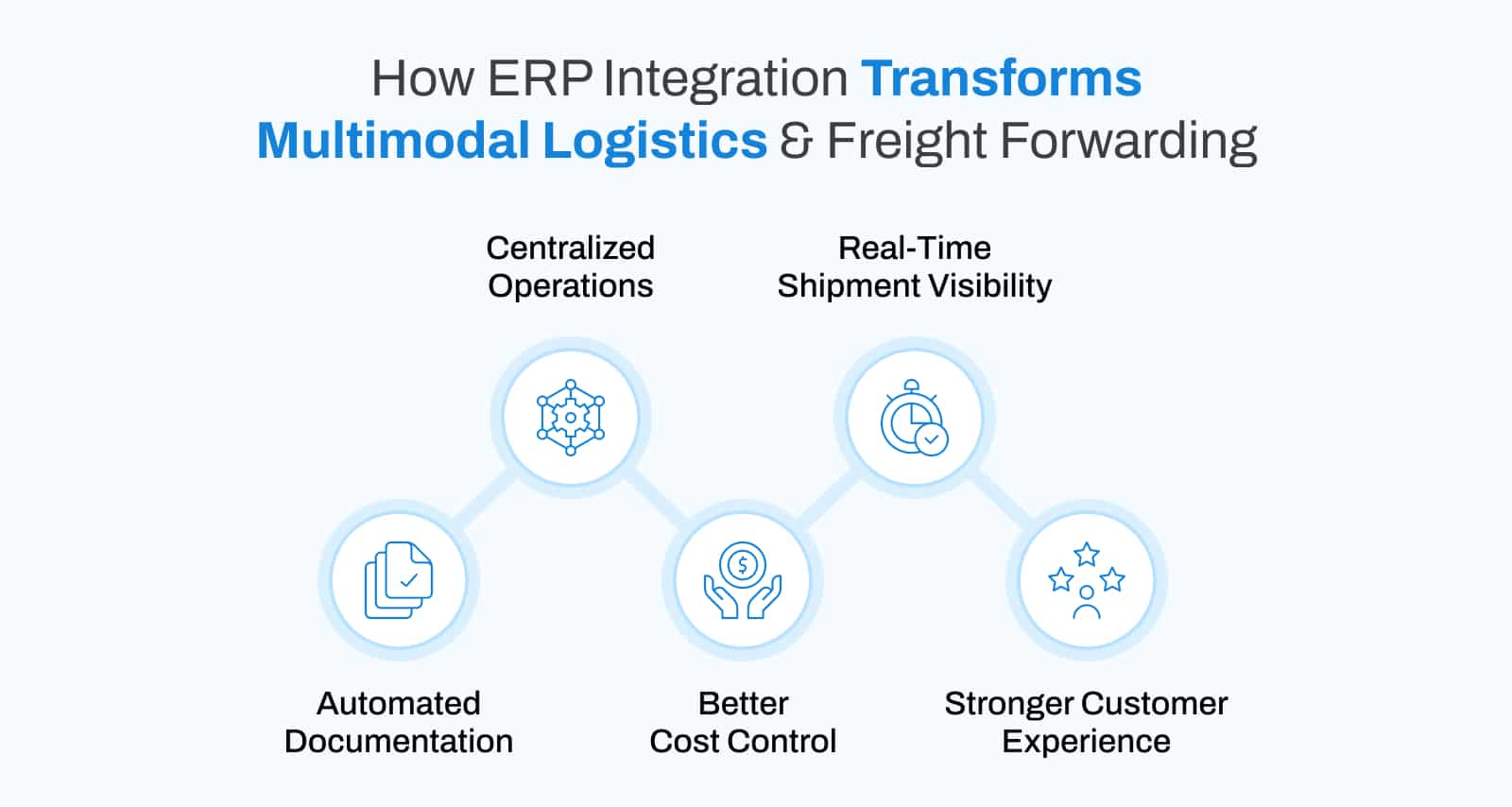
Implementing a freight forwarding ERP system in multimodal logistics is not only about streamlining operations; it also addresses the daily challenges freight forwarders face. A logistics ERP integration helps you manage your multimodal logistics without disruption. Let’s have a look at what it truly delivers:
-
Centralized Operations
There are no jumps between instruments to view air and land shipments because everything is on a single dashboard. This saves time, reduces confusion, and keeps teams on track.
-
Real-Time Shipment Visibility
You do not have to wonder where a shipment is, why it is taking so long, or what is happening. This level of clarity will help you make decisions quickly and avoid surprises.
-
Automated Documentation
Custom papers, invoices, compliance documents, and bills of lading are automatically generated. This eliminates manual work, minimizes errors, and accelerates processing. Digitally transforming logistics can help you automate most repetitive tasks, including those mentioned above.
-
Better Cost Control
An ERP system helps you select the most appropriate route, eliminate unnecessary warehousing, reduce detention, and avoid costly rerouting. All decisions made are smarter and cost-efficient.
-
Stronger Customer Experience
Your customers receive precise updates, achievable ETAs, and timely responses- since you are dealing with real-time information. This establishes trust and long-term relationships.
Companies that integrate ERP in logistics experience up to 20-30% operational delays and clear cost reductions, as they do not respond to issues promptly and begin to avoid them. To a freight forwarder, that is the distinction between merely handling shipments and scaling a profitable and predictable logistics operation. With the proper logistics software development services, you can streamline processes and improve your visibility over the business.
Data That Defines ERP’s Role in Modern Freight
The freight-forwarding software market is projected to grow to USD 4.7 billion (2035) with an upward trend of a 10% annual growth rate (CAGR)—Future Market Insights.
The cloud ERP market has grown significantly over the last few years, and more than 53% of organizations that use ERP now utilise cloud-based solutions (cloud share increasing). Market estimates for cloud ERP indicate the market will grow faster by 2030. NetSuite
McKinsey case evidence on digitally enabled supply chains shows that early adopters achieve ~15% reductions in logistics costs, inventory reductions, and significant service-level gains. These are the outcomes of end-to-end digital supply-chain initiatives (including ERP/advanced planning). McKinsey & Company
A transportation/ logistics industry survey indicated that nearly 48% of participants believed data would substantially enhance asset and goods visibility within 3 years. A core ERP value proposition. Deloitte
According to Gartner, supply-chain/ERP modernization, ecosystem integration, and cloud ERP are among the top strategic supply-chain technology trends in 2024, implying a dependency and investment priority at the board level. Gartner
Key Considerations Before Integrating Freight Forwarding ERP
It is essential to identify your true challenges before implementing an ERP system in your multimodal logistics operations. It is easy to integrate ERP into your existing workflow, but not to make it a single workflow. The following are some considerations before integrating freight forwarding ERP into your system.
-
Identify Your Biggest Bottlenecks
See where in your operations you are the slowest. Are there delays in sea shipments? Air to land miscommunication? Manual paperwork? Awareness of your pain points will help you select an ERP that effectively addresses them.
-
Check Whether the ERP Handles All Transport Modes
Not all ERPs are designed for land, air, and sea. Ensure the system can handle your existing routes and scale with you as you add new partners or lanes. Managing all kinds of transport is hectic when you have multiple communication channels. Always check whether there is scope to handle all of these at once.
-
Evaluate System Compatibility
Our ERP solution should integrate well with the tools you are currently using – whether that be TMS, WMS, accounting software, or customer portals. A fully integrated system will not only eliminate duplicate data entry but also reduce errors.
-
Prepare Your Team for Change
Even the best ERP will fail if your team is not ready for the transition. Consider how much training will be required, who will use it daily, and how long it will take your employees to adapt to the new system. An intuitive system will help minimize the time needed to be comfortable with the transition.
-
Ensure Global Compliance
Lastly, your ERP will need to support international trade requirements (formatting for customs, multi-currency invoices, and compliance with regional regulations). This is very important for any mode of transport moving across a border, not just truckloads moving through Canada or Mexico. Each country has its own requirements and documentation to accompany shipments.
Steps to Integrate ERP for Multimodal Freight Forwarding
Deploying a freight forwarding ERP system requires significant effort. It is like carefully managing specific ERP components so that everything runs smoothly and doesn’t disrupt day-to-day operations. Let’s review the steps needed to integrate an ERP system for multimodal freight forwarding.
1. Start by Mapping Your Current Workflow
Before touching any software, think about how your logistics process works today. Where do you typically see delays? Who spends too much time chasing information? What tasks are still being performed manually? This will help you identify what needs improvement.
2. Choose the Right ERP System
Now that you understand your pain points, look for a customized ERP system that provides the full suite of capabilities you need for sea, air, and land freight, billing, documentation, customer management, and more. To get the best value, ensure the system is an excellent fit for your business and that you are not adapting your business to fit it.
3. Customize It for Your Operations
Every freight forwarder works differently. Make sure your ERP is tailored to your workflows. Freight forwarding automation is a key to your success. It can automate certain documents, adjust approval rules, and create dashboards for different teams. These improvements will give you the feeling that the system fits perfectly.
4. Migrate Data and Test Carefully
Start moving shipment data, customer records, and documentation over to the new ERP. Just do not move everything at once- start with a bit at a time. Testing helps flag real data issues that could be addressed and prevent them from occurring within the system. This will help you ensure that everything is going on the right track.
5. Train Your Team—This Part Is Crucial
Your company’s employees are the primary factor determining the success of an ERP system.
Training them appropriately, providing them with answers whenever they have questions, and designating a few “ERP champions””. Here are some ways to make them feel valued.
It raises trust and thus reduces resistance.
6. Track, Monitor, and Keep Improving
After the implementation of the freight management ERP system, keep track of the data through its analytics:
Are delays being reduced? Are mistakes going down? Are customers getting updates faster? Installation is just a step toward the bigger goal of continuous improvement.
Challenges in Freight Forwarding ERP Integration & How to Overcome Them
Implementing an ERP system can change how a business operates—but the process is rarely straightforward. Many companies see technical, operational, and process-related challenges that can hinder adoption or performance. Knowing the challenges upfront can help teams coordinate plans and implement more innovative alternatives.
1. System Compatibility Issues
The problem: Your existing systems (TMS, WMS, accounting, customs portals) may not be integrated or “connect” to the new ERP system. This results in duplicate work, incorrect data, and delays.
How to fix it:
- Identify and list all systems that must be integrated with the ERP software (system name, purpose, and data exchanged).
- Request API and integration documentation from vendors. Look for systems with REST APIs that support direct integration or prebuilt connectors to reduce development time.
- If no direct connector is available, consider middleware or an iPaaS (integration platform as a service) to handle the integration.
- Map data fields between systems (i.e., shipment ID in TMS = job number in ERP system) before embarking on integration.
- Conduct test integrations using limited datasets and verify accuracy.
2. Staff Resistance to Change
The problem: People fear extra work, job loss, or complex interfaces, which slow adoption.
How to fix it:
- Communicate early and often. Explain why change matters, not just what’s changing.
- Involve end users from day one—gather their input when mapping workflows and defining requirements.
Run hands-on training sessions (small groups, role-based). Use real scenarios they handle daily. - Create a support structure: ERP champions, help desk contacts, and quick-reference guides.
- Celebrate early wins publicly (e.g., reduced paperwork, faster Customs clearance) to build momentum.
3. Data Migration Complexities
The problem: Legacy data is messy. The data could be duplicated, missing information, or have inconsistent formats. Migrating blindly leads to errors and poor reports.
How to fix it:
- Audit existing data in advance by counting records, identifying nulls, and flagging duplicates.
- Clean and standardize data before migration. For example, standardize dates, units of measure, and customer names.
- Define migration rules: what moves, what’s archived, what’s transformed. Define the migration rules, including which records will migrate, which will be archived, and the rules that will apply when creating new records.
- Migrate in stages (customers → carriers → shipments → invoices).
- Validate with end users after each stage. Run parallel systems for a short period to compare outputs.
4. Cost and Time Constraints
The problem: ERP projects can become costly and lengthy, affecting operations and ROI.
How to fix it:
- Clearly define your scope while managing features to focus on “must-haves” versus ” nice-to-haves.”
- Use a step-wise approach: first work on the core modules (booking, tracking, invoicing), then add features (advanced analytics).
- Build a realistic budget with contingency (10–20%).
Measure ROI early by tracking time savings on specific tasks, then assess the financial benefits (e.g., by reducing demurrage fees). - Choose flexible licensing (pay-for-what-you-use) when possible.
5. Security & Compliance Concerns
The problem: Measure ROI early by tracking the time savings on specific tasks, then assess the monetary benefits (e.g., through savings on demurrage fees).
How to fix it:
- Choose security-certified vendors. (ISO 27001, SOC2).
Implement a role-based access control model (what they will see/how they will be able to do it). - Enable logging and audit trails for all critical actions.
- Ensure your ERP supports the regulatory requirements for customs, e-invoicing, and data retention in the countries where you operate.
- Plan periodic security reviews and penetration tests to inform priority decisions.
Wrapping Up
Ultimately, implementing an ERP system is more than just adding another software program. It is essentially about eliminating the daily disruptions that slow transport. When sea, air, and land operations can work together and synchronize, everything changes. There are fewer delays, fewer manual errors, faster decision-making, and customers who feel informed do not have to follow up constantly.
If you have different systems, missing updates, or your teams are spending hours fixing errors that could have been avoided, an ERP is not a thing of the future — it is the upgrade your business has been waiting for. It empowers you with clarity, control, and confidence in every shipment you carry.
And in a world where logistics demands speed and accuracy, having that kind of connected visibility isn’t just helpful—it’s a competitive advantage. Get in touch with us today for ERP software development services that fit perfectly with your business needs.

SPEC INDIA is your trusted partner for AI-driven software solutions, with proven expertise in digital transformation and innovative technology services. We deliver secure, reliable, and high-quality IT solutions to clients worldwide. As an ISO/IEC 27001:2022 certified company, we follow the highest standards for data security and quality. Our team applies proven project management methods, flexible engagement models, and modern infrastructure to deliver outstanding results. With skilled professionals and years of experience, we turn ideas into impactful solutions that drive business growth.
Table of contents
- Understanding Multimodal Logistics
- What is a Freight Forwarding ERP System?
- Benefits of Freight forwarding ERP integration in Multimodal Logistics
- Data That Defines ERP's Role in Modern Freight
- Key Considerations Before Integrating Freight Forwarding ERP
- Steps to Integrate ERP for Multimodal Freight Forwarding
- Challenges in Freight Forwarding ERP Integration & How to Overcome Them
- Wrapping Up
Delivering Digital Outcomes To Accelerate Growth
Let’s TalkTable of contents
- Understanding Multimodal Logistics
- What is a Freight Forwarding ERP System?
- Benefits of Freight forwarding ERP integration in Multimodal Logistics
- Data That Defines ERP's Role in Modern Freight
- Key Considerations Before Integrating Freight Forwarding ERP
- Steps to Integrate ERP for Multimodal Freight Forwarding
- Challenges in Freight Forwarding ERP Integration & How to Overcome Them
- Wrapping Up
Delivering Digital Outcomes To Accelerate Growth
Let’s Talk
Let’s get in touch!
India
SPEC House, Parth Complex, Near Swastik Cross Roads, Navarangpura, Ahmedabad 380009, INDIA.
-
 +91-79-26404031, 32-33-34
 -
 [email protected]