

ERP in Retail Industry: Key Features, Benefits, Challenges & Platforms
May 4, 2026
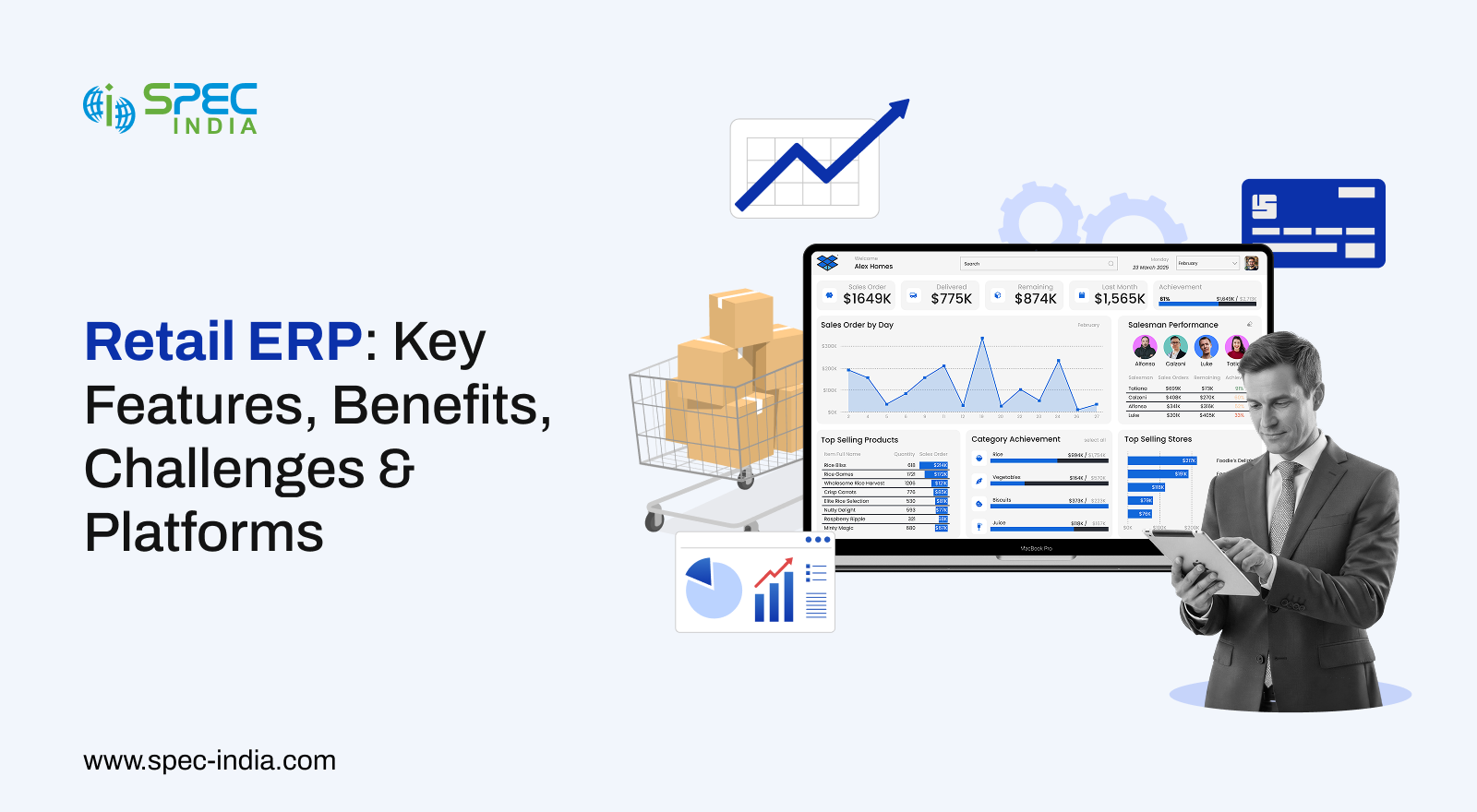
Think about what a modern retail business has to manage simultaneously. In the context of ERP in retail industry, inventory is moving across multiple warehouses and store locations. Online orders are coming in alongside walk-in customers. Supplier relationships, purchase orders, and delivery schedules. Staff rosters, payroll, and performance. Finance, budgeting, and compliance. Customer loyalty programs, returns, promotions, and personalized marketing. And all this ideally, in real time, with visibility across every channel. Now ask yourself: how many different systems is your team currently juggling to keep all of that running?
This is exactly the problem that ERP in retail is designed to solve.
An ERP for retail business, Enterprise Resource Planning is a single, integrated platform that connects every function of your retail operation. Inventory, supply chain, finance, HR, CRM, sales, and reporting all in one place, all talking to each other, all updating in real time.
This blog covers everything you need to know about what retail ERP does, the features that matter, the real benefits, the honest challenges, how to choose between building and buying, and what the leading ERP platforms look like today.
What is ERP in Retail and Who is It Actually For?
There’s a lingering misconception that ERP is something only enterprise-scale retailers need to think about. It’s complex, expensive, and built for organizations with dedicated IT departments and seven-figure technology budgets. That used to be true. It isn’t anymore.
The retail ERP solution landscape has changed dramatically over the last decade. Cloud-native platforms, modular implementations, and flexible pricing models have brought ERP within genuine reach of mid-market and even growing independent retailers. The conversation has shifted from “can we afford this?” to “can we afford not to have it?” And the answer to that second question is becoming clearer every year.
According to Allied Market Research, the global retail ERP market was valued at $5.7B in 2022 and is expected to reach $13.8B by 2032, growing at a 9.3% CAGR. This growth is largely driven by faster ERP adoption among mid-market retailers compared to large enterprises.
Key Features Every Retail ERP System Should Have
Not all custom ERP software for the retail industry is built equally. The features that matter for a fashion retailer look different from those that matter for a grocery chain or a consumer electronics business. But there’s a core set of capabilities that any serious retail ERP solution needs to deliver. Understanding these features and what they do in practice is the starting point for evaluating any platform.
1. Inventory Management
- Real-time stock visibility across every location – Whether you’re running one store or fifty, a solid retail ERP gives you a live view of exactly what stock is where in warehouses, on shelves, in transit, and reserved against online orders. No more end-of-day stock takes that are already out of date by the time they’re done.
- Automated reorder triggers – When the stock of a product drops below a defined threshold, the system generates a purchase order automatically. No manual monitoring. No stockouts from human oversight.
- Multi-location and multi-warehouse management – Stock can be transferred between locations, allocated to channels, and tracked at every step of its journey through the business.
- Batch and serial number tracking – For retailers managing perishables, electronics, or regulated goods, traceability at the individual unit level is essential, and a good retail ERP makes it straightforward.
2. Supply Chain Management
- Supplier relationship and purchase order management – Manage all your suppliers, orders, delivery commitments, and payments in one place. With complete visibility into your supply chain, you can anticipate fewer surprises and build better supplier relationships.
- Demand Forecasting – Using historical sales data and seasonality patterns, modern retail ERP platforms predict future demand with real accuracy, allowing procurement teams to order the right quantities at the right time.
- Logistics and delivery tracking – From the moment a purchase order is raised to the moment goods arrive on the shelf, every step of the supply chain is visible and logged.
- Supplier performance analytics – Which suppliers deliver on time? Which ones have quality issues? Business intelligence in retail is only as good as the data behind it, and ERP gives supply chain teams the data they need to make smarter sourcing decisions
3. CRM in Retail
- Unified customer profiles – Every purchase, return, inquiry, and loyalty point across every channel online, in-store, and mobile is attached to a single customer record. This is the foundation of genuinely personalized retail.
- Loyalty program management – Points, tiers, rewards, and promotions are managed centrally and applied consistently across all touchpoints.
- Targeted marketing and segmentation – With clean, centralized customer data, marketing teams can build segments and run campaigns based on real purchase behavior rather than guesswork.
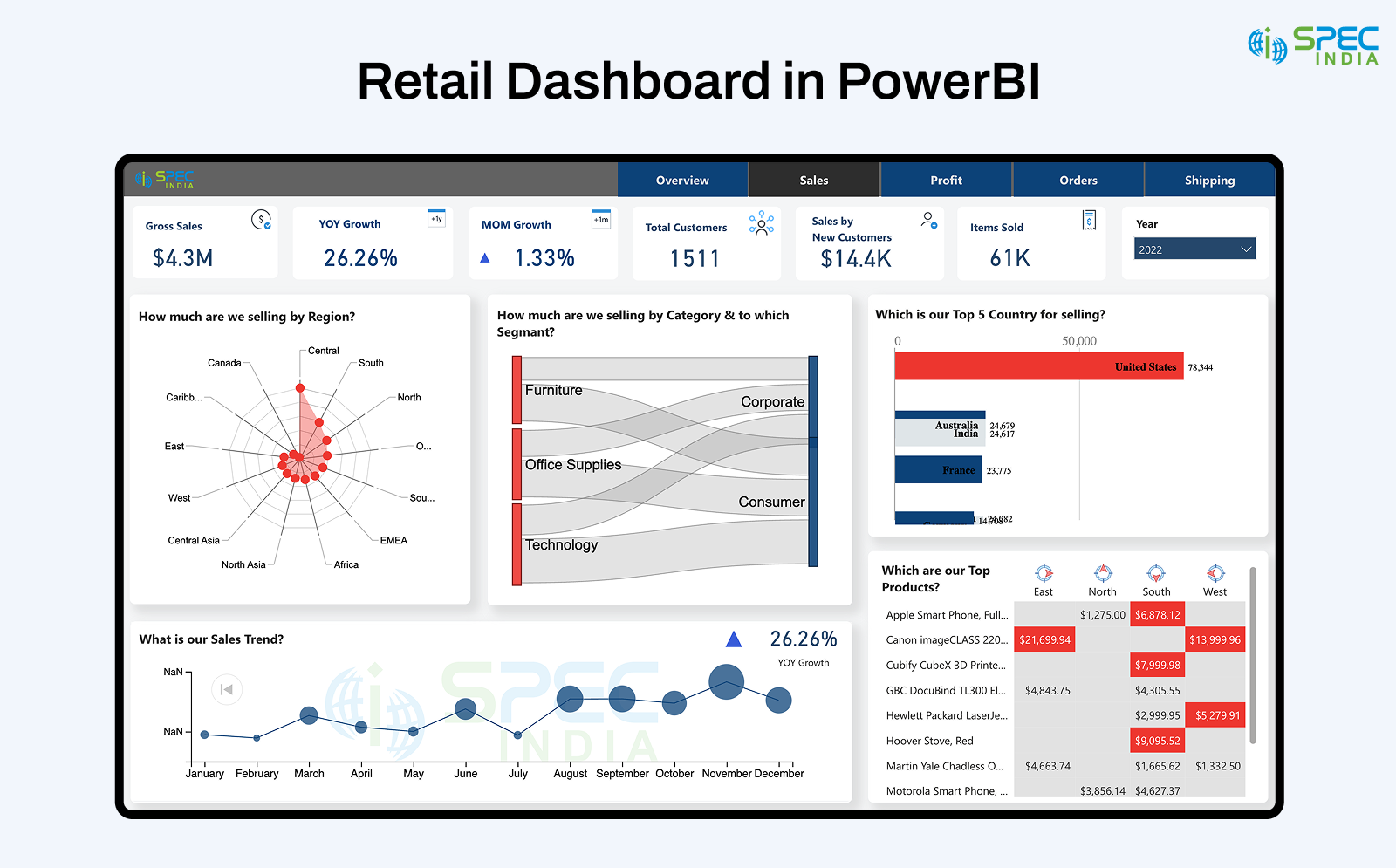
4. Business Intelligence in Retail
- Real-time information and reporting – Sales by store, by channel, by product category, and by time are instantly visible without a manual report being built. Leadership sees what’s happening, not what happened last week.
- Profit and loss visibility by product and location – Understanding exactly where margin is being made and lost across the business is one of the most valuable things a retail ERP delivers and one of the things most disconnected systems simply cannot do.
- Trend analysis and performance benchmarking – Compare performance across periods, locations, and channels. Identify what’s working and what isn’t with data rather than instinct.
5. Business Automation
- Automated financial workflows – Invoice processing, payment approvals, bank reconciliation, and month-end reporting tasks that used to consume significant finance team hours can be automated, reducing both cost and error rates.
- Replenishment automation – From forecasting to ordering to receipt, the entire replenishment cycle can run with minimal manual intervention in a well-implemented retail ERP system.
- HR and payroll automation – Staff scheduling, attendance tracking, payroll processing, and compliance reporting are managed within the same platform as the rest of the business.
Real Benefits of ERP for Retail Business
The business case for ERP in retail is usually made in terms of the features that the system provides. But the more compelling conversation is about outcomes, what changes for the business after a successful implementation.
What Changes When Retail Operations Run on ERP
- Decisions get made on real data, not assumptions – When sales, inventory, finance, and customer data all live in one place and are updated in real time, the quality of decisions across the business improves dramatically. Buyers stop guessing at reorder quantities. Finance no longer waits until the month-end to understand the cash position. Operations stop firefighting stockouts that should have been prevented.
- Staff spend less time on manual work and more on meaningful work – Business automation eliminates the repetitive, error-prone manual tasks that eat into every retail team’s day, such as data entry, report pulling, stock reconciliation, and invoice matching. The hours saved are real, and they get reinvested into work that moves the business forward.
- The customer experience gets more consistent – When every channel online, in-store, and mobile is connected to the same data, customers get a consistent experience regardless of how they choose to shop. Stock availability is accurate. Returns are seamless. Loyalty points apply everywhere. This is what modern retail customers expect, and it’s what ERP makes possible.
- Retail operations become genuinely scalable – Adding a new store location, launching a new sales channel, or entering a new market, all of these things become significantly less painful when the underlying operational platform is designed to scale. Manual processes and disconnected systems don’t scale. ERP does.
Common Challenges You’ll Face During Retail ERP Implementation
There’s no value in painting a picture of ERP implementation as something that’s straightforward and painless. It isn’t. And retail businesses that go in expecting otherwise tend to end up frustrated, over budget, and under-delivered.
What Makes Retail ERP Implementation Genuinely Hard
Data migration is always more complex than expected – Years of product data, customer records, supplier information, and transaction history need to be extracted from existing systems, cleaned, transformed, and loaded into the new platform. This is almost always the most time-consuming and technically demanding part of any ERP implementation, and it almost always takes longer than the initial estimate.
- Change management is underestimated every time – ERP changes how people work every day, in practical ways. Buyers, store managers, finance teams, and customer service staff all need to learn new workflows. Without proper training, communication, and leadership buy-in, adoption is low, and workarounds multiply. The technology delivers. The change management determines whether anyone uses it.
- Selecting the wrong ERP system for your retail environment – Not all ERP software is created equally for retail. Some ERP software was designed for other industries, such as manufacturing or professional services. While it could work for retail, it would require significant customization. Selecting the correct retail-based ERP system from the outset could help avoid significant headaches down the road.
- Scope creep: Scope creep leads to project delays and cost overruns – ERP software selection and implementation are well known for scope creep. Scope creep occurs when changes are made to the project scope without formal approval and control. It is critical to maintain project scope and control scope changes.
According to Panorama Consulting Group (2023), “75% of ERP projects experience cost or schedule overruns, typically due to poor planning and underestimated data migration issues.”
Tip: Although scope creep is common in ERP software selection and implementation, it does not mean that your project is doomed to experience scope creep. It just means you should plan for it.
Should You Build a Custom Retail ERP or Buy an Existing Platform?
This is a question that comes up in almost every retail ERP conversation, and it deserves a straight answer.
The build vs buy debate has historically been more nuanced than it is today. Ten years ago, there were genuine gaps in the retail ERP market that made custom development a reasonable choice for businesses with very specific needs. Today, the leading retail ERP platforms are comprehensive, configurable, and retail-native. The case for building from scratch has narrowed considerably.
The Build vs Buy Decision in Plain Terms
- Buying is almost always faster – A proven retail ERP solution can be implemented in months. Building a comparable system from scratch takes years and requires ongoing development resources to maintain and evolve it.
- Buying carries lower risk – Established ERP platforms have been tested across thousands of retail implementations. The edge cases have been discovered. The integrations have been built. The compliance frameworks are in place. Custom builds carry all of the discovery risk on your shoulders.
- Building gives you more control, but at a steep price – If your retail operation genuinely has requirements that no existing platform can meet, custom development may be the answer. But this is rarer than most people think. More often, the perceived need for a custom build is a need for good configuration and implementation expertise.
- Retail software development services bridge the gap – The best approach for many retailers isn’t a pure build or a pure buy; it’s buying a strong platform and working with experienced retail software development services to configure it precisely to your operational context, build the integrations your ecosystem requires, and extend it where necessary.
Choosing the Right ERP Implementation Partner
Your ERP solution is as good as the partner you choose to implement it with. The right partner will help you in smooth implementation, data migration, and business impact, while the wrong partner will cost you dearly.
We, at SPEC India, offer retail ERP solutions, custom solutions, and digital transformation services to cater to your retail business needs. Connect with us to develop a solution for your retail business.
Top Retail ERP Platforms to Know
The choice of an ERP solution for your retail business is one of the most important decisions, and there are numerous ERP solutions available in the market. Here’s an honest look at the top ERP solutions used in retail businesses today.
Top ERP Platforms Used in Retail
- SAP S/4HANA Retail – The market leader for large and enterprise-scale retailers. Deeply functional, highly customizable, and built for complex global operations. The implementation complexity and cost reflect its scale; it’s best suited to retailers with significant resources and sophisticated requirements.
- Microsoft Dynamics 365 Commerce – A good option for mid-market retailers, especially those already working with the Microsoft environment. Great Office 365 and Azure integrations, good retail CRM functionality via Dynamics CRM, and increasing retail functionality.
- Oracle NetSuite – A cloud-based ERP system is a great option for retail businesses with growth potential, offering good financial management as well as retail functionality. Scalability is good, and implementation speed is fast relative to other ERP systems, like SAP.
- Epicor Retail – Designed specifically for the retail industry, with good functionality at the point of sale, inventory management, and supply chain management. Popular among specialty retailers.
- Infor CloudSuite Retail – A retail-native cloud ERP platform offers strong industry-specific functionality backed by modern architecture, making it ideal for businesses seeking scalability and real-time visibility. These platforms are often well-regarded for their advanced analytics and business intelligence capabilities in retail. However, for organizations with highly unique operational requirements that standard solutions cannot address, custom-built ERP systems remain a viable—though more demanding—option. Such solutions are typically developed by experienced retail software development partners to ensure flexibility, control, and long-term alignment with business goals.
Conclusion
The retail landscape in 2025 is genuinely demanding. Customers expect seamless omnichannel experiences. Supply chains remain unpredictable. Margins are under pressure from every direction. And the pace of change in consumer behavior, in technology, in competition shows no sign of slowing.
In that environment, running your business on disconnected systems and manual processes isn’t just inefficient. It’s a competitive disadvantage that compounds over time.
ERP in retail changes the equation. Not by adding more complexity, but by removing it. By bringing every part of the business into a single, connected platform that gives everyone the visibility, the tools, and the automation they need to do their jobs well.
The retailers who will lead the next decade won’t necessarily be the biggest or the most well-funded. They’ll be the ones who built the operational foundation to move faster, decide smarter, and serve customers better than the competition.
That foundation starts with the right retail ERP solution.
Connect with SPEC India today, let’s build a retail ERP strategy that’s designed for where your business is going, not just where it is today.
Frequently Asked Questions
Think of it as one central platform that connects your inventory, supply chain, finance, HR, and CRM all in one place, all updating in real time. It matters because juggling five disconnected systems creates errors, blind spots, and delays that cost money. A retail ERP solution fixes that by giving everyone in the business a single, accurate picture of what's happening. ERP helps streamline retail operations by connecting inventory, supply chain, finance, and customer data into one unified system.
At its core, a good retail ERP should cover real-time inventory management, supply chain and purchase order tracking, integrated CRM in retail, financial reporting, business automation for repetitive tasks, business intelligence dashboards, and seamless integration with your POS and e-commerce platforms. If a system can't do all that cleanly, it's not ready for serious retail operations.
The short answer: better visibility, less manual work, and a system that scales with you. Teams make faster decisions with real data. Inventory problems get caught before they cost sales. Customers get a consistent experience across every channel. And when you're ready to open a new store or launch a new channel, you're not rebuilding everything from scratch.
For a mid-sized retailer, expect 4 to 9 months for a Cloud ERP go-live. Larger businesses or those with complex data migration and integrations can take 12 to 18 months. The honest advice: don't rush it. Projects that cut corners on time almost always create bigger problems on the other side of launch.
Cloud ERP runs on remote servers you access via the internet, no on-site hardware, no manual updates, no IT overhead to manage a server room. For most retailers, it's the right call. Lower upfront costs, automatic updates, access from anywhere, and it scales as the business grows. On premises still works for very specific situations, but cloud is the default for good reason.
It essentially links everything together, starting with predicting what customers will want and generating purchase orders, and then moving on to monitoring deliveries and receiving inventory. This gives you a complete view of the process, which translates to fewer instances of running out of stock, more intelligent ordering practices, and supplier relationships built on hard data instead of guesswork.
Every single customer interaction, from purchasing and returning items to loyalty program membership and service history, is combined into one complete picture. So, your marketing team can create campaigns based on actual behaviour, your loyalty program works everywhere, and your customer service team always has access to the entire picture. No more disjointed information across three different applications.

SPEC INDIA is your trusted partner for AI-driven software solutions, with proven expertise in digital transformation and innovative technology services. We deliver secure, reliable, and high-quality IT solutions to clients worldwide. As an ISO/IEC 27001:2022 certified company, we follow the highest standards for data security and quality. Our team applies proven project management methods, flexible engagement models, and modern infrastructure to deliver outstanding results. With skilled professionals and years of experience, we turn ideas into impactful solutions that drive business growth.
Table of contents
- What is ERP in Retail and Who is It Actually For?
- Key Features Every Retail ERP System Should Have
- Real Benefits of ERP for Retail Business
- Common Challenges You'll Face During Retail ERP Implementation
- Should You Build a Custom Retail ERP or Buy an Existing Platform?
- Top Retail ERP Platforms to Know
- Conclusion
Delivering Digital Outcomes To Accelerate Growth
Let’s TalkTable of contents
- What is ERP in Retail and Who is It Actually For?
- Key Features Every Retail ERP System Should Have
- Real Benefits of ERP for Retail Business
- Common Challenges You'll Face During Retail ERP Implementation
- Should You Build a Custom Retail ERP or Buy an Existing Platform?
- Top Retail ERP Platforms to Know
- Conclusion
Delivering Digital Outcomes To Accelerate Growth
Let’s TalkRelated Blogs
Let’s get in touch!
India
SPEC House, Parth Complex, Near Swastik Cross Roads, Navarangpura, Ahmedabad 380009, INDIA.
-
 +91-79-26404031, 32-33-34
 -
 [email protected]