

The Role of AI in Transforming Renewable Energy
May 30, 2026
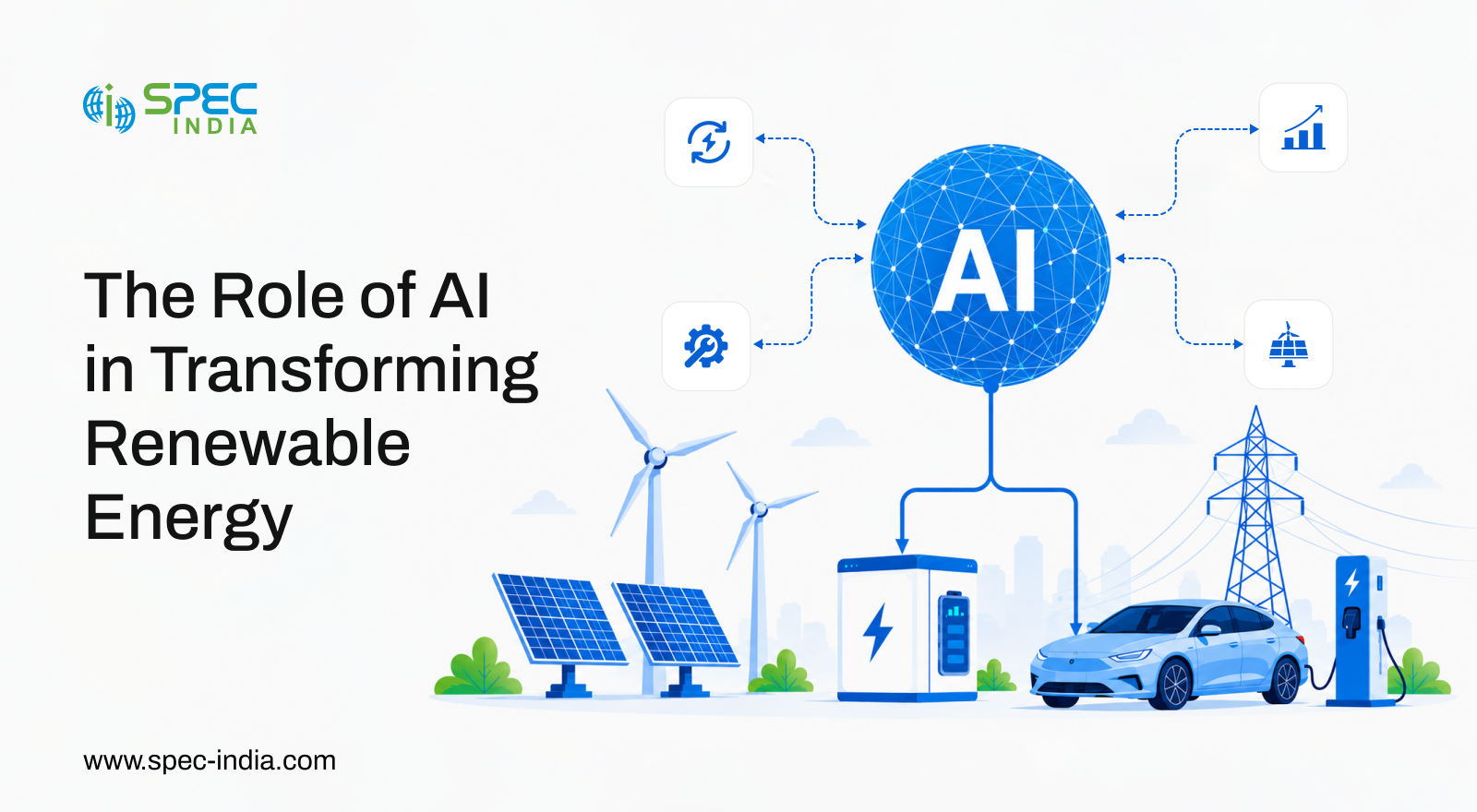
The world is in the middle of one of the most consequential energy transitions in human history. Governments are retiring coal plants. Corporations are signing massive renewable power purchase agreements. And utilities are scrambling to manage grids that were never designed to handle the variability of wind and solar at scale. Somewhere in the middle of all this complexity sits a technology that is quietly becoming indispensable — artificial intelligence. The role of AI in renewable energy is no longer theoretical. It is operational, measurable, and in many cases, mission-critical.
This blog explores how artificial intelligence in renewable energy is being applied across the value chain; From predicting how much power a wind farm will produce tomorrow morning to stabilizing a grid that is balancing thousands of distributed solar panels in real time. The applications are broad, the impact is growing, and the case for adoption has never been stronger.
The Forecasting Problem That AI Is Finally Solving
Ask any grid operator what keeps them up at night, and forecasting will be near the top of the list. The fundamental challenge of AI in renewable energy sector is this: solar and wind are weather-dependent, and weather is inherently uncertain. A sudden cloud cover in the afternoon can drop solar output by 40% in minutes. A shift in wind patterns can leave a turbine farm producing far less than expected. These fluctuations, if not anticipated, force grid operators to keep expensive and polluting backup generation on standby.
This is where wind and solar forecasting using AI changes the game. Traditional forecasting relied on numerical weather prediction models — useful, but limited. They work well for broad regional trends but struggle with the hyperlocal conditions that actually govern how much power a specific solar array or wind farm will generate. Machine learning models, trained on years of historical production data combined with satellite imagery, atmospheric sensor readings, and real-time telemetry, can produce far more granular and accurate predictions.
Modern AI for renewable energy forecasting platforms use ensemble methods, combining multiple models to generate a range of probable outcomes rather than a single point estimate. This is enormously valuable for grid planning because it lets operators understand not just what is likely to happen but how confident they should be in that prediction. A forecast with wide uncertainty bounds triggers different operational decisions than one with tight confidence intervals. The result is fewer emergency dispatches, better reserve management, and lower costs passed on to consumers.
AI-Based Demand Forecasting: The Other Side of the Equation
Supply forecasting alone is not enough. AI-based energy demand forecasting is equally critical. The grid must balance supply and demand in real time — if they diverge even briefly, frequency and voltage can destabilize, potentially triggering outages. Historically, demand was relatively predictable. Utilities had decades of data on exactly when people used power and how much. That certainty made grid planning manageable. What is happening now is something different entirely.
Why Traditional Demand Models Are No Longer Reliable
That old predictability is eroding fast. The rise of electric vehicles, smart appliances, distributed battery storage, and the permanent shift to remote and hybrid work has made load patterns far more variable than any prior generation of grid planners had to contend with. A neighborhood that draws a consistent 2 megawatts at 6 p.m. today might draw 3.5 megawatts tomorrow if a heat wave hits and half the households start charging EVs simultaneously. Traditional statistical models, built on the assumption that yesterday roughly resembles today, struggle to handle this kind of structural change in consumer behavior.
What AI-Driven Demand Forecasting Actually Looks Like
Modern predictive analytics in renewable energy platforms handle this complexity by pulling in dozens of data streams simultaneously — weather forecasts, economic activity indicators, local event calendars, building occupancy sensor data, and in some cases, anonymized signals from smart meter networks. Machine learning models trained on this richer data can identify subtle demand patterns that traditional models simply miss. A major sporting event downtown, an approaching cold front, a factory running a night shift — each of these shows up in the data and gets weighted accordingly. The result is demand forecasts that are meaningfully more accurate than what was achievable even five years ago.
The Financial Case Is Stronger Than It Looks
Some utilities have reported reductions in forecast error of 20% to 30% after deploying AI-based demand models. That might sound incremental on the surface, but the financial math is compelling. In a sector where a single percentage point improvement in forecast accuracy can translate to millions of dollars in avoided generation costs — through better reserve scheduling, fewer emergency dispatch events, and reduced reliance on expensive peaker plants — these gains compound quickly. Renewable energy analytics platforms are making this level of forecasting precision accessible even to mid-sized utilities that do not have large internal data science teams, which means the competitive advantage of better demand intelligence is no longer limited to the largest players in the market.
Smart Grid AI: Stability in a World of Distributed Energy
The electric grid was built around a simple idea; big power plants generate electricity and push it out to customers through a one-way network. That model worked well for decades. Renewable energy breaks it.
Rooftop solar, community wind farms, and home battery systems have turned ordinary consumers into producers. Managing power flowing in both directions, across millions of connection points, is a fundamentally different operational challenge than anything grid engineers originally designed for. Smart grid AI is what makes it manageable.
AI systems watch voltage levels, frequency, load flows, and equipment condition across thousands of grid nodes simultaneously. They catch problems before they become outages and reroute power automatically to keep things stable — in some cases, making those decisions in milliseconds, far quicker than any human dispatcher could even register that something had gone wrong.
AI for power grid optimization goes well beyond just preventing blackouts. It minimizes transmission losses by finding the most efficient routing for power across the network. It coordinates when grid-scale batteries charge and discharge to absorb the natural variability of renewable output. It manages demand response programs, dialing back load from large industrial users when supply gets tight. Each of these capabilities has standalone value. Running them together produces a grid that is genuinely more resilient than anything we had before.
AI Energy Management Systems: From Substations to Buildings
The same intelligence reshaping grid operations is now embedded in individual buildings. AI energy management systems have become standard in large commercial offices, data centers, manufacturing facilities, and university campuses. They watch energy use in real time, find waste, and adjust equipment automatically — without anyone having to intervene and without disrupting how a building operates.
In a well-run commercial building, one of these systems might be managing HVAC schedules based on how many people are actually in the building, coordinating EV charging to stay below peak demand thresholds, making the most of rooftop solar, and pre-conditioning the space during off-peak hours when electricity is cheaper. It is not a set-and-forget tool either — it keeps learning from operational data and keeps getting better at balancing competing priorities.
For utilities, this building-level intelligence is genuinely useful. Aggregating flexibility from thousands of buildings through demand response programs creates something that behaves like a power plant — without the capital cost of actually building one. The relationship between ai in utilities and what is happening inside customer buildings is becoming one of the defining features of how modern grids are managed.
See How Digital Innovation Improved Utility Operations
Explore our Spot Billing Solution for a Gas Utility Company to understand how energy businesses can modernize billing, field operations, and customer service.
The Role of AI and IoT in the Renewable Energy Ecosystem
No discussion of AI in energy would be complete without addressing the infrastructure that feeds it.
- AI and IoT in renewable energy are deeply intertwined.
- The Internet of Things provides the sensor networks that generate the data AI systems need to function.
- Smart meters, weather stations, drone inspection systems, vibration sensors on turbine blades, thermal cameras on solar panels — all of these IoT devices produce continuous streams of operational data.
- This data, properly collected and processed through robust data engineering pipelines, becomes the raw material for AI models.
- Without a reliable data infrastructure, the most sophisticated AI algorithms produce unreliable results.
This is why serious deployments of AI in the energy sector invest heavily in data quality, data governance, and the engineering systems that ensure data flows cleanly from the field to the models that analyze it.
The combination of AI and ML in renewable energy applications with well-designed IoT infrastructure is enabling capabilities that were simply not possible before. Predictive maintenance on wind turbines — using vibration and thermal data to identify bearing failures weeks before they cause a breakdown, is one example. AI-driven inspection of solar panels using drone imagery is another. These applications reduce downtime, extend equipment life, and improve the economics of renewable energy projects.
Cloud Analytics Services and the Democratization of Energy AI
For most of the last decade, serious AI capability in the energy sector required serious resources — large data science teams, expensive infrastructure, and multi-year implementation programs. Only the biggest utilities and energy companies could afford it. That is changing, and cloud analytics services are the primary reason why.
Cloud platforms now package AI and machine learning tools in ways that do not require building everything from scratch. A regional utility or an independent renewable developer can access forecasting and optimization capabilities that would have taken a large enterprise years to build internally. The barrier to entry has dropped considerably, and adoption is accelerating across the energy and utilities industry solutions space as a result.
There is another benefit that does not get talked about enough. Cloud infrastructure makes it easier for different organizations to work with shared data. Grid operators, generators, and large industrial customers can collaborate through secure cloud environments, unlocking system-level optimizations that were previously impossible simply because the relevant data was sitting in separate silos. The AI & digital transformation in energy sector is as much about breaking down those walls as it is about any specific model or algorithm.
Building an Enterprise AI Strategy for Energy Companies
Despite the clear benefits, many energy companies are still in the early stages of their AI journey. Implementing AI at scale requires more than selecting the right software. It requires a coherent AI strategy for energy companies that addresses technology, talent, data, and organizational change simultaneously.
Start With Use Cases That Have Clear Business Value
The most successful implementations of enterprise ai in energy and utilities tend to have one thing in common — they do not try to do everything at once. They pick use cases with clear business value and measurable outcomes, build data infrastructure before they build models, develop internal capability rather than outsourcing everything, and treat AI as something that keeps evolving rather than a project with an end date. Organizations that skip this groundwork and jump straight into complex model development pay for it later, usually in the form of expensive rework and disappointing results.
Prioritize Organizational Readiness, Not Just Technology
Technology is rarely the hardest part. AI implementation in utilities asks grid operators, engineers, and business analysts to collaborate with data scientists in ways most organizations simply are not used to. Without proper change management, training, and honest communication about what AI can and cannot do, even technically sound deployments fall flat. The companies that consistently get the best results are the ones that treat the people side of this transformation with the same seriousness as the technical side — because culture and capability have to grow alongside the technology, not after it.
Leverage External Expertise to Accelerate the Path to Production
Most utilities and energy companies do not have deep machine learning expertise sitting in-house, and there is no shame in that. Expert AI ML development services providers can close that gap quickly — particularly those who understand the regulatory, operational, and safety realities of the power sector. A good external partner does not just bring technical skills. They bring hard-won experience from previous deployments, which shortens the path from pilot to production considerably.
Build Data Infrastructure Before Building Models
Poor data will sink any AI initiative, regardless of how sophisticated the models are. Before anything else, organizations need to invest in data engineering pipelines, governance frameworks, and integration layers that ensure clean, timely data flows from field devices into analytical systems. Companies that rush past this step spend most of their time fixing data problems instead of extracting value from AI. A solid cloud analytics services foundation, paired with well-structured IoT data collection, is what actually creates the conditions for AI to deliver on its promise.
Ready to Build an AI Strategy for Renewable Energy Operations?
SPEC India helps energy companies apply AI, IoT, cloud analytics, and data engineering to improve forecasting, grid visibility, operational efficiency, and decision-making.
What the Future Looks Like
The energy transition is still in its early chapters. As renewable penetration increases, the challenges of forecasting, optimization, and grid stability will only get harder. The grids of 2035 will look very different from those of 2015 — more distributed, more dynamic, and far more demanding to operate.
AI in energy is not just one tool among many for managing that complexity. It is becoming the connective tissue holding the entire system together — linking weather data to generation forecasts, demand predictions to dispatch decisions, equipment sensors to maintenance schedules, and billions of individual consumption choices to grid-wide operational strategy.
The utilities and energy companies that build these capabilities now — the data infrastructure, the analytical talent, the operational integration — will be far better placed to compete and operate as the grid evolves. Those that wait risk managing a high-renewable grid with tools built for a completely different era.
Conclusion
Artificial intelligence in renewable energy is not a future story. It is happening now, and the outcomes are measurable — more accurate forecasting, more stable grids, better use of clean generation, and an energy transition that moves faster and costs less than it otherwise would.
Whether you are a utility executive weighing your next technology investment, an energy developer trying to squeeze more value out of a wind project, or a grid operator dealing with increasing operational complexity, the direction is clear. The technology is mature, the use cases are proven, and the window for early-mover advantage is still open but it will not stay open indefinitely.
The clean energy future will be run by intelligent systems. The only real question is whether your organization is building that capability now or watching others do it first.
Frequently Asked Questions
AI draws on real-time weather feeds, satellite data, and years of historical generation patterns to produce predictions that traditional models simply cannot match. Utilities that have made the switch report forecast error reductions of 20–30%.
Lower reserve generation costs, less unplanned downtime through predictive maintenance, and a more efficient grid overall. Most enterprise deployments reach measurable ROI somewhere between 12 and 24 months in.
It watches voltage, frequency, and load conditions across thousands of nodes simultaneously and triggers corrective actions in milliseconds; well before a human dispatcher could respond. It also manages battery dispatch and demand response to absorb the variability that comes with renewable generation.
Generation and demand forecasting, predictive asset maintenance, real-time grid optimization, building-level energy management, and demand response program coordination.
It is, and the value tends to grow with scale. More assets mean more data, which means better-trained models. Most enterprise AI platforms connect without too much friction to existing SCADA systems and cloud infrastructure.
A well-scoped pilot typically runs three to six months. Getting from pilot to full enterprise deployment usually takes another six to eighteen months, depending largely on how mature the underlying data infrastructure already is.
Through APIs and data pipelines that connect to existing cloud environments and operational technology — smart meters, SCADA systems, IoT sensors. The smoothness of that integration comes down almost entirely to how clean and well-structured the underlying data is before the AI layer is added.

SPEC INDIA is your trusted partner for AI-driven software solutions, with proven expertise in digital transformation and innovative technology services. We deliver secure, reliable, and high-quality IT solutions to clients worldwide. As an ISO/IEC 27001:2022 certified company, we follow the highest standards for data security and quality. Our team applies proven project management methods, flexible engagement models, and modern infrastructure to deliver outstanding results. With skilled professionals and years of experience, we turn ideas into impactful solutions that drive business growth.
Table of contents
- The Forecasting Problem That AI Is Finally Solving
- AI-Based Demand Forecasting
- Smart Grid AI
- AI Energy Management Systems: From Substations to Buildings
- The Role of AI and IoT in the Renewable Energy Ecosystem
- Cloud Analytics Services and the Democratization of Energy AI
- Building an Enterprise AI Strategy for Energy Companies
- What the Future Looks Like
- Conclusion
Delivering Digital Outcomes To Accelerate Growth
Let’s TalkTable of contents
- The Forecasting Problem That AI Is Finally Solving
- AI-Based Demand Forecasting
- Smart Grid AI
- AI Energy Management Systems: From Substations to Buildings
- The Role of AI and IoT in the Renewable Energy Ecosystem
- Cloud Analytics Services and the Democratization of Energy AI
- Building an Enterprise AI Strategy for Energy Companies
- What the Future Looks Like
- Conclusion
Delivering Digital Outcomes To Accelerate Growth
Let’s TalkRelated Blogs
Let’s get in touch!
India
SPEC House, Parth Complex, Near Swastik Cross Roads, Navarangpura, Ahmedabad 380009, INDIA.
-
 +91-79-26404031, 32-33-34
 -
 [email protected]