| Data Type | Primary Source | Business Use |
|---|---|---|
| Production Data |
|
Monitor throughput, track production cycle performance, improve capacity utilization, and optimize production plans. |
| Machine Data |
|
Helps with predictive maintenance, identify equipment failures, monitor critical equipment health, and reduce unplanned downtime. |
| Quality Data |
|
Improve quality control, detect defects early, enhance product quality, reduce scrap and rework. |
| Supply Chain Data |
|
Demand forecasting, inventory optimization, supply planning, and supplier performance evaluation. |
| Inventory Data |
|
Optimize inventory levels, track raw materials consumption, prevent stockouts and excess inventory. |
| Workforce Data |
|
Analyze resource utilization, monitor shift performance, and improve workforce productivity. |
| Energy Data |
|
Identify energy-intensive production processes, reduce operational costs, and improve sustainability. |
| Sales and Market Data |
|
Analyze historical sales data, identify demand patterns, improve forecast accuracy and production planning. |


Loading...
Data Analytics in Manufacturing Industry: Key Use Cases and Applications
Posted
July 7, 2026
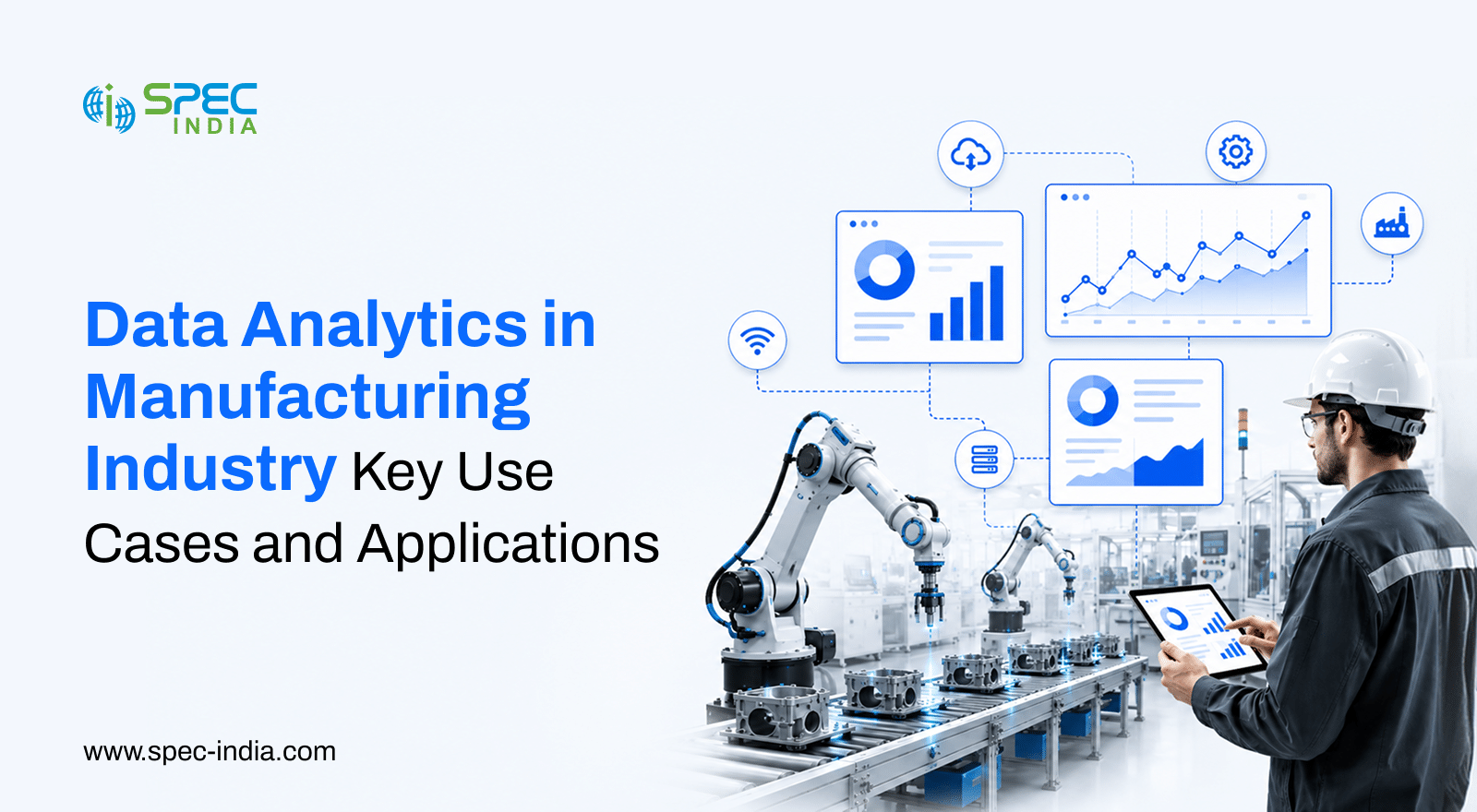
Every production line generates thousands of signals every hour compounding data points related to;
- PLC events
- Machine telemetry
- Quality inspection records
- Maintenance logs
- Inventory movements
- Supplier updates
- ERP transactions
All these metrics and signals collectively create a growing stream of manufacturing data. However, the challenge businesses face today is not data collection, that is already sorted with a wide array of tools and firmware, but the real challenge is turning that data into decisions before production losses occur.
This is where data analytics for manufacturing industry comes to your rescue as it connects;
- Production data
- Machine performance metrics
- Quality records
- Supply chain information
This allows manufacturers to gain real time insights into manufacturing operations resulting in better production planning, stronger quality control, accurate demand forecasting, fewer equipment failures, and faster responses to conditions developing on the factory floor.
What is Data Analytics in Manufacturing Sector?
Data analytics in manufacturing is the practice of collecting, contextualizing, and analyzing data generated across production systems to improve operational performance, product quality, asset reliability, and business outcomes.
Manufacturing analytics focuses on identifying patterns that humans can miss, predicting future events that existing software cannot figure out, and enabling data driven decisions that directly affect production processes.
Modern manufacturing data analytics combines information from a wide array of components, including;
- Machines
- Sensors
- MES platforms
- SCADA systems
- ERP applications
- Quality management systems
- Supply chain management platforms
This segment of analytical studies and inferences connect these previously isolated data sources to create a complete operational picture that is easy to understand. Big data analytics in manufacturing industry leverage several data systems, including;
Production Data
Production data captures throughput, cycle times, changeovers, work orders, production plans, capacity utilization, and overall equipment effectiveness (OEE) allowing manufacturers to identify bottlenecks, optimize processes, and improve production efficiency.
Machine Data
Machine data originates from PLCs, industrial internet-connected devices, and equipment sensors. Data analytics enables continuous monitoring of sensor data to;
- Detect abnormal operating conditions
- Supports predictive maintenance programs
- Identify potential equipment failures before they disrupt production
- Quality Data
Quality data in manufacturing process analytics extracts inspection results, defect records, scrap rates, rework metrics, and process deviations. On top of this, advanced analytics helps manufacturers trace quality issues to specific manufacturing process conditions and enhance product quality through faster root-cause identification.
Supply Chain Data
Supply chain data covers inventory management, supplier performance, procurement activity, raw materials availability, logistics events, and demand and supply planning. This data is then used by manufacturers to optimize inventory, supply chain, and forecast demand.
Workforce Data
Workforce data includes labor utilization, shift performance, operator productivity, training records, and safety incidents. When combined with operational data, it helps manufacturing teams improve resource utilization, reduce downtime, and align labor capacity with production plans.
Types of Manufacturing Data and their Applications
There’s no such thing as lack of data in a manufacturing unit, the challenge is connecting different data streams and extracting actionable insights for different operations. Since each category of manufacturing process analytics data extracted serves a different purpose, here’s how you can use each data type to your benefit.
Key Applications of Data Analytics in Manufacturing
Manufacturing operations generate data across production lines, machines, quality processes, supply chains, energy systems, and workforce activities. Data analytics solutions bring this information together and turn it into actionable insights that support faster and more informed operational decisions. From identifying production inefficiencies to predicting equipment failures and improving resource utilization, manufacturers are applying analytics across critical areas of their operations.
Here are some of the key applications of data analytics solutions in manufacturing
Production Performance Optimization
Losses in production, whether its lowering capacity or production are a result of a single event. Downtrends in production performance result from small inefficiencies that accumulate across the manufacturing process, like;
- Short machine stoppages
- Inefficient changeovers
- Unbalanced production lines
- Material shortages
These and several more issues can collectively reduce overall equipment effectiveness without triggering major alarms.
Manufacturing analytics helps organizations identify bottlenecks by combining real time data from machines, production lines, and operators, ensuring production managers can analyze cycle times, queue lengths, machine utilization, and throughput rates to pinpoint where production capacity is being constrained resulting into;
- Process optimization
- Better productivity
- Increased throughput
In many facilities, analyzing data from multiple production stages reveals hidden losses that traditional reporting methods fail to detect.
Predictive Maintenance
Scheduled maintenance work assumes that all equipment needs service, change of parts, greasing, and whatnot. However, the on-ground reality is far more complex. Predictive maintenance uses a wide array of data, including;
- Sensor data
- Machine telemetry
- Vibration patterns
- Temperature readings
- Historical data
This data helps assess the actual condition of equipment and simultaneously advanced analytics and machine learning algorithms identify anomalies that often precede equipment failures minimizing unplanned downtime and ensure you give priority to maintenance resources based on risk rather than fixed schedules.
Quality Control and Defect Prevention
Manufacturing data analytics enables continuous monitoring of quality parameters throughout production processes tracking even the smallest defects and reporting them before they turn into bigger problems.
Quality teams can then correlate and combine different data types whether its related to production, machines, operations, environmental, etc. and perform root cause analysis to determine exactly which variables contributed to quality issues.
When integrated with real time quality monitoring systems, manufacturing analytics software can trigger alerts when process parameters move outside acceptable ranges allowing manufacturers to maintain quality, reduce wastage, and maintain consistency in product quality.
Supply Chain Optimization
Data analytics for manufacturing, specifically covering supply chain optimization covers different data types, including;
- Historical sales data
- Market trends
- Inventory levels
- Supplier performance metrics
- Procurement information
Manufacturers use this data for demand forecasting and effectively addressing shortages or excess inventory after they occur. Moreover, supply chain optimization also improves visibility into raw materials availability and supplier reliability. Organizations that leverage manufacturing analytics typically make better inventory management decisions, improve demand and supply planning, and strengthen supply chain resilience.
Energy Consumption Analysis
Analytics systems collect data from production equipment, utilities, and facility infrastructure to identify energy-intensive operations and control energy-related expenses.
The manufacturing management analytics systems analyze energy consumption alongside production output, to measure resource usage at a machine, line, or plant level.
As a result, you can determine the process and equipment operating outside optimal conditions, has unnecessary idle-time energy consumption, and inefficient production schedules so that you can adjust production processes and reduce energy waste without affecting output.
Workforce Productivity Analysis
Manufacturing business analytics helps organizations evaluate workforce productivity by analyzing;
- Shift performance
- Labor allocation
- Production targets
- Downtime events
- Operator efficiency
Instead of relying on anecdotal observations, managers gain objective visibility into workforce performance and data analysis to uncover hidden patterns like recurring productivity losses and training gaps.
When workforce data is combined with production and operational data, manufacturers gain complete visibility into how labor affects output, quality, and production efficiency, which helps support better decision making and scheduling.
Manufacturing Challenges and Their Analytics Solutions
Even when manufacturers know operational problems exist they don’t understand how to quantify their root causes. Manufacturing analytics bridges that gap by converting raw operational data into measurable interventions that improve production, quality, maintenance, and supply chain performance.
| Challenge | Analytics Solution | Business Impact |
|---|---|---|
| Unplanned equipment failures | Predictive maintenance driven by Artificial Intelligence models using sensor data and historical data |
|
| Production bottlenecks | Production performance analytics and round-the-clock OEE monitoring |
|
| Excess inventory or stockouts | Demand forecasting and inventory optimization models |
|
| Excess inventory or stockouts | Demand forecasting and inventory optimization models |
|
| Quality defects and scrap | Real-time quality control and root cause analysis |
|
| Supplier delays | Supplier performance analytics and supply chain monitoring |
|
| Rising energy costs | Energy consumption analytics and resource usage tracking |
|
| Inefficient workforce allocation | Workforce productivity and shift-performance analytics |
|
| Poor operational visibility | Centralized analytics systems and dashboards |
|
Types of Data Analytics Used in Manufacturing Units
Descriptive analytics explains what happened, but advanced analytics helps determine what is likely to happen next and what actions should be taken. Most high-performing manufacturers use all four forms of analytics as part of a connected decision-making framework.
| Analytics Type | Purpose | Example |
|---|---|---|
| Descriptive Analytics | Understand what happened by analyzing historical production, maintenance, and quality data. | A dashboard shows last month’s OEE, downtime events, and scrap rates with clear visualizations and charts. |
| Diagnostic Analytics | Determine why an event occurred through deeper data analysis. | Root cause analysis identifies a machine setting or software setting responsible for recurring defects. |
| Predictive Analytics | Forecast future outcomes using historical data, real-time data, and machine learning algorithms. | Predictive maintenance models identify potential equipment failures before breakdowns occur and prevent unplanned downtime. |
| Prescriptive Analytics | Recommend optimal actions based on predictive insights and business constraints. | A system recommends how and where to adjust production plans or inventory levels to align with the demand patterns and supply chain risks. |
Real World Manufacturing Use Cases
The value of analytics in manufacturing becomes most visible when insights translate directly into operational improvements. Whether it is a smart factory aiming to forecast demand or a textile production factory looking to optimize its supply chain, manufacturers increasingly use data science and predictive analytics to improve performance across the value chain.
| Use Case | Analytics Applied | Potential Outcome | Technology | Purpose |
|---|---|---|---|---|
| Smart Factory Operations |
|
|
|
Optimize manufacturing operations |
| Predictive Maintenance Programs |
|
|
|
Improve asset reliability |
| Inventory Optimization |
|
|
|
Optimize inventory levels |
| Demand Forecasting |
|
|
|
Align production with market demand |
| Quality Improvement Initiatives |
|
|
|
Reduce defects and scrap |
Common Challenges Manufacturers Face with Data Analytics
The success of data analytics in manufacturing industry depends on a host of variables, but the most important of them all is the manufacturing data environment.
- Fragmented Data and Poor Quality: 44% manufacturers report that poor and fragmented data quality results in failure of data analytics and AI driven initiatives in a factory.
- Data Silos: When production, maintenance, quality, and supply chain systems operate independently without any alignment, it creates data silos, which becomes one of the largest obstacles, and this makes cross-functional analysis difficult.
- Legacy Systems: Legacy systems create another challenge as older PLCs, SCADA platforms, and proprietary databases were not designed for modern data collection and integration requirements. Even when manufacturers successfully collect data, poor data quality can undermine results. Missing records, inconsistent naming conventions, and unreliable sensor inputs often lead to flawed data interpretation.
- Integration Complexity: When the task involves integrating ERP, MES, quality systems, and operational technology environments, manufacturers need robust data management practices. Lack of skill or the required system compounds these challenges, as many organizations lack the data science, engineering, and analytics expertise needed to transform raw data into actionable insights that support manufacturing operations.
Which KPIs Manufacturers Can Improve with Data Analytics?
Manufacturing analytics delivers value when it improves measurable business outcomes. By continuously analyzing operational data, production data, and supply chain metrics, manufacturers can monitor performance more accurately and respond faster to emerging issues.
| KPI | Impact |
|---|---|
| Overall Equipment Effectiveness (OEE) | Used to improve machine availability, performance, and quality metrics. |
| Overall Equipment Effectiveness (OEE) | Identifies underutilized assets and production constraints in the manufacturing unit. |
| Production Throughput | Increases output by eliminating bottlenecks and inefficiencies before they turn into bigger problems. |
| Downtime Duration | Reduces both planned and unplanned downtime events. |
| First Pass Yield (FPY) | Improves product quality and reduces rework with advanced checks and analysis. |
| Scrap Rate | Minimizes waste through earlier defect detection and prevents compounding problems. |
| Forecast Accuracy | Strengthens demand forecasting and production planning to prevent inventory outages and overstocking. |
| Inventory Turnover | Improves inventory optimization and working capital efficiency. |
| Supplier On-Time Delivery | Supports supplier performance improvement initiatives. |
| Energy Consumption per Unit Produced | Reduces operational costs and improves sustainability metrics by assessing the usage of energy to manufacture every unit. |
| Maintenance Cost per Asset | Optimizes predictive maintenance and maintenance scheduling. |
| Customer Satisfaction | Improves delivery reliability, product quality, and service consistency. |
Explore our live customized Manufacturing KPI dashboard
How to Implement Data Analytics in Manufacturing Industry?
Bid data analytics in manufacturing industry needs a planned process. How well your data analytics system helps in achieving the core objective depends on the effectiveness of your implementation plan.
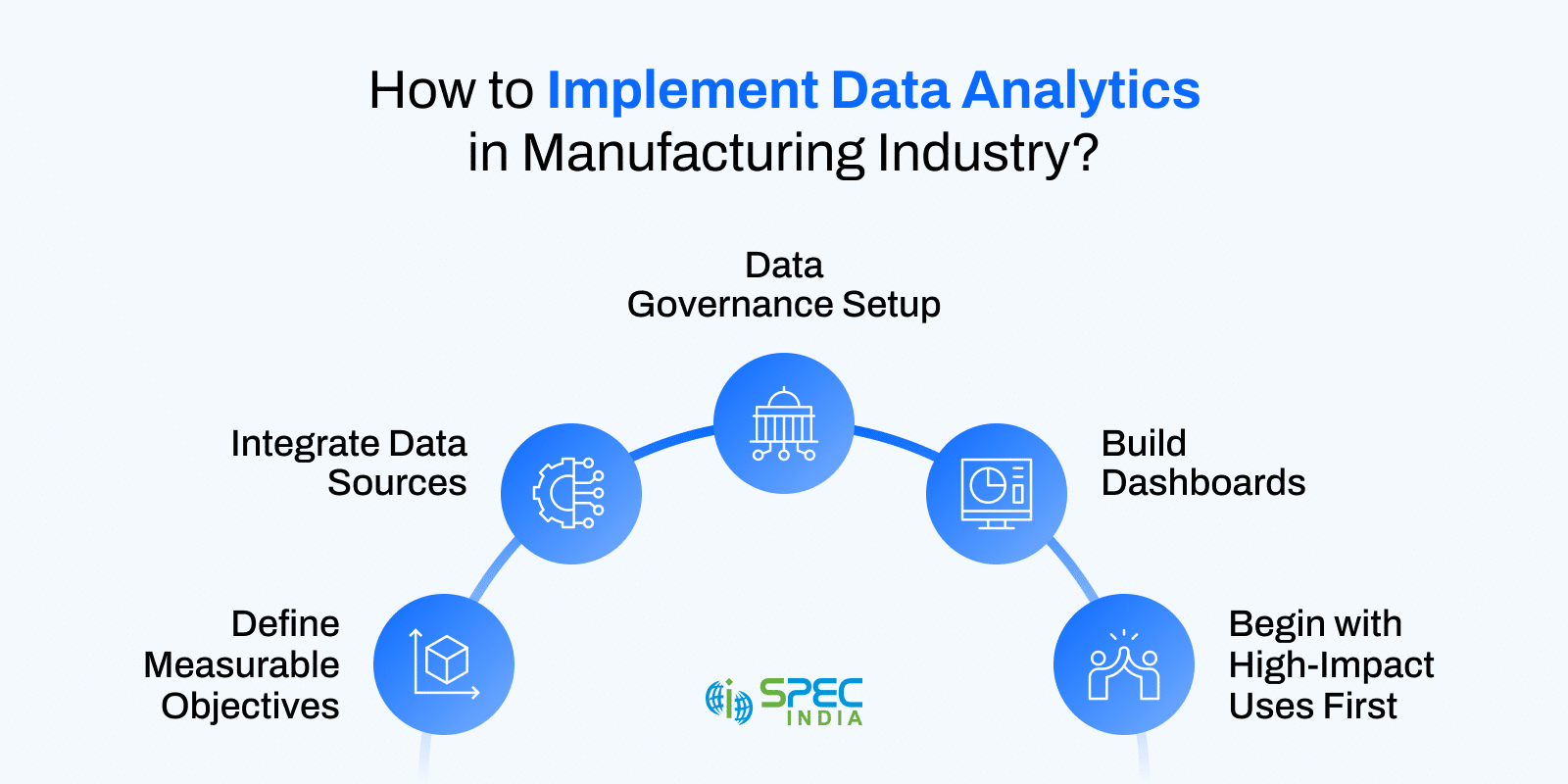
1. Define Measurable Objectives: Measurable objectives include reducing downtime, improving overall equipment effectiveness, increasing forecast accuracy, enhancing product quality, or lowering inventory costs. The objectives will help determine the next course of action.
2. Integrate Data Sources: Collect and add data sources across the factory floor and enterprise systems including;
- Production systems
- ERP platforms
- MES applications
- SCADA environments
- Maintenance records
- Supply chain data
Connect these to create a unified view of operations, as they will help build a foundation, and without them, the analytics capabilities remain limited.
3. Data Governance Setup: Strong data governance is equally important and requires manufacturers to standardize definitions, ownership models, validation rules, and data management processes to ensure reliable analysis.
4. Build Dashboards: Once trusted data pipelines are established, organizations should build dashboards and reporting environments that deliver real-time insights to decision-makers. Within the dashboards, ask your data analytics services provider to add data visualization, as it will help plant managers, operations leaders, and executives monitor KPIs without manually compiling reports.
5. Begin with High-Impact Uses First: Rather than attempting large-scale transformation immediately, manufacturers should begin with high-impact use cases such as;
- Predictive maintenance
- Quality control
- Demand forecasting
These small and early wins create momentum, bring confidence, and validate business value while giving you a framework for scaling advanced analytics across multiple plants, production processes, and manufacturing operations.
How SPEC India Helps Manufacturers Unlock the Power of Data Analytics?
SPEC India helps manufacturers transform fragmented operational data into actionable insights that improve efficiency, quality, and profitability. Leveraging our experience in data analytics services and manufacturing software development services, you can design custom solutions to the unique requirements of modern manufacturing environments.
We excel at manufacturing analytics consulting and help organizations identify high-value opportunities across production, maintenance, inventory management, and supply chain operations.
You can also hire us to develop custom manufacturing analytics solutions that integrate data from ERP platforms, MES systems, SCADA infrastructure, IoT devices, and enterprise applications.
From Custom Analytical Software to Advanced BI Dashboard
SPEC India delivers advanced BI dashboard development and data visualization services, enabling stakeholders to monitor critical KPIs through intuitive reporting environments. Using platforms such as Power BI, manufacturers gain real-time insights into production performance, quality metrics, resource utilization, and operational efficiency.
If that’s not all, we also combine IoT integration, predictive analytics services, and big data services to build scalable analytics ecosystems.
Whether you need to build a strategy around manufacturing process analytics or need a specialized architecture from design to implementation, we offer on-demand development services to long-term support. From strategy and architecture design to implementation, optimization, and long-term support, hire us for end-to-end expertise that accelerates data-driven manufacturing transformation.

SPEC INDIA is your trusted partner for AI-driven software solutions, with proven expertise in digital transformation and innovative technology services. We deliver secure, reliable, and high-quality IT solutions to clients worldwide. As an ISO/IEC 27001:2022 certified company, we follow the highest standards for data security and quality. Our team applies proven project management methods, flexible engagement models, and modern infrastructure to deliver outstanding results. With skilled professionals and years of experience, we turn ideas into impactful solutions that drive business growth.
Table of contents
- What is Data Analytics in Manufacturing
- Types of Manufacturing Data and their Applications
- Key Applications of Data Analytics in Manufacturing
- Manufacturing Challenges and Their Analytics Solutions
- Types of Data Analytics Used in Manufacturing Units
- Real World Manufacturing Use Cases
- Common Challenges Manufacturers Face with Data Analytics
- Which KPIs Manufacturers Can Improve with Data Analytics
- How to Implement Data Analytics in Manufacturing
- How SPEC India Helps Manufacturers
Delivering Digital Outcomes To Accelerate Growth
Let’s TalkTable of contents
- What is Data Analytics in Manufacturing
- Types of Manufacturing Data and their Applications
- Key Applications of Data Analytics in Manufacturing
- Manufacturing Challenges and Their Analytics Solutions
- Types of Data Analytics Used in Manufacturing Units
- Real World Manufacturing Use Cases
- Common Challenges Manufacturers Face with Data Analytics
- Which KPIs Manufacturers Can Improve with Data Analytics
- How to Implement Data Analytics in Manufacturing
- How SPEC India Helps Manufacturers
Delivering Digital Outcomes To Accelerate Growth
Let’s TalkRelated Blogs
Let’s get in touch!
India
SPEC House, Parth Complex, Near Swastik Cross Roads, Navarangpura, Ahmedabad 380009, INDIA.
-
 +91-79-26404031, 32-33-34
 -
 [email protected]