| Feature | Traditional Industrial Robots | Collaborative Robots (Cobots) |
|---|---|---|
| Working environment | Isolated, caged areas | Directly alongside human operators |
| Task type | High-speed, high-volume, repetitive | Flexible, mixed, precision-based |
| Deployment time | Longer, complex setup | Faster, minimal reconfiguration |
| Upfront cost | Higher capital investment | Lower, accessible to mid-sized operations |
| Human interaction | Minimal, physically separated | Continuous, sensor-guided safety |
| Best suited for | Large-scale, fixed production lines | Dynamic, mixed production environments |


Loading...
AI in Industrial Automation for Australian Enterprises: Key Trends and Business Impact
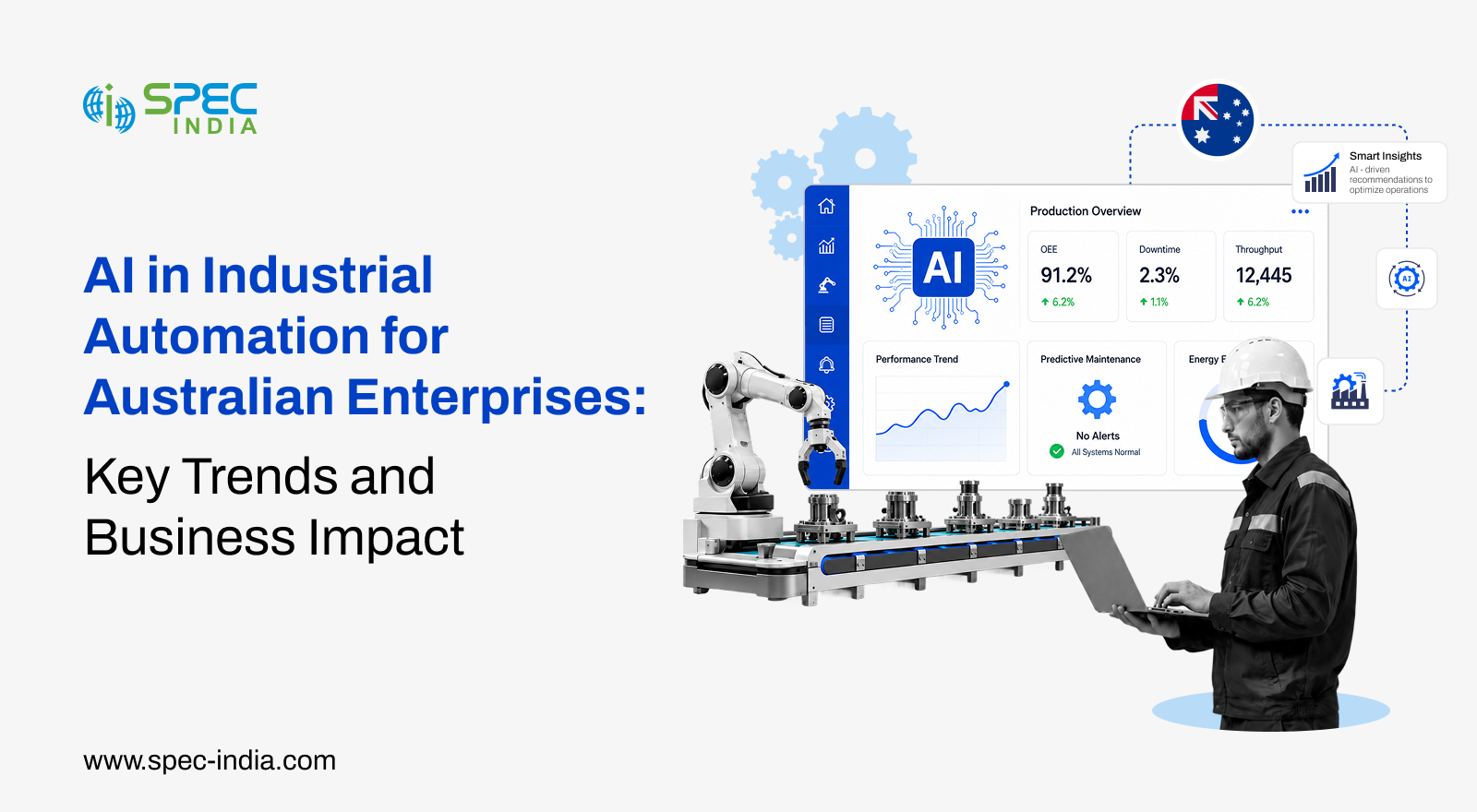
Australian manufacturers are facing growing pressure from every side. Labor shortages continue to slow industrial automation and operations. The price of energy remains unstable. Meanwhile, numerous enterprises are still using industrial automation processes that are years old. The current systems are not coping with those contemporary production needs.
Today, manufacturers are using artificial intelligence to achieve safer and more efficient workflows in their business operations. Without cutting corners on safety or quality, Australian AI in industrial automation is growing significantly. All thanks to AI-powered technologies, machine learning, and real-time visibility, which help transform industrial automation.
Australia’s smart manufacturing market reached $11.1 billion in 2025 and is projected to reach $28.7 billion by 2034. According to IMARC Group, the market is growing at a 10.78% CAGR. This blog explores the trends, business impact, and future of industrial automation in Australia.
Why AI in Industrial Automation is a Priority for Australia Right Now
AI in industrial automation is becoming a major priority across Australia. Manufacturers are dealing with rising operational costs, labor shortages, stricter compliance requirements, and growing production pressure. Many existing systems no longer support the speed and flexibility modern industrial operations demand. As a result, enterprises are adopting intelligent automation, machine learning, and connected automation tools to improve operational efficiency, predict equipment failures, and strengthen production workflows.
Labor Shortages Are Forcing Faster Decisions
Finding skilled workers in manufacturing keeps getting harder across Australia. The 2024 Occupation Shortage List identified shortages across 303 of 916 occupations. That gap continues to affect enterprise processes, production timelines, and maintenance planning.
- AI handles repetitive and data-heavy industrial processes on the production floor.
- Cobots help smaller teams manage higher production volumes efficiently
- Workers spend more time on quality control, oversight, and critical decisions
- AI agents support live production tracking across industrial environments
Cost Pressures and Energy Volatility
Industrial electricity prices in Australia remain unpredictable. Those fluctuations directly affect the industrial automation industry and operating margins. Consequently, automation technologies and AI-based technologies are now part of boardroom discussions. Businesses seeking ROI never rely on experimental projects.
AI-based industrial automation industry supports that goal through:
- Minimal cost of operations through predictive maintenance and low downtime
- Real-time data insights that balances energy loads more efficiently
- Faster throughput with fewer manual interventions across industrial procedures
- Edge computing that improves response time during production shifts
Compliance and Regulatory Accountability
Australia’s National AI Plan 2025 and the Privacy Act 1988 impose growing responsibilities on enterprises that use AI in industrial automation. Manual reporting methods struggle to keep pace with modern industrial automation. AI helps enterprises maintain better visibility and accountability.
Key Advantages include:
- Structured audit trails across enterprise operations and AI techniques
- Real-time compliance monitoring inside production environments
- Consistent reporting aligned with Australian Privacy Principles
- AI-enabled models that improve accuracy across compliance workflows
Assuredly, the challenges faced by manufacturers are genuine. However, there is also an increasing number of opportunities. Industrial automation powered by AI provides Australian businesses with enhanced control, visibility, and intelligence to manage industrial environments at scale.
Key AI Trends Transforming Industrial Automation in Australia
Australian enterprises have moved beyond small AI experiments. A large number of people have begun to apply AI technologies to core industrial automation tools and production processes. Business expectations are no longer about disconnected automation initiatives but about connected, intelligent business operations to increase speed, visibility, and enterprise efficiency.
1. AI-Powered Predictive Maintenance
Equipment failures most often occur with a warning. Most machines show small performance changes long before breakdowns occur. Human teams often miss those signals in busy industrial environments. Here’s where AI-powered predictive maintenance helps. It changes industrial automation.
Machine behavior, real-time data, and IIoT sensors provide feedback to AI systems. It helps predict equipment failures before production suddenly halts. Then, predictive maintenance teams can act during downtime rather than during operation.
How Australian Manufacturers Are Applying It
Australian manufacturers are adding AI-based automation to existing systems instead of replacing entire industrial automation technologies. This approach reduces disruption and speeds up adoption.
Here is how it works in practice:
- IIoT sensors collect live operational monitoring data across vibration, pressure, and temperature levels
- AI and ML models identify unusual patterns before predicting equipment failures
- Predictive maintenance teams schedule repairs before a system stops unexpectedly
- Industrial automation with AI reduces downtime and improves operational efficiency
2. Smart Factory Automation and Digital Twins
Smart factory automation is changing rapidly in Australia. Digital twin technology allows manufacturers to simulate industrial process before making changes and to use intelligent manufacturing systems to ensure they get it right. By using these virtual environments, teams can test workflows, monitor automation technologies, and identify bottlenecks earlier.
This visibility enables businesses to prevent costly implementation pitfalls and enhance decision-making across the manufacturing processes.
Key Capabilities Driving Adoption Include:
- Virtual simulation of production lines before physical rollout
- Real-time monitoring across connected industrial automation systems
- AI-driven adjustments based on live factory conditions
- AI vision systems that improve production visibility and accuracy
- Smart automation tools that optimize industrial regulations continuously
Real-World Example: COREMATIC’s Fully Automated Baking Factory
Homestyle Bake partnered with COREMATIC to build an advanced automation environment powered by robotics and AI tools. The setup included 19 robots supporting baking, packaging, inspection, and quality control operations.
The project helped address labor shortages while improving workforce training and operational consistency. It also showed how AI in industrial automation in Australia is moving from theory to practical deployment.
3. Computer Vision, Robotics, and AI Technologies in Manufacturing
Robotics and AI in manufacturing now work together inside modern industrial automation industry environments. Robots no longer follow rigid instructions alone. Today’s AI-powered systems can adapt to workflow changes, identify defects, and respond to production conditions in real time.
Many enterprises also adopt Computer Vision and AI models to enhance accuracy and minimize manual operations in enterprise activities.
In 2024, companies deployed a record 64,542 collaborative robots worldwide, a 12% increase from the previous year, according to International Federation of Robotics (IFR). Australian manufacturers are steadily joining that shift.
Collaborative Robots vs. Traditional Industrial Robots
The difference matters when enterprises plan long-term artificial intelligence automation strategies.
4. AI-Based Quality Control Systems
Manual inspection slows down quickly at scale. It also increases inconsistency across industrial process. AI-based quality control systems solve that challenge through ML and computer vision.
These AI-powered systems inspect products continuously during production. They identify defects in real time and improve accuracy across industrial environments where speed matters.
Key capabilities these systems bring to the production floor:
- Real-time defect detection across surfaces and assemblies
- Continuous inspection at full production speed
- Faster response to product quality issues
- Automated rejection and tracking of defective units
- AI agents that improve consistency across operations
Industries Seeing the Biggest Gains
Food processing, electronics, automotive, and pharmaceutical manufacturing are seeing strong results from artificial intelligence automation and intelligent quality control systems. These industries manage strict compliance requirements and high production volumes daily.
Industrial automation with AI helps these enterprises maintain product quality without slowing industrial procedures or increasing labor pressure.
5. Industrial IoT and AI for Real-Time Process Optimization
Industrial IoT and AI agents now operate together across modern industrial automation systems. Connected devices collect real-time data from machines, sensors, and production lines. AI-based systems then analyze that data and recommend immediate adjustments.
This approach improves visibility, response time, and operational efficiency across the industrial ecosystem.
What This Connected Environment Makes Possible:
- Edge computing that processes real-time data closer to production equipment
- AI-driven insights that identify inefficiencies during active operations
- Automated adjustments across energy loads, scheduling, and machine performance
- Real-time data monitoring that supports faster industrial decision-making
- Smart automation that improves throughput without increasing manual oversight
These trends are transforming industrial automation industry in Australia through AI-driven production optimization. New enterprises are creating connected businesses that are faster, smarter, and much more responsive than traditional automation environments.
Business Impact of AI in Industrial Automation, Australia
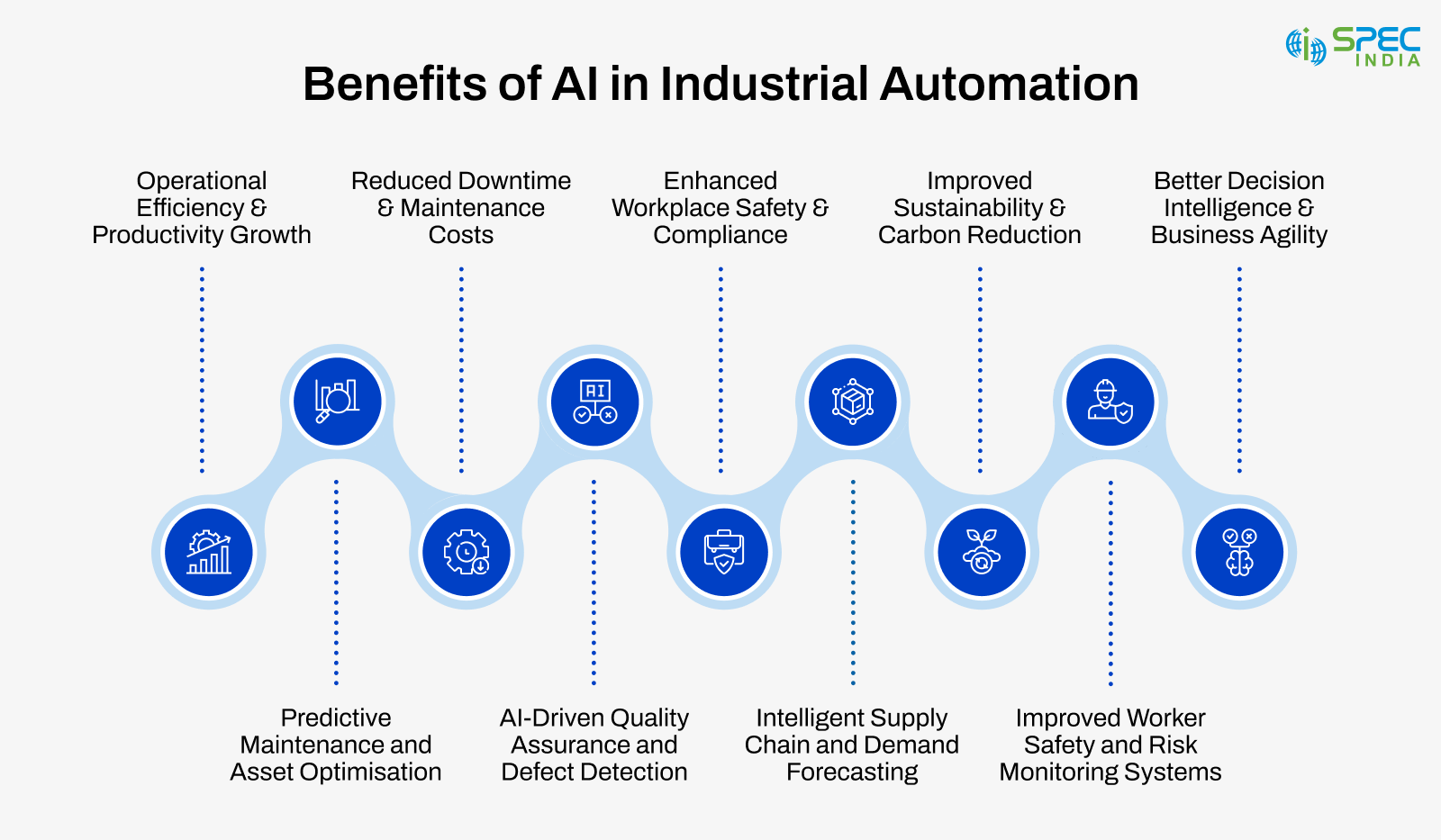
AI-powered industrial automation is helping Australian enterprises improve enterprise processes, reduce delays, and respond faster to market changes. AI, ML, and automation systems are now becoming part of long-term business strategy across the industrial automation industry.
Operational Efficiency and Cost Reduction
AI enterprise automation solutions improve scheduling, quality control, and continuous monitoring across industrial automation systems. This reduces tool failures, lowers overhead, and improves operational efficiency across production environments.
Explore SPEC India’s manufacturing software development services to build scalable industrial automation ecosystems.
Competitive Advantage Through AI in Manufacturing Australia
Enterprises investing early in AI in manufacturing in Australia are improving speed, flexibility, and production visibility. AI capabilities help businesses optimize industrial AI processes while reducing manual intervention.
The Future Made in Australia initiative is also accelerating nationwide investment in advanced manufacturing and automation, including artificial intelligence.
Industry 4.0 Australia: Driving the Bigger Picture
Industry 4.0 Australia brings together industrial IoT, AI, robotics, edge computing, and intelligent automation within connected industrial environments. Enterprises that use digital transformation in manufacturing gain stronger control and better production insights.
Build that strategy with SPEC India’s AI and ML software development services.
What Australian Enterprises Must Consider Before Scaling AI Automation & Existing Systems
Scaling intelligent automation involves more than installing new automation systems. Australian enterprises also need to consider governance, data security, operational readiness, and long-term scalability. Businesses that plan these areas early usually avoid expensive disruptions later.
Choosing the Right AI Agents for Enterprises
Not every manufacturer needs a complete system overhaul. Many existing systems still effectively support critical business processes. The real challenge is extending those systems with AI automation solutions for enterprises without disrupting production.
Before scaling advanced automation, enterprises should evaluate:
- Whether legacy industrial automation ecosystems can support AI capabilities
- The cost and risk of replacing existing infrastructure completely
- Production complexity and long-term operational goals
- Real-time data availability across industrial environments
AI automation solutions for enterprises work best when they align with actual operational needs, not ideal scenarios. That is why many businesses partner with experienced AI software development companies before making large-scale decisions.
Data Security and Privacy in Industrial Applications with Artificial Intelligence
Industrial AI applications process large amounts of operational and production data every day. In Australia, enterprises must comply with the Privacy Act 1988 while managing industrial environments securely.
Before implementation, enterprises should assess:
- Whether AI systems process data internally or through external vendors
- Visibility and control across operations in productions and AI systems
- Audit readiness during security reviews or compliance checks
- Risks connected to connected automation ecosystems and instant monitoring
Strong governance matters here. In-house AI infrastructure helps enterprises maintain better control over sensitive industrial automation processes. SPEC India’s infrastructure follows that approach. Businesses can also strengthen protection with AI-powered threat detection and predictive analytics services.
Building the Right Team and Technology Stack
In industrial automation, success does not necessarily mean adopting technology. It’s not about skilled teams, reliable AI structures, or strong governance and audits; it’s a perfect blend of all of these.
Machine learning in manufacturing requires specialists who understand industrial procedures, AI software development, and business efficiency.
Key areas enterprises should prioritize include:
- Data engineers who prepare operational data for advanced models
- Domain experts familiar with industrial automation industry workflows
- Governance frameworks supporting accountable AI-driven process automation
- Flexible AI software development services that scale with business growth
Without the right structure, AI-driven automation can create new operational risks instead of solving old ones.
Industrial Automation Trends in Australia: What’s Next
Industrial automation trends in Australia are moving beyond pilot projects and small-scale testing. Enterprises now want faster deployment, better enterprise efficiency, and stronger visibility across business processes. AI capabilities are becoming part of long-term industrial automation strategies instead of isolated innovation efforts.
Several trends are shaping the next phase of AI in industrial automation in Australia:
- Autonomous value chains that connect procurement, production, and logistics through AI systems
- Explainable AI (XAI) that improves visibility into AI-driven decisions across industrial environments
- AI automation tools that track emissions and energy usage through active monitoring
- Edge computing that supports faster decisions across a connected automation environment
- AI agents that help optimize industrial norms with minimal manual intervention
AI for Factory Automation: The Road Ahead
AI for factory automation is becoming more accessible for mid-sized and growing manufacturers. Modular automation tools now allow businesses to scale industrial automation without redesigning entire production environments.
| Trend | What It Means for Australian Enterprises |
|---|---|
| Modular automation processes | Plug-and-play deployment without full line redesigns |
| Low-code AI platforms | Faster configuration with less specialist overhead |
| Scalable robotics | Start small, expand as production demands grow |
| SME-focused solutions | Enterprise-grade capability at mid-market pricing |
Manufacturing automation services are also becoming easier to adopt. Enterprises can now start small, gradually improve industrial automation, and expand smart automation as operational needs grow.
Ready to Automate Smarter?
SPEC helps Australian enterprises implement AI-powered industrial automation solutions that improve operational efficiency, enable predictive decision-making, and accelerate digital transformation.
Conclusion
AI in industrial automation in Australia is no longer optional for modern enterprises. Rising labor costs, growing compliance pressures, and evolving industrial demands are pushing businesses toward smarter industrial automation. Enterprises that invest early in intelligent automation, machine learning, and connected industrial automation will be better prepared for long-term growth.
The shift is already happening across manufacturing, logistics, mining, and processing industries. Businesses are using AI systems, ongoing monitoring, and intelligent automation to improve organizational efficiency, predict equipment failures, and strengthen industrial automation at scale.
SPEC India helps Australian enterprises build secure, scalable, AI-powered industrial automation solutions. With in-house AI infrastructure, deep industry expertise, and 39+ years of technology experience, we help businesses modernize industrial environments with confidence.

SPEC INDIA is your trusted partner for AI-driven software solutions, with proven expertise in digital transformation and innovative technology services. We deliver secure, reliable, and high-quality IT solutions to clients worldwide. As an ISO/IEC 27001:2022 certified company, we follow the highest standards for data security and quality. Our team applies proven project management methods, flexible engagement models, and modern infrastructure to deliver outstanding results. With skilled professionals and years of experience, we turn ideas into impactful solutions that drive business growth.
Table of contents
- Why AI in Industrial Automation is a Priority for Australia Right Now
- Key AI Trends Transforming Industrial Automation in Australia
- Business Impact of AI in Industrial Automation, Australia
- What Australian Enterprises Must Consider Before Scaling AI Automation & Existing Systems
- Industrial Automation Trends in Australia
- Conclusion
Delivering Digital Outcomes To Accelerate Growth
Let’s TalkTable of contents
- Why AI in Industrial Automation is a Priority for Australia Right Now
- Key AI Trends Transforming Industrial Automation in Australia
- Business Impact of AI in Industrial Automation, Australia
- What Australian Enterprises Must Consider Before Scaling AI Automation & Existing Systems
- Industrial Automation Trends in Australia
- Conclusion
Delivering Digital Outcomes To Accelerate Growth
Let’s TalkRelated Blogs
Let’s get in touch!
India
SPEC House, Parth Complex, Near Swastik Cross Roads, Navarangpura, Ahmedabad 380009, INDIA.
-
 +91-79-26404031, 32-33-34
 -
 [email protected]