| Area | Paper-Based Manufacturing | Paperless Manufacturing |
|---|---|---|
| Work instructions | Printed documents | Digital work instructions |
| Data collection | Manual data entry | Automated real-time data collection |
| Production records | Paper files | Electronic records |
| Quality checks | Paper checklists | Digital quality workflows |
| Approvals | Physical signatures | Digital signatures |
| Inventory updates | Delayed entries | Real-time inventory management |
| Production tracking | Limited visibility | Live production tracking |
| Compliance | Manual documentation | Automated compliance reports |
| Traceability | Difficult | Complete digital traceability |
| Decision making | Delayed | Real-time visibility |


Loading...
Paperless Manufacturing: Benefits, Challenges, Implementation, and Best Practices
Posted
August 4, 2026
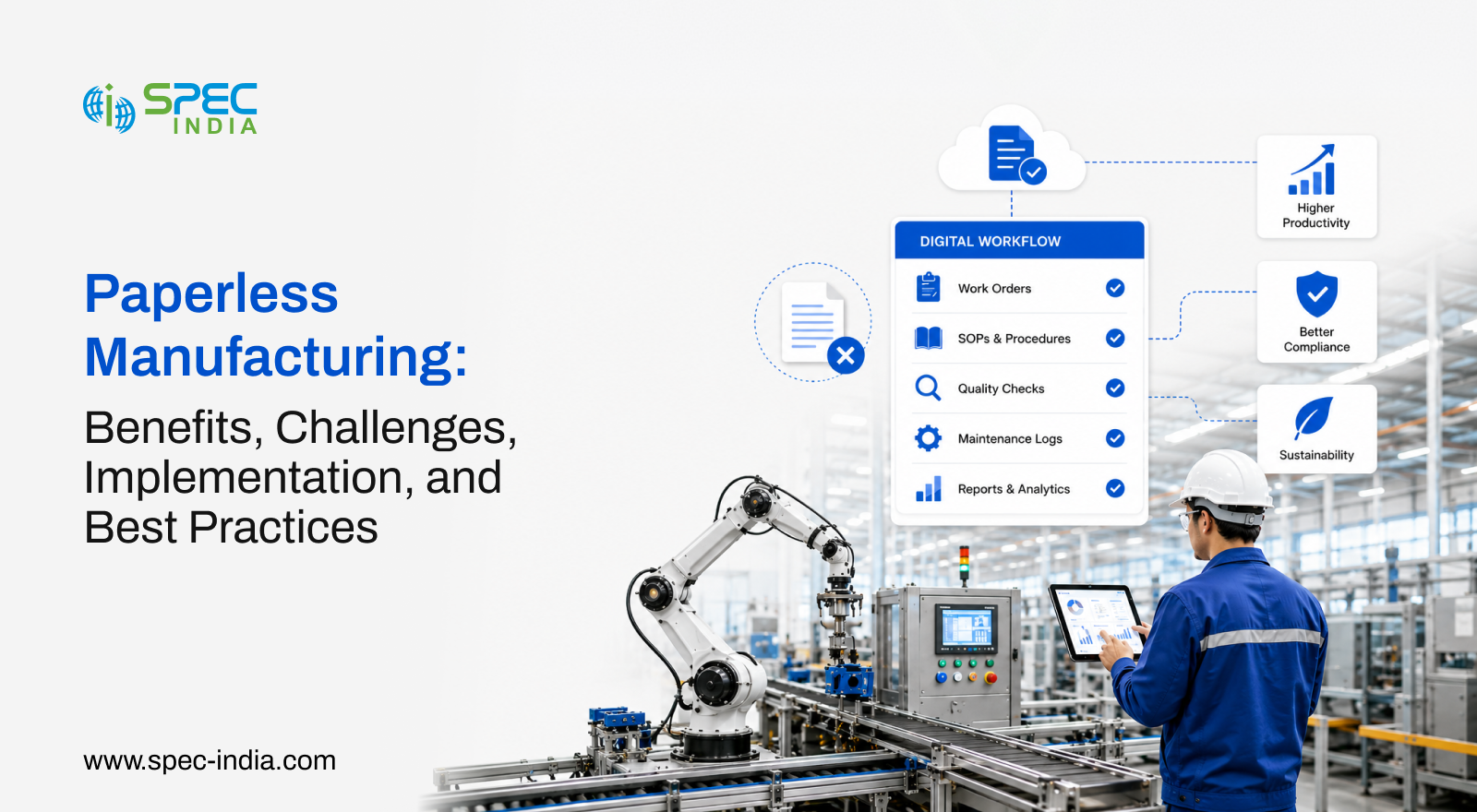
Numerous factories continue to operate on paper. Clipboards are stocked with work orders, checklists, and inspection sheets. This paper trail delays production and brings unwanted, expensive errors along. This also negatively affects real-time visibility on the shop floor.
Manufacturers are rapidly transforming to digital operations. In 2026, the Industry 4.0 market was valued at USD 172.5 billion worldwide. However, it is expected to grow to USD 1.2 trillion by 2035. Global Market Insights estimated this at a 24% CAGR. At the heart of this change is paperless manufacturing.
We will now discuss what paperless manufacturing is and why it is important. You will understand why manufacturers are making the switch. We will also cover digital factory technology. You will find steps in implementing, common challenges, and best practices.
What is Paperless Manufacturing?
Paperless manufacturing is running production without paper records. All work orders, checklists, and reports are digital. Information is entered, accessed, and approved via screens, not paper forms.
There’s document digitization, and there’s paperless. Document digitization is not the same as paperless. The paper form doesn’t change when it’s converted to a PDF. With true paperless production, the production process is reengineered. Data flows automatically between machines, software, and people. Usually, a paperless manufacturing environment consists of:
- A paperless factory that connects ERP, MES, and shop floor devices
- Sensors and tablets that capture production data instantly
- Real-time visibility into production status without waiting for paperwork
- Connected digital workflows that support industrial digitalization
This shift supports faster manufacturing digitization across the plant. Manufacturers adopt digital manufacturing to cut errors and speed up decisions. Paperless operations also simplify compliance and audits. Small and mid-size manufacturers now adopt these systems too, as cloud pricing has made implementation far more affordable.
Why Manufacturers Are Replacing Paper-Based Processes
Traditional paper-based manufacturing struggles to keep up with modern demand. Digital transformation services close these gaps effectively.
Challenges of Traditional Paper Systems
Paper-based systems create daily friction on the shop floor. Common challenges include:
- Lost documents that cause delays and repeated work
- Duplicate data across multiple paper forms
- Manual data entry that increases the risk of human error
- Approvals delayed by physical signatures
- Poor communication between production shifts
- Reporting that takes hours instead of minutes
- Compliance risks when paper trails go missing
These issues add hidden costs across every production line.
How Paperless Manufacturing Solves Them
Paperless manufacturing fixes these problems at the source by replacing manual workflows with connected digital processes.
Key improvements include:
- Real-time production data for faster decision-making
- Electronic approvals that remove unnecessary waiting
- Electronic work instructions that guide operators accurately
- Instant access to production records
- Better collaboration through shared information
- Complete digital traceability for every production activity
This shift also strengthens shop floor management and supports lean manufacturing goals. Manufacturers gain the visibility needed to prevent costly downtime.
Traditional Paper-Based Manufacturing vs. Paperless Manufacturing
The comparison clearly shows how paperless manufacturing shifts daily operations from delayed, manual, and document-heavy processes to a more connected digital workflow. Instead of managing production through scattered records and physical approvals, manufacturers can create a structured system where information moves faster and teams work with greater clarity.
This shift lays the foundation for a more responsive, scalable, and future-ready manufacturing environment.
Move Beyond Paper-Based Manufacturing
Elevate manual operations with intelligent software to achieve faster, more accurate, and more scalable manufacturing.
Benefits of Paperless Manufacturing
There are quantifiable benefits throughout the plant floor when your documents don’t have to be paper. These benefits help enhance quality, speed, cost, and day-to-day decision-making. These are the largest benefits that manufacturers can expect.
1. Better Production Visibility
Real-time information helps teams identify issues before they affect production.
Key improvements include:
- Live dashboards that provide a clear view of the shop floor
- Simpler shop floor management through automatic data updates
- Real-time production monitoring to identify bottlenecks quickly
- Accurate production tracking across every stage of manufacturing
As a result, teams respond faster to disruptions and keep production moving smoothly.
2. Higher Data Accuracy
Reliable data creates better decisions across manufacturing operations.
Key improvements include:
- Digital records that replace handwritten entries
- Better data quality through automated data capture
- Fewer duplicate entries across departments
- More consistent and trustworthy production information
Accurate data improves collaboration and gives every team greater confidence in daily decisions.
3. Faster Quality Control
Digital quality processes help manufacturers detect and resolve issues earlier.
Key improvements include:
- Digital quality checks that identify defects immediately
- A built-in quality management system (QMS) that standardizes inspections
- Automated compliance reporting for faster audits
- Consistent quality processes across every production line
Early issue detection reduces rework, minimizes waste, and protects customer satisfaction.
4. Better Inventory and Scheduling
Connected production data improves planning and resource utilization.
Key improvements include:
- Real-time inventory management as materials move across the floor
- Better inventory control with accurate stock levels
- Faster production scheduling based on current demand
- More predictable raw material planning for uninterrupted production
This approach strengthens paperless production management and helps manufacturers maintain efficient production schedules.
5. Lower Costs and Better Efficiency
Removing paper from production creates savings across multiple business areas.
Key improvements include:
- Lower printing, storage, and administrative expenses
- Cost reduction through fewer errors and less rework
- Higher operational efficiency with streamlined workflows
- Continuous improvement supported by reliable historical data
Over time, these enhancements provide long-term value and strengthen a manufacturing enterprise’s resilience and performance.
Technologies Behind Paperless Manufacturing
The key to a successful paperless manufacturing environment is the right technologies. They are designed to interlink machines, humans, and business systems for enhanced visibility, collaboration, and decision-making.
Manufacturing ERP
A manufacturing ERP brings business and production data together on a single platform. It helps manufacturers:
- Connect finance, procurement, and production planning.
- Maintain a single source of operational data.
- Improve inventory planning and resource allocation.
- Support cloud ERP for manufacturing for greater flexibility.
Several manufacturers integrate ERP with a paperless MRP system to manage materials without spreadsheets.
| Example: After each production run, a manufacturer may not need to manually enter inventory levels, as the system can do so automatically. |
Manufacturing Execution System (MES)
A manufacturing execution system (MES) controls production processes on the shop floor. It has several important features such as:
- Tracking work orders in real time.
- Monitoring machine status and operator activities.
- Recording production progress automatically.
- Connecting planning with daily manufacturing execution.
With the increased demand for factory digitization, MES software development is providing even more options for increased production visibility.
| For example: Production supervisors can immediately detect machine downtime and make adjustments before schedules become out of sync. |
IoT and Smart Manufacturing
IoT in manufacturing connects machines, sensors, and software into a unified network. This technology enables:
- Manufacturing automation across production lines.
- Factory automation with minimal manual intervention.
- A connected factory that shares information instantly.
- Smart manufacturing through continuous machine monitoring.
These features enable manufacturers to identify problems before they begin and contribute to predictive maintenance.
| Example: Sensors can sense unusual machine vibration and alert maintenance staff to avoid machine failure. |
Cloud and Mobile Technologies
Cloud platforms make production information available wherever teams need it. They support:
- Secure access to production data.
- Mobile updates directly from the shop floor.
- Seamless integration between existing systems and new digital tools.
- Scalable paperless manufacturing solutions for multiple plants.
These technologies combine to form full-fledged smart factory solutions and manufacturing workflow automation throughout enterprises.
| Example: A production change on a mobile device is approved by a supervisor without the need to go into the office. |
The Manufacturing Execution Systems (MES) market is projected to witness a compound annual growth rate (CAGR) of 7.2% from 2026 to 2035. Business Research Insights predicts it will hit USD 37.23 billion by 2035.
| Technology | Primary Role | Better planning and inventory control |
|---|---|---|
| Manufacturing Execution System (MES) | Capture machine and process data | Real-time production monitoring |
| IoT Sensors | Manual data entry | Predictive maintenance |
| Cloud Platform | Stores and shares production data | Instant access across locations |
| Mobile Applications | Enable shop floor updates | Faster approvals and reporting |
| Barcode/RFID Systems | Track materials and products | Accurate production tracking |
| Inventory updates | Delayed entries | Real-time inventory management |
| Digital Dashboards | Display live KPIs | Faster operational decisions |
| Workflow Automation | Automates approvals | Higher operational efficiency |
How to Implement Paperless Manufacturing Successfully
A successful rollout is well planned and follows a clearly mapped-out pathway. A staged approach minimizes risk, enhances user adoption, and helps ensure long-term benefits.
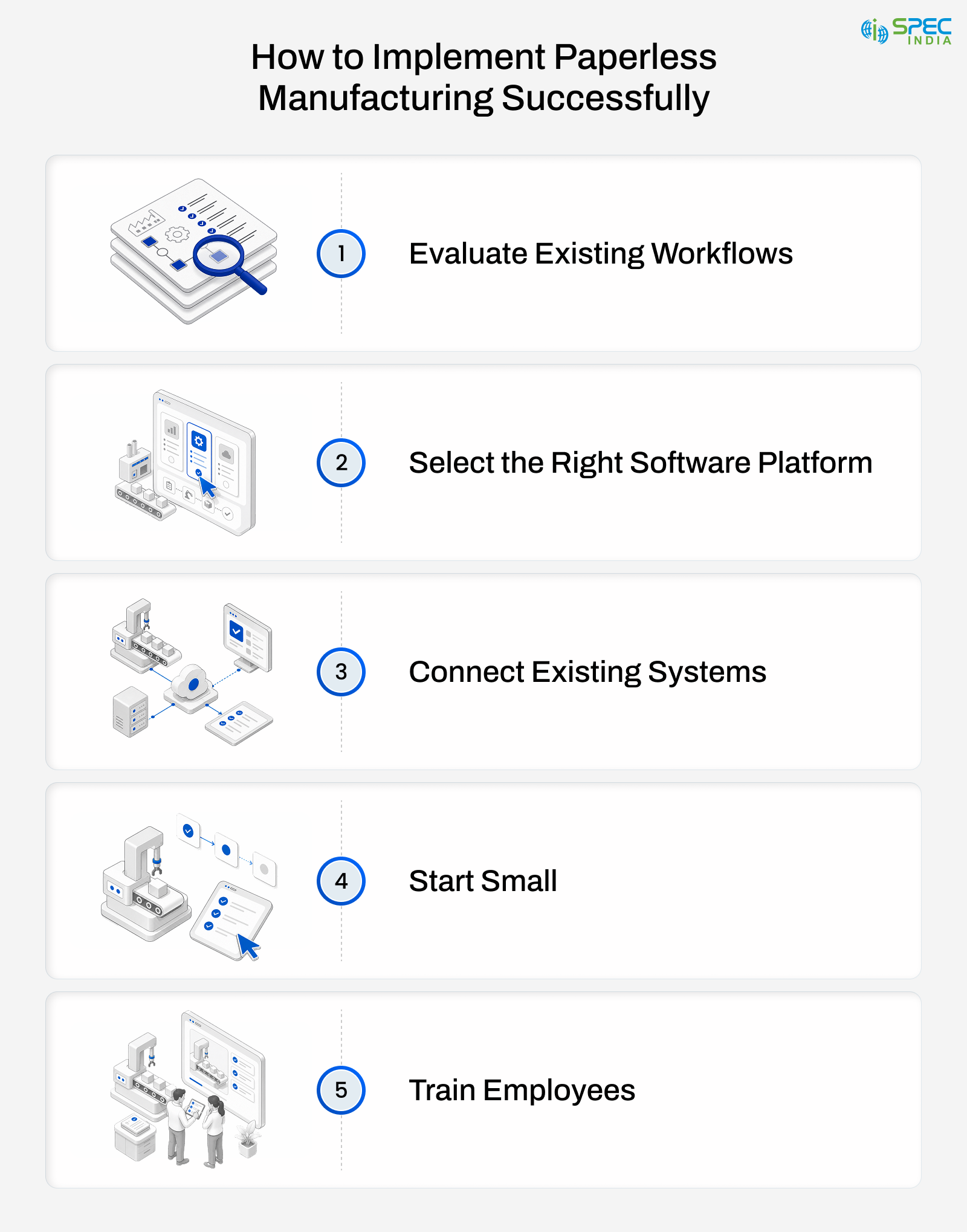
Step 1: Evaluate Existing Workflows
First, make an inventory of where in the process paper causes bottlenecks or inefficiencies.
Focus on:
- Mapping every paper-based process across the shop floor
- Identifying delays, bottlenecks, and manual tasks
- Prioritizing areas with the greatest improvement potential
A detailed assessment builds a strong foundation for a successful implementation.
Step 2: Select the Right Software Platform
Select paperless manufacturing software development services compatible with your production and plans.
Look for a solution that offers:
- Proven manufacturing software development expertise
- Easy integration with existing business systems
- Scalability to support future expansion
The right platform makes adoption easier and delivers business value over time.
Step 3: Connect Existing Systems
Integrate your manufacturing ERP solutions, MES, and other production systems to create a connected environment.
Consider:
- Connecting ERP for manufacturing and MES platforms
- Integrating legacy equipment using middleware when required
- Enabling seamless integration across departments
Connected services eliminate redundant data and enhance operational visibility.
Step 4: Start Small
Start with a single production line, then gradually roll out the project across the factory.
A pilot program helps you:
- Validate the new workflow
- Identify issues early
- Build confidence among production teams
Small measurable successes are much easier to implement on a large scale.
Step 5: Train Employees
Technology can only achieve its desired outcomes when its users can use it effectively.
Support employees by:
- Providing hands-on training sessions
- Sharing clear digital work instructions
- Encouraging feedback throughout the rollout
For the product to be successful, there is a need for strong user adoption and continuous product improvement.
| Phase | Review paper workflows | Identify improvement opportunities |
|---|---|---|
| Planning | Define goals and KPIs | Clear implementation roadmap |
| Software Selection | Choose ERP/MES solutions | Right technology foundation |
| Integration | Connect existing systems | Unified data flow |
| Pilot Program | Test one production line | Reduced implementation risk |
| Full Deployment | Expand plant-wide | Complete paperless operations |
| Continuous Improvement | Monitor performance | Ongoing optimization |
A paperless manufacturing rollout works best when it moves from assessment to adoption in controlled phases. Each stage should reduce risk, validate the workflow, and prepare teams for wider digital usage across the plant.
This approach helps manufacturers avoid rushed implementation and build a stronger foundation for long-term paperless operations.
Build a Smarter Manufacturing EnvironmentSPEC India develops scalable manufacturing software that supports end-to-end digital production. |
Common Challenges During Paperless Manufacturing Adoption
Adopting paperless manufacturing brings real challenges alongside the benefits. Employee resistance is common when teams are used to paper. Structured training and clear communication ease this transition. Legacy systems can also slow down integration efforts, so choosing flexible software with strong integration support helps. Data migration from old records needs careful planning and phased testing.
Manufacturers should prepare for several practical challenges, including:
- Compliance requirements that demand reliable digital audit trails
- Budget constraints that often require a phased rollout or pilot program
- Data security concerns that call for encrypted cloud storage and strict access controls
- Change management to help employees adapt to new ways of working
Early action on the challenges helps with smoother implementation! Establishing clear goals, open dialogue, and employee engagement creates confidence and boosts long-term adoption.
| Common Challenges | Solutions |
|---|---|
| Employee resistance | Training |
| Legacy systems | Integration |
| Data migration | Phased rollout |
| Compliance | Digital audit trails |
| Budget constraints | Pilot implementation |
| Data security | Encrypted cloud and access controls |
Best Practices for Long-Term Success
For a long-term successful outcome, there must be regular monitoring and improvement. Monitor and report performance indicators to determine actual achievements over time. Manufacturing data analytics services transform production data into easily digestible insights to identify process improvements.
Predictive maintenance prevents downtime by detecting problems before they occur.
To maintain long-term success, manufacturers should:
- Support continuous improvement initiatives across teams.
- Use workflow automation to eliminate repetitive manual tasks.
- Encourage employee engagement throughout the organization.
- Follow clear standard operating procedures for consistent execution.
- Keep software updated to meet evolving business needs.
These best practices help manufacturers maximize the value of their paperless manufacturing investment while staying prepared for future growth.
The smart manufacturing market shows how fast this space is growing. It stood at USD 410.70 billion in 2025. It is projected to reach USD 1,063.2 billion by 2033, a CAGR of 12.1%, according to Grand View Research. Manufacturers that invest early gain a lasting competitive advantage.
Why Choose SPEC India for Paperless Manufacturing Solutions?
SPEC India helps manufacturers replace paper-driven workflows with connected digital solutions. With decades of software development experience, we understand the operational challenges manufacturers face and build solutions that support long-term business growth.
- 39+ Years of Manufacturing Technology Experience: Our team has delivered enterprise software across industries for decades. This experience helps manufacturers modernize operations with confidence.
- Custom Manufacturing Software Development: Our manufacturing software development services are tailored to your production workflows, business goals, and operational requirements.
- ERP, MES, and Manufacturing Automation Expertise: From ERP and MES integration to industrial automation, we connect legacy equipment with modern technologies to improve efficiency and visibility.
- End-to-End Digital Transformation: Our digital transformation, data analytics, and enterprise software development services help manufacturers streamline operations, make informed decisions, and scale with confidence.
- Long-Term Partnership and Support: From implementation to continuous optimization, our team works alongside you to ensure your paperless manufacturing initiative delivers lasting value.
Paperless manufacturing is more than replacing paper with digital tools. It creates a connected production environment that improves efficiency, quality, and decision-making. With the right strategy and technology partner, manufacturers can build a smarter, more resilient future.
Connect with SPEC India to begin your paperless manufacturing journey.

SPEC INDIA is your trusted partner for AI-driven software solutions, with proven expertise in digital transformation and innovative technology services. We deliver secure, reliable, and high-quality IT solutions to clients worldwide. As an ISO/IEC 27001:2022 certified company, we follow the highest standards for data security and quality. Our team applies proven project management methods, flexible engagement models, and modern infrastructure to deliver outstanding results. With skilled professionals and years of experience, we turn ideas into impactful solutions that drive business growth.
Table of contents
- What is Paperless Manufacturing
- Why Manufacturers Are Replacing Paper-Based Processes
- Benefits of Paperless Manufacturing
- Technologies Behind Paperless Manufacturing
- How to Implement Paperless Manufacturing Successfully
- Common Challenges During Paperless Manufacturing Adoption
- Best Practices for Long-Term Success
- Why Choose SPEC India for Paperless Manufacturing Solutions
Delivering Digital Outcomes To Accelerate Growth
Let’s TalkTable of contents
- What is Paperless Manufacturing
- Why Manufacturers Are Replacing Paper-Based Processes
- Benefits of Paperless Manufacturing
- Technologies Behind Paperless Manufacturing
- How to Implement Paperless Manufacturing Successfully
- Common Challenges During Paperless Manufacturing Adoption
- Best Practices for Long-Term Success
- Why Choose SPEC India for Paperless Manufacturing Solutions
Delivering Digital Outcomes To Accelerate Growth
Let’s TalkRelated Blogs
Let’s get in touch!
India
SPEC House, Parth Complex, Near Swastik Cross Roads, Navarangpura, Ahmedabad 380009, INDIA.
-
 +91-79-26404031, 32-33-34
 -
 [email protected]