| Digital Transformation Challenge | Business Impact | Recommended Solution |
|---|---|---|
| Lack of Strategy | Misaligned goals, wasted budget | Define a clear strategy with measurable KPIs |
| Legacy Systems | High maintenance costs, slow innovation | Modernize through phased application updates |
| Data Silos | Poor decisions, duplicate data | Build strong data governance and one data source |
| Resistance to Change | Low adoption, delayed rollout | Invest in change management and training programs |
| Security Risks | Data breaches, compliance fines | Apply a multi-layered security approach |
| Skills Gap | Delayed projects, higher costs | Combine upskilling with trusted outsourcing partners |
| Integration Issues | Workflow delays, data mismatches | Use API-first, modular architecture |
| Budget Constraints | Stalled projects, limited scope | Prioritize high-impact, phased initiatives |


Loading...
Digital Transformation Challenges: Key Obstacles and How to Overcome Them
Posted
August 10, 2026
Category Digital Transformation
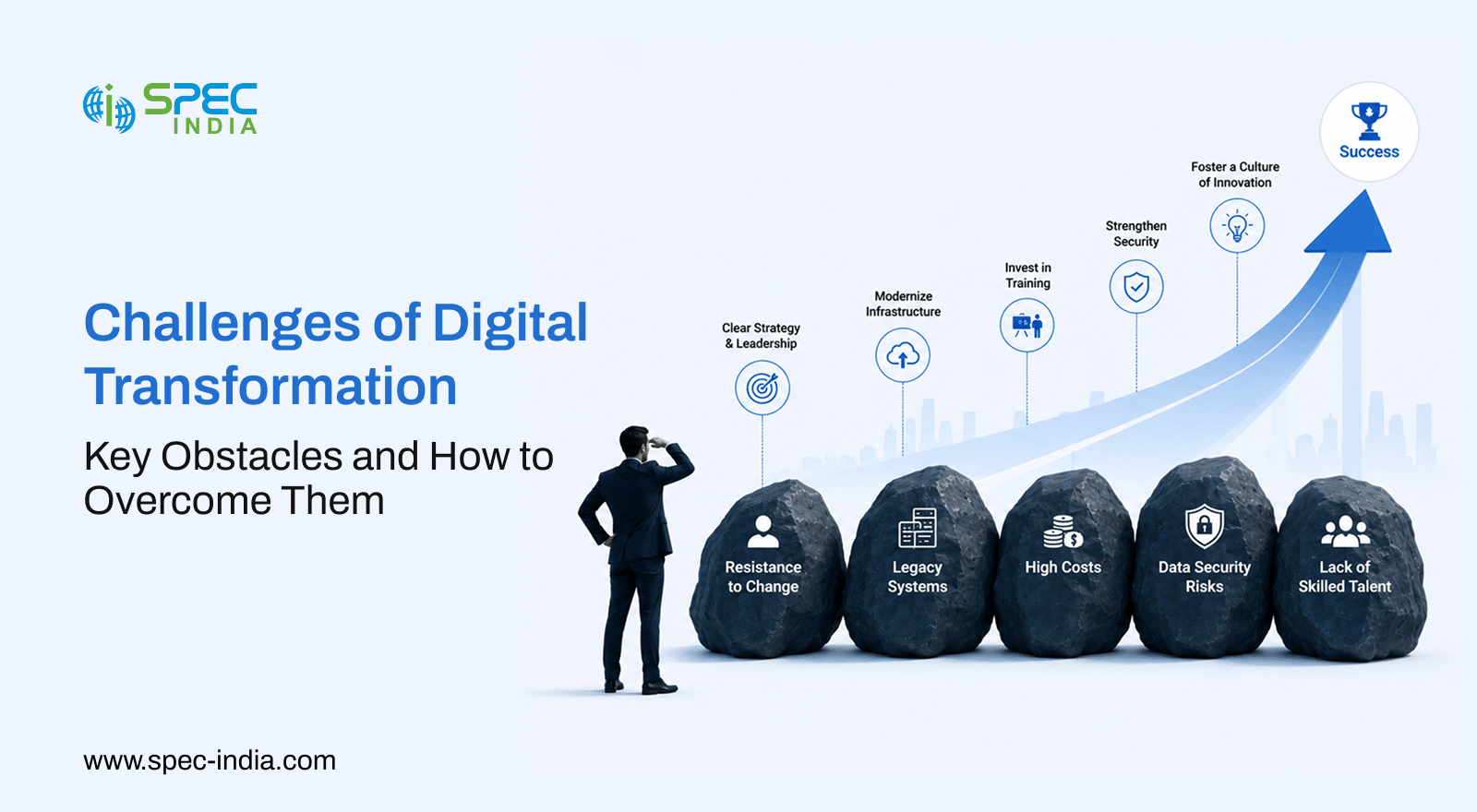
Customer expectations can shift before a business has time to react. New competitors emerge, markets change, and familiar ways of working can quickly lose their edge. Digital transformation helps businesses respond to these shifts, but technology alone cannot deliver lasting results. A clear business plan must guide every transformation decision.
Businesses also end up launching change programs they wish would last forever, and although they make a huge effort, they just can’t get the word to stick. According to McKinsey research, almost 70% of companies’ transformation programs fail to deliver intended results. Planning, leadership congruence, and reluctance to change are impediments to the program’s progress.
Cost challenges are faced by businesses in all industries that go through digital transformation. This guide discusses the challenges of DT and why so many digital transformation projects fail. It offers insights on typical snags, ways to define a clear digital strategy, and how to prepare for a successful digital future.
Why Digital Transformation Projects Fail?
Many organizations start the process of digital transformation with lofty goals and never achieve tangible business results. Most failures stem from a lack of planning, insufficient execution, and insufficient organizational readiness. This digital transformation problem slows projects and increases costs.
The Most Common Reasons include:
- Lack of a clear strategy: Teams don’t have a clear vision, priorities, and measurable goals.
- Technology-first thinking: Companies purchase a tool they believe will deliver the same business value, without clearly communicating that focus to business stakeholders.
- Low performance: Digital transformation is implemented with insufficient planning, ownership, and timelines.
- Lack of readiness for organizational change: Employees don’t want to change their processes without training and clear regular communication.
With greater resilience and a better chance for success in the next few years, Organizations can become more resilient and be more successful. However, sometimes they can recognize and overcome these barriers before they occur, helping to limit risks.
Top 9 Surprising Challenges of Digital Transformation
All institutions have to overcome difficulties in modernizing their activities. These include technology-related issues, as well as people and process related challenges. Businesses need to be aware of some of the common problems faced by digital transformation to prepare and respond accordingly.
1. Lack of a Clear Digital Transformation Strategy
Many organizations tend to embark on transformation without direction. Teams may make decisions without a well-defined digital transformation strategy, which would not benefit their long-term business.
Common Issues include:
- Unclear goals: A lack of clear goals may lead to unclear work outcomes and unclear indications of success.
- Misaligned business and IT requirements: Teams pursue different objectives, causing decisions to be slower to make and execute.
- No KPIs: Leaders have no way to mark progress or to move things forward.
- Lack of clarity on ownership: Projects stall when owners are not clearly identified.
One clear plan ensures that all digital transformation initiatives are connected to business priorities.
2. Legacy Systems and Technical Debt
Many companies continue to use legacy systems that are not equipped to meet the needs of the digital age. These serve as obstacles to innovation and, at the same time, represent higher maintenance costs.
Key Issues include:
- Lacking up-to-date apps: Aging platforms may not work with new digital tools and evolving business requirements.
- Integration complexities: Old or new systems may need to be custom-developed and may become increasingly complex.
- Expensive maintenance: IT staff waste valuable time on issues with outdated software rather than developing new features.
- Limited modernization: Gradual modernization, application modernization, and enterprise application integration minimize disruption and ease cloud migration.
This lowers risk and supports future innovation through modernization.
3. Resistance to Change
Whether transforming towards new technologies is successful depends as much on people as on technology.
Organizations often Face Challenges, like:
- Low adoption among employees: Due to poor digital literacy, new tools are less likely to be accepted by employees.
- Cultural resistance: At times, an existing organizational culture may be resistant to innovations in work.
- Limited leadership involvement: When leadership is highly aligned, there is confidence and engagement.
- Inadequate change management: Regular change training and employees’ clear knowledge of changes pave the way for a smooth transition.
Regular communication and ongoing training foster adoption and boost employees’ confidence.
4. Data Silos and Poor Data Quality
Many organizations remain sheltered with off-shape information systems.
Common issues include:
- Fragmented systems: Information remains outside the reach of different applications, so getting it together and working collaboratively is difficult.
- Inconsistent data: Duplicate or outdated records lead to reporting errors and reduced accuracy.
- Poor data governance: When data standards are not established, it becomes difficult to manage data consistently across departments.
- Different sources of truth: Teams use different reports, making business decisions difficult.
Good data governance ensures data is the source of truth and supports better business decisions.
5. Cybersecurity and Compliance Risks
New digital tools, apps, devices, and cloud services are adding to the problem of data security.
Businesses should pay close attention to:
- Increasing attack surface: Connected environments create more opportunities for a data breach.
- Data privacy laws and regulations: Companies should comply with data protection laws and regulations in their industry and regions.
- Secure digital transformation: Integrating security from initial digital transformation efforts, not making it an afterthought.
- Continuous protection: A layered security strategy, including intrusion detection systems and constant monitoring, enhances overall system security.
Vigilant cybersecurity safeguards data and supports secure innovation.
6. Budget Constraints and ROI Concerns
Finance is one of the main challenges in a transformation project. Initial investment can be high, resulting in delays. One of the most frequent obstacles for digital transformation is financial pressures.
Organizations typically face:
- Cost of setting it up: There’s a significant upfront investment required for software, infrastructure, and implementation.
- Understated implementation costs: training, integration, maintenance, and process change-up costs.
- Challenging to measure value: Leaders need to invest in business metrics rather than just short-term savings when measuring success.
- Budget constraints: Many small businesses face digital transformation challenges due to a finite budget, which can be addressed through incremental investments that deliver real efficiency.
By focusing on bottom-line efforts, companies can realize greater benefits in the long run.
Also Read – Financial Impacts of Digital Transformation: Costs & ROI
7. Digital Skills Gap and Talent Shortage
Digital talent is still in demand. Many organizations are having difficulty finding software specialists with experience in AI, cloud, data engineering, and enterprise integration. This shortage often causes project risks and frequently holds up digital transformation plans.
Organizations commonly face:
- Reluctance to adopt AI expertise: Developing AI solutions demands specialized expertise in machine learning and experienced teams to develop them.
- Cloud expertise gaps: An organization that adopts cloud must have expertise in cloud architecture, cloud migration, and cybersecurity.
- Lack of integration specialists: Strong technical and domain knowledge is desired to integrate enterprise platforms.
- Upskilling vs outsourcing: Training internally strengthens ongoing capabilities, and outsourcing supports difficult projects because it facilitates faster delivery.
Include upskilling among employees and external experts to boost speed.
8. Integration Complexity
Connected business applications are an essential component of modern enterprises. It can be one of the most significant hurdles of enterprise digital transformation. Inefficient integration results in sub-optimal value of investments in digital.
Common integration issues include:
- Linking core platforms: ERP, CRM, and other business applications must share data without delay.
- Third-party applications: External platforms and services need to integrate with the system.
- API management: Effective API management enables clear communication and enhances scalability across applications.
- Hybrid environments: Deploying a cloud-based platform in conjunction with on-prem infrastructure demands planning and testing.
A good integration strategy fosters cooperation, addresses challenges, and facilitates future expansions.
9. Scaling Digital Transformation Across the Enterprise
Having a successful pilot is just the start. Scaling a successful campaign can be more difficult than initiating one. If growth proceeds without planning, it can become difficult to manage.
Successful enterprise-wide adoption depends on:
- Going beyond pilot projects: Drive successful digital transformation initiatives standardized before expanding them across the organization.
- Good governance: Clear policies reflect shared transformation and business goals.
- Process standardization: Shared processes and technology create common standards for collaboration and minimize duplication.
- Performance monitoring: Regular reviews help organizations track their digital transformation progress and ensure digital transformation proceeds according to plan.
Organizations can scale transformation successfully through ongoing monitoring and governance. The top digital transformation challenges go beyond technology. It takes good leadership, competent teams, reliable data, secure systems, and a clear strategy to succeed. Those who embrace these challenges head-on are more likely to achieve a successful digital transformation.
How to Address the Biggest Digital Transformation Roadblocks
The table below maps common digital transformation challenges to practical solutions. Gartner research shows that about 40% of infrastructure systems have technical debt. This makes proactive planning essential for any modern enterprise.
These challenges rarely occur in isolation. A weak strategy can affect technology choices, while legacy systems can increase costs and integration issues. Addressing each problem with the right solution helps businesses reduce risk, improve efficiency, and keep transformation efforts aligned with their broader business goals.
Best Practices to Overcome Digital Transformation Challenges
A successful digital transformation involves more than implementing new technology. Companies must have a grounded strategy that combines technology with enterprise goals. A structured method minimizes risk, increases adoption, and ultimately maximizes results over time.
Focus on these best practices:
- Start with business objectives
- Build a clear digital strategy
- Prioritize high-impact initiatives
- Invest in scalable digital technologies
- Strengthen data governance
- Promote continuous learning
- Encourage innovation
- Measure key performance indicators regularly
Monitor and update programs on an ongoing basis to respond to changing business needs. Good leadership and the appropriate technology enhance the prospects of transformation. Business First with Hyperautomation, when relevant, offers solutions to help ease the burden of digital transformation, boost efficiency and productivity, and enhance customer service and experiences to drive long-term growth.
Ready to Overcome Your Digital Transformation Challenges?
Partner with a team that understands your industry and goals. Get expert guidance to modernize systems and reduce project risk.
Industry-Specific Digital Transformation Challenges
Today, every industry has its own set of digital transformation challenges. Aspects such as business priorities, regulations, and customer expectations influence them. There is an ever-increasing demand for industry-appropriate solutions.
The global digital transformation market is shrinking. It has reached $2,632.49 billion in 2025 and is expected to hit $14,847.91 billion by 2034, according to Fortune Business Insights. This explosive growth signifies the rising investment in transformation activities in the industry.
Manufacturing
Common priorities include:
- Modernizing legacy equipment
- Reducing unplanned downtime
- Connecting shop floor systems
| Digital solution: Monitoring, predictive maintenance, and automation with IoT for better production efficiency. |
Healthcare
Key challenges include:
- Protecting patient data
- Meeting compliance requirements
- Improving interoperability
| Digital solution: Healthcare needs to be coordinated so better care can be delivered, with secure cloud-based solutions and integrated health records. |
Logistics & Freight
Organizations often struggle with:
- Fragmented tracking systems
- Manual fleet operations
- Limited supply chain visibility
| Digital solution: Real-time tracking, route optimization, and intelligent automation enhance operational efficiency. |
Retail
Retailers frequently face:
- Omnichannel complexity
- Inventory inaccuracies
- Rising customer expectations
| Digital solution: AI-powered business insights and commerce platforms improve the customer experience and inventory management. |
Banking & Financial Services
- Financial institutions must address:
- Legacy core banking systems
- Strict regulatory compliance
- Growing cybersecurity threats
| Digital solution: Cloud modernization, enhanced security infrastructure, and intelligent automation provide secure, compliant banking operations. |
| Industry | Common Challenge | Solution |
|---|---|---|
| Manufacturing | Legacy equipment, disconnected systems | IoT sensors and predictive maintenance |
| Healthcare | Data privacy and interoperability | Secure cloud-based patient platforms |
| Logistics | Fragmented tracking and manual operations | Real-time visibility and automation |
| Retail | Inventory gaps and omnichannel complexity | AI-driven inventory and customer insights |
| Banking | Legacy systems and regulatory compliance | Cloud modernization and enhanced security |
While each industry has its unique challenges, the overall goal is the same. Customizing a digital transformation plan enables organizations to overcome industry challenges, increase productivity, and deliver long-term business value.
How to Build a Successful Digital Transformation Roadmap
A successful digital transformation roadmap connects technology investments with business priorities and measurable outcomes.
An effective roadmap should include:
Assess digital maturity to identify current strengths and areas for improvement.
- Define business objectives that support long-term growth and operational goals.
- Prioritize initiatives based on business value, feasibility, and expected impact.
- Modernize technology by replacing outdated platforms with scalable solutions.
- Integrate systems to improve data flow and eliminate operational silos.
- Train employees through continuous learning and practical skill development.
- Measure outcomes using key performance indicators and optimize as business needs evolve.
Organizations that follow a structured roadmap adapt more effectively to digital technological advancements and changing market demands. Regular reviews ensure the roadmap stays aligned with business priorities and supports sustainable digital transformation.
Why Partnering with the Right Technology Company Matters
The right technology partner reduces risk and speeds implementation.
A reliable technology partner offers:
- Faster project implementation
- Lower project risk
- Specialized expertise in AI, cloud, and enterprise solutions
- Scalable architecture that supports future growth
- Long-term support and continuous optimization
With the right expertise, organizations can accelerate enterprise digital transformation, improve solution quality, and adapt confidently as business needs and customer expectations continue to evolve.
Why Choose SPEC India for Digital Transformation?
With over four decades of experience, SPEC India helps organizations modernize confidently while aligning technology investments with business goals.
Why businesses choose SPEC India:
- 39+ years of enterprise software development expertise.
- Digital transformation consulting tailored to your business needs.
- Legacy application modernization with minimal business disruption.
- Expertise across AI, Data Analytics, Cloud, ERP, and Enterprise Integration.
- Custom software development services for industry-specific business challenges.
- Agile delivery to facilitate transparent communication at every project stage.
- Long-term support, optimization, and continuous improvement after deployment.
From digital transformation strategy to implementation, SPEC India delivers scalable digital solutions built for long-term business growth.

SPEC INDIA is your trusted partner for AI-driven software solutions, with proven expertise in digital transformation and innovative technology services. We deliver secure, reliable, and high-quality IT solutions to clients worldwide. As an ISO/IEC 27001:2022 certified company, we follow the highest standards for data security and quality. Our team applies proven project management methods, flexible engagement models, and modern infrastructure to deliver outstanding results. With skilled professionals and years of experience, we turn ideas into impactful solutions that drive business growth.
Table of contents
- Why Digital Transformation Projects Fail?
- Top 9 Surprising Challenges of Digital Transformation
- 1. Lack of a Clear Digital Transformation Strategy
- 2. Legacy Systems and Technical Debt
- 3. Resistance to Change
- 4. Data Silos and Poor Data Quality
- 5. Cybersecurity and Compliance Risks
- 6. Budget Constraints and ROI Concerns
- 7. Digital Skills Gap and Talent Shortage
- 8. Integration Complexity
- 9. Scaling Digital Transformation Across the Enterprise
- How to Address the Biggest Digital Transformation Roadblocks
- Best Practices to Overcome Digital Transformation Challenges
- Industry-Specific Digital Transformation Challenges
- How to Build a Successful Digital Transformation Roadmap
- Why Partnering with the Right Technology Company Matters
- Why Choose SPEC India for Digital Transformation
Delivering Digital Outcomes To Accelerate Growth
Let’s TalkTable of contents
- Why Digital Transformation Projects Fail?
- Top 9 Surprising Challenges of Digital Transformation
- 1. Lack of a Clear Digital Transformation Strategy
- 2. Legacy Systems and Technical Debt
- 3. Resistance to Change
- 4. Data Silos and Poor Data Quality
- 5. Cybersecurity and Compliance Risks
- 6. Budget Constraints and ROI Concerns
- 7. Digital Skills Gap and Talent Shortage
- 8. Integration Complexity
- 9. Scaling Digital Transformation Across the Enterprise
- How to Address the Biggest Digital Transformation Roadblocks
- Best Practices to Overcome Digital Transformation Challenges
- Industry-Specific Digital Transformation Challenges
- How to Build a Successful Digital Transformation Roadmap
- Why Partnering with the Right Technology Company Matters
- Why Choose SPEC India for Digital Transformation
Delivering Digital Outcomes To Accelerate Growth
Let’s TalkRelated Blogs


Let’s get in touch!
India
SPEC House, Parth Complex, Near Swastik Cross Roads, Navarangpura, Ahmedabad 380009, INDIA.
-
 +91-79-26404031, 32-33-34
 -
 [email protected]