

Hyperautomation as the Next Phase of Enterprise Digital Transformation
We’ve moved past the days when “automation” just meant a simple bot doing one repetitive task. Today, the conversation has shifted toward hyperautomation in digital transformation, which is essentially about building an intelligent, self-orchestrating nervous system for your business. Gartner recently dropped a striking stat: by 2026, 30% of enterprises will have over half of their network activities running on autopilot. That’s a massive jump from where we were just a few years ago, and it’s a clear sign that intelligent automation is no longer a “nice-to-have,” it’s a survival requirement.
This isn’t just a tech upgrade; it’s a fundamental pivot in digital transformation automation. Organizations are realizing that “point improvements” don’t cut it anymore. If you want true operational efficiency, you can’t rely on isolated bots. Legacy system automation that depends on old-school, rule-based scripting is too rigid for the chaotic reality of modern supply chains and customer demands. When your automation efforts are disconnected, you don’t get resilience; you just get technical debt and a bunch of silos that don’t talk to each other.
In this guide, we’re digging into why the “old way” of automating is hitting a wall and how an enterprise hyperautomation approach can actually move the needle. Whether you’re just starting out or trying to scale a messy pilot, a solid hyperautomation strategy is what separates the winners from the companies still stuck in manual hell.
Why Are Your Traditional Automation Efforts Failing to Scale?
Let’s be honest for a second: the first wave of automation, which was mostly just basic business process automation, was great for grabbing the low-hanging fruit. It saved time on data entry, sure. But that “task-only” mindset is exactly what stops a company from actually scaling. You end up with these “islands of automation” that require a ridiculous amount of manual babysitting just to keep them running.
Traditional automation usually fails because of four main friction points:
- The Silo Effect: Every department buys its own tool, leading to a fragmented mess where data goes to die.
- Static Thinking: If a business rule changes, the bot breaks. It lacks the AI-driven automation needed to handle the messy, dynamic shifts of the real world.
- Maintenance Nightmares: You spend more time updating brittle scripts than you actually save.
- The Connectivity Gap: Your bots can’t bridge the gap between your shiny new apps and your dusty, legacy system automation needs.
As leaders push for digital transformation consulting to find real, sustainable growth, these cracks become impossible to ignore. You need an ecosystem that can learn and adapt. This is where hyperautomation solutions finally prove their worth.
What Exactly is Hyperautomation and How Does it Work?
At its core, hyperautomation in digital transformation is the “supergroup” of enterprise tech. It’s what happens when you take robotic process automation (RPA) and supercharge it with AI, machine learning, and low-code automation. Unlike the old way of doing things, this creates end-to-end automation that actually mimics human decision-making rather than just human clicking.
What makes it actually different?
- Smart Orchestration: It’s the “conductor” for your entire tech stack, syncing workflows across different business units so nobody is working in a vacuum.
- RPA and AI Integration: It doesn’t just move data; it interprets it. It can read a contract, spot a pattern, and suggest a next step.
- Total Visibility: Tools like intelligent document processing act as an X-ray for your business, showing you exactly where the bottlenecks are hiding.
- Evolutionary Growth: These systems get smarter the more they’re used, moving you closer to true enterprise automation solutions.
What Technologies are Needed for a Successful Hyperautomation Setup?
To make a hyperautomation strategy work, you need several moving parts to click together like Lego bricks. You shouldn’t be looking at a shopping list; you should be looking at a cohesive architecture:
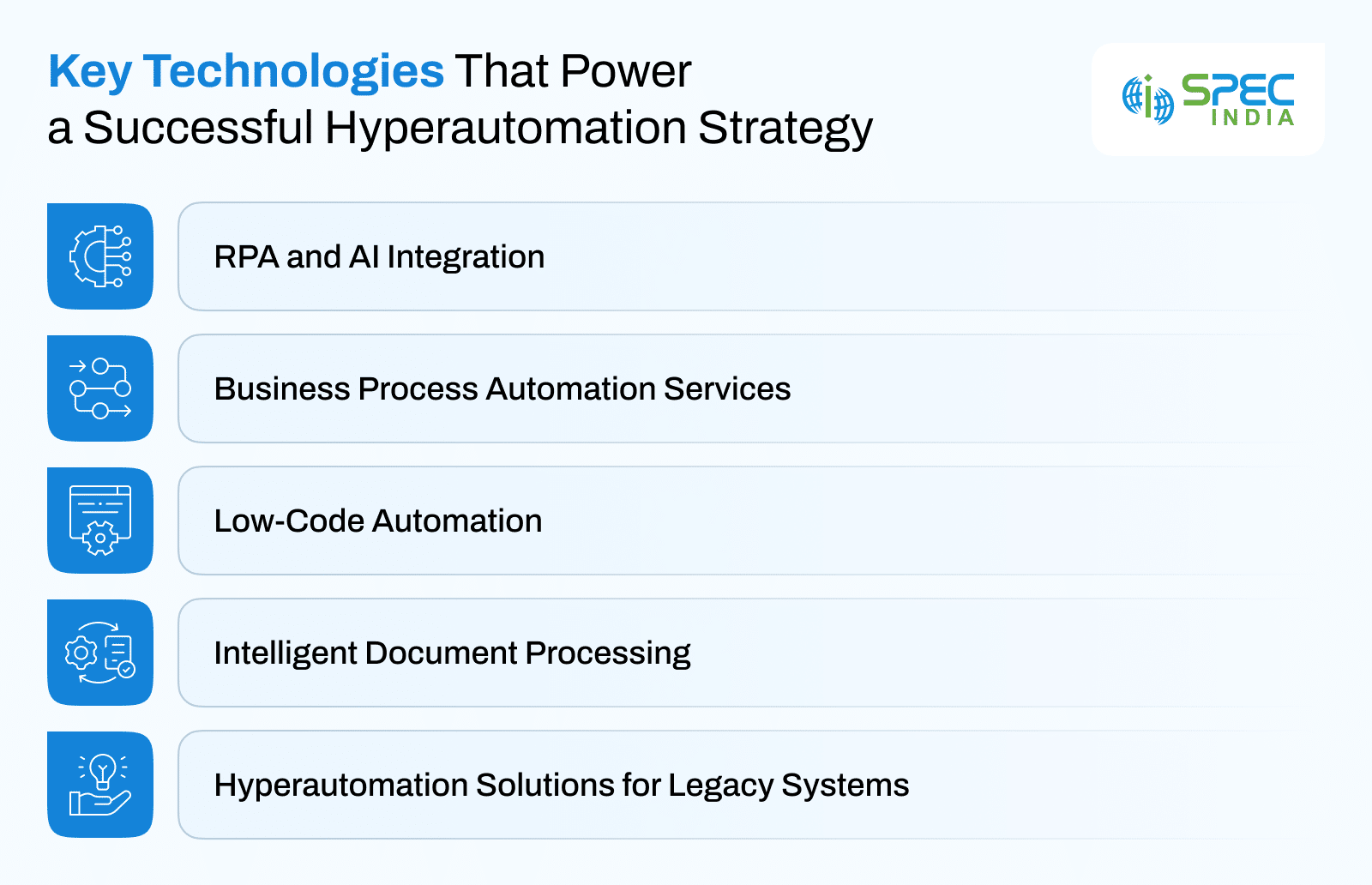
By treating business process automation services as a strategic weapon, you move from “doing things” to “evolving the business.”
How Can You Transition From Simple Tasks to Full Business Transformation?
Most companies start their journey by picking off small tasks, things like basic invoice processing or data entry. These are fine for a quick win, but they rarely move the needle for the entire enterprise. Hyperautomation in digital transformation is about shifting that lens entirely. We’re moving away from asking, “What small task can we automate?” and instead asking, “How do we fix the entire journey from start to finish?”
End-to-end automation is the difference between speeding up one gear and actually tuning the entire engine. It’s about creating a seamless flow that connects your front-office experience with your back-office reality.
AI-driven automation handles the complex decisions that used to require a human touch.
Low-code automation allows your teams to build these workflows without waiting for a ticket to clear the IT backlog.
Cross-functional data stops being a “silo” problem and starts being a strategic asset.
Take finance, for example. Instead of just automating an invoice, a solid hyperautomation strategy connects onboarding, risk checks, and compliance into one intelligent loop. In manufacturing, it links your procurement directly to your logistics. You aren’t just doing things faster; you’re doing them smarter, killing off the latency that usually stalls your operational efficiency.
How Do You Manage Risks and Security in an Automated Enterprise?
Here’s the truth: enterprise hyperautomation without a guardrail is just a faster way to create chaos. As you scale, you run into “bot sprawl,” inconsistent AI logic, and shadow IT projects that create massive security holes. You need a “Center of Excellence” to act as the adult in the room, setting the standards for enterprise automation solutions so they don’t become a liability.
It’s not just about the code, either. When intelligent automation starts making real-world decisions, you need ethical oversight to catch bias and ensure transparency. You also need an ironclad security credential vaulting and monitoring are non-negotiable when bots are touching your most sensitive systems.
Perhaps most importantly, don’t forget the humans. Automation doesn’t replace people; it changes their job description. A big part of your hyperautomation services plan has to be “Workforce Enablement.” If you don’t reskill your team to manage these new digital coworkers, your investment will just sit on the shelf.
What are the Biggest Mistakes Companies Make with Hyper automation?
Most organizations fail not because they lack the tech, but because they lack the plan. They fall into the “Tool-First” trap, buying a shiny new business process automation tool before they even know what problem they’re trying to solve.
The biggest mistakes we see:
- Automating a Mess: If you automate a broken process, you just get a faster version of a broken process. Optimize first, then automate.
- Ignoring the Big Picture: Pilots are easy; scaling across the entire company is hard. If your architecture isn’t built for enterprise hyperautomation from day one, it will break under pressure.
- The Integration Gap: Real RPA and AI integration is messy. It requires a deep understanding of your legacy system automation needs and how they play with modern APIs.
What Steps Should You Take to Build a Reliable Automation Roadmap?
Let’s be real: you can’t just “pilot” your way into hyperautomation in digital transformation. If you treat it like a series of isolated science experiments, you’re going to end up with a fragmented mess. Success requires a structured hyperautomation strategy that actually aligns your business goals with your tech stack.
An effective roadmap starts with a hard look at where you actually are, not just which tools you want to buy.
- Check Your Maturity: Before jumping into AI-driven automation, you need to be honest about your current business process automation state. Is your data actually clean? Do your systems even talk to each other? If the foundation is shaky, the AI won’t save you.
- Pick the Right Battles: Not every task needs a bot. You want to focus on workflows that are high-volume, mind-numbingly repetitive, and prone to human error. Look for the spots where operational efficiency is currently dying a slow death.
- Build for Scale, Not Just Proof-of-Concept: Your architecture needs to be open and API-driven from day one. Enterprise automation solutions fail when they can’t bridge the gap between your shiny new apps and your legacy system automation needs.
- Measure What Matters: If you can’t prove the ROI, the project is a dead end. Track things like cycle time reduction and actual cost savings. Business process automation services should be a profit driver, not just a line item.
- Expand with Intent: Once you’ve nailed the first few wins, you can start rolling out hyperautomation solutions to other departments, but keep the governance tight so you don’t end up with “bot sprawl.”
How Do You Choose the Best Partner for Enterprise Automation Projects?
As these projects get more complex, most leadership teams realize they need more than just a software vendor. Stitching together AI models, RPA bots, and low-code automation is a high-wire act. You need specialized hyperautomation services that understand the “guts” of an enterprise.
The right partner, think of firms like SPEC India, doesn’t just sell you a license. They offer deep digital transformation consulting and have a proven track record in RPA and AI integration. You’re looking for someone who can design a scalable architecture that doesn’t buckle when you add your hundredth bot.
At the end of the day, a partner should be focused on your long-term enterprise hyperautomation goals. They should bridge the gap between technical orchestration and business optimization, ensuring that your business process automation services are delivering a measurable competitive advantage.
Which Industries Are Seeing the Most Success With Intelligent Automation?
While the tech is industry-agnostic, the way it shows up on the ground is very specific. It’s all about solving the unique friction points of a particular sector.
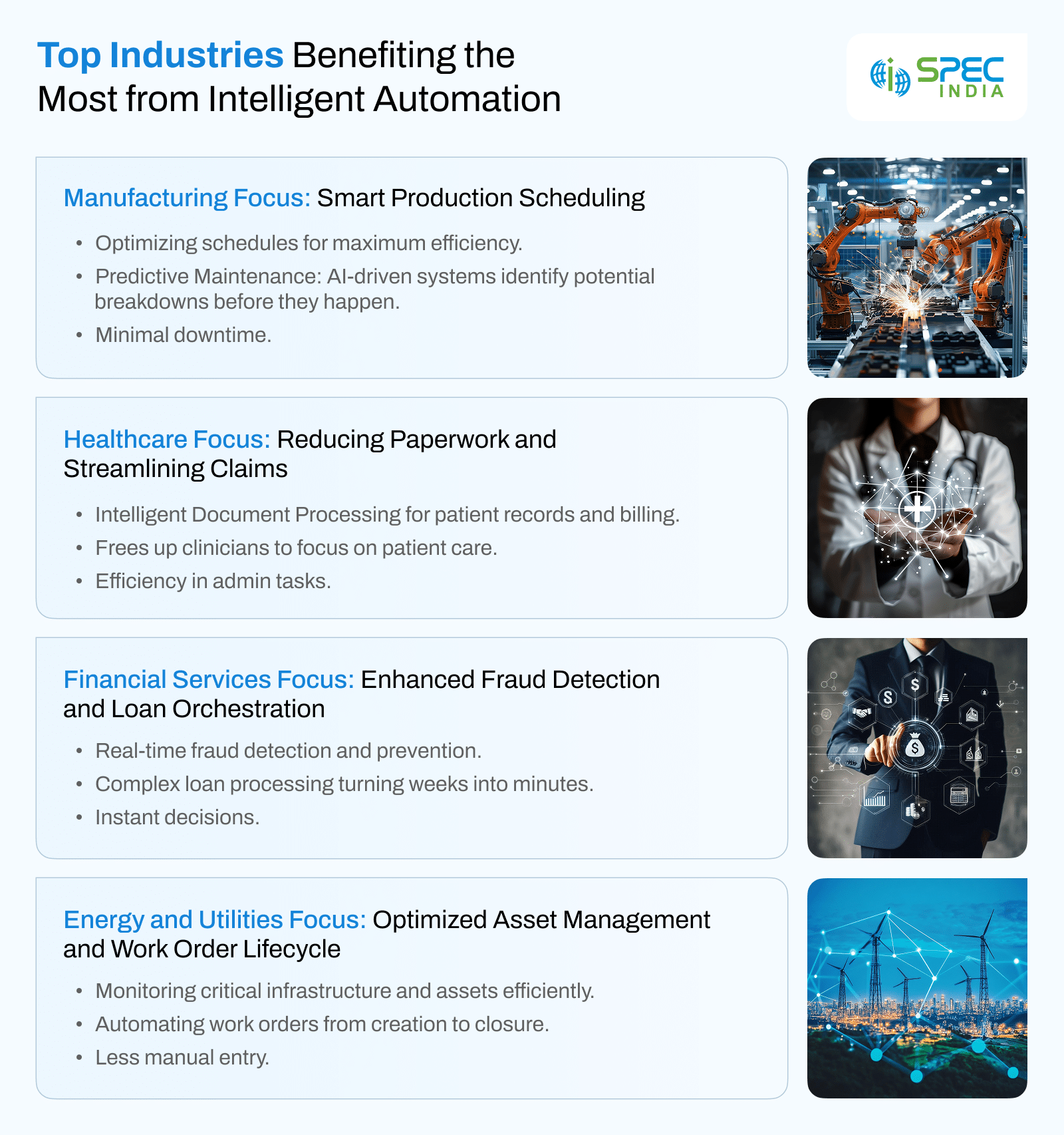
- Manufacturing: Think beyond just assembly. We’re talking about smart production scheduling and AI-driven automation for predictive maintenance that stops a breakdown before it happens.
- Healthcare: It’s about killing the paperwork. From claims processing to intelligent document processing for patient records, it frees up clinicians to actually focus on care.
- Finance: This is where intelligent automation shines in fraud detection and complex loan orchestration, turning weeks of waiting into minutes.
- Energy & Utilities: Using hyperautomation solutions to monitor assets and manage the entire lifecycle of a work order without a mountain of manual entry.
Across every one of these industries, the goal remains the same: use enterprise automation solutions to strip away the manual “grunt work,” boost your operational efficiency, and let your people focus on the stuff that actually requires a human brain.
What Does the Future of Intelligent Business Operations Look Like?
We need to look at hyperautomation in digital transformation as more than just a tech upgrade; it’s a structural shift in how a business actually breathes. We’re moving past the era of simply “digitizing” old habits and entering a phase of intelligent, adaptive operations.
The future isn’t just about bots; it’s about a deeper, more visceral connection between human intent and machine execution. We’re going to see:
Generative AI tools are woven so tightly into workflows that you won’t see the “seams” anymore.
Autonomous decision engines that don’t just follow rules but actually learn from outcomes.
The massive expansion of low-code no-code app development, which basically gives every employee the power to fix their own bottlenecks through “citizen automation.”
As we start to see AI in CRM systems and real-time analytics platforms merging, enterprise hyperautomation will become the literal backbone of the modern digital ecosystem. In the very near future, we won’t define success by which software you bought, but by how well you’ve orchestrated intelligent automation across every single layer of your company. It’s not an “add-on” to your journey; it is the journey.
Conclusion: Is Your Business Ready to Use Automation as a Strategic Advantage?
Let’s be honest: most companies have spent the last ten years playing catch-up, modernizing a server here, deploying a bot there. But we’ve hit a wall where “incremental” isn’t enough anymore. The real competitive advantage in 2026 belongs to the organizations that can orchestrate their entire operation cohesively. This is exactly where hyperautomation in digital transformation moves from a buzzword to a defining capability.
We’re shifting the lens from “how fast can this bot click?” to “how transformed is the entire enterprise?” By layering AI-driven automation on top of your core business process automation and low-code automation platforms, you move away from fragmented fixes. You aren’t just speeding up a broken process; you’re building an end-to-end automation ecosystem that gets smarter every time it runs.
But here’s the “straight talk”: the tech won’t save you if you don’t have a plan. You need a deliberate hyperautomation strategy and a way to handle legacy system automation without breaking your budget. Without that structure and the right digital transformation consulting to guide you, automation just creates more noise.
The next decade won’t be won by the company with the most AI pilots. It’ll be won by the enterprise that embeds enterprise automation solutions into its very DNA. Hyperautomation isn’t a passing trend or a shiny toy; it is the operational architecture of the future. The leaders who treat it as a strategic priority won’t just improve their operational efficiency; they’ll completely redefine what “work” looks like for their entire organization.
Frequently Asked Questions
Think of traditional automation as a specialist that’s really good at one repetitive task. Hyperautomation in digital transformation is the entire brain and nervous system. While the old way focuses on isolated, rule-based bots, hyperautomation pulls in AI, process mining, and low-code automation to handle end-to-end automation. It doesn't just "click buttons"; it connects your entire enterprise and actually gets smarter the more it runs.
Because department-level "mini-wins" just aren't enough to survive in today's market. Enterprise hyperautomation breaks down those annoying silos and drives operational efficiency at a scale you can actually measure. It’s the difference between fixing one leaky faucet and upgrading the entire plumbing. It turns your business into an adaptive machine that can handle market chaos without breaking.
It’s the "speed-enabler." You can't wait six months for an IT ticket every time you want to optimize a workflow. Low-code automation lets your people, the ones who actually know the business processes, collaborate with IT to build hyperautomation solutions on the fly. It kills the development bottlenecks and makes digital transformation automation something that actually happens in real-time.
Absolutely, and that’s usually where the most value is hidden. You don't have to rip and replace your old software to be "modern." Through legacy system automation, you can use APIs or RPA to bridge the gap between your decades-old core systems and your newest AI tools. It’s the smartest way to boost operational efficiency without the high-risk, high-cost nightmare of a total system overhaul.
It’s basically the "supergroup" of enterprise tech. You’ve got the heavy hitters like RPA and AI, but it also pulls in machine learning, intelligent document processing, and process mining. When these tools work together as a cohesive enterprise automation solutions architecture, they do more than just "automate"; they orchestrate your entire operation.
The tech doesn't care what you sell, but your hyperautomation strategy certainly should. Whether you’re in healthcare, finance, or manufacturing, intelligent automation can move the needle, provided it's tailored to your specific regulatory "red tape" and process complexity. The goal is always the same: stop wasting human brains on manual grunt work.

SPEC INDIA is your trusted partner for AI-driven software solutions, with proven expertise in digital transformation and innovative technology services. We deliver secure, reliable, and high-quality IT solutions to clients worldwide. As an ISO/IEC 27001:2022 certified company, we follow the highest standards for data security and quality. Our team applies proven project management methods, flexible engagement models, and modern infrastructure to deliver outstanding results. With skilled professionals and years of experience, we turn ideas into impactful solutions that drive business growth.
Table of contents
Delivering Digital Outcomes To Accelerate Growth
Let’s TalkTable of contents
Delivering Digital Outcomes To Accelerate Growth
Let’s TalkRelated Blogs
Let’s get in touch!
India
SPEC House, Parth Complex, Near Swastik Cross Roads, Navarangpura, Ahmedabad 380009, INDIA.
-
 +91-79-26404031, 32-33-34
 -
 [email protected]