| Failure Point | Operational Impact | Required Fix |
|---|---|---|
| Disconnected TMS and customs platforms | Manual document re-entry, customs delays | API-based real-time integration layer |
| No single shipment data record | Conflicting status updates across teams | Unified shipment data model |
| Spreadsheet-based rate management | Rate errors on quotes and invoices | Rate engine integrated with TMS and billing |
| Carrier data not auto-ingested | Manual tracking updates, missed ETAs | Carrier API integration with event processing |
| Finance system disconnected from ops | Delayed billing, missed charges, poor cash flow | Freight forwarding ERP integration |
| No data governance framework | Inconsistent data quality across all platforms | Data dictionary, ownership rules, validation logic |


Loading...
The Hidden Cost of Poor Data Architecture in Freight Forwarding
Posted
May 11, 2026
The global freight forwarding market was valued at USD 216.47 billion in 2024 and is projected to reach USD 285.60 billion by 2030. The growth is undeniable. What is less discussed is the operational inefficiency at the core of most forwarding businesses: poor data architecture that fragments shipment records across disconnected systems, adds complexity to managing diverse and interconnected supply chain data, forces manual reconciliation, and relies on outdated processes and manual tasks that further increase inefficiency. This blocks the digital visibility that shippers now demand, as these outdated processes are time-consuming and contribute to operational delays.
Gartner estimates poor data quality costs businesses an average of $12.9 million per year in operational inefficiencies. For freight forwarders managing high volumes of cross-border shipments and vast amounts of cargo and data, that figure materializes through billing errors, customs delays, missed charges, and decisions built on stale or incomplete data.
Data architecture in freight forwarding refers to the structure, standards, and systems that govern how data is created, stored, processed, and shared across a freight operation. It covers how shipment records are structured in your TMS, how data flows between your customs platform, ERP, carrier APIs, and customer portals, and who owns each data entity across your business.
Good logistics data management means data enters once, flows cleanly, and reaches the right systems without manual intervention. Poor data architecture means the opposite: disconnected platforms, duplicate records, and decisions built on incomplete information.
Despite the importance of integration, only 29% of enterprise applications are integrated on average, according to MuleSoft’s 2025 Connectivity Benchmark. For freight forwarders routinely managing six to ten operational systems per shipment, that integration gap has direct, daily consequences.
The Real Costs of Poor Data Architecture in Freight Forwarding
The costs of poor data architecture are rarely visible on a single P&L line. They accumulate across operations, finance, compliance, and customer retention. When data architecture is not designed to support evolving business needs or to streamline business processes, it can disrupt workflows, hinder automation, and make it difficult to adapt to changing operational requirements. Here is where they appear:
1. Operational Delays from Data Silos
When your TMS, customs platform, WMS, and finance system hold separate, unconnected records of the same shipment, your teams spend time reconciling data instead of moving freight. Data silos in logistics are the single biggest driver of internal delays, especially when managing data across multiple suppliers, which further complicates operational workflows.
Salesforce research shows data silos cost organizations $7.8 million annually in lost productivity, with employees wasting 12 hours per week searching for information across disconnected systems. In a freight forwarding context, that translates to slower customs clearance, missed carrier cut-off times, and reactive rather than proactive operations.
2. Revenue Leakage from Billing Errors
Billing in freight forwarding is complex. Managing transportation costs and billing accuracy is a significant concern for freight forwarders, as these factors directly impact profitability. Charges accumulate across carriers, agents, customs authorities, and ancillary service providers throughout a shipment’s lifecycle. Without a data architecture that captures every charge in real time, billing becomes a retrospective exercise and revenue leaks in the gaps.
Uninvoiced surcharges, duplicate billing, and missed accessorial charges are direct consequences of freight-forwarding challenges stemming from fragmented data. Only 69% of European freight forwarders have adopted digital innovations, and many still lack automated invoicing capabilities, a gap that directly contributes to billing inaccuracies and revenue leakage.
3. Compliance Failures and Regulatory Risk
Customs compliance, sanctions screening, AES filing, and certificate of origin management all require accurate, complete, and timely data, making regulatory compliance in international shipping essential for smooth and lawful freight forwarding operations. When data governance in logistics is weak, compliance processes depend on manual checks rather than systematic data controls. A single data error in a customs declaration can trigger a hold, a fine, or a regulatory review, a recurring operational cost for forwarders handling high volumes of cross-border shipments.
4. Customer Visibility Gaps and Retention Impact
Shippers expect real-time visibility into their cargo. When your freight forwarding software cannot surface accurate, current shipment data into a customer portal because internal systems are disconnected, you lose the visibility race to competitors who have invested in supply chain data integration. This lack of integration can result in missed or unreliable delivery times, directly impacting customer satisfaction and trust.
Logistics teams using integrated freight platforms report up to 30% reduction in booking time and 25% improvement in shipment visibility, according to Freightos 2024 data. Forwarders not delivering that standard are actively creating customer churn.
5. Blocked Strategic Intelligence
Lane profitability, carrier performance, customer margin analysis, and demand forecasting all depend on clean, connected data. Without modern data architecture, strategic decisions default to gut feel and lagging indicators.
McKinsey research confirms that companies with highly integrated supply chain operations achieve 20% higher efficiency rates than those with fragmented structures. That efficiency gap is the direct consequence of data architecture decisions.
Where Data Architecture Breaks Down in Freight Forwarding
These are the most common structural weaknesses in freight forwarding data environments:
Digitizing data exchange between systems and partners is essential to streamline freight operations and logistics operations, enabling better collaboration, reducing manual work, and eliminating data silos.
What Modern Data Architecture Looks Like for Freight Forwarders
A modern data architecture for freight forwarding is not about replacing every system at once. It is about building the connective tissue between your platforms so that data flows accurately and automatically. The core components are:
A Unified Data Layer
A centralized data layer sits between your operational systems, TMS, WMS, customs, finance, and customer portal, ensuring every platform reads from and writes to a single, consistent source of truth. Managing all freight forwarding operations through a single system not only streamlines workflow but also significantly improves efficiency by consolidating quoting, invoicing, and dispatch tracking into one platform. Supply chain data integration at this level eliminates the reconciliation work that consumes your operations team’s time.
Real-Time API Integration
Modern digital freight forwarding platforms connect to carriers, ports, customs authorities, and customers through APIs that exchange data in real time. When a carrier updates an ETA, that change flows automatically into your customer portal, planning tools, and finance system without a human in the middle.
Cloud-Based Infrastructure
On-premises systems are the most common source of freight-forwarding challenges in data architecture. Cloud-based logistics software delivers the scalability to handle volume spikes and the integration flexibility required by API-first platforms. Gartner projects that more than 85% of organizations will have adopted a cloud-first principle by 2025, with cloud adoption delivering a 27% increase in productivity for mid-market firms. For large enterprises, cloud-based solutions are especially beneficial for managing complex logistics operations, enabling greater transparency, control, and efficiency at scale.
Freight Forwarding ERP Integration
The gap between operational data and financial data is where most billing errors originate. Proper freight-forwarding ERP integration closes that gap by connecting shipment milestones, charge accumulation, and invoice generation into a single automated workflow. Charges are captured as they occur, invoices are generated on schedule, and your finance team works from the same data as your operations team.
Data Governance Framework
Technology alone does not fix poor data architecture. A data governance framework in logistics defines who owns each data entity, which source is authoritative, how quality is validated, and how conflicts are resolved. Without governance, even well-integrated systems drift into inconsistency over time.
Freight Forwarding Business and Growth
The freight forwarding business faces fierce competition. Countless companies fight for market share in a fast-changing logistics landscape.
Smart freight forwarders know the secret. They adopt cutting-edge technology and fine-tune their operations non-stop.
Cloud-based freight forwarding software changes everything. It streamlines workflows, cuts costs, and gives you real-time supply chain visibility.
Multiple carriers, complex regulations, global shipment tracking these challenges keep freight forwarders up at night. The right freight forwarding software handles these headaches efficiently.
You get smoother operations. Your customers get reliable service.
Market conditions shift. Customer expectations climb higher. Your freight forwarding business needs three things: better efficiency, lower costs, and happier customers.
Stay competitive by embracing the latest technology. Adapt to industry trends as they emerge.
This approach drives real business growth. It secures your position as a logistics industry leader.
The Role of AI and Analytics Once Data Architecture Is Fixed
According to Accenture, 29% of supply chain executives plan to reinvent supply chain management using generative AI. Yet AI in freight forwarding is only effective when the underlying data is clean, connected, and consistently structured. Once your logistics data management foundation is solid, AI delivers:
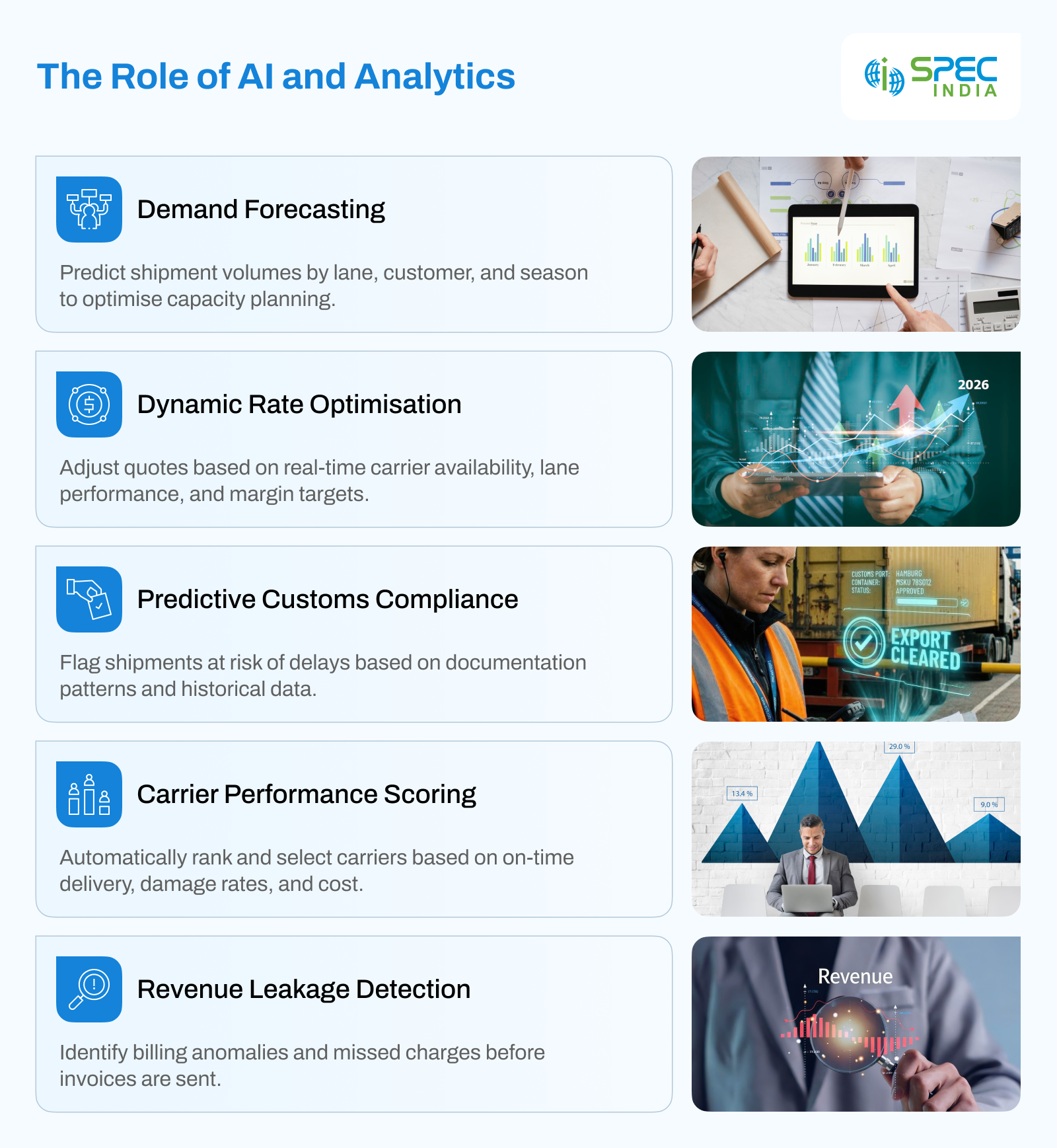
AI-powered analytics can also enable advanced self-service features, giving customers real-time data access and shipment updates so they can independently manage and track their freight.
IDC research shows organizations with mature integration achieve an average ROI of 3.7x from AI initiatives, with top performers reaching 10.3x. The logistics digital transformation journey stalls when the data architecture is not first fixed. Integration is what unlocks the analytics.
How SPEC India Helps Freight Forwarders Fix Data Architecture
SPEC’s freight forwarding software development services are built around the specific data and integration challenges that freight forwarders face. Our logistics practice has delivered custom platforms, integration layers, and data engineering solutions for forwarding companies across the USA, Europe, and the Middle East. These solutions help both freight business and logistics business clients streamline operations, reduce costs, and improve customer satisfaction.
What we build for freight forwarders:
- Unified shipment data platforms that consolidate records across TMS, customs, WMS, and finance into a single accurate source of truth.
- Carrier and port API integrations that automate tracking updates, ETA management, and event-driven workflow triggers.
- Freight forwarding ERP integration connects operational milestones directly to billing and financial reporting workflows.
- Cloud-based logistics software on AWS, Azure, and GCP that scales with shipment volumes and supports global multi-entity operations.
- Ocean freight management features include tracking and documentation for ocean-bound shipments, providing full visibility and control over international shipping.
- Data governance frameworks covering data dictionaries, validation rules, and ownership models that maintain data quality as your business grows.
- AI and analytics platforms for demand forecasting, carrier scoring, compliance risk flagging, and margin analysis built on your clean, connected data.
If your operations are running on disconnected systems and rely on manual workarounds, the cost is already mounting. Our logistics software development services team can help you build the data architecture that eliminates it. These solutions are scalable for both large enterprises and smaller organizations, adapting to the needs of any freight or logistics business.
Conclusion
Data architecture in freight forwarding is not an IT problem. It is a business performance problem. Operational delays, billing errors, compliance failures, customer churn, and strategic blindness all share the same root cause: fragmented, unconnected, and ungoverned data.
The path to modern data architecture is well defined. It starts with integration, connecting the systems you already have, so data flows automatically. It continues with governance, ensuring connected data is clean, consistent, and trusted. It culminates in analytics and AI using that clean data to make better decisions faster.
Forwarders who treat logistics digital transformation as a data project first and a technology project second will move faster and waste less. The hidden costs of poor data architecture are real and compounding. The question is when you start fixing them.
Frequently Asked Questions
Data architecture in freight forwarding organizes how shipment, financial, customs, and carrier data are created, stored, and shared across systems to ensure accuracy and reduce manual errors.
Freight forwarders often have disconnected systems added over time without integration, causing manual reconciliation and data silos that slow operations.
Without real-time data capture and integration, billing teams miss charges and invoice late, causing revenue leakage and errors.
Poor architecture involves siloed, manual data; modern architecture uses unified data layers, real-time APIs, cloud infrastructure, and governance for efficiency and accuracy.
AI requires clean, consistent data; fragmented systems prevent reliable AI outputs, so a unified data architecture is essential for effective AI use.
It connects internal and external systems via APIs and event-driven architectures to provide a single accurate shipment view.
Integration projects take 3-4 months; full overhauls with governance and analytics take 6-12 months, delivered in phases.
Yes, We supports integration with leading platforms via REST, SOAP, EDI, and file-based methods. Explore our success story.
Data governance defines data ownership, quality validation, and conflict resolution to maintain data integrity over time.
We builds custom platforms for freight forwarders, including shipment management, integrations, billing automation, visibility portals, and AI analytics.

SPEC INDIA is your trusted partner for AI-driven software solutions, with proven expertise in digital transformation and innovative technology services. We deliver secure, reliable, and high-quality IT solutions to clients worldwide. As an ISO/IEC 27001:2022 certified company, we follow the highest standards for data security and quality. Our team applies proven project management methods, flexible engagement models, and modern infrastructure to deliver outstanding results. With skilled professionals and years of experience, we turn ideas into impactful solutions that drive business growth.
Table of contents
- The Real Costs of Poor Data Architecture in Freight Forwarding
- Where Data Architecture Breaks Down in Freight Forwarding
- What Modern Data Architecture Looks Like for Freight Forwarders
- Freight Forwarding Business and Growth
- The Role of AI and Analytics
- How SPEC India Helps Freight Forwarders Fix Data Architecture
- Conclusion
Delivering Digital Outcomes To Accelerate Growth
Let’s TalkTable of contents
- The Real Costs of Poor Data Architecture in Freight Forwarding
- Where Data Architecture Breaks Down in Freight Forwarding
- What Modern Data Architecture Looks Like for Freight Forwarders
- Freight Forwarding Business and Growth
- The Role of AI and Analytics
- How SPEC India Helps Freight Forwarders Fix Data Architecture
- Conclusion
Delivering Digital Outcomes To Accelerate Growth
Let’s TalkRelated Blogs
Let’s get in touch!
India
SPEC House, Parth Complex, Near Swastik Cross Roads, Navarangpura, Ahmedabad 380009, INDIA.
-
 +91-79-26404031, 32-33-34
 -
 [email protected]