

Why Manufacturing Automation Needs RPA Integration
April 8, 2026
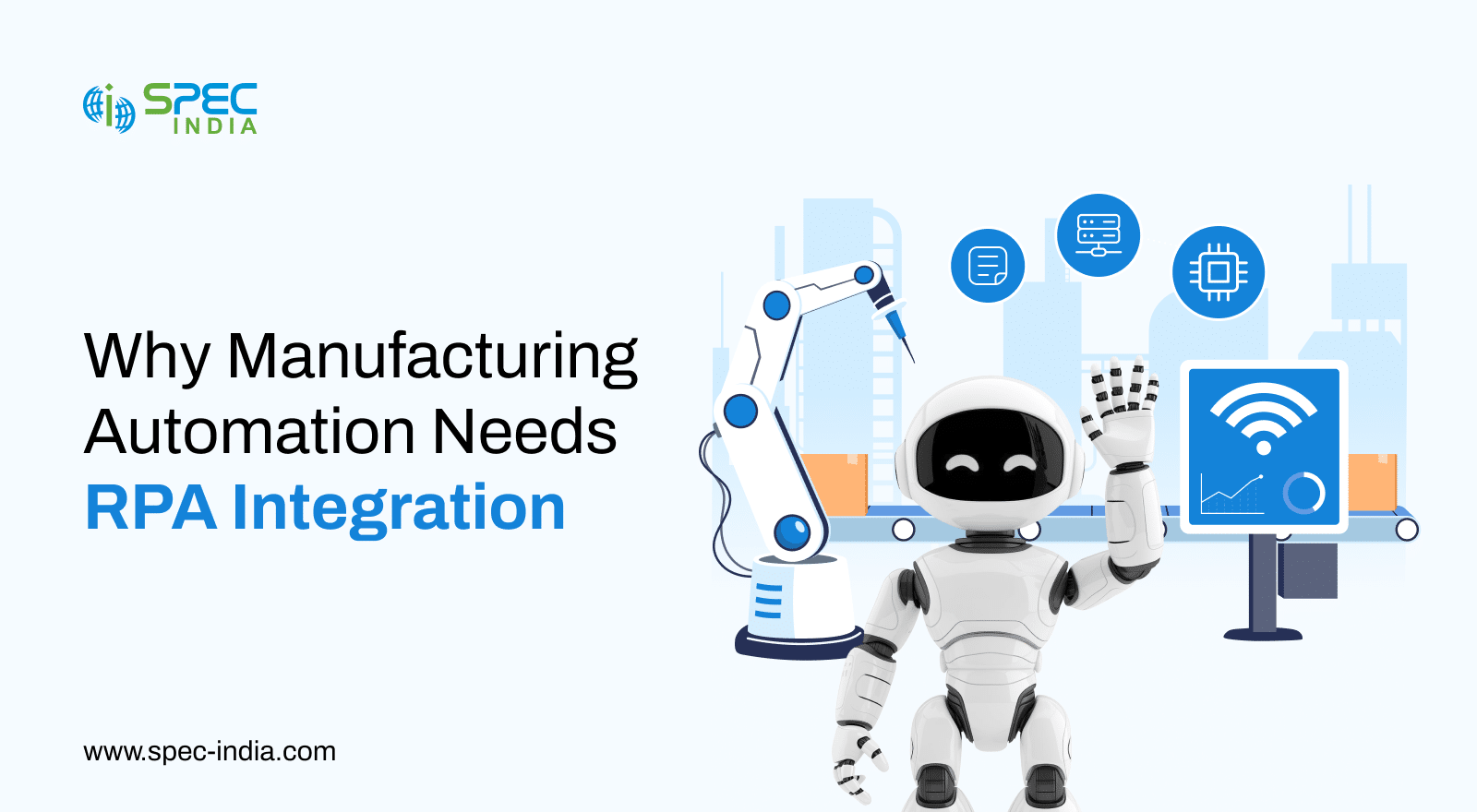
The factory floor has always been the heartbeat of industry. But today, that heartbeat runs on data — mountains of it, generated from sensors, machines, ERP systems, MES platforms, supply chain portals, and quality dashboards. The question modern manufacturers face isn’t whether to automate. That ship sailed years ago. The real question is: Are you automating the right way?
Many manufacturers have invested in Robotic Process Automation (RPA) and seen meaningful gains; faster invoice processing, reduced data entry errors, streamlined compliance reporting. But here’s what the most forward-thinking operations are realizing: RPA alone is only half the equation. Without deep system integration, RPA becomes an island — powerful, but isolated. And isolated automation, no matter how sophisticated, can never unlock the full potential of a modern smart factory.
At SPEC, we’ve worked with manufacturers across industries — discrete, process, hybrid, and one pattern repeats itself: the organizations achieving real competitive advantage are those who pair RPA development with robust integration architecture.
Let’s understand deeply why it has become important to bring digital transformation in manufacturing through RPA integration.
What is RPA in Manufacturing?
If you’ve ever watched someone on a factory floor manually copy production data from one system into another, or seen a procurement team spend half their day entering the same numbers into three different spreadsheets — that’s exactly the problem robotic process automation in manufacturing was built to solve.
RPA is a industrial automation solution hat mimics what a human does when interacting with digital systems. It logs in, reads data, moves it, enters it, triggers actions, and reports back; just without anyone sitting at a keyboard to do it. In a manufacturing context, that means automating the repetitive, rule-based digital work that surrounds physical production: inventory updates, purchase order creation, compliance reporting, quality data logging, and dozens of other tasks that consume time without requiring genuine human judgment.
It’s also worth being clear about what RPA isn’t. It’s not a robot on the production line, and it’s not AI making complex decisions. It’s a digital worker handling the administrative and data layer of manufacturing operations — reliably and quickly, without the errors that creep in when humans repeat the same task hundreds of times a day.
Where RPA integration becomes especially powerful is when these bots are connected across systems — pulling data from a manufacturing execution system, pushing it into an ERP, triggering quality workflows, and flagging exceptions automatically. That connected layer is what separates basic task automation from something that genuinely changes how an operation runs.
For manufacturers dealing with tight margins and growing compliance demands, RPA integration is quickly becoming the practical backbone that keeps operations moving without proportionally growing the headcount behind them.
What “Integration” Actually Means in a Manufacturing Context
By integration in manufacturing automation, we are referring to the establishment of a single data fabric that links your:
- ERP systems (SAP, Oracle, Microsoft Dynamics).
- Manufacturing Execution Systems (MES).
- SCADA and IoT platforms
- Quality Management Systems (QMS).
- Procurement and supply chain portal.
- The manufacturing analytics dashboards are made.
- Warehouse and inventory management solutions.
The actual integration implies that these systems communicate with each other in real time – exchanging data via APIs, middleware, or event-driven architectures – instead of allowing manual data transfers or UI-based bots to transfer information between the two.
When you add to this type of deep integration the development of RPA, you finally get something powerful: you no longer automate tasks but automate results.
5 Reasons RPA in Manufacturing Falls Short Without Integration?
Robotic Process Automation in manufacturing is a popular automation of repetitive functions in manufacturing to enhance efficiency. Nonetheless, the effects of RPA can be insignificant when it is adopted without the incorporation of core systems such as ERP, MES, and supply chain platforms. Automation stays limited to isolated processes instead of enabling smooth, end-to-end operations. The following are five reasons why RPA, as an entity on its own, fails in manufacturing.
1. Data Silos Kill Manufacturing Analytics
Manufacturing analytics is only as good as the data feeding it. When your quality data lives in one system, your production throughput in another, and your maintenance logs in a third — and none of them talk to each other — you’re doing analytics on fragments, not facts.
RPA can pull data from each system individually, but it does so sequentially and often with latency. Integration creates continuous, synchronized data streams. The result? Your manufacturing analytics dashboards reflect what’s happening right now, not what happened an hour ago when the bot last ran its script.
Real-time manufacturing analytics is the difference between reactive and proactive operations. It’s the difference between discovering a quality defect after 500 units are produced versus catching the process drift after the first five.
2. Process Automation Requires End-to-End Orchestration
The manufacturing process does not begin and end with a system of procurement. It starts with a production demand signal, proceeds through inventory checks, triggers a purchase order in the ERP, updates the supplier portal, routes to approval, reconciles with the invoice, and closes the accounts payable system.
An RPA bot can handle pieces of this. But without integration, those pieces are disconnected. You end up with a patchwork of automated steps separated by manual handoffs — which means you haven’t actually automated the process. You’ve automated the busywork within each step while leaving the connective tissue human.
Integration weaves those steps into a single, continuous automated workflow. Integration binds those steps into one continuous automated workflow. The RPA development subsequently puts the intelligence layer – exception processing, business rule implementations, escalation triggers, etc – over that integrated backbone.
3. Predictive Maintenance Demands Real-Time Data Flow
Predictive maintenance has become one of the most valuable uses of manufacturing automation today. IoT sensors on machinery generate continuous streams of temperature, vibration, pressure, and cycle data. When this data is analyzed in real time against historical failure patterns, manufacturers can predict equipment failures before they happen — scheduling maintenance proactively rather than scrambling reactively.
RPA alone cannot support this use case. It’s not designed for real-time event-driven triggers from IoT systems. But when you integrate your IoT platform with your CMMS (Computerized Maintenance Management System) and layer in an intelligent automation in manufacturing workflow, the system becomes much more connected and responsive. This includes using RPA for downstream process steps like creating work orders, notifying technicians, and ordering parts, resulting in a complete, closed-loop predictive maintenance system.
That’s the power of RPA integration.
4. Compliance and Traceability Require an Unbroken Data Chain
In controlled environments (pharmaceuticals, food and beverage, aerospace, automotive, etc.), compliance is not a choice. Traceability is not a luxury. All the components, all the batches, and all the parameters of the processes should be recorded accurately, and they should be made available whenever required.
Fragmented systems create compliance gaps. If your RPA bot pulls quality data and logs it somewhere, but that log isn’t tied back to the original batch record in the MES, which isn’t linked to the supplier certificate in the QMS, you have a compliance chain with missing links.
Integration creates the unbroken data chain that compliance demands. RPA development then automates the documentation, reporting, and audit trail generation on top of that integrated foundation, turning what was a labor-intensive compliance burden into an automated, always-on process.
5. Scalability Requires Architectural Soundness
When manufacturers scale — adding production lines, entering new markets, acquiring facilities — their automation needs to scale with them. RPA bots built on UI interactions are brittle. Add a new system, change a process, upgrade an ERP version, and your bots need to be rebuilt or significantly reworked.
Integration-first automation is inherently more scalable. APIs and middleware are designed to be modular and extensible. When you build automation on top of a well-integrated stack, adding a new system means creating a new integration — not rebuilding your entire manufacturing automation infrastructure.
At SPEC India, we design RPA and integration architectures with scale in mind from day one — because the most expensive automation is the kind you have to throw away and rebuild.
Upgrade Your Automation Strategy with RPA
True manufacturing excellence comes from connected systems and intelligent workflows. RPA helps you get there; faster, smarter, and without disruption.
The SPEC India Approach: Unified Automation Architecture
We do not focus on developing or integrating RPA when it comes to manufacturing automation. It is to create them jointly as an architecture.
We start with the process. We track the overall workflow, the end-to-end workflow, of the triggers and results, and all the system touch points, decision points, and data transfers. Then we select the appropriate automation tool for each layer: API integration, where systems must share data in real-time, RPA, where human interventions with the older systems cannot be avoided, and intelligent automation, where decisions must be made in a dynamic way.
The outcome is not only fast, but intelligent automation. Not merely allied, but strong. Not only to fix the inefficiency of today, but to prepare for the growth of tomorrow.
What the Numbers Say
The manufacturers who use RPA with integration boast impressive results:
- 60% reduction in manual data processing in production and back-office operations.
- 40-50% exception resolutions with in-built alert and escalation processes.
- Real-time manufacturing analytics and closed-loop feedback have led to significant improvements in first-pass quality rates.
- Integrated automation programs with calculable ROI in 6-12 months of implementation.
These are not hypothetical forecasts. They are deliverables we assist our manufacturing client companies to attain via rigorous, architecture-based automation initiatives.
Is Your Manufacturing Automation Ready for the Next Level?
The manufacturers winning in 2026 and beyond aren’t the ones who automated the most tasks. They’re the ones who built automation that’s connected, intelligent, and integrated into the fabric of their operations.
We are highly experienced in RPA development, enterprise integration, and manufacturing analytics, which can be used to support you in creating that advantage at SPEC India. Whether you’re starting from scratch or evolving an existing automation program, we’re ready to help you architect the right solution.
Let’s talk about what’s possible for your manufacturing operations.
SPEC is a leading technology solutions company specializing in RPA development, enterprise integration, manufacturing analytics, and intelligent automation. With decades of experience across global manufacturing industries, We help organizations automate smarter, not just faster.
Frequently Asked Questions
Lack of clear automation strategy, resistance to change, and legacy systems are some of the reasons why many struggle. In the absence of proper process mapping, RPA can easily be deployed in silos rather than provide end-to-end value.
Yes, RPA can be used with old ERP and MES systems, by simulating human behavior in the UI level, and it is a viable solution where there are limited or no APIs.
They integrate RPA with real-time data systems such as IoT and analytics systems, making sure that bots operate with dynamic data rather than fixed inputs.
The main risks are automating inefficient processes, bot failures as a result of changes in the system, inconsistencies in the data, and absence of governance and monitoring.
Yes, RPA is beneficial because it automates the flow of data between systems, enhances demand forecasting, inventory tracking, and communication throughout the supply chain. With SPEC India's expertise, manufacturers can implement tailored RPA solutions that seamlessly connect ERP, MES, and other systems, ensuring better visibility and smarter decision-making across operations.
RPA frees manual processes such as data entry and report creation, eliminating human errors and promoting uniformity and adherence to rules. SPEC assists in designing and deploying smart automation processes that not only reduce errors, but also enhance process accuracy and conformity of key manufacturing processes.
ROI is usually achieved through low operational costs, quicker processing, higher precision, and efficient use of resources- most times can be seen within months of its implementation.

SPEC INDIA is your trusted partner for AI-driven software solutions, with proven expertise in digital transformation and innovative technology services. We deliver secure, reliable, and high-quality IT solutions to clients worldwide. As an ISO/IEC 27001:2022 certified company, we follow the highest standards for data security and quality. Our team applies proven project management methods, flexible engagement models, and modern infrastructure to deliver outstanding results. With skilled professionals and years of experience, we turn ideas into impactful solutions that drive business growth.
Table of contents
Delivering Digital Outcomes To Accelerate Growth
Let’s TalkTable of contents
Delivering Digital Outcomes To Accelerate Growth
Let’s TalkRelated Blogs
Let’s get in touch!
India
SPEC House, Parth Complex, Near Swastik Cross Roads, Navarangpura, Ahmedabad 380009, INDIA.
-
 +91-79-26404031, 32-33-34
 -
 [email protected]