

Why Shopping Cart Integration is Critical for Modern Retail Operations
May 18, 2026
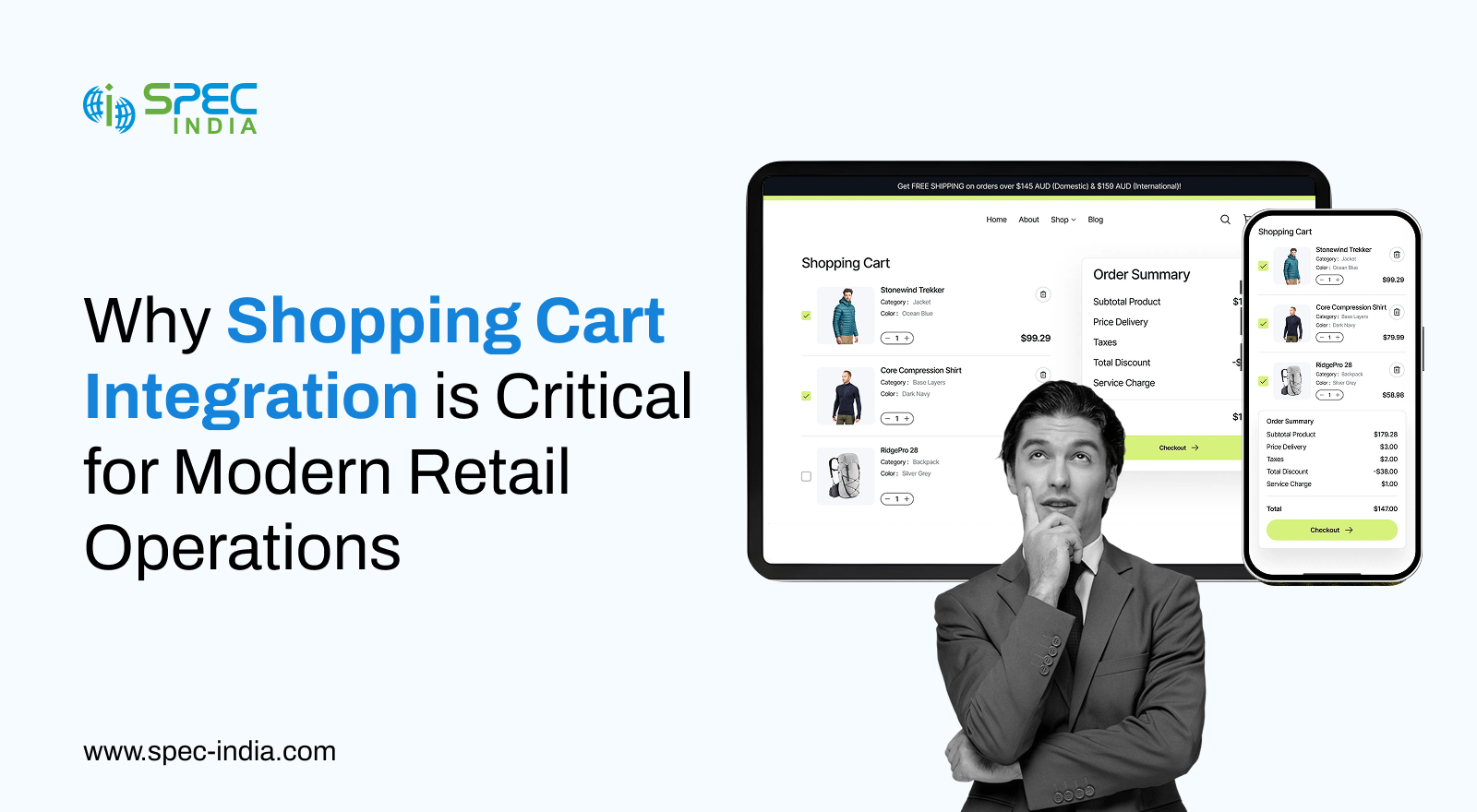
There was a time when running a retail business meant managing one thing: the store. Inventory sat on shelves you could walk through. Sales happened face to face. And if a product ran out, someone scribbled a note on a clipboard. That world is gone. Today’s retailer is managing a storefront, a warehouse, a website, a mobile app, and a social media shop — sometimes all at once — while customers expect every one of those touchpoints to work as a single, seamless experience.
At the heart of making that experience work is shopping cart integration. It sounds like a narrow technical concept, but in practice it touches almost everything: how orders get processed, how inventory gets updated, how customers receive confirmations, how finance teams reconcile numbers, and how operations teams plan for demand. Getting it right is no longer optional for retailers who want to compete.
Why Integration Has Become a Priority
Retail has never been more fragmented. A mid-sized brand today might sell through its own website, a mobile app, Amazon, and two or three social platforms — all while managing a network of physical stores. Each of those channels generates data. Each has its own cart, its own checkout flow, and its own record of what a customer bought.
Without proper retail system integration, those channels become silos. The online store doesn’t know what the physical store just sold. The warehouse ships something that was already out of stock. A customer places an order, gets a confirmation, and then receives a cancellation email three days later because no one caught the inventory error in time. These are not rare edge cases, they are the daily reality for retailers who haven’t invested in connecting their systems.
The demand for tighter retail operations has pushed integration from a technical nice-to-have into a genuine business requirement. Retailers that have unified their systems report fewer order errors, faster fulfillment, and better customer satisfaction scores. Those that haven’t are finding it increasingly hard to keep up.
What Shopping Cart Integration Actually Means
At its simplest, ecommerce shopping cart integration is the process of connecting a retail cart — whether it lives on a proprietary website, a third-party marketplace, or a POS terminal — to the other systems a business relies on. That usually means the inventory management system, the order management system, the ERP, the CRM, and sometimes the shipping and logistics platform.
When these connections are in place, a customer adding something to their cart triggers a chain of events that flows through the business automatically. Stock levels update. Payment gets authorized. The warehouse receives a pick list. The customer gets a tracking number. The finance system logs the transaction. None of this requires manual intervention. That is the promise of well-executed ecommerce workflow automation.
The technical backbone for most of these connections is the API. Shopping cart API integration allows disparate systems to talk to each other in real time, exchanging data about orders, customers, products, and fulfillment status. A retailer with a robust API layer can add new sales channels, swap out back-end tools, or scale operations without tearing everything apart and starting over.
The Real-Time Inventory Problem
Ask any retail operations manager about their biggest headaches and inventory accuracy will be near the top of the list. Overselling, underselling, and mismatched stock counts are not just operational problems, they are customer experience problems. A shopper who orders something online and gets told a week later that it is out of stock does not come back.
This is where real-time inventory updates become critical. When a sale happens — whether online, in-store, or through a third-party marketplace — the inventory count needs to reflect that instantly. Not in a nightly batch. Not in a few hours. Immediately.
The tighter the integration between the point-of-sale system and the online cart, the more accurate those numbers stay.
For multi-location retailers, this is especially complex. A product might exist in five warehouses and twelve store locations. Determining which location should fulfill a given order — based on proximity to the customer, available stock, and shipping cost — requires constant synchronization between the cart, the order management system, and the inventory platform.
Without that synchronization, the entire fulfillment process becomes a guessing game.
Proper retail data synchronization eliminates that guesswork. When every system is pulling from a single, accurate source of inventory truth, decisions about fulfillment, replenishment, and merchandising get easier and faster.
POS Integration and the In-Store Dimension
Physical retail is not going away. Even as ecommerce grows, stores remain a significant part of how consumers shop, particularly for categories like apparel, electronics, and home goods. The challenge for modern retailers is connecting the in-store experience to the digital one in a way that feels natural to the customer.
Effective retail POS integration means the point-of-sale system at the register is not operating in isolation. It feeds data back to the central inventory system every time a transaction is completed. It recognizes returning customers and surfaces their order history. It can process online order pickups, handle returns from digital purchases, and apply loyalty points earned both in-store and online.
For the customer, this integration is largely invisible — which is exactly how it should be. They should be able to buy online and return in-store without friction. They should be able to check online whether a product is available at their nearest location. They should be able to pick up where they left off regardless of where they started. When the online store integration is working properly, these experiences feel effortless. When it is not, they generate complaints, abandoned carts, and lost sales.
ERP and Enterprise System Connectivity
For larger retailers and brands, the complexity multiplies. Enterprise-level businesses run sophisticated back-office systems — ERP platforms, financial systems, supply chain management tools, HR systems — that were often built before ecommerce existed as a major revenue channel. Connecting those legacy systems to modern digital storefronts is one of the defining challenges of enterprise system modernization.
A well-executed retail ERP integration brings the cart and the enterprise together. Orders placed online automatically create entries in the ERP. Financial data flows without manual exports and imports. Procurement decisions get informed by real-time sales velocity from the online channel. Customer data from the cart enriches the CRM, allowing more targeted marketing and better customer service.
This level of ecommerce backend integration requires careful planning, but the payoff is substantial. Retailers who have connected their carts to their enterprise systems report significant reductions in manual data entry, faster month-end close cycles, and better visibility into the business as a whole. Perhaps more importantly, it gives leadership a single view of performance across all channels — something that is nearly impossible to achieve when systems operate in silos.
Custom vs. Platform: Choosing the Right Approach
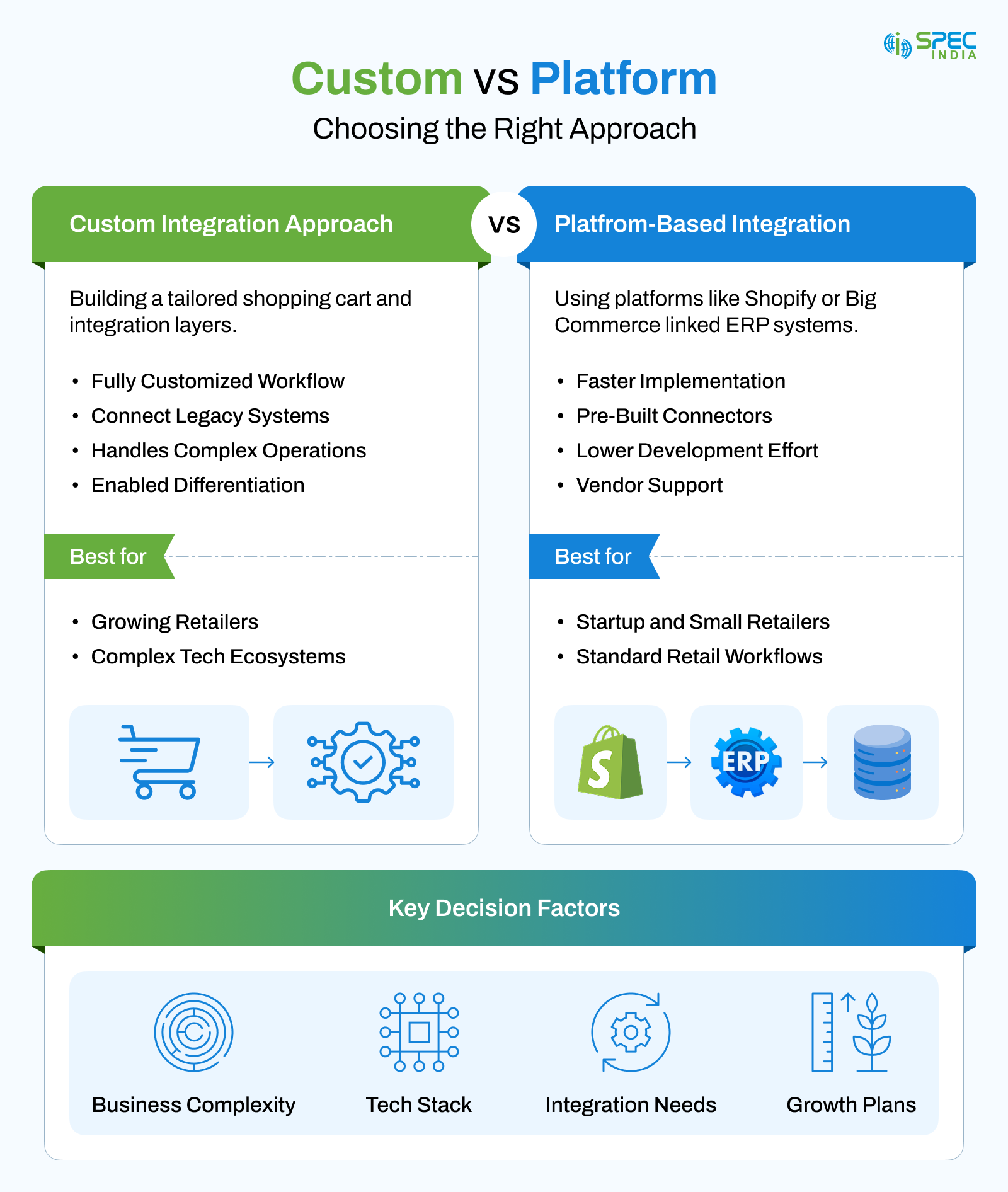
One of the first decisions retailers face when approaching integration is whether to build on an existing platform or develop a custom solution. Both have legitimate use cases, and the right choice depends heavily on the complexity of the business, the existing tech stack, and long-term growth plans.
Off-the-shelf ecommerce platform integration — connecting a Shopify or BigCommerce store to an existing ERP, for instance — is often the fastest path to a functional connected system. Pre-built connectors and certified integrations reduce development time significantly and come with support structures that make troubleshooting easier.
But off-the-shelf solutions have limits. For retailers with highly specific workflows, proprietary back-end systems, or competitive differentiation tied to their technology, a custom shopping cart and a purpose-built integration layer often makes more sense. Custom ecommerce platform development allows teams to design exactly the flows they need, connect to systems that lack standard connectors, and build in the logic that reflects how their particular business actually operates.
This is why many growing retailers turn to specialized retail software development services to help them design and build integration architectures that fit their unique needs. The right partner brings both technical expertise and an understanding of retail operations — a combination that is harder to find than it sounds, and considerably more valuable than generic software implementation.
Automation: The Long-Term Return on Integration Investment
The immediate value of integration is accuracy — getting the right data in the right place at the right time. But the longer-term value is automation. Once systems are connected and data flows reliably, it becomes possible to layer on logic that removes entire categories of manual work from retail operations.
Consider what becomes possible with mature retail automation integration: replenishment orders triggered automatically when stock dips below a threshold; customer service tickets created and routed without a human reading each email; promotional pricing updated across all channels simultaneously; fraud signals acted on before an order ships. These are not futuristic ideas. They are capabilities that integrated retail systems make practical today.
The operational savings from this kind of automation compound over time. Staff who were previously spending hours on data reconciliation, manual order entry, and inventory audits can focus on work that requires human judgment. The business becomes more scalable — able to handle higher order volumes without a proportional increase in headcount. And errors that used to slip through during manual handoffs get caught automatically before they reach the customer.
Central to all of this is retail ecommerce data integration — making sure that the information generated across every channel and every system is unified, clean, and accessible. Without that foundation, automation is impossible. With it, the ceiling on what a retail operation can achieve rises considerably.
What Good Integration Looks Like in Practice
It is one thing to talk about integration in the abstract — seamless data flows, connected systems, unified customer records. It is another to see what it actually looks like when a retail business pulls it off. To make this concrete, consider a mid-market apparel brand selling through its own website, two third-party marketplaces, and forty physical stores. Before investing in API integration Solution, this brand operated like most retailers do: separate inventory systems for online and in-store, order data reconciled through weekly exports, and customer records scattered across databases that were never quite in sync.
After building out a proper integration layer, three things changed in a meaningful way:
Real-Time Inventory Became the Single Source of Truth
Before integration, a sale at a Chicago register and a sale on a London mobile browser lived in two different systems that talked to each other — at best — once a night. After integration, every transaction updated a single inventory ledger in real time, regardless of where it originated. Fulfillment decisions were no longer made by a warehouse team manually checking spreadsheets. An algorithm handled them, factoring in stock location, shipping cost, and delivery speed automatically. Overselling dropped. Order accuracy climbed. And the operations team stopped spending Monday mornings reconciling the weekend’s numbers by hand.
The Customer Experience Became Channel-Agnostic
One of the cleaner wins from unifying customer records was something deceptively simple: a shopper returning an in-store purchase was finally recognized as the same person who had bought online six months earlier. Loyalty points applied correctly. Return history was visible to the store associate. Personalized promotions could be extended across channels without requiring the customer to manage separate accounts. None of this required a dramatic overhaul of the customer-facing experience — it just required the back-end systems to share data properly. That is what good retail ecommerce data integration makes possible.
Leadership Finally Had a Real-Time View of the Business
Perhaps the most underappreciated benefit was in the boardroom, not the warehouse. Before integration, pulling together a cross-channel performance report meant waiting for someone to export data from twelve different systems and spend a day cleaning it up in a spreadsheet. After integration, leadership could see — at any moment — which products were moving, where excess stock was building, and which promotions were actually driving conversion. That visibility did not just save time. It changed the quality of decisions being made, because those decisions were finally based on a complete and current picture of what the business was doing.
One retail business partnered with SPEC India to centralize customer engagement, streamline campaign management, and improve operational visibility through an integrated retail ecosystem. By connecting customer, campaign, and operational workflows, the business achieved better data consistency and more personalized customer experiences.
The Integration Challenges Retailers Need to Plan For
Integration projects are not without their difficulties, and it is worth being honest about what can go wrong. The retailers who navigate these projects most successfully are not necessarily the ones with the largest budgets — they are the ones who go in with their eyes open, treating the known challenges as planning inputs rather than mid-project surprises. There are three areas in particular that catch teams off guard if they are not addressed early.
Legacy Systems and Data Quality Gaps
Legacy systems were built to do a job, not to share data. Many of them do their original job well — but connecting them to a modern cart or retail ERP integration layer can be genuinely stubborn work. APIs may not exist, documentation may be outdated, and vendors may be slow to support integration efforts. On top of that, data quality problems that were invisible when systems operated in isolation tend to surface the moment you try to synchronize them. Duplicate customer records, inconsistent product SKUs, and missing field values are not edge cases — they are the rule in most mature retail environments.
Security and Access Control Across Connected Systems
Connecting systems means creating pathways for data to travel between them — and every one of those pathways is a potential vulnerability if not properly secured. Any serious approach to ecommerce platform integration needs to account for authentication, role-based access control, and the encryption of data in transit. A breach that originates at the cart and cascades through to the ERP is not a theoretical scenario. It is exactly the kind of incident that happens when integration is built quickly, without a dedicated security review.
Organizational Alignment and Change Management
This one is rarely discussed in technical documentation, but it is often the real reason integration projects stall. Teams that have grown accustomed to owning their own data — and the processes built around it — can resist the shift to shared, centralized systems. Finance does not want to give up its spreadsheet. The warehouse team trusts the system it has used for eight years. The ecommerce team worries that connecting to the ERP will slow down their ability to make changes on the store. These are human concerns, not technical ones, and they require human solutions. The most successful integration projects involve stakeholders from operations, finance, and IT from the very beginning — not as sign-off recipients at the end, but as active participants in shaping what gets built. That buy-in is what makes the difference between an integration that gets adopted and one that quietly gets worked around.
Wrapping Up
Retail has always rewarded operators who build better infrastructure than their competitors. Faster logistics networks, smarter merchandising systems, more efficient supply chains — the businesses that invest in these capabilities early tend to sustain advantages that are genuinely hard to replicate.
Shopping cart integration is increasingly that kind of infrastructure. The retailers who have built tightly connected systems — where the cart talks to the warehouse, the POS talks to the online store, the ERP talks to everything — are operating with a structural advantage. They fulfill faster, make fewer errors, waste less inventory, and serve customers better than competitors who are still managing disconnected systems and manual reconciliation processes.
The good news for retailers who have not yet made this investment is that the tools, the platforms, and the expertise to build these integrations have never been more accessible. Whether the right path is connecting an existing platform using pre-built connectors, developing a custom architecture tailored to the business, or modernizing legacy enterprise systems through a phased migration, the options are real and the results are proven.
The question retailers should be asking is not whether to integrate, but how quickly they can do it well. Every month that passes with disconnected systems is a month of operational inefficiency, customer experience gaps, and missed opportunities to use data more intelligently. The retailers who move with urgency on integration today are building the foundation for how retail will operate tomorrow — and that foundation is increasingly what separates the businesses that thrive from the ones that struggle to keep up.
Integration is no longer a back-office project. It is the engine of modern retail.

SPEC INDIA is your trusted partner for AI-driven software solutions, with proven expertise in digital transformation and innovative technology services. We deliver secure, reliable, and high-quality IT solutions to clients worldwide. As an ISO/IEC 27001:2022 certified company, we follow the highest standards for data security and quality. Our team applies proven project management methods, flexible engagement models, and modern infrastructure to deliver outstanding results. With skilled professionals and years of experience, we turn ideas into impactful solutions that drive business growth.
Table of contents
- Why Integration Has Become a Priority
- What Shopping Cart Integration Actually Means
- The Real-Time Inventory Problem
- POS Integration and the In-Store Dimension
- ERP and Enterprise System Connectivity
- Custom vs. Platform: Choosing the Right Approach
- Automation: The Long-Term Return on Integration Investment
- What Good Integration Looks Like in Practice
- The Integration Challenges Retailers Need to Plan For
- Wrapping Up
Delivering Digital Outcomes To Accelerate Growth
Let’s TalkTable of contents
- Why Integration Has Become a Priority
- What Shopping Cart Integration Actually Means
- The Real-Time Inventory Problem
- POS Integration and the In-Store Dimension
- ERP and Enterprise System Connectivity
- Custom vs. Platform: Choosing the Right Approach
- Automation: The Long-Term Return on Integration Investment
- What Good Integration Looks Like in Practice
- The Integration Challenges Retailers Need to Plan For
- Wrapping Up
Delivering Digital Outcomes To Accelerate Growth
Let’s Talk
Let’s get in touch!
India
SPEC House, Parth Complex, Near Swastik Cross Roads, Navarangpura, Ahmedabad 380009, INDIA.
-
 +91-79-26404031, 32-33-34
 -
 [email protected]