| Attended Bots | Unattended Bots |
|---|---|
| Attended bots, which run on an employee’s desktop and require a human trigger, cost less to license than unattended RPA bots that operate independently on a server with no human in the loop. | Unattended automation bots demand more infrastructure, such as dedicated VMs, scheduling engines, and credential management, and this is one of the reasons enterprise RPA pricing skews toward them despite the higher sticker price. |


Loading...
How Much Does Robotic Process Automation (RPA) Cost?
A CFO asking “what does RPA cost” usually gets an answer built for a sales deck, not a budget review. Vendors quote a license fee. They skip the virtual machines, the credential vaults, the six-figure maintenance line that shows up in year two.
Businesses are pouring money into automation for a reason that has nothing to do with hype. A workforce buried in repetitive, rule-based tasks, including;
- Invoice matching
- Claims intake
- Data reconciliation
These might look like simple tasks, but they bleed hours of extra work that never show up as strategic output. In the UK, repetitive tasks are costing companies around £179 billion and unfathomable harm to morale.
US is not far behind, as manual data entry work which can be automated costs US companies $28,500 per employee every year. Moreover, 51% of an employee’s day goes to trivial tasks and busywork like data tasks, which are repetitive and can be automated.
Robotic process automation lets you reclaim the lost time by preparing a structured and high-volume workflow that runs around the clock without fatigue or error drift.
But if you are looking for a definite number on robotic process automation cost, stop looking, as there isn’t a fixed cost here.
Let’s find out the true cost of robotic process automation and how the RPA solutions pricing differs according to the industry and scope of work.
What is the Average Robotic Process Automation Cost?
A three-bot invoice automation pilot and a 60-bot enterprise deployment spanning ERP, CRM, and legacy mainframe systems do not belong on the same price sheet as an automation system running a stock inventory and management system.
The actual cost for RPA solutions depends on a few factors;
- Process complexity
- Bot volume
- Platform licensing
- Integration depth
- Compliance burden
RPA cost scales with organizational maturity, not just bot count and naturally, a small business piloting its first automation typically spends far less per bot than an enterprise running a multi-disciplinary bot deployment.
Small businesses generally use RPA tools to automate processes like;
- Accounts payable
- Basic data entry
- Report generation
For these processes, they can use RPA solutions with pre-packaged licenses and minimal custom development. The cost of RPA implementation at this tier stays lean because there is no orchestration layer to manage and no legacy integration to declutter.
Mid-sized businesses, when using RPA tools, they need to use ERP and CRM tools, require orchestration across multiple RPA bots, handling logic, and integration with systems like SAP, Salesforce, or QuickBooks.
On the other hand, when enterprise workflow automation deployments are considered, these businesses need 20 to 100+ RPA tools and bots across departments, with a governance layer, security hardening, and a dedicated Centre of Excellence (CoE) to;
- Standardize bot development
- Monitor performance
- Enforce reuse across business units
This is where robotic process automation software cost stops being a line item and becomes a program budget.
Average RPA Development Cost by Project Size
The cost of Robotic Process Automation (RPA) implementation varies depending on the project scope, business size, process complexity, integrations, and deployment timeline. The table below provides estimated RPA development costs, implementation timelines, and the types of projects each investment range typically covers.
| RPA Solutions and Project Type | RPA Implementation Costs | Implementation Timeline | Best For |
|---|---|---|---|
| Small Business | $5,000 – $25,000 | 4 – 8 weeks | 1–3 rule-based processes, single department |
| Mid-Sized Business | $25,000 – $150,000 | 2 – 5 months | Multi-department workflows, ERP/CRM integration |
| Enterprise | $150,000 – $500,000+ | 6 – 12+ months | 20+ RPA bots, CoE governance, cross-system orchestration |
| Intelligent Automation (RPA + AI) | $75,000 – $400,000+ | 3 – 9 months | Unstructured data, document-heavy or judgment-based workflows |
These RPA tools bands sit close to industry benchmarks, where a single bot commonly falls between $5,000 and $15,000 depending on complexity, and full enterprise systems can run into the hundreds of thousands once integration and governance are layered in.
What Factors Affect Robotic Process Automation Cost?
Before estimating an RPA budget, it’s important to evaluate the scope of your automation initiative. Project requirements, technology choices, and enterprise needs all contribute to the level of effort involved.
Here are the primary factors that determine the overall implementation cost.
1. Business Process Complexity
A rule-based process with a fixed input and a predictable output, like a simple copy-paste task, costs less than a workflow where the bot has to work with conditions, exceptions, and multiple applications.
Complexity is the single largest factor in any RPA quote.
Moreover, the number of processes you plan to automate further adds to the complexity. In essence, ten simple processes might cost less in aggregate than two deeply conditional ones, because each simple bot reuses the same development pattern while a complex bot demands custom logic from scratch.
2. Number of Bots Required
Attended RPA tools and bots sit on an employee’s machine and activate on command, which keeps licensing cheaper, but it also limits scalability. On the other hand, unattended RPA bots run independently and carry higher licensing and infrastructure costs because they need their own compute environment and scheduling logic.
Enterprise businesses today are also using hybrid deployments with a mix of both, and these are coordinated through an Orchestrator or Control Room license. Every additional bot adds not just a license fee but a slice of ongoing monitoring and maintenance overhead.
3. RPA Platform Selection
The cost of RPA implementation is also determined by orchestration tools like UiPath and Automation Anywhere, which charge per-bot and per-orchestrator fees and are accessible via tiered plans that separate developer licenses from production (unattended) licenses.
Cloud-native automation platforms shift some of this into consumption-based pricing, which can lower entry robotic process automation cost but complicates long-term forecasting. But if you are looking to remove the license fees entirely, use open-source frameworks, but the costs are determined via development hours.
Different platforms have set tiered plans giving access to their RPA as a Service system and here’s an itemized matrix RPA Licensing Models and Platform Pricing.
| Platform | Pricing Plans or Structure | Core Inclusions | Pricing Model |
|---|---|---|---|
| UiPath | $1,380 / month (Pro Plan) |
|
Flat monthly subscription |
| Microsoft Power Automate | $15 to $215 user/month | Varies based on license type
|
|
| Argos Labs | $6,000/year |
|
Annual flat subscription |
| IBM RPA | Tiered volume pricing |
|
Tiered package bundles |
| SAP Build Process Automation |
|
|
Per-user plus consumption-based units for unattended |
4. AI and Intelligent Automation Integration
Robotic Process Automation (RPA) is built and trained to process structured data. But for unstructured and raw data, you will need Optical Character Recognition (OCR), Natural Language Processing (NLP), or machine learning models.
This includes RPA solutions accessing data;
- Scanned invoice
- Handwritten form
- Free-text customer email,
This brings us to intelligent automation, where other tools first help decipher and process data and then share it with RPA tools.
Intelligent document processing extracts and classifies unstructured data before robotic process automation ever touches it, but this additional layer of work also adds real cost. Building this layer usually draws on the same teams behind our broader AI software development services, since document classification and NLP extraction are AI disciplines, not RPA software responsibility.
5. Third-Party Integrations
Every connection to an ERP, a CRM, an accounting platform, or a legacy mainframe adds time, effort, and cost to RPA implementation. APIs built for modern systems integrate data and process it easily. But a 15-year-old on-premise system with no API often means a slower, screen-scraping approach that costs more to build and more to maintain.
Enterprise application integration services with RPA solutions, connecting bots to SAP, Oracle, or other in-house and third-party platforms, account for some share of total project hours, and the exact costs depend on how easily you can integrate.
Explained: RPA vs API Integration
6. Security & Compliance Requirements
You cannot ignore data protection requirements within existing systems just because a robot is doing the work, and robots are not supposed to make mistakes like a person can.
RPA software bots handling personally identifiable information or financial records need encrypted credential vaults, role-based access controls, and full audit trails documenting every action taken.
Within this, you also need to account for industry-specific regulations in robotic process automation like;
- Healthcare deployment touching HIPAA-covered data
- UK or EU deployment subject to GDPR
- Financial services bot operating under SOX
All these bots and their workflows carry compliance engineering, which will certainly increase the costs that a robotic process automation tools quote will not include.
Ready to Scope Your RPA Budget With Precision?
Stop guessing at cost ranges and get a process-level assessment from engineers who have priced automation programs across regulated industries in the US, UK, Canada, and UAE.
RPA Development Cost Breakdown
Every RPA budget breaks into six functional phases;
- Discovery: It all begins with discovery, which sets the foundation. If you skip the first step, every downstream phase costs more to fix later
- Process Assessment: Then comes process assessment, which we use to identify which workflows justify automation and which do not, as not every repetitive task needs automation and can deliver the ROI you expect.
- Workflow or Solution Design: Moving on, we have workflow design that translates the chosen process into a technical blueprint the development team can build against.
- Bot Development: This is the step where we build bots and engineering hours concentrate, particularly for processes with branching logic or multiple system touchpoints.
- Testing: Testing catches the exceptions a bot will encounter in production but never saw in a demo environment.
- Deployment: Deployment moves the bot into a live, governed environment, and training ensures the business team can operate and escalate issues without waiting on the RPA vendor.
- Ongoing Maintenance: Ongoing maintenance is the phase most buyers underprice, and it is where the real budget conversation belongs.
| Development Phase | Estimated Cost Share | Purpose |
|---|---|---|
| Discovery & Process Assessment | 10 – 15% | Identify automation processes Map ROI potential |
| Solution Design | 10 – 15% | Build technical architecture and bot logic blueprint |
| Bot Development | 30 – 35% | Write, configure, and build automation scripts |
| Testing & QA | 10 – 15% | Validate exception handling and edge cases |
| Deploying RPA | 5 – 10% | Move RPA bots into the production environment |
| Support & Maintenance | 15-20% annually | Monitor, patch, and refactor RPA bots post-launch |
Hidden Costs Businesses Often Overlook
RPA pricing models are always crystal clear and are often advertised on the official pages of the provider. Still, there are a few hidden costs that businesses must account for in intelligent automation services.
- Growing Bot Count Costs: The RPA software licensing renewal costs will not stay flat, as once you integrate RPA into your work process, the requirement for RPA bots will increase. RPA Vendors adjust pricing tiers annually, and a bot count that grows organically as departments request more automation pushes you into a higher bracket without anyone explicitly approving the increase.
- Scaling Cloud Infrastructure Costs: Robotic process automation software costs must also include cloud infrastructure costs that scale with bot activity. A bot processing ten times its original volume consumes proportionally more compute, storage, and API calls, and that cost compounds quietly on a cloud invoice most finance teams review only quarterly.
- Bot Monitoring: Bot monitoring requires either a dedicated internal resource or a managed service contract, as these bots do not self-report failure. A silent failure in an unattended process can run for days before anyone notices missing output.
- Employee Training Costs: Employee training for RPA adoption extends beyond the initial rollout, and when you hire new experts, they must be trained in bot-assisted workflows and change management.
The organizational work of shifting teams from manual execution to bot oversight carries its own cost, not just in increasing monetary expenses, but also in lost productivity during the transition window, a cost that standard RPA proposals rarely itemize.
Custom RPA Development vs Off-the-Shelf RPA Platforms
Custom RPA development gives you a system built around your specific process logic, with no licensing constraints dictating how a bot behaves. It draws on the same engineering discipline behind custom software development services more broadly.
Off-the-shelf platforms get you moving faster, with pre-built connectors and a vendor support structure already in place.
However, the tradeoff between these two approaches sits in long-term flexibility versus short-term speed.
- A commercial platform locks you into its licensing model and its roadmap.
- A custom build locks you into your own engineering team’s capacity, but frees you from per-bot fee escalation as you scale.
| Factor | Custom RPA Development | Off-the-Shelf RPA Platform |
|---|---|---|
| Initial Investment | Higher upfront engineering cost | Lower entry cost as it’s generally subscription-based |
| Customization | Fully tailored to unique workflows | Limited to the platform’s configuration options |
| Scalability | Scales without per-bot license inflation | Costs climb with each additional bot/license tier |
| Integration | Built to match legacy and niche systems precisely | Depends on the RPA vendor’s pre-built connector library |
| Ownership | Full ownership of code and architecture | RPA Vendor retains platform IP; you own configuration only |
| Long-Term Cost | Lower at scale, higher initially | Lower initially, higher as bot count grows |
Neither path is categorically cheaper, as businesses needing a three-bot pilot will want an off-the-shelf platform, but a 50 bot enterprise program with heavy legacy integration frequently reaches cost parity with custom development within three to four years, and surpasses it once license tier escalation kicks in.
How to Reduce Robotic Process Automation Costs?
Robotic process automation costs are a cost- and resource-intensive project, especially for enterprise-level businesses. For any business process automation cost, there are always some areas that we can optimize to reduce the total cost of implementation.
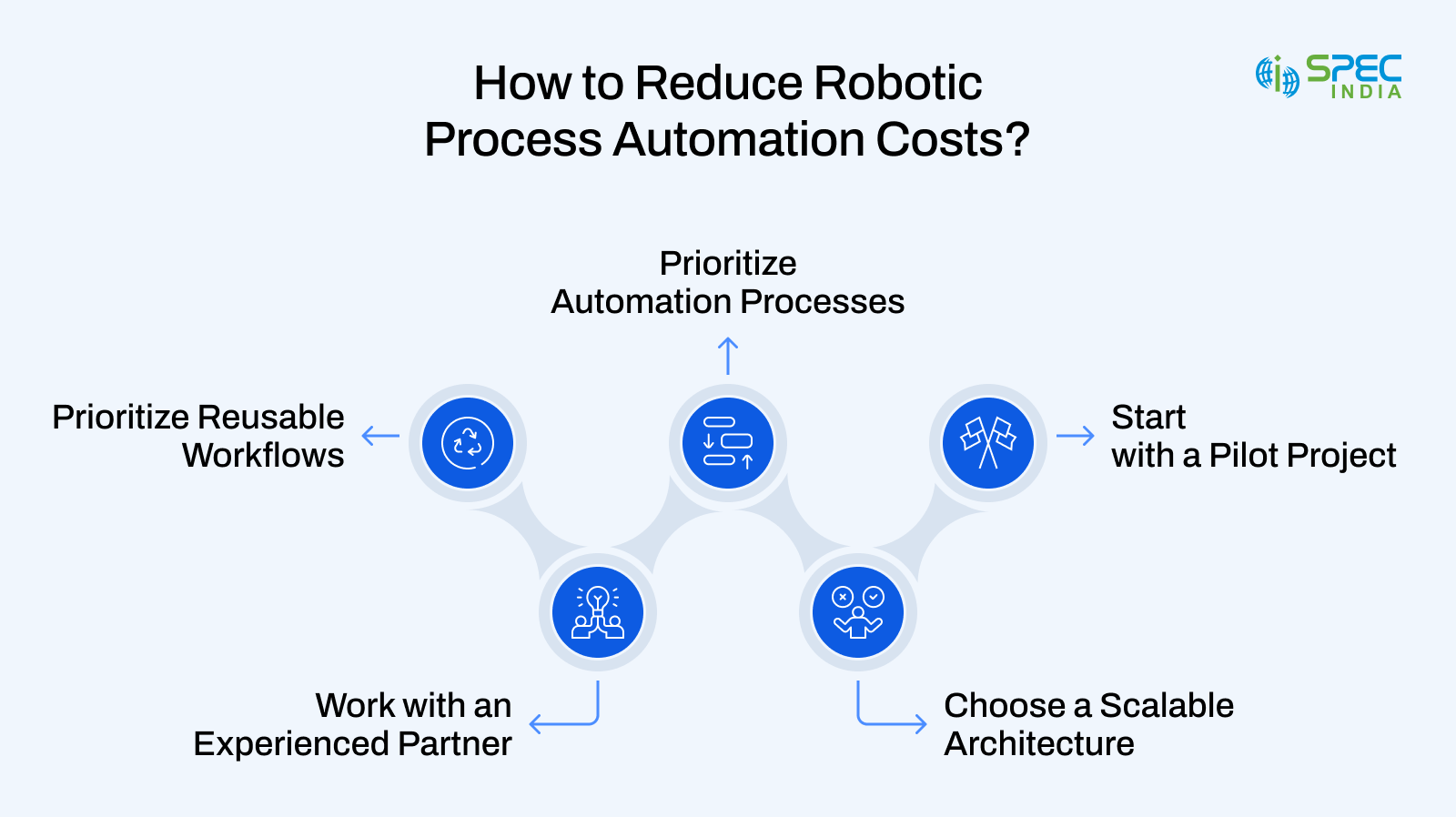
- Prioritize Automation Processes: The first attempt for cost savings is to automate the highest-impact processes first, as a process consuming 40 hours of manual labor weekly justifies engineering investment that a five-minute daily task never will.
- Start with a Pilot Project: A pilot project means you start small with a single process or scope one or two processes before committing to a department-wide rollout. A pilot surfaces integration gaps and exception patterns, and at this stage, the money you spend is still manageable and an easy burden to bear as compared to the business process automation cost.
- Prioritize Reusable Workflows: A bot component built to validate an email address or parse a PDF invoice should be built once and reused across every process that needs it, not rebuilt from scratch each time.
- Choose a Scalable Architecture: A scalable architecture means you have a system that can easily scale from a three-bot workflow to a 30-bot RPA tools machine without needing too much re-architecture.
- Work with an Experienced Partner: An experienced RPA development partner has already priced these tradeoffs across multiple industries. A vendor operating on proprietary, in-house AI infrastructure, rather than routing your workflows through third-party service providers, will have a lower cost of RPA implementation.
Moreover, a dedicated partner with an in-house team will also let you cut external licensing overhead and close off a category of data privacy risk often associated with the RPA implementation partner’s third-party vendor stack.
Is Robotic Process Automation Worth the Investment
ROI expectations of robotic process automation must be viewed realistically compared against actual outcomes and not vendor promises.
Well-scoped RPA programs commonly reach break-even point within twelve to eighteen months, and productivity gains show up first; here’s how;
- A bot processing invoices at machine speed clears backlogs that used to take a team days to work through.
- Error reduction follows as a correctly configured bot does not mistype a field or skip a validation step under deadline pressure.
Following this process, operational efficiency compounds once multiple RPA bots share a governance structure and reusable components, which is exactly why the cost per bot starts to decline as your organization moves from a three-bot pilot toward a multi-faceted CoE with 50 RPA bots or more.
This means long-term cost savings with enterprise automation technologies costing depend entirely on whether an organization budgets for maintenance from day one. Moreover, automation programs that treat Bot Drift as an afterthought see their ROI reduce steadily over the following two years.
RPA is worth the investment for organizations with genuinely repetitive, high-volume, rule-based work.
How to Calculate RPA ROI?
RPA Return on Investment (ROI) is a way to quantify the expected actual return after implementing RPA. Here’s a simple formula to calculate RPA ROI;
Return on Investment = (Net Return on Investments/Cost of Investment) * 100
To figure out your RPA software’s impact, you need to do the following;
- Find Key Performance Indicators (KPIs) related to what you want to achieve through automation. Since different organizations use RPA for different purposes, the KPIs you select before implementation, track them to asses ROI.
- Another way to find the ROI is knowing hours repurposed towards more important and strategic tasks. With this, you must also find the capital preserved by eliminating human-driven data entry errors and compliance fines.
- Know the Total Cost of Ownership (TCO) for your RPA implementation and this includes costs for;
-
- Preparation
- Installation
- Configuration
- Deployment
- Software and Hardware costs (On-premise or Cloud solutions)
- Data Privacy and Security
- CoE costs
- Infrastructure and software maintenance costs
- Monitoring and training costs
A realistic ROI calculation pits the measurable value of automation against the fully loaded cost of building, hosting, and maintaining the infrastructure.
Not Sure If Your Processes Justify the Investment?
An honest process assessment tells you which workflows deliver real ROI before you commit a budget, not after.
Why Choose SPEC India for Robotic Process Automation Development?
SPEC India has spent 39+ years building enterprise RPA software, which means our RPA engagements start from a position that most of the recently initiated AI software development companies cannot match.
Our teams work across RPA, AI, and workflow automation as a connected discipline, not three separate practices sold in silos, and this inter-disciplinary approach matters the most when a project moves beyond simple rule-based bots into intelligent document processing, NLP-driven workflows, or machine learning-assisted exception handling.
At SPEC India, we excel at the following aspects;
- Every engagement is built around your specific business processes.
- We integrate directly with ERP, CRM, and legacy systems.
- Security and scalability are architected from day one.
- Our proprietary, in-house AI infrastructure keeps sensitive process data off third-party middleware.
We handle the full lifecycle of robotic process implementation, including consulting, development, deployment, and support, while covering the specificities of different compliance environments spanning the US, UK, Canada, Europe, UAE, and Australia.
Ready to Build an RPA Program That Scales Without Surprise Costs?
Partner with an enterprise automation team backed by proprietary, in-house AI infrastructure that keeps your data secure, your integrations stable, and your total cost of ownership predictable. Hire RPA Developers.

SPEC INDIA is your trusted partner for AI-driven software solutions, with proven expertise in digital transformation and innovative technology services. We deliver secure, reliable, and high-quality IT solutions to clients worldwide. As an ISO/IEC 27001:2022 certified company, we follow the highest standards for data security and quality. Our team applies proven project management methods, flexible engagement models, and modern infrastructure to deliver outstanding results. With skilled professionals and years of experience, we turn ideas into impactful solutions that drive business growth.
Table of contents
- What is the Average Robotic Process Automation Cost?
- What Factors Affect Robotic Process Automation Cost?
- RPA Development Cost Breakdown
- Hidden Costs Businesses Often Overlook
- Custom RPA Development vs Off-the-Shelf RPA Platforms
- How to Reduce Robotic Process Automation Costs?
- Is Robotic Process Automation Worth the Investment
- Why Choose SPEC India for RPA Development
Delivering Digital Outcomes To Accelerate Growth
Let’s TalkTable of contents
- What is the Average Robotic Process Automation Cost?
- What Factors Affect Robotic Process Automation Cost?
- RPA Development Cost Breakdown
- Hidden Costs Businesses Often Overlook
- Custom RPA Development vs Off-the-Shelf RPA Platforms
- How to Reduce Robotic Process Automation Costs?
- Is Robotic Process Automation Worth the Investment
- Why Choose SPEC India for RPA Development
Delivering Digital Outcomes To Accelerate Growth
Let’s TalkRelated Blogs
Let’s get in touch!
India
SPEC House, Parth Complex, Near Swastik Cross Roads, Navarangpura, Ahmedabad 380009, INDIA.
-
 +91-79-26404031, 32-33-34
 -
 [email protected]