| Term | Meaning |
|---|---|
| Digitization | Moving from paper to electronic files, information, and systems |
| Automation | Utilizing technology to complete repetitive warehouse jobs |
| Digitalization | Integrating warehouse inventories, information, and activities |


Loading...
Digital Warehousing: From Manual Operations to Intelligent Warehousing
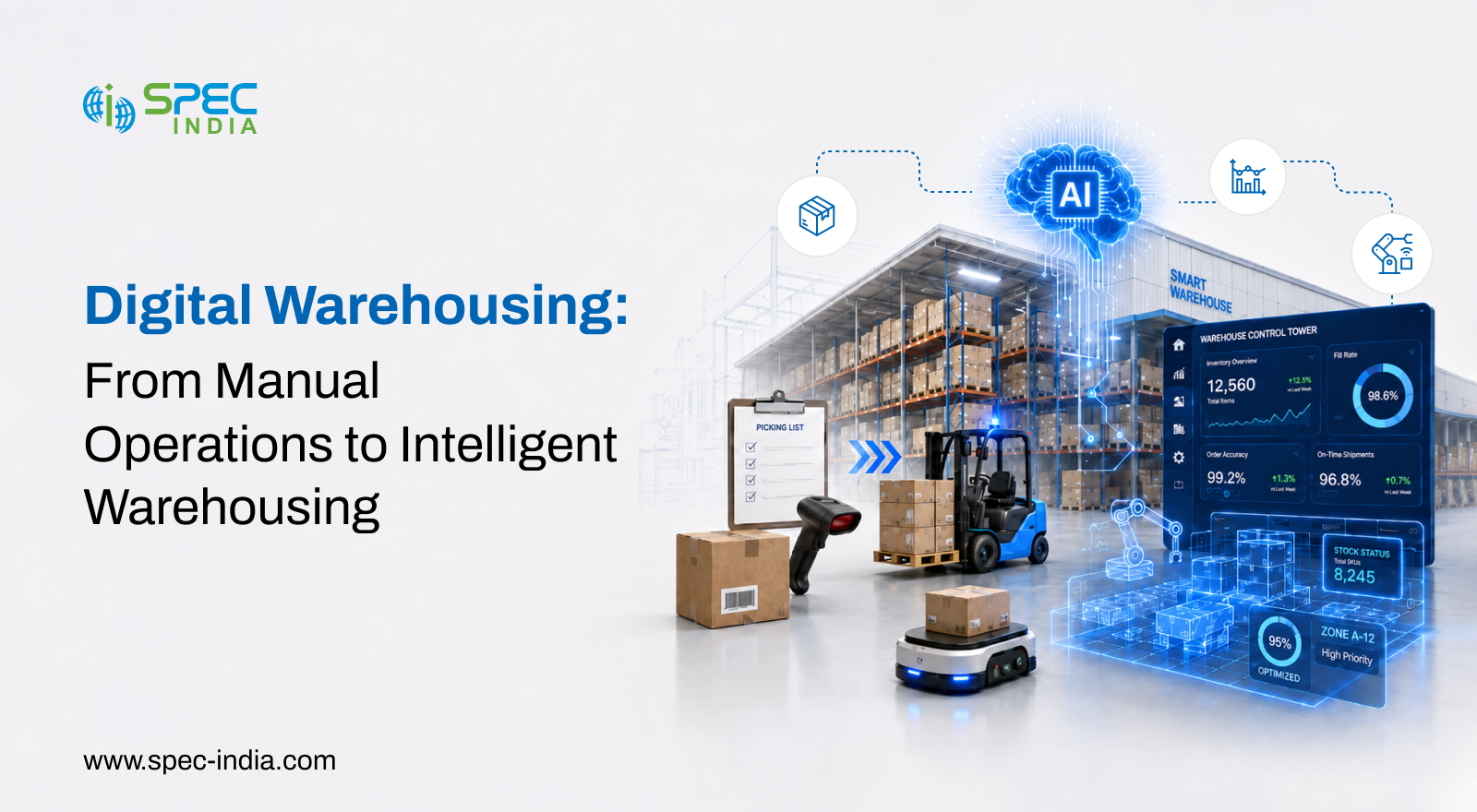
Warehouses used to be operated without aids such as computers or barcodes. Warehouses were formerly paper-based and relied on manual counting. All items were marked using tactile observations. There were a significant number of human errors and routine late deliveries. As supply chains have become increasingly complex, businesses have required digital warehousing solutions. Digital warehousing evolved as the solution, embracing data-driven business activities.
The market value of global warehouse automation in 2023 was $19.23 billion USD. Grand View Research expects this market to reach $59.52 billion USD by 2030. It also expects it to expand at an 18.7% CAGR. Various tools for digital warehouse management systems are improving speed, accuracy, and visibility, especially those now being utilized by businesses across the globe
In this blog, I discuss that change. You will see important tech and real benefits, and how to select your warehouse management software development services.
What is Digital Warehousing?
Today’s warehouses do much more than serve as storage facilities. They gather real-time data, make decisions automatically, and react promptly.
Warehouse digitalization is more than just about replacing paperwork or automating tasks individually. It links systems and real-time data and streamlines processes throughout the warehouse.
How It Differs from Traditional Warehousing
Warehouse digitalization transforms the functionality of all its key operations. This change is more than just a technological one. It’s about velocity, precision, and control on every level.
| Area | Traditional Warehousing | Digital Warehousing |
|---|---|---|
| Inventory tracking | Manual counts, paper logs | Real-time automated tracking |
| Order processing | Slow, error-prone | Fast, system-driven accuracy |
| Warehouse Visibility | Limited, delayed | Full, live operational view |
| Decision-making | Experience-based guesswork | Data-driven and predictive |
| Scalability | Costly and slow to expand | Flexible, scales on demand |
| Error rate | High due to manual handling | Swiftly eliminates human error |
Key Components of a Digital Warehouse
A digital warehouse is based on a network of integrated systems. They all have distinct roles to play and contribute to increased visibility, control, and operational efficiency.
Core components include:
- Internet of Things (IoT) sensors: Always track asset location, temperature, and more
- Data analytics tools: Extract actionable insights from operational real-time data analytics
- Cloud infrastructure: Enables scalability, remote access, and system integration
- Warehouse Management System (WMS): Manage inventory, orders, and movement in real time
- Automated equipment: Conveyors, robot pickers, automated sorting systems, and guided vehicles AGVS for repetitive tasks
Why Traditional Warehouses Struggle Today?
Supply chain timings have dropped to a new low. Expectations for purchases are rising, and inventory levels continue to grow, while fragmented systems and manual data entry processes struggle to keep pace with conventional warehouse workflows. The constraints may affect the accuracy of inventory and order processing, as well as overall work efficiency.
| Traditional Warehouse Challenge | Business Impact | Digital Solution |
|---|---|---|
| Inventory inaccuracies | Stockouts, overstocking, and fulfillment errors | Real-time inventory tracking through WMS |
| Delayed fulfillment | Slower order processing and shipping | Automated systems, workflows, and real-time inventory management |
| Manual dependency | Higher error rates and lower productivity | Process warehouse automation and system-driven tasks |
| Limited visibility | Delayed decisions and operational blind spots | Live inventory and warehouse monitoring |
| Rising operational costs | Increased labor shortages and correction expenses | Optimized processes and resource utilization |
| Poor warehouse coordination | Communication gaps across teams | Connected systems and centralized real-time data |
Warehouse Digitalization Roadmap
Warehouse digitalization is typically implemented in stages rather than all at once. A structured approach reduces disruption and yields more lasting results.
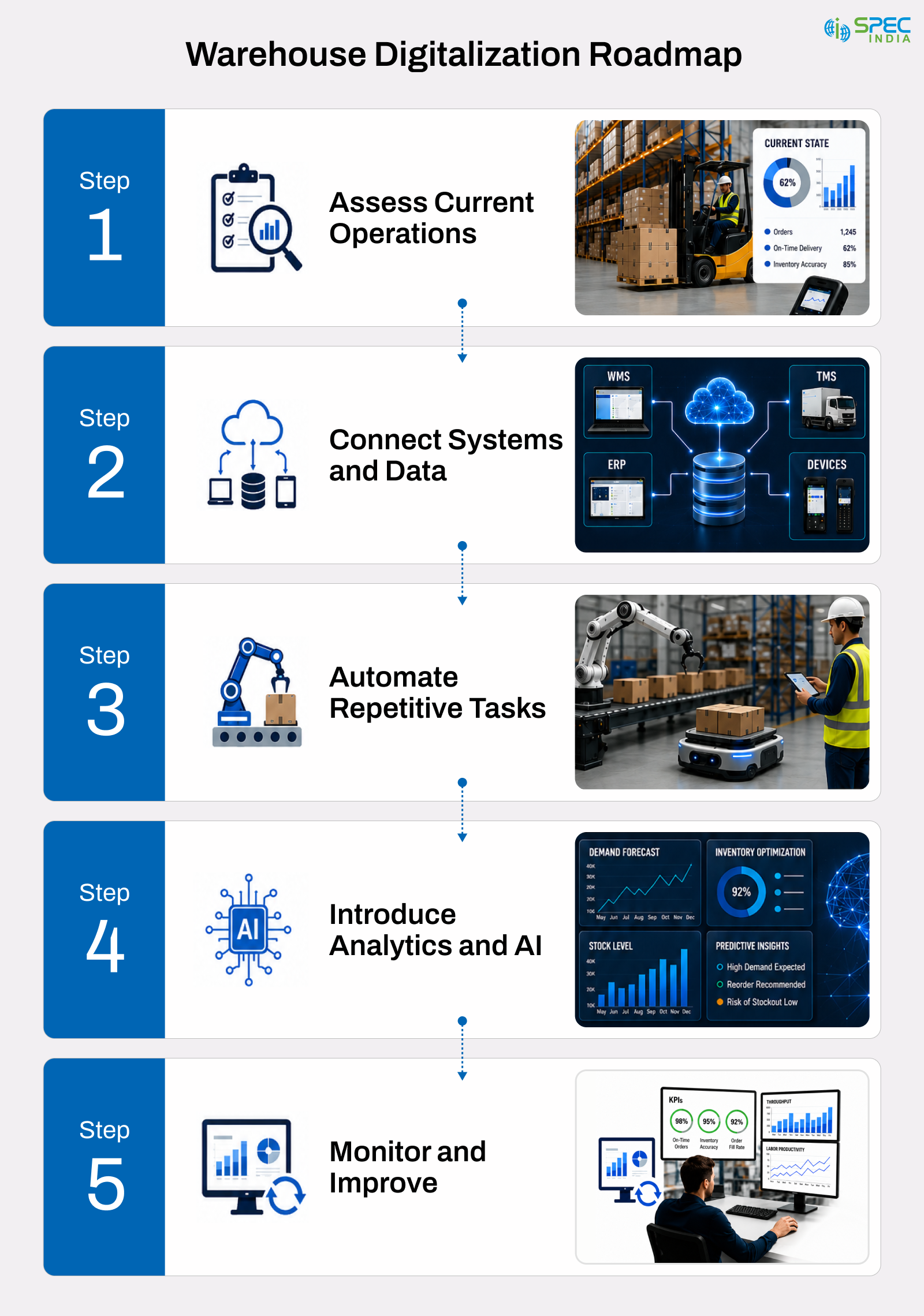
Step 1: Assess Current Operations
Start by evaluating existing warehouse processes, inventory movement, and order fulfillment workflows. Identify inefficiencies, recurring delays, and areas that depend heavily on manual effort. This assessment helps establish priorities for warehouse digitalization.
Focus Areas:
- Review inventory accuracy and stock management practices
- Identify operational bottlenecks and process gaps
- Define clear business goals and improvement targets
Step 2: Connect Systems and Data
Integrate warehouse systems with ERP, procurement, logistics, and inventory platforms. Connected systems improve data consistency and eliminate information silos. Teams gain access to accurate information across all warehouse functions.
Focus Areas:
- Integrate ERP, WMS, and logistics systems
- Establish a centralized flow of operational data
- Improve visibility across departments and processes
Step 3: Automate Repetitive Tasks
Automate routine warehouse activities to reduce manual effort and improve accuracy. Businesses often begin with inventory updates, order processing, stock replenishment, and shipment tracking.
Focus Areas:
- Automate inventory and order management workflows
- Reduce manual data entry and processing errors
- Improve operational efficiency and productivity
Step 4: Introduce Analytics and AI
Once reliable data is available, businesses can apply analytics and AI to improve planning and decision-making. These tools help warehouses respond faster to operational changes and inventory demands.
Focus Areas:
- Implement demand forecasting and inventory optimization.
- Use predictive insights to support planning
- Detect operational issues before they escalate
Step 5: Monitor and Improve
Warehouse digitalization is an ongoing process. Regular performance reviews help businesses measure results and identify opportunities for further improvement. Continuous optimization ensures long-term operational value.
Focus Areas:
- Track key warehouse performance metrics
- Identify areas for process improvement
- Refine workflows based on operational data
Phases are useful because they enable businesses to build a strong foundation for future warehouse technologies.
Core Emerging Technologies Driving Warehouse Digitalization
A modern warehouse is illuminated with multiple solutions and advanced technologies. They all address the same problem and speed up warehouse operations, making them smarter and more reliable.
Digital Warehouse Management System
Any modern warehouse is founded and operated by a warehouse digitization system. It unifies your inventory, orders, people, and your devices in one system.
Key functions it handles:
- Tracks stock levels and locations instantly
- Automates order picking, packing, and dispatch
- Generates reports on productivity and e-commerce fulfillment accuracy
A WMS eliminates time spent searching for information and more time acting on it in their warehouses.
IoT Development Services and Smart Sensors
Smart sensors and connected devices give warehouses a real-time view of the floor. It’s only possible at scale with IoT development services.
What IoT enables in warehouses:
- Live data tracking of inventory location and movement
- Temperature and humidity monitoring for sensitive goods
- Equipment performance monitoring to prevent breakdowns
- Automated system alerts when stock levels drop or anomalies occur
Fortune Business Insights predicts a significant boost in the global IoT in warehouse operators market. It is expected to increase from $17.79 billion USD in 2026 to $40.59 billion USD by 2034, which is a CAGR of 10.90%. Sensors have proven vital to maintaining warehouse accuracy and efficiency.
AI in Warehouse Management
AI in warehouse management shifts the focus from reactive to predictive solutions. Systems recognize and adapt to past observations, making intelligent decisions that improve over time.
Core AI applications in warehousing:
- Automated quality checks using computer vision
- Intelligent slotting to optimize product placement
- Route optimization for picking and delivery
- Real-time anomaly detection across logistics workflows
AI development services can empower businesses to create intelligent warehouse solutions. Increased visibility in digital warehouses caters to their unique supply chain operations and customer satisfaction, backed by artificial intelligence.
- Predictive Analytics: It utilizes historical data to anticipate future needs. It helps warehouse managers prepare for problems in advance, reducing downtime and waste.
- Demand Forecasting: It helps ensure the right stock is delivered at the right time. It greatly reduces overstocking and stockouts.
Cloud Data Warehouse and Scalable Infrastructure
A cloud data warehouse removes the limitations of physical infrastructure, enabling businesses to store, use, and analyze operational data.
Key advantages for warehouse operations:
- Scales automated storage and computing power on demand
- Enables remote access to live supply chain operations
- Supports integration across multiple warehouse locations
- Optimizes real-time inventory management and customer satisfaction
- Reduces upfront hardware investment significantly
Are Your Warehouses Prepared for the Digital Transformation?
Discover how the appropriate technology stack can enhance your warehouse speed, accuracy, and real-time visibility.
Benefits of Digital Transformation in Warehousing
Digital warehousing brings tangible benefits in all aspects of business. Here are five reasons the change has benefits for supply chain and warehouse automation.
1. Operational Efficiency Gains
Manual processes delay everything. Digital systems eliminate all that friction. Repetitive tasks are completed more quickly and with no less accuracy with automated workflows. Warehouse employees should instead work on more lucrative tasks.
Key efficiency improvements:
- Automated picking and packing cuts order processing time significantly
- Real-time dashboards replace time-consuming manual reporting
- Automated processes streamline every stage of fulfillment
- Digital systems run 24/7 without productivity loss
- Operations become leaner, faster, and more reliable at every level.
2. WMS Benefits for Inventory Control
Poor inventory management leads to stockouts, overstock, and wasted money. A digital WMS provides accurate, real-time inventory data at all times. You always know what you have and where it is.
Benefits of an Inventory Management System
The benefits of inventory management systems go beyond basic stock tracking. These cutting-edge technologies do the following:
- Enable smarter restocking
- Reduce carrying costs
- Prevent fulfillment delays
Automated alerts flag low stock and monitor inventory levels before they become a problem.
3. Cost Reduction and Scalability
Digital warehouses play several roles in reducing operating costs. Warehouse automation not only decreases labor costs but also the need for manual processes. Fewer errors mean fewer returns and corrections. Optimized storage is more efficient in terms of space utilization.
Key cost and scalability benefits:
- Reduces labor costs through warehouse automation processes
- Decreases rework costs from improved order accuracy
- Scale up or down the cloud-based systems as business demands shift
- Supports multi-location operations without heavy infrastructure investment
Businesses grow without proportional increases in overhead.
4. Enhanced Supply Chain Visibility
Digital systems link all of your points in the supply chain. All movements are tracked and recorded from receipt through dispatch across distribution centers.
Key real-time visibility benefits:
- Live shipment and inventory tracking across all locations
- Faster identification and resolution of bottlenecks
- Better coordination with suppliers and logistics partners
- Instant access to order status for warehouse teams
- Optimum results for real-time visibility and customer expectations
The whole Supply Chain is clearer, and decisions are taken faster without the headaches of nasty surprises.
5. Workforce Productivity and Smarter Operations
Digital tools do not replace workers. They make workers more effective. The staff spends less time looking for items, correcting paperwork, and fixing errors. They pay attention to tasks that require judgment.
Key workforce benefits:
- System-directed tasks reduce wasted movement on the warehouse floor
- Training time shortens with historical data and guided digital workflows
- Worker performance becomes measurable and easier to improve
It is these benefits that are already becoming a reality for businesses around the world. Before investing in testing or piloting design changes, companies can boost efficiency by 20-25% through digital warehouse design, according to McKinsey. Such a benefit is a game-changer for any business with intricate operations.
Real-World Use Cases of Digital Warehouses
Digital warehousing is used by businesses across several industries to improve their inventory management, delivery, and real-time visibility. They all set objectives but have similar key technologies that address problems faced by warehouses.
| Industry | Digitalization Goal | Key Outcome |
|---|---|---|
| Retail & E-commerce | Speed up order processing and inventory updates | Faster fulfillment and fewer stock discrepancies |
| Manufacturing | Improve raw material and inventory visibility | Better production planning and reduced shortages |
| Logistics & 3PL | Higher error rates and lower productivity | Process warehouse automation and system-driven tasks |
| Limited visibility | Coordinate inventory across multiple facilities | Improved shipment accuracy and warehouse coordination |
| Healthcare & Pharma | Track products throughout the supply chain | Better traceability, regulatory compliance, and inventory control |
Building Modern Warehouse Solutions
Warehouse digitalization requires more than technology. The right architecture, integration, and strategy are just as critical to success. That’s the actual application of that.
ERP Software Development Services and Integration
A warehouse does not operate in isolation. It connects to finance, procurement, logistics, and customer satisfaction. ERP software development services bring all these functions onto one unified platform.
If ERP is not integrated, there are silos of data. Teams have limited information and make decisions on incomplete information. Decisions slow down. When integrated, the gap is removed.
Key benefits of ERP integration in warehousing:
- Automatically updates inventory, procurement, and finance data
- When stock levels get to a minimum, automatic purchase happens
- Breaks down facility operations for a better customer experience
- Optimizes retrieval systems for optimum inventory management level
- Minimizes manual data transfer and the associated issues
- Provides a clear and seamless insight into operational performance to leadership
WMS benefits become extremely valuable when integrated with a larger ERP system. Orders, inventory, and invoices easily cross departments and are seamless.
Enterprise Data Warehouse Modernization
Older data systems fail to keep up with today’s warehouse requirements. They get slow, stiff, and hard to scale. Enterprise data warehouse modernization is the reworking of the architecture and the replacement of the legacy infrastructure.
Today’s data warehouses can easily process large volumes of operational data. They enable complex analytics, quick reporting, and quality multi-team decision-making.
What modernization delivers for warehouse operations:
- Faster access to inventory, order, and shipment data
- Better integration with AI, IoT, machine learning, and cloud-based digital tools
- Scalable storage capacity that grows with your business volume
- Improved data accuracy across all connected warehouse systems
- Enhanced security and quality controls over sensitive operational data
Best Practices for Data Warehouse Implementation
Successfully implementing a digital warehouse requires more than just good technology. It is the value or complexity of the system being delivered that will be the outcome of its planning, governance, and integration strategy. Some of the best practices for data warehouse planning:
| Best Practice | What It Means | Why It Matters |
|---|---|---|
| Define clear objectives | Set measurable goals before implementation | Keeps the project focused and on track |
| Audit existing data | Review current data quality and structure | Prevents legacy issues from carrying forward |
| Phased rollout | Implement in stages, not all at once | Reduces disruption to live operations |
| Staff training | Train teams on new tools before go-live | Ensures adoption and reduces human errors |
| Performance monitoring | Track key performance indicators after implementation | Identifies gaps and improvement areas |
Choosing the Right Warehouse Software Development Partner
Your warehouse operates based on the technology you use. It’s as crucial to choose the right development partner as it is to choose the right tools.
How to choose the right fit:
- Identify precise operational needs and issues
- Ask about the partner’s experience with solutions specific to warehouse needs
- Test the usability of integration with your current systems
- Inquire about post-deployment support and maintenance packages
- Verify their data security and compliance measures.
What to Look for in a Technology Partner
Not all software development companies are familiar with warehousing. Seek out collaborating partners who can apply warehouse digitization to the ground. They should understand how information on inventory, orders, and logistics is related.
Also, evaluate how they communicate. Transparent timelines, clear milestones, and regular updates matter as much as technical skill. A reliable partner keeps you informed at every stage, not just at delivery.
Why Domain Experience Matters
Warehouse automation and warehouse digitization involve many moving parts. A partner without domain experience will miss critical operational details. Those gaps lead to cost savings after launch. An experienced team brings:
- Familiarity with WMS, ERP, and IoT integrations
- Knowledge of warehouse workflows across different industries
- Ability to anticipate scale and performance requirements
- Proven methods for managing digital transformation in warehousing projects
Domain experience significantly shortens delivery time and reduces implementation risk.
Future Trends in Digital Warehousing
Warehouse operations continue to evolve as technology advances. Several trends are shaping the next generation of digital warehouses.
- AI-driven operations: Artificial intelligence helps forecast demand, optimize inventory levels, and identify operational issues earlier.
- Warehouse robotics: Autonomous robots support picking, sorting, and material movement with greater consistency.
- Digital twins: Virtual warehouse models help teams test layouts, workflows, and operational changes before implementation.
- Sustainable warehousing: Businesses are adopting energy-efficient equipment and smarter supply chain management practices.
- Connected supply chain operations: Integrated warehouse management systems improve data sharing between warehouses, suppliers, and logistics partners.
Looking to Optimize Warehouse Operations?
SPEC India helps businesses build scalable, secure, and digital warehousing solutions tailored to their operational needs.
Conclusion
Warehousing has changed significantly over the years. Manual tracking and paper-based warehouse processes are no longer enough for modern supply chains. Digital warehousing helps businesses improve inventory accuracy, streamline workflows, and respond faster to changing demand.
With the right systems in place, warehouse teams can make better decisions and optimize operations, keeping them running smoothly. Choosing the right technology partner can make implementation easier and help deliver long-term value.

SPEC INDIA is your trusted partner for AI-driven software solutions, with proven expertise in digital transformation and innovative technology services. We deliver secure, reliable, and high-quality IT solutions to clients worldwide. As an ISO/IEC 27001:2022 certified company, we follow the highest standards for data security and quality. Our team applies proven project management methods, flexible engagement models, and modern infrastructure to deliver outstanding results. With skilled professionals and years of experience, we turn ideas into impactful solutions that drive business growth.
Table of contents
- What is Digital Warehousing
- Why Traditional Warehouses Struggle Today
- Warehouse Digitalization Roadmap
- Core Emerging Technologies Driving Warehouse Digitalization
- Benefits of Digital Transformation in Warehousing
- Real-World Use Cases of Digital Warehouses
- Building Modern Warehouse Solutions
- Choosing Right Warehouse Software Development Partner
- Future Trends in Digital Warehousing
- Conclusion
Delivering Digital Outcomes To Accelerate Growth
Let’s TalkTable of contents
- What is Digital Warehousing
- Why Traditional Warehouses Struggle Today
- Warehouse Digitalization Roadmap
- Core Emerging Technologies Driving Warehouse Digitalization
- Benefits of Digital Transformation in Warehousing
- Real-World Use Cases of Digital Warehouses
- Building Modern Warehouse Solutions
- Choosing Right Warehouse Software Development Partner
- Future Trends in Digital Warehousing
- Conclusion
Delivering Digital Outcomes To Accelerate Growth
Let’s TalkRelated Blogs

Let’s get in touch!
India
SPEC House, Parth Complex, Near Swastik Cross Roads, Navarangpura, Ahmedabad 380009, INDIA.
-
 +91-79-26404031, 32-33-34
 -
 [email protected]