| Capability | Operational Function | Direct Business Impact |
|---|---|---|
| Barcode / RFID integration | RFID inventory tracking captures SKU movement at point of scan across receiving, picking, and shipping. | Reduces manual entry errors and closes the gap between physical and system stock levels. |
| Real-time inventory monitoring | Updates stock visibility and changes across all departments, and you can track inventory as changes occur rather than on a batch schedule. | Enables accurate inventory management, inventory optimization, and immediate exception handling. |
| Multi-location inventory management | Add stock counts from every warehouse and store into a single ledger. | Supports confident allocation and purchase decisions without duplicating fixed costs. |
| Automated replenishment | Triggers purchase orders based on real-time safety stock thresholds and lead-time variance. | Smart procurement management prevents both stockouts and excess inventory carrying costs. |
| Order management | Routes orders to the optimal fulfillment system based on proximity and available stock. | Shortens fulfillment cycles and protects service-level agreements. |
| Demand forecasting | Applies historical data and seasonality models to predict SKU-level demand. | Improves procurement accuracy and reduces safety-stock padding through warehouse automation. |
| Inventory analytics dashboards | Surfaces turnover ratios, aging stock, and fill-rate metrics in one interface. | Gives leadership a defensible, data-backed view of inventory health and supply chain management. |


Loading...
How a Centralized Inventory Management System Transforms Inventory Operations
Posted
August 8, 2026
Category WMS
Inventory distortion costs the global economy roughly $1.77 trillion annually, and standard carrying costs consume 20% to 30% of a company’s average inventory value in any given year.
These costs, while not visible on the front end, show up directly on a P&L statement as write-offs, expedited freight charges, and markdown losses.
So when your inventory is fragmented, using a spreadsheet macro isn’t the right way to counter this inconvenience. Since inventory mismanagement is a direct threat to working capital and margin integrity, you need a centralized inventory management system to close the gap between siloed, stale data and real-time operational control.
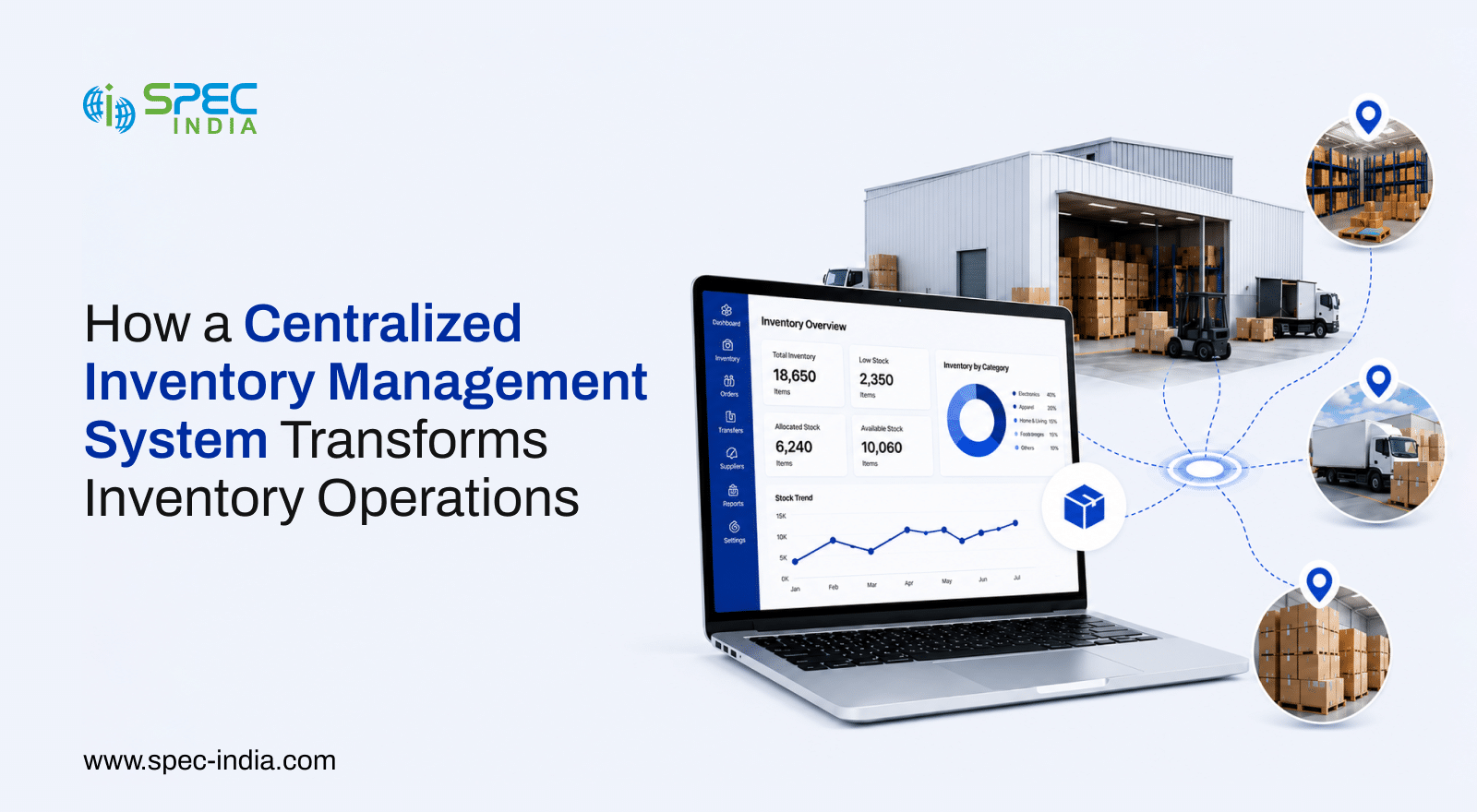
A centralized inventory management system consolidates stock tracking, order routing, and supply chain into a single platform.
The Mechanics of a Centralized Inventory System
A centralized inventory system is a data architecture decision that provides a single source of truth by collecting data from every channel, warehouse, and transit node in real time, whether it’s POS terminals, 3PL feeds, Enterprise Resource Planning (ERP) modules, or IoT sensors on the dock.
The centralized management system then reconciles the data into one authoritative inventory ledger. Every SKU has one true count, one location history, one status, regardless of which system originally captured the transaction.
Comparing a centralized system to a disconnected model, here’s what you will get;
- Siloed spreadsheets
- Regional server instances
- Warehouse management systems (WMS) don’t talk to each other.
In a decentralized setup, inventory data and its authenticity change as soon as it’s shared.
A stock count pulled from Warehouse B at 9 in the morning is already wrong by the noon sales meeting if a shipment cleared customs in the interim.
A true centralized inventory management system eliminates that lag by treating stock visibility as a live property of the data layer.
This is the foundational distinction between an inventory management system that reports history and one that reports the present.
The Financial and Operational Issues with a Fragmented Inventory Management System
We have established that a centralized inventory system addresses the gaps left over by the fragmented system. But the failures here cascade: a COO evaluating fragmented inventory tracking is really evaluating a chain of compounding operational risks.
- The Visibility Gap: Overstocking has high carrying costs, and without real-time inventory data, inventory and warehouse managers default to buffer stock as a hedge against uncertainty. That buffer ties up cash in excess inventory sitting idle across multiple warehouses.
- The Bullwhip Effect: Due to any forecasting error, there can be erratic procurement, so much so that even small demand signal distortions can amplify as they travel upstream through disconnected systems, triggering overordering, especially in a retail environment, causing havoc in order management.
- Dead Stock Across Multi-Location Facilities: With stockpiling up across multiple locations, there’s a capital drain. Slow-moving SKUs stranded in the wrong distribution centers don’t just sit; they actively erode margin through storage costs, insurance, and eventual write-down.
- Manual Reconciliation: When teams spend disproportionate time cross-checking spreadsheets against physical counts rather than managing exceptions, it takes a direct hit on operational efficiency.
- Inaccurate Stock Inventory Levels: Stockouts mean damaged vendor and customer relationships. A phantom “in stock” status that doesn’t match the physical shelf means an inability to deliver orders and broken promises up and down the supply chain.
Core Capabilities of a Centralized Inventory Management System
Enterprise centralized inventory management software represents a stack of interdependent capabilities organized around three core functions:
- Capturing data accurately
- Orchestrating stock across nodes
- Generating intelligence from the resulting dataset
These three capabilities further branch out to form a modern centralized inventory management system architecture.
Most importantly, these capabilities don’t operate independently; they work in unison. For instance;
- Barcode data feeds the real-time monitoring layer
- The monitoring layer feeds the analytics engine
- The analytics engine informs replenishment logic
A weak link anywhere, like when RFID tags aren’t consistently read at dock doors, will degrade the accuracy of every downstream function.
For a deeper technical breakdown of how warehouse-side automation supports this stack, check out the benefits of WMS and how these dashboards tie into broader reporting infrastructure; check out our business intelligence services.
Strategic Impact of Centralized Inventory Management System
Centralized inventory automation solutions create a solid impact on every business type, whether it’s manufacturing, retail, eCommerce, healthcare, or more. By providing a single source of truth, they eliminate fragmented data and independent allocations, creating an aligned system overall.
1. Working Capital Efficiency
Real-time visibility lowers inventory carrying costs by eliminating the redundant buffer stock that fragmented systems force teams to hold defensively.
When planners can trust a livestock count rather than a three-day-old export data sheet, they hold less safety stock per SKU without increasing stockout risk, and the resulting difference shows up directly in cash flow.
2. Forecast-Driven Demand Planning
AI-augmented demand forecasting, often implemented through specialized AI development services, builds on a clean, unified inventory database to reduce both excess inventory and stockout frequency.
Demand planning is mathematically challenging when data is siloed and lagging. However, AI-driven forecast accuracy compounds and improves all downstream functions, and better inputs yield better automated replenishment triggers, which lead to tighter inventory turnover ratios.
3. Fulfillment Speed and Customer Retention
Faster, more accurate order fulfillment is a direct output of multi-location inventory management logic that routes orders to the nearest node with confirmed stock.
With the best centralized inventory management software, your order accuracy rates climb because the system doesn’t promise inventory that doesn’t physically exist.
Over the course of a fiscal year, this translates into higher customer satisfaction and repeat purchase rates, especially in omnichannel inventory management environments.
Ready to Centralize Your Inventory?
Streamline inventory operations, gain real-time visibility, and improve stock accuracy with a custom inventory management solution.
Centralized vs Decentralized vs Hybrid Stock Models
For every vendor who asks how to manage inventory across multiple locations, the answer isn’t always a centralized multi-location inventory management system.
The right model depends on SKU velocity, delivery SLAs, and network topology.
| Factor | Centralized | Decentralized | Hybrid (Operator Choice) |
|---|---|---|---|
| Data accuracy | Highest accuracy as there is a single ledger and no reconciliation lag. | Lower accuracy due to multiple systems of record. | High accuracy with governance discipline delivered from both systems. |
| Holding costs | Lowest costs as the stock is consolidated, reducing duplication. | Highest costs among all due to redundant safety stock per location. | Moderate costs, which are optimized by SKU class and category. |
| Last-mile delivery time | Slower time due to greater average distance to customer. | Fastest delivery as the stock is at the nearest point of demand. | Balanced approach as fast movers positioned locally to ensure timely delivery. |
| Best suited for | Slow-moving, high-value, or specialized SKUs. | High-velocity, high-demand regional SKUs. | Full catalogs with mixed velocity profiles. |
| Implementation complexity | Moderate as you need to bring in all systems under one roof. | Low per-site, high in aggregate. | Highest as this approach requires smart routing logic. |
Centralized inventory vs decentralized inventory decisions increasingly resolve into a hybrid answer: centralize slow-movers and long-tail SKUs where holding-cost control matters most; decentralize fast-movers where proximity to the customer determines the sale.
Modern platforms facilitate this through smart routing algorithms that dynamically reassign stock based on real-time demand signals rather than static allocation rules.
Industry-Specific Inventory Management Challenges and Solutions
| Industry | Primary Inventory Challenge | The Centralized Solution |
|---|---|---|
| Manufacturing | Raw material staging & bill of materials (BOM) accuracy when shared across all production runs. | Centralized inventory management for manufacturing synchronizes BOM data with real-time raw material availability to effectively reduce production line stoppages. When paired with a robust ERP for manufacturing, this unified approach lays the groundwork for true paperless manufacturing, eliminating manual tracking errors on the shop floor. |
| Retail & eCommerce | Retailers face challenges preventing overselling online when the same SKU is sold across multiple sales channels. | Centralized inventory management for retail and eCommerce offers unified stock counts across storefronts, preventing the duplicate allocation of the same unit.
Leveraging a tailored ERP for retail, alongside specialized retail software development services, ensures that both physical point-of-sale terminals and digital checkouts pull from the same live ledger. |
| Logistics & Wholesale | High-volume throughput and pallet-level tracking across distribution centers. | Centralized stock management gives dispatch teams a single view of pallet location and movement, reducing dwell time.
Companies often rely on logistics software development services to build these high-throughput routing algorithms and integrate them seamlessly with broader supply chain networks. |
| Healthcare | Expiry date tracking, lot traceability, and regulatory compliance | Automated expiry alerts and lot-level audit trails reduce compliance exposure and product loss |
Retail businesses running an online store alongside physical retail locations face the sharpest version of this problem: a sale in one channel isn’t instantly reflected across all channels, resulting in a canceled order and a frustrated customer. For manufacturers, the equivalent failure is a BOM shortage discovered mid-production rather than during planning.
How to Transition to a Centralized Inventory Management System?
Rolling out a centralized inventory management system is as much a change management exercise as a technical one. Often serving as the cornerstone of broader digital transformation services, this rollout requires prioritizing the operational sequence over the individual tools.
1. Audit Current Workflows: You need to begin with mapping every point where inventory and stock-related data is currently created, updated, or exported, including undocumented spreadsheet workarounds that teams have built around legacy systems.
2. Normalize Legacy Data: Legacy data issues like not being able to read or transmit data are one of the biggest bottlenecks, including;
- Inconsistent SKU naming
- Duplicate records
- Unit-of-measure mismatches across existing systems
Using the as-is approach means you are preparing your new inventory management system to fail.
3. Integrate with the Existing Ecosystem: The next step in this process is to connect the new inventory management platform to existing or newly acquired ERP, CRM, and 3PL systems through documented API endpoints.
If you are evaluating the architectural differences between these core platforms, such as mapping ERP vs CRM data flows, engaging expert ERP software development services can help you validate JSON payload structures before go-live rather than during it.
4. Pilot on a Single Warehouse or Product Line: Instead of implementing the new system for every need at once, validate the accuracy of real-time inventory tracking and physical counts, and track a few key KPIs that show progress before scaling to multiple warehouses.
5. Conduct Structured Change Management: Handling change is an important step in the process, as you need to train warehouse staff, procurement teams, and store managers while understanding their concerns and challenges with using the new inventory management process, with clear escalation paths for discrepancies.
6. Establish Governance Protocols: Assign data ownership for each SKU category and enforce audit cadences to prevent the system from drifting back into inconsistency.
Inventory control system implementation fails most often not at the software layer, but at the data normalization and training layer. Clean data and trained staff are the actual dependencies for accurate and efficient inventory management; the platform is secondary.
Mistakes to Avoid with Centralized Inventory Management System Implementation
- Choosing Non-Scalable Software: A platform architected for single-warehouse operations will struggle as the business expands into multiple warehouses or new sales channels, forcing a costly replatforming within 18 to 24 months.
- Migrating Uncleaned, Duplicate, or Fragmented Data: A centralized inventory management system built on dirty legacy data doesn’t fix the underlying accuracy problem; it just centralizes the errors and makes them harder to trace.
- Underestimating API Integration Complexity: Poor API design between the inventory platform and third-party logistics partners or accounting systems creates operational paralysis, in which stock updates lag physical reality by hours rather than seconds.
- Skipping Warehouse Automation Readiness: Deploying real-time inventory monitoring software without addressing warehouse automation gaps, such as manual scanning and inconsistent labeling, limits the accuracy ceiling, regardless of whether you use off-the-shelf or custom inventory management software.
Choosing the Right Vendor for Inventory Management Software Development
Vendor selection for best centralized inventory management software should move past feature checklists and pricing tiers into architectural due diligence:
- Cloud vs. On-premises Deployment: Evaluate based on data security requirements, remote access needs across store locations, and disaster recovery posture.
- Open API Architecture: Confirm the platform supports documented, well-tested integrations rather than proprietary black-box connectors that limit future flexibility.
- Advanced Reporting and Inventory Analytics: Verify that the system can generate SKU-level, location-level, and channel-level reports without custom development.
- Vendor Track Record in your Vertical: A cloud inventory management system built primarily for retail may lack the depth of lot traceability required by healthcare or manufacturing operations.
- Procurement Management Integration: Assess whether the platform natively supports purchase order automation or requires a separate bolt-on tool.
- Total Cost of Ownership: Factor in implementation, training, and ongoing inventory software consulting costs, not just the license fee.
Track the ROI of Centralized Inventory Management System
Once implemented, you can expect to see the results within a few months. The first few months will go toward setup and integration before the benefits start to materialize and processes become more efficient.
Track these KPIs to assess ROI, as they reflect improvements in inventory management.
- Inventory Turnover Rate
- Order Fulfillment Accuracy
- Stockout Frequency
- Carrying Costs
- Customer Satisfaction Levels
- Lead Time Reduction
- Gross Margin Return on Investment
Centralizing your inventory management, whether you use multi-warehouse inventory software or a cloud-based inventory management system, leads to significant cost savings by reducing excess inventory, lowering storage costs, and minimizing the risk of stockouts.
Transform Your Inventory Operations
Eliminate stock discrepancies, automate inventory tracking, and optimize warehouse efficiency with a centralized inventory management system.
Centralize your Inventory Management and SPEC India
SPEC India has spent 39+ years engineering enterprise software, and inventory operations sit squarely inside that track record.
We build custom inventory management software architected around multi-location inventory management, AI-powered demand forecasting, and cloud-ready deployments that scale with warehouse count rather than breaking at it.
Our expertise extends deeply into manufacturing software development, ensuring that complex production pipelines align seamlessly with livestock counts.
We also help with supply chain consulting, legacy data migration, and post-launch governance support to determine whether a centralized inventory management system can handle production load.
Contact us to book a consultation and learn more about developing inventory management software.

SPEC INDIA is your trusted partner for AI-driven software solutions, with proven expertise in digital transformation and innovative technology services. We deliver secure, reliable, and high-quality IT solutions to clients worldwide. As an ISO/IEC 27001:2022 certified company, we follow the highest standards for data security and quality. Our team applies proven project management methods, flexible engagement models, and modern infrastructure to deliver outstanding results. With skilled professionals and years of experience, we turn ideas into impactful solutions that drive business growth.
Table of contents
- The Mechanics of a Centralized Inventory System
- The Financial and Operational Issues with a Fragmented Inventory Management System
- Core Capabilities of a Centralized Inventory Management System
- Strategic Impact of Centralized Inventory Management System
- Centralized vs Decentralized vs Hybrid Stock Models
- Industry-Specific Inventory Management Challenges and Solutions
- How to Transition to a Centralized Inventory Management System?
- Choosing the Right Vendor for Inventory Management Software Development
- Track the ROI of Centralized Inventory Management System
- Centralize your Inventory Management and SPEC India
Delivering Digital Outcomes To Accelerate Growth
Let’s TalkTable of contents
- The Mechanics of a Centralized Inventory System
- The Financial and Operational Issues with a Fragmented Inventory Management System
- Core Capabilities of a Centralized Inventory Management System
- Strategic Impact of Centralized Inventory Management System
- Centralized vs Decentralized vs Hybrid Stock Models
- Industry-Specific Inventory Management Challenges and Solutions
- How to Transition to a Centralized Inventory Management System?
- Choosing the Right Vendor for Inventory Management Software Development
- Track the ROI of Centralized Inventory Management System
- Centralize your Inventory Management and SPEC India
Delivering Digital Outcomes To Accelerate Growth
Let’s Talk
Let’s get in touch!
India
SPEC House, Parth Complex, Near Swastik Cross Roads, Navarangpura, Ahmedabad 380009, INDIA.
-
 +91-79-26404031, 32-33-34
 -
 [email protected]