| Manufacturing Challenge | Business Impact | Traditional Limitation |
|---|---|---|
| Unplanned equipment downtime | Lost output, emergency repair costs | Reactive, schedule-based maintenance |
| Labor and skills shortages | Knowledge gaps, slower output | Manual training, undocumented processes |
| Defects and rework | Wasted materials, delayed shipments | Inconsistent manual inspection |
| Rising costs and data silos | Hidden inefficiencies, poor decisions | Disconnected systems, no unified view |


Loading...
How Does AI Improves Productivity in Manufacturing: From Reactive Operations to Predictive Growth
Posted
June 22, 2026
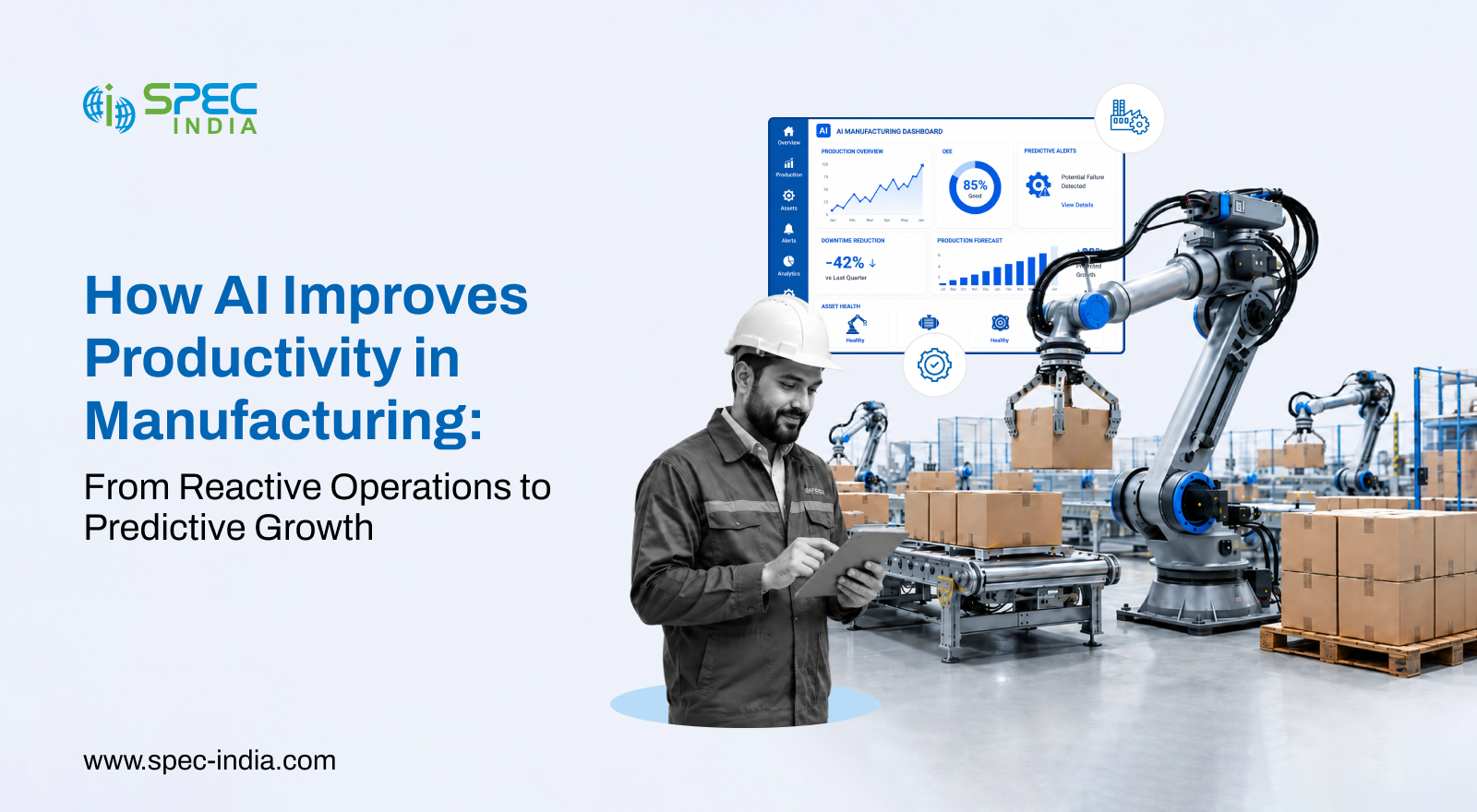
Manufacturing experts are increasingly compelled to deliver high-quality operations with fewer resources. There’s a small margin, a tight deadline, and conventional solutions like routine maintenance and manual checks simply don’t align. Many leaders wonder, with the increasing number of AI-driven systems today: “How does AI improve productivity in manufacturing?” The solution: Make decisions based on data insights, rather than just guesswork.
AI in manufacturing is shifting operations from reactive to predictive. Problems get caught before they cause disruption. According to McKinsey, manufacturers applying AI-driven automation in industrial plants reported a 10–15% increase in production and a 4–5% rise in EBITA. These are real results, not projections.
This blog covers ten practical AI applications, real industry examples, and how to begin your adoption journey. Whether you’re considering AI software development services for your operations, this guide can help you make informed decisions.
What AI Means in Modern Manufacturing
Many brands use the terms “automation” and “AI” interchangeably. They do NOT mean the same thing. Learning how to differentiate is the first step towards being smarter in adoption.
Automation vs AI
Traditional automation works based on fixed rules: A machine that operates in the same way, whatever the circumstances. Artificial intelligence works differently; it:
Learns from data and adapts to new patterns
Makes decisions without manual reprogramming
Handles variability that rigid automation simply cannot
This adaptive decision-making helps answer how AI improves productivity in manufacturing at a practical level.
How AI Uses Manufacturing Data
Data analytics in manufacturing is the fuel that powers AI. Key AI systems pull from three core data streams:
1. Production data: Output volumes, cycle times, and yield rates
2. Machine data: Sensor data readings, temperature, vibration, and load
3. Operational data: Shift schedules, maintenance logs, and supply inputs
AI can detect patterns in these streams that humans might not recognize when these streams merge. It works safely alongside humans to streamline operations and enhance productivity.
Core Technologies Behind AI Manufacturing Solutions
A key element of manufacturing software development services is the use of a set of verified technologies that work together.
- Machine Learning: Machine learning algorithms and models analyze historical data to improve on-time performance. They can be used for power demand forecasting, anomaly detection, and process optimization.
- Computer Vision Systems: Cameras and imaging systems look in greater detail and at higher speeds than human capabilities. They flag defects on the production line as they occur.
- Predictive Analytics: These analytics predict equipment breakdowns, supply delays, and quality problems before they happen. Team action on warning, not on breakdown.
- Generative AI: GenAI Autofills SOPs, Maintenance Guides, and Troubleshooting docs. It also enables quick access to knowledge plant-wide.
Connected Manufacturing Ecosystem
AI in manufacturing industry delivers real value when connected to existing systems. AI, coupled with IoT, can record real-time machine data from all sensors. AI and ERP synchronize production, inventory, and procurement. AI with MES provides supervisors with step-by-step production visibility. These competencies, when combined, make AI in manufacturing appear to be a true layer of operational intelligence.
The Real Productivity Challenges Manufacturers Face Today
Manufacturers across industries share a common problem. Growth is slowing due to aging systems, a dwindling talent pool, and rising costs, which make consistent output increasingly challenging.
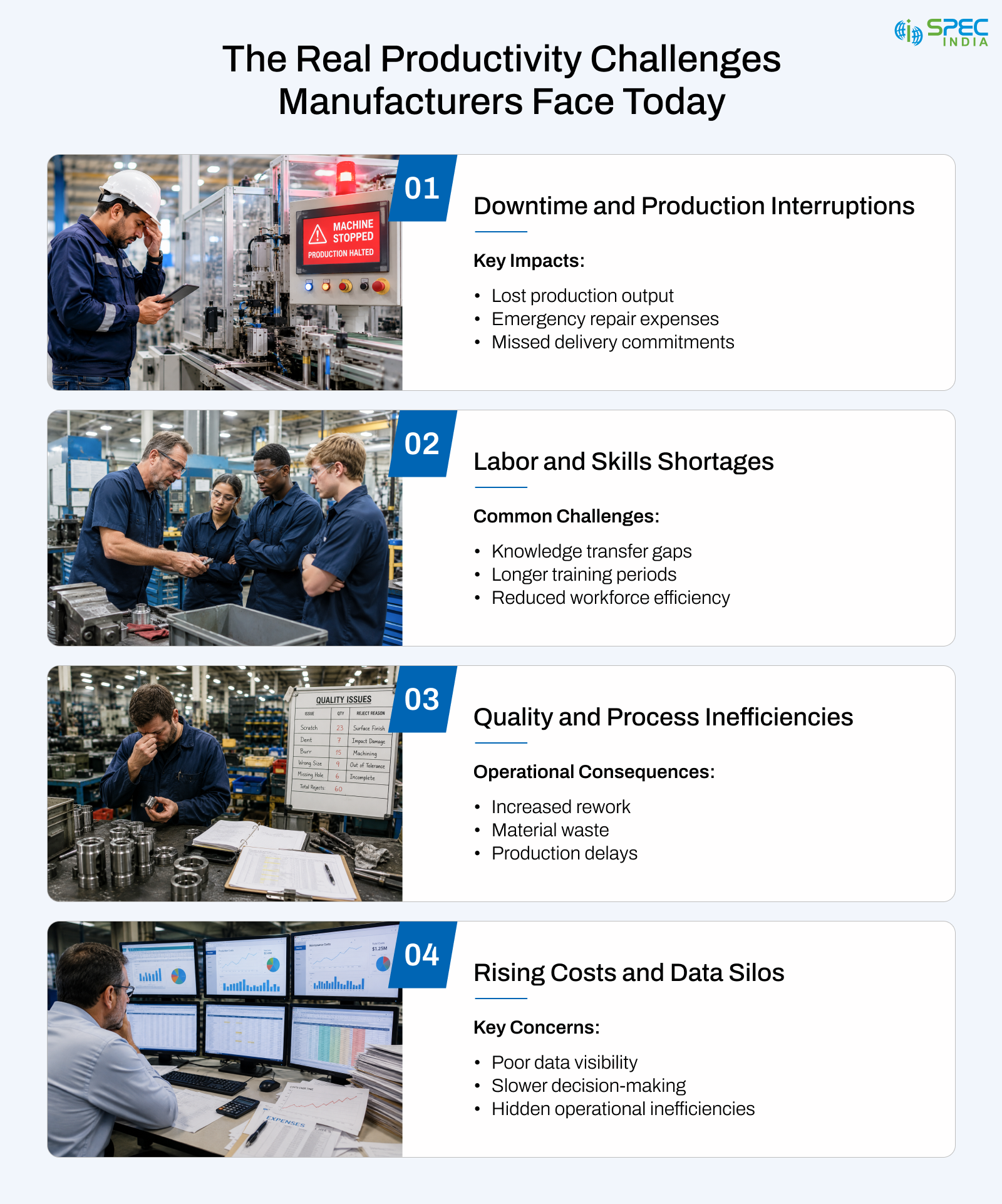
1. Downtime and Production Interruptions
Production is abruptly halted for any reason by equipment failure. Over time, it’s money, lost orders, and lost customers. Most plants continue to use the traditional maintenance schedules. These schedules lack any early warning signs. Teams without manufacturing analytics might just be responding to trouble, rather than preventing it.
Key impacts:
- Lost production output
- Emergency repair expenses
- Missed delivery commitments
2. Labor and Skills Shortages
Post-modern workers are leaving before newer, younger workers are placed in their roles. This results in a significant lack of information on the shop floor. Workers need training, and documented procedures frequently don’t work. Critical operational efficiency is not stored in systems; it’s in people’s brains.
Common challenges:
- Knowledge transfer gaps
- Longer training periods
- Reduced workforce efficiency
3. Quality and Process Inefficiencies
Slow in-class quality checking is unreliable. Defects pass through, which causes rework and waste. Material, workforce, and machine time are lost with each drum turn. In the absence of AI in factory automation tools, the target’s ability to identify recurring quality issues will be time-consuming.
Operational consequences:
- Increased rework
- Material waste
- Production delays
4. Rising Costs and Data Silos
Energy and material costs continue to climb. At the same time, most manufacturers run disconnected systems. ERP, MES, and floor sensors rarely communicate effectively. This lack of factory digitization hides inefficiencies in plain sight. Without unified data, predictive analytics services cannot deliver actionable insights across operations.
Key concerns:
- Poor data visibility
- Slower decision-making
- Hidden operational inefficiencies
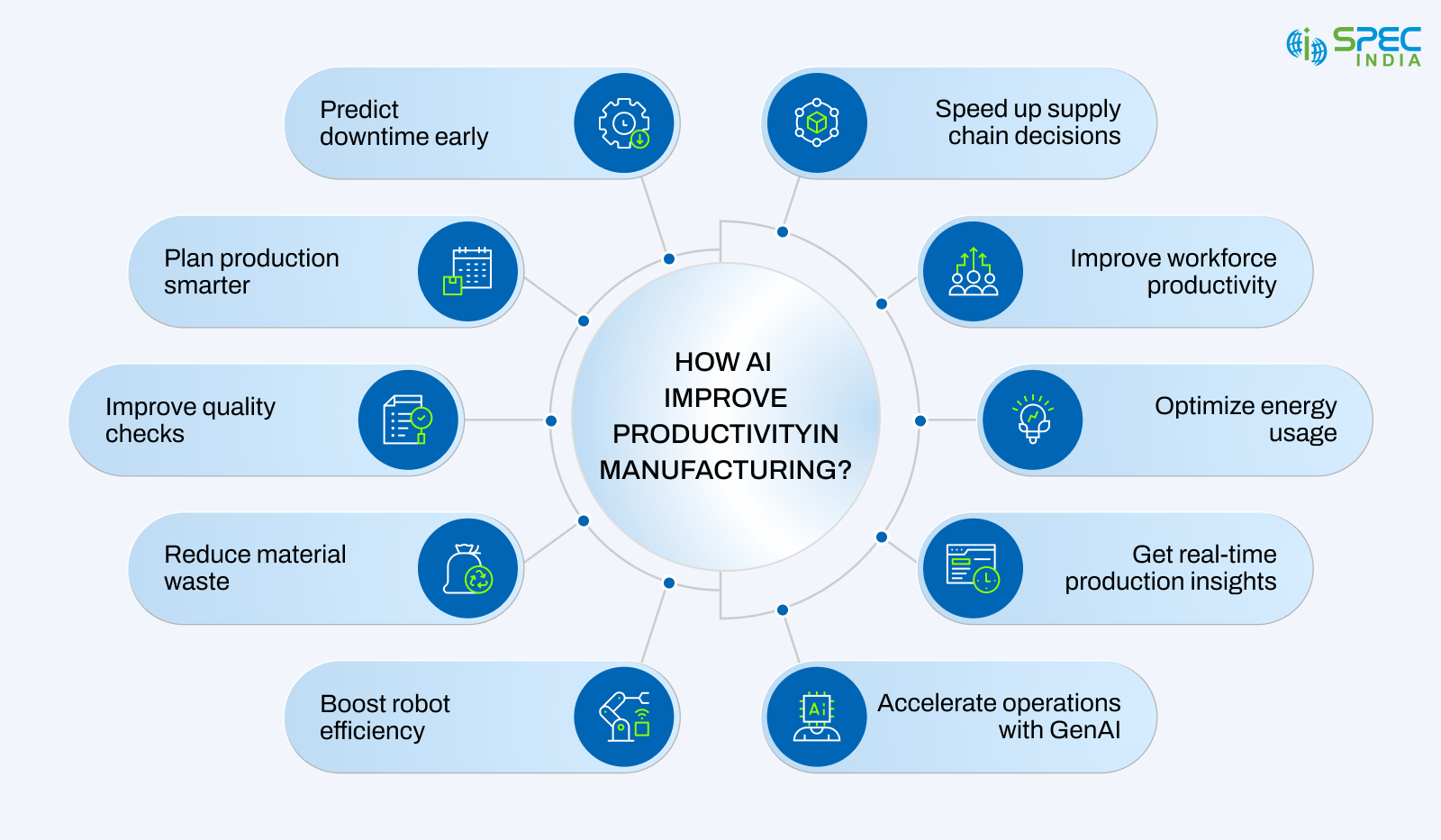
How Does AI Improve Productivity in Manufacturing? 10 Practical Applications
Large manufacturers generate exponentially more data each day. The challenge is to make that data into agility and real productivity. AI can help by spotting trends, forecasting issues, and advising on action before they impact production.
Let’s explore 10 real-world use cases for applying AI to boost efficiency in manufacturing operations.
1. Predictive Maintenance Reduces Downtime
Equipment failure doesn’t usually happen without warning. Changes are usually detected well before the breakdown of the sensors. Predictive maintenance in manufacturing involves using AI to continuously analyze these signals and detect issues that could affect the production process. This shifts maintenance from a reaction to a given process.
How AI helps
- Analyzes vibration, temperature, and pressure data
- Detects abnormal equipment early
- Monitors machines continuously
Business impact
- Fewer unplanned shutdowns
- Lower maintenance costs
- Improved equipment availability
| Before AI | After AI |
|---|---|
| The machine breaks down | Sensor anomaly detected early |
| Emergency repair required | KPlanned maintenance scheduled |
| 4–8 hours unplanned downtime | 30–60 minutes planned downtime |
| Higher repair costs | Lower maintenance costs |
| Significant output loss | Minimal production disruption |
2. AI Improves Production Planning and Scheduling
Production planning often depends on historical data and human judgment. AI removes these limitations by evaluating demand signals, inventory levels, and machine capacity together. AI for production optimization helps planners build schedules that reflect real operating conditions.
How AI helps
- Forecasts demand more accuracy
- Allocates resources using live data
- Identifies bottlenecks early
Business impact
- Faster production cycles
- Better capacity utilization
- Reduced scheduling conflicts
3. Computer Vision Enhances Quality Control
Manual inspection processes can be slow and inconsistent. Computer vision in manufacturing uses cameras and AI models to inspect products automatically at production speed. Every item receives the same level of attention throughout the shift.
How AI helps
- Detects defects automatically
- Compares products against reference standards
- Inspects output in real time
Business impact
- Reduced quality defects
- Faster inspection cycles
- Improved customer satisfaction
4. AI Helps Reduce Material Waste
Raw material waste directly affects profitability. Defects, overproduction, and process inefficiencies lower cash flow. AI allows manufacturers to maintain stable production conditions and reduce scrap.
According to the World Economic Forum, Agilent Technologies reduced waste from recycling by 53% and manufacturing productivity improvement by 31% using AI-powered machine learning.
How AI helps
- Optimize material usage
- Improve cutting and batch planning
- Detects process drift early
Business impact
- Lower scrap generation
- Reduced material costs
- Higher production efficiency
5. AI-Powered Robots Improve Shop Floor Efficiency
AI robots are more intelligent and flexible than traditional industrial robots and have been around for years. Smart manufacturing solutions integrate robots with AI to make machines more adaptable to varying conditions.
How AI helps
- Supports collaborative robots
- Enables safer human-machine interaction
- Automates repetitive tasks
Business impact
- Faster task execution
- Consistent product quality
- Improved worker productivity
6. AI Enables Faster Supply Chain Management Decisions
Today, supply chain management generates vast amounts of information among suppliers, warehouses, and distribution systems. AI-driven manufacturing systems can analyze this information on the fly and alert personnel to potential dangers before they impact the manufacturing line.
How AI helps
- Optimize inventory levels
- Tracks supplier performance
- Monitors external risk factors
Business impact
- Reduced stock shortages
- Better inventory’s quality control
- Faster procurement decisions
7. AI Improves Workforce Productivity
Skilled labor shortage remains a problem for manufacturers. AI aids employees by providing information, guidance, and training when it is needed. Integrating Generative AI software development services into workforce applications improves field operations software in various ways.
How AI helps
- Delivers smart work instructions
- Supports employee training
- Provides contextual guidance
Business impact
- Faster onboarding
- Lower error rates
- Increased workforce efficiency
8. AI Enhances Energy Efficiency
Rising energy costs remain an issue across the manufacturing sector. A connected factory environment, enabled by factory digitization, enables monitoring of the company’s energy consumption and potential savings from AI.
How AI helps
- Tracks energy consumption in real time
- Identify inefficient equipment
- Forecasts future consumption
Business impact
- Lower utility costs
- Better resource utilization
- Improved sustainability performance
9. AI Delivers Real-Time Production Insights
Traditional reports typically arrive late and cannot be used to take immediate action. AI-driven manufacturing analytics offers real-time insights into manufacturing performance and operational well-being.
How AI helps
- Consolidates data from multiple systems
- Tracks performance continuously
- Identifies bottlenecks automatically
Business impact
- Faster data-driven decision-making
- Improved operational visibility
- Quicker issue resolution
10. Generative AI Accelerates Manufacturing Operations
Generative AI for manufacturing is going beyond creating content to supporting operations. It enables teams to access information conveniently, develop documentation in less time, and require less administrative effort. The range of AI applications in manufacturing continues to grow across production environments.
How AI helps
- Generates SOPs and reports
- Organizes operational knowledge
- Improve information access
Business impact
- Faster documentation
- Reduced Administrative Workload
- Better knowledge retention
Industry Examples of AI-Driven Manufacturing Success
Companies are leveraging AI systems to tackle real-world manufacturing problems in several sectors. The applications vary, but the goal is always the same: to improve efficiency, increase quality, and make operational decisions quicker.
-
Automotive Manufacturing
Precision, speed, and supply chain coordination are key to vehicle production. Manufacturers integrate AI into:
- Monitor assembly line equipment continuously
- Detect defects through vision inspection
- Automate quality control across production stages
This will help reduce stoppages, improve product quality control, and ensure output consistency.
-
Pharmaceutical Manufacturing
Quality control and regulatory compliance are essential in pharmaceutical manufacturing. Artificial intelligence allows manufacturers to:
- Monitor batch parameters in real time
- Identify process deviations before failures occur
- Optimize production using historical yield data
This helps minimize batch failures, offer consistency, and optimize compliance efforts. Generative AI in manufacturing is also streamlining documentation.
-
Food Manufacturing
Balance is the key for food producers in evaluating quality, freshness, and demand fluctuations. Artificial intelligence allows manufacturers to:
- Inspect packaging, labels, and seal integrity
- Verify fill levels during production
- Forecast demand using retailers and seasonal data
These decrease waste, improve product quality, and align production with consumer demand.
-
Electronics Manufacturing
Electronics manufacturing processes require high accuracy levels throughout the manufacturing process. AI empowers manufacturers to:
- Detect solder defects and PCB faults
- Identify component alignment issues
- Optimize throughput based on component availability
This increases efficiency, enhances quality, and eliminates production bottlenecks. Numerous manufacturing companies use custom software development services to tailor these solutions to their production environments.
Measurable Business Benefits Manufacturers Achieve with AI
The impact of AI applications in manufacturing processes is evident in three areas: operations, finance, and workforce performance.
1. Operational Improvements
AI extends equipment life and optimizes equipment usage. According to Deloitte’s predictions, predictive maintenance will boost equipment uptime and availability by 10-20%. It will reduce total maintenance costs by 5-10% and reduce time to market by 20-50%. AI can detect inefficiencies before they build up and run a line nearer to its designed capacity.
2. Financial Improvements
Reduced Defect rates reduce scrap, rework, and material costs per unit. By optimizing energy use, bills are reduced. Thus, better inventory management helps lower capital tied up in overstock. AI-powered digital marketing can permanently lower costs on more lines at once for individual manufacturers.
3. Workforce Improvements
Human workers make faster decisions when AI surfaces the right data at the right moment. Smart work instructions reduce errors and cut training time. Supervisors spend less time pulling reports and more time resolving issues. Staff focuses on judgment-based tasks while AI handles routine monitoring and data processing.
| Area | Typical Improvement |
|---|---|
| Equipment uptime and availability | 10–20% increase (Deloitte) |
| Maintenance planning time | 20–50% reduction (Deloitte) |
| Overall maintenance costs | 5–10% reduction (Deloitte) |
| Inventory carrying costs | Reduced through smarter replenishment |
| Decision-making speed | Faster with real-time data and alerts |
Common Challenges When Implementing AI in Manufacturing
Adopting AI technologies can deliver significant productivity gains. However, most manufacturers face a few common obstacles during implementation.
1. Legacy System Integration
Many plants still rely on older equipment and software that were not built for AI connectivity. Common challenges include:
- Legacy PLC and SCADA systems
- Disconnected ERP and production data
- Limited system interoperability
2. Data Quality Issues
AI relies on accurate and consistent data. Poor data quality can reduce performance and reliability. Common issues include:
- Incomplete records
- Inconsistent sensor readings
- Siloed data sources
3. Change Management and Adoption
Successful implementation depends on people as much as AI algorithms, enabling manufacturers to face it often:
- Resistance to new workflows
- Limited AI awareness
- Insufficient training
4. Security and Governance
Digital transformation in manufacturing processes increases system connectivity and data sharing. Organizations must address:
- Data access quality controls
- Cybersecurity risks
- Governance and compliance requirements
Manufacturers that address these challenges early are more likely to achieve successful AI adoption and operational, continuous improvements.
How to Start AI Adoption in Manufacturing?
Successful AI adoption does not require a complete operational overhaul. Most manufacturers achieve better results by starting small, proving value, and scaling gradually. A structured approach reduces risk and accelerates digital transformation in manufacturing.
Step 1: Identify Bottlenecks
Focus on areas causing downtime, delays, quality issues, or excess costs.
Step 2: Collect Operational Data
Gather reliable data from machines, AI-powered production systems, and business applications.
Step 3: Launch One High-Impact Use Case
Start with a practical project such as predictive maintenance or quality inspection.
Step 4: Integrate AI into Existing Systems
Connect AI algorithms with ERP, MES, and shop floor systems to enable data flow.
Step 5: Scale Across Operations
Expand successful use cases to additional production lines and facilities.
Many manufacturers work with experienced AI software development companies to accelerate implementation and avoid common deployment challenges. The key is to focus on measurable outcomes and build momentum through incremental success.
The Future of AI in Manufacturing
The next phase of AI in manufacturing will focus on greater autonomy, faster decision-making, and deeper operational intelligence. As technology matures, manufacturers will move beyond isolated use cases toward connected and self-improving operations.
Autonomous Factories
Future factories will automate more routine decisions and operational tasks. AI systems will monitor production schedules, identify issues, and recommend corrective actions with minimal human operator intervention.
AI-Driven Digital Twins
Digital twins will create virtual replicas of production environments. Manufacturers will test process changes, predict outcomes, and optimize performance before making adjustments on the shop floor.
Self-Optimizing Production Lines
AI manufacturing solutions will continuously analyze production data and automatically adjust schedules, machine settings, and resource allocation. This enhances efficiency while reducing waste and downtime.
Human Operators and AI Collaboration
People will remain central to manufacturing operations. AI technologies support human workers with insights, recommendations, and real-time guidance, enabling teams to make faster, more informed decisions while focusing on higher-value work.
Why Choose SPEC India for AI-Powered Manufacturing Solutions?
Manufacturers need more than technology. They need a partner that understands production environments and delivers measurable outcomes.
- Manufacturing Domain Expertise: Deep understanding of operational efficiency, quality AI processes, and industry-specific challenges within the AI in manufacturing industry.
- End-to-End AI Development Capabilities: From strategy and consulting to development, integration, and ongoing support.
- Scalable and Secure Implementations: Solutions designed to support long-term growth while maintaining security, compliance, and reliability.
- From Pilot Projects to Enterprise Rollouts: Start with a focused use case and expand across facilities through a structured approach to factory digitization.
SPEC India helps manufacturers transform operational data into practical solutions that improve productivity, efficiency, and business performance.
Conclusion
Manufacturing is moving beyond reactive operations. Instead of responding to breakdowns and quality issues after they occur, manufacturers can now anticipate and prevent them. From predictive maintenance to production planning, AI systems help organizations operate more efficiently. This answers a key question for modern plant leaders: how does AI improve productivity in manufacturing?
Future-ready manufacturers will be those that turn operational data into actionable decisions. The journey does not have to start with a large-scale transformation. With the right strategy and partner, businesses can start small and scale confidently. SPEC India helps manufacturers build practical AI-powered collaborative robots that drive long-term productivity and growth.

SPEC INDIA is your trusted partner for AI-driven software solutions, with proven expertise in digital transformation and innovative technology services. We deliver secure, reliable, and high-quality IT solutions to clients worldwide. As an ISO/IEC 27001:2022 certified company, we follow the highest standards for data security and quality. Our team applies proven project management methods, flexible engagement models, and modern infrastructure to deliver outstanding results. With skilled professionals and years of experience, we turn ideas into impactful solutions that drive business growth.
Table of contents
- What AI Means in Modern Manufacturing
- The Real Productivity Challenges Manufacturers Face Today
- How Does AI Improve Productivity in Manufacturing? 10 Practical Applications
- Predictive Maintenance Reduces Downtime
- AI Improves Production Planning and Scheduling
- Computer Vision Enhances Quality Control
- AI Helps Reduce Material Waste
- AI-Powered Robots Improve Shop Floor Efficiency
- AI Enables Faster Supply Chain Management Decisions
- AI Improves Workforce Productivity
- AI Enhances Energy Efficiency
- AI Delivers Real-Time Production Insights
- Generative AI Accelerates Manufacturing Operations
- Industry Examples of AI-Driven Manufacturing Success
- Measurable Business Benefits Manufacturers Achieve with AI
- Common Challenges When Implementing AI in Manufacturing
- How to Start AI Adoption in Manufacturing?
- The Future of AI in Manufacturing
- Why Choose SPEC India for AI-Powered Manufacturing Solutions?
- Conclusion
Delivering Digital Outcomes To Accelerate Growth
Let’s TalkTable of contents
- What AI Means in Modern Manufacturing
- The Real Productivity Challenges Manufacturers Face Today
- How Does AI Improve Productivity in Manufacturing? 10 Practical Applications
- Predictive Maintenance Reduces Downtime
- AI Improves Production Planning and Scheduling
- Computer Vision Enhances Quality Control
- AI Helps Reduce Material Waste
- AI-Powered Robots Improve Shop Floor Efficiency
- AI Enables Faster Supply Chain Management Decisions
- AI Improves Workforce Productivity
- AI Enhances Energy Efficiency
- AI Delivers Real-Time Production Insights
- Generative AI Accelerates Manufacturing Operations
- Industry Examples of AI-Driven Manufacturing Success
- Measurable Business Benefits Manufacturers Achieve with AI
- Common Challenges When Implementing AI in Manufacturing
- How to Start AI Adoption in Manufacturing?
- The Future of AI in Manufacturing
- Why Choose SPEC India for AI-Powered Manufacturing Solutions?
- Conclusion
Delivering Digital Outcomes To Accelerate Growth
Let’s TalkRelated Blogs

Let’s get in touch!
India
SPEC House, Parth Complex, Near Swastik Cross Roads, Navarangpura, Ahmedabad 380009, INDIA.
-
 +91-79-26404031, 32-33-34
 -
 [email protected]