| Factors | Hyperautomation | RPA |
|---|---|---|
| Purpose | Orchestrate and continuously optimize end-to-end business processes. | Execute repetitive, rule-based, and mundane tasks. |
| Technologies Used | RPA, AI, ML, process mining, IDP, low-code platforms. | Bots operating on the UI layer. |
| Process Complexity | Handles complex tasks with variable inputs and exceptions. | Best suited to structured, predictable workflows. |
| AI Capabilities | Embeds machine learning and natural language processing for decisions. | Minimal to none; follows fixed scripts. |
| Human Intervention | Reduced to oversight and exception handling. | Required for process design and monitoring. |
| Scalability | Scales horizontally across departments and systems. | Scales within a single process or system. |
| Best For | Enterprise-wide digital transformation. | Isolated, high-volume repetitive tasks. |


Loading...
Hyperautomation vs RPA | What’s the Difference and Which is Right for Your Business?
Posted
July 22, 2026
Category Artificial Intelligence
Enterprise leaders are not scaling automation because it’s what everyone is doing today, but because margin protection now depends on decoupling revenue growth from headcount growth.
Hyperautomation has quickly become a billion-dollar market, expected to exceed $45.17 billion by 2031, driven by the industry’s efforts to address labor shortages, regulatory pressures, and compressed margins.
Every finance director who has sat through a recent planning cycle asks the same question: Can we process more volume without adding more people? That pressure has pushed business process automation from a back-office project into a board-level capital allocation decision.
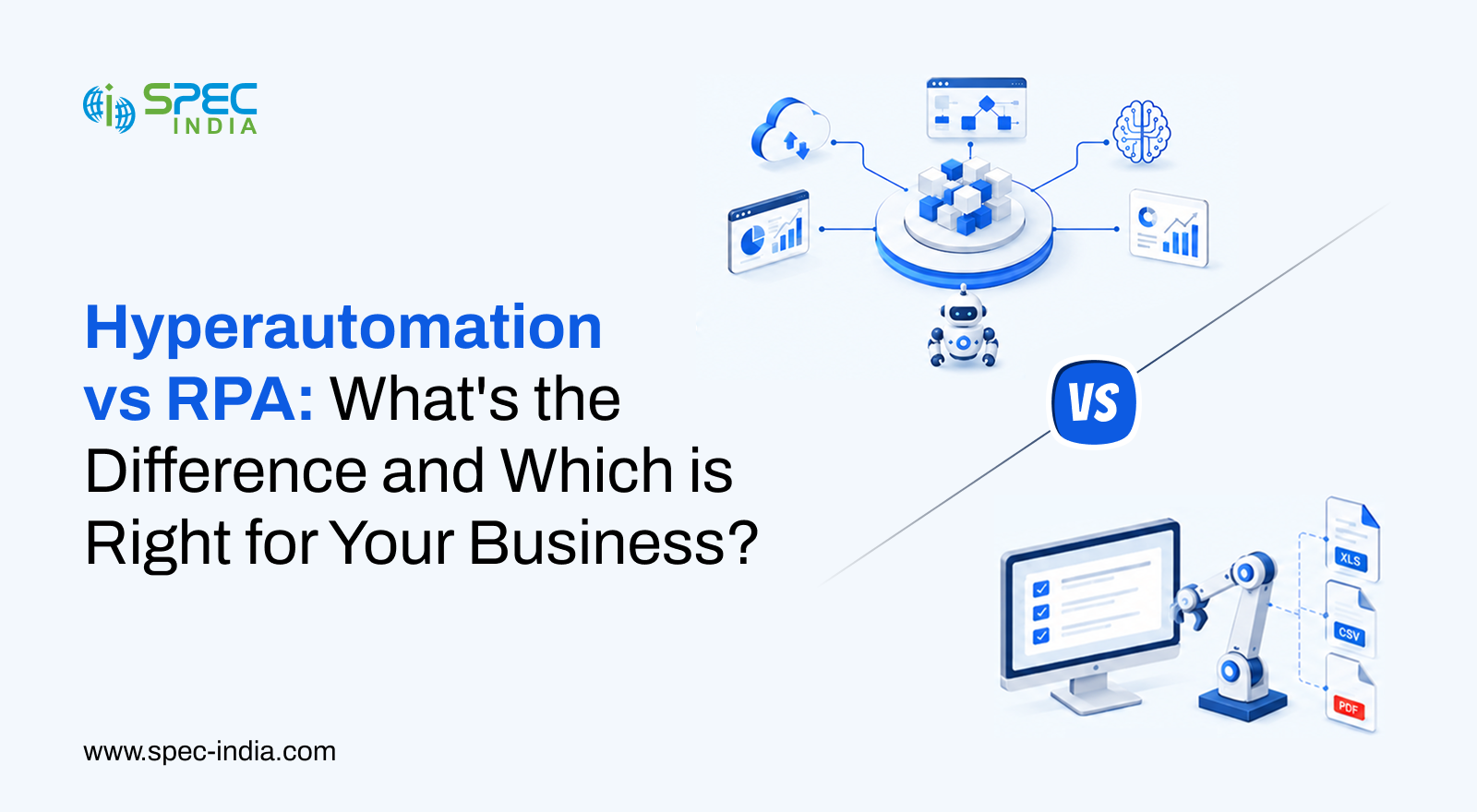
This is what confuses teams between hyperautomation vs RPA, and today we aim to fix that confusion. Let’s solve the RPA vs hyperautomation question before it turns into a costly re-architecture project, telling you precisely where to spend on robotic process automation, where to invest in a broader hyperautomation stack, and where the two need to work together.
Hyperautomation vs RPA: A Quick Overview
RPA is the tactical execution engine, which means it completes each command as instructed, including;
- Clicks
- Types
- Copies
- Validates
RPA completes every task given at a speed that no human can sustain across an eight-hour shift.
Hyperautomation is the overarching cognitive framework, which means it’s the brain and it;
- Decides what to automate
- How to route exceptions
- How to keep improving the process itself.
Hyperautomation service providers are built to orchestrate this framework around your organizational workflow, processes, and outcomes.
The difference between hyperautomation and RPA is evident in your architecture diagram and ROI model.
RPA answers: How do we automate this task faster?
Hyperautomation answers the question: How do we automate, monitor, and continuously improve this entire process?
What is Hyperautomation?
Hyperautomation is a business-driven, disciplined approach to rapidly identifying, vetting, and automating as many business processes as feasible.
But these processes are intelligence-driven, meaning they keep improving without constant manual redesign.
Rather than deploying a single tool, experienced intelligent automation solutions companies build a stack of AI-powered automation technologies where;
- RPA handles deterministic execution
- Machine learning models classify inputs.
- Process mining tools analyze system logs to surface bottlenecks nobody documented on a whiteboard.
- Workflow orchestration engines route work between bots, systems, and human workers based on real-time conditions, and low-code automation platforms let business analysts adjust routing logic without a development sprint.
This is also where intelligent document processing (IDP) and optical character recognition earn their place, as they are critical for converting unstructured scans and handwritten forms into machine-readable data that downstream bots can use and complete the processes.
This orchestration is only possible if you hire AI software development providers experienced with bots and hyperautomation tools.
What is Robotic Process Automation (RPA)?
RPA is software that executes deterministic, keystroke-level tasks by mimicking a human operator, and the common tasks include;
- Logging in
- Reading a field
- Copying value
- Pasting it elsewhere
- Moving to the next record thousands of times without fatigue or deviation.
RPA bots typically operate at the presentation layer, interacting with the same screens a human would, and they don’t touch or access the underlying code. Hence, an RPA development services provider should start with a screen and process audit rather than just building the bot after the first meeting.
This is one of the reasons for choosing between hyperautomation vs RPA: the latter is the default entry point for enterprise automation.
RPA does not require rewriting legacy systems or negotiating API access from a vendor who stopped supporting integrations a decade ago.
This same mechanism also defines the capabilities of RPA while excelling at;
- High-volume, structured data inputs
- Reconciling ledger entries
- Migrating records
- Populating standardized forms.
You simply need to feed it a scanned PDF or a free-text customer email, and RPA will complete the given tasks as per the instructions.
Every Hyperautomation vs RPA conversation eventually hits this ceiling: optical character recognition (OCR) becomes the missing piece, not an optional add-on.
Hyperautomation vs RPA: What are the Key Differences?
RPA is a single tool within a hyperautomation system, but when used as a standalone capability, it automates repetitive tasks, increasing productivity.
- Scope of Automation: RPA automates individual tasks, whereas hyperautomation automates end-to-end, complex processes, including decisions that humans used to own.
- Technologies Used: RPA is largely a single technology, as it’s a single tool or function built for a specific purpose. Hyperautomation combines RPA with AI, ML, NLP, and intelligent business process management (BPM) tooling into a single system.
- Intelligence & Decision-Making: RPA follows if-this-then-that logic, meaning it runs on predefined instructions and parameters. Hyperautomation applies trained models to ambiguous inputs, making probabilistic decisions where rules break down, or the task needs additional effort to complete, and this is where AI software development companies differ from RPA-only vendors.
- Process Complexity: RPA handles narrow, repeatable steps and cannot handle complex tasks, but hyperautomation is built for complex workflows spanning multiple systems and formats.
- Scalability: RPA is built to scale bot instances within a single workflow, meaning a single bot can be scaled across departments and processes to complete a task.
Hyperautomation scales the program itself by continuously mining new processes and adding them to the workflow. - Integration Capabilities: RPA integrates at the UI layer, often as a workaround, without tampering with the underlying code. Hyperautomation integrates through APIs and event-driven orchestration, which means it has access to the underlying code.
- Business Outcomes: RPA delivers quick, isolated savings, as its scope is limited and it depends on human input. Hyperautomation delivers compounding gains because the system keeps optimizing itself post-launch.
| Aspect | Hyperautomation | RPA |
|---|---|---|
| Automation Scope | End-to-end business processes | Single, isolated tasks |
| AI & Machine Learning | Core to the enterprise architecture | Absent or bolted on |
| Decision-Making | Cognitive, model-driven | Rule-based tasks with fixed logic |
| End-to-End Automation | Standard design goal | Rare; needs manual handoffs |
| Data Processing | Structured and unstructured data | Structured data only |
| Integration | API-first, multi-system | UI-layer, single system |
| ROI Potential | Higher, compounding over time | Fast but plateaus quickly |
When Should You Choose RPA?
RPA is the right call when the problem you want to solve is narrow, the data is clean, and the system won’t change anytime soon. This becomes the entry point for your engagement with business process automation services companies.
- Legacy systems without APIs: When a mainframe or unsupported ERP module offers no integration hooks, RPA automates the screen instead of waiting on a vendor roadmap.
- Structured Data Entry and Validation: Moving fields between systems with a fixed format is a textbook RPA job.
- Standardized Invoice Processing: Fixed-template invoices with predictable line items require consistent execution rather than judgment, and RPA is effective at processing them.
- Automated Daily Report Generation: Pulling the same fields from the same sources on schedule is exactly what bots were built for, and they can do so with far greater efficiency than humans.
When Should You Choose Hyperautomation?
Hyperautomation proves its worth when the process you want to intelligently automate spans systems, involves judgment calls, or touches data that doesn’t arrive in a clean, structured format, for which you need enterprise automation solutions delivered by SPEC India.
- Unstructured Data Processing: Free-text emails, scanned contracts, and handwritten forms need IDP and ML models before any bot can act.
- End-to-end Supply Chain Orchestration: AI-powered task automation tools can handle procurement-to-payment workflows, including cross-purchasing, finance, and vendor systems, and complete tasks based on the goals you share.
- Cognitive Decision-making: Fraud scoring, credit risk assessment, and triage claims require probabilistic judgment, which hyperautomation systems provide, and handle business process management (BPM).
- Cross-Departmental Workflows: Onboarding an employee involves HR, IT, facilities, and payroll simultaneously, and hyperautomation, when integrated into enterprise automation systems, coordinates handoffs seamlessly to ensure cross-departmental processes are completed without error.
- Enterprise-wide Digital Transformation: When the mandate is “automate as much as possible,” you need a platform for workflow automation in every department and process, not a point tool.
Can Hyperautomation and RPA Work Together?
Hyperautomation vs RPA aren’t competing frameworks; instead, they are a part of a bigger picture: intelligent automation. If you book a hyperautomation consulting session with us, our experts will clear up any doubts and explain the concepts more clearly.
Here, RPA represents the fundamental building block within a broader hyperautomation ecosystem, not a rival approach to hyperautomation.
Every mature business process automation deployment still has bots doing the heavy lifting; they just aren’t working in isolation.
The combination becomes powerful once process mining identifies the real bottlenecks, and artificial intelligence models handle judgment calls that used to route straight to a human’s inbox.
RPA then executes the resulting actions at scale while layering in feedback loops, and the system starts flagging its own drift; this self-optimizing system is where hyperautomation rules.
So, you don’t want to look for hyperautomation or RPA; instead, focus on how much cognitive orchestration this specific process requires and whether you need a single bot framework or multiple bots managed by an intelligence layer on top.
The debate over hyperautomation vs intelligent automation terminology matters far less than whether your bots and your models are talking to each other.
How to Choose Between Hyperautomation and RPA?
The right answer depends on organizational size, process maturity, and regulatory exposure. To help you choose, our RPA consulting services provide the answers you need.
| Business Need | Recommended Approach |
|---|---|
| Startup | RPA for a handful of high-volume manual tasks is enough. |
| Small & medium businesses | RPA first, with selective AI add-ons for document-heavy workflows and processes. |
| Enterprise | Full hyperautomation stacks across core operational processes. |
| Highly regulated industries | Hyperautomation with strong audit trails, explainable AI, and human-in-the-loop checkpoints. |
A ten-person operations team chasing quick wins on invoice matching doesn’t need a workflow automation license bundled with process mining.
But a 5,000-employee insurer processing claims across six legacy systems cannot get there with bots alone, and this exception volume demands genuine AI automation, not just faster keystrokes.
Common Mistakes Businesses Make When Choosing an Automation Strategy
The first impression of an organization here is that it automates broken processes, locks in bad data, and, in doing so, forgets the human touch. But these mistakes can negate the benefits of robotic process automation and hyperautomation.
1. Automating a Broken Process: Bots execute a bad workflow faster, but don’t expect them to fix it. So, before you bring in the bots, rationalize the process first, or you will just have industrialized inefficiency.
2. Choosing a Vendor Too Early: Signing a contract before understanding the actual process steps guarantees a mismatch between tool capabilities and needs, and this mistake no hyperautomation vs. RPA comparison sheet can fix easily, without adding extra costs.
3. Ignoring Horizontal Scalability: A bot built for one department’s exact configuration rarely survives contact with a second department’s slightly different one. Workflow automation solutions are built around this and ensure all bots are easy to scale across departments from day one.
4. Underestimating Change Management: Employees who fear job displacement will quietly route around the bots rather than adopt them, and this can even disrupt the bot’s workflow.
Why Choose SPEC India for Intelligent Automation Solutions?
SPEC India has spent 39+ years in software engineering, long enough to know which architectural decisions hold up under production load. That depth translates directly into hyperautomation services and RPA development services built around your actual systems, not a generic template.
The team’s expertise spans custom RPA builds and applied AI and ML models that need to turn unstructured data into something your workflows can act on. Legacy and ERP integrations, the part of most automation projects that quietly detail timelines, are handled as a core competency, not an afterthought.
Whether your enterprise needs automation solutions for a single workflow or a full digital transformation services engagement spanning procurement to finance, SPEC India builds platforms designed to remain secure, auditable, and adaptable as your systems evolve.
Book your first session with our experts to find out more.

SPEC INDIA is your trusted partner for AI-driven software solutions, with proven expertise in digital transformation and innovative technology services. We deliver secure, reliable, and high-quality IT solutions to clients worldwide. As an ISO/IEC 27001:2022 certified company, we follow the highest standards for data security and quality. Our team applies proven project management methods, flexible engagement models, and modern infrastructure to deliver outstanding results. With skilled professionals and years of experience, we turn ideas into impactful solutions that drive business growth.
Table of contents
- Hyperautomation vs RPA: A Quick Overview
- What is Hyperautomation?
- What is Robotic Process Automation (RPA)?
- Hyperautomation vs RPA: What are the Key Differences?
- How to Choose Between Hyperautomation and RPA?
- Common Mistakes Businesses Make When Choosing an Automation Strategy
- Why Choose SPEC India for Intelligent Automation Solutions?
Delivering Digital Outcomes To Accelerate Growth
Let’s TalkTable of contents
- Hyperautomation vs RPA: A Quick Overview
- What is Hyperautomation?
- What is Robotic Process Automation (RPA)?
- Hyperautomation vs RPA: What are the Key Differences?
- How to Choose Between Hyperautomation and RPA?
- Common Mistakes Businesses Make When Choosing an Automation Strategy
- Why Choose SPEC India for Intelligent Automation Solutions?
Delivering Digital Outcomes To Accelerate Growth
Let’s Talk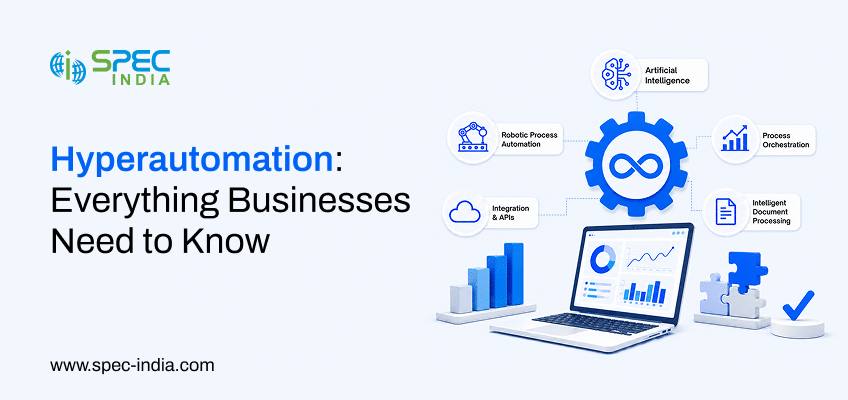
Let’s get in touch!
India
SPEC House, Parth Complex, Near Swastik Cross Roads, Navarangpura, Ahmedabad 380009, INDIA.
-
 +91-79-26404031, 32-33-34
 -
 [email protected]