| Technology | Role in Hyperautomation | Business Benefit |
|---|---|---|
| RPA | Executes repetitive, complex processes and rules-based tasks across structured data and legacy interfaces. | Frees staff from manual, high-volume work; reduces error rates in transactional automated processes. |
| AI | Applies reasoning to unstructured inputs, including text, images, and speech, for context-aware decisions. | Extends automation into judgment-based work that rules alone can’t handle. |
| ML | Learning from historical transaction data to improve predictions and flag anomalies. | Sharpens fraud detection, demand forecasting, and risk scoring over time. |
| OCR / IDP | Converts scanned and unstructured documents into structured, machine-readable data. | Eliminates manual data capture from invoices, claims forms, and contracts. |
| Process Mining | Analyzing system logs to map real workflows and pinpoint automation-worthy bottlenecks. | Prevents wasted investment on automating the wrong processes and business operations. |
| BPM | Governs, versions, and orchestrates automated workflows across departments. | Keeps automation auditable, compliant, and scalable rather than fragmented. |


Loading...
What is Hyperautomation? Everything Businesses Need to Know
Posted
July 17, 2026
Category Artificial Intelligence
Ask a CTO in 2022 what automation meant, and they will talk about how we can use RPA bots to click through invoice approvals.
But if you ask the same question today, the conversation changes entirely.
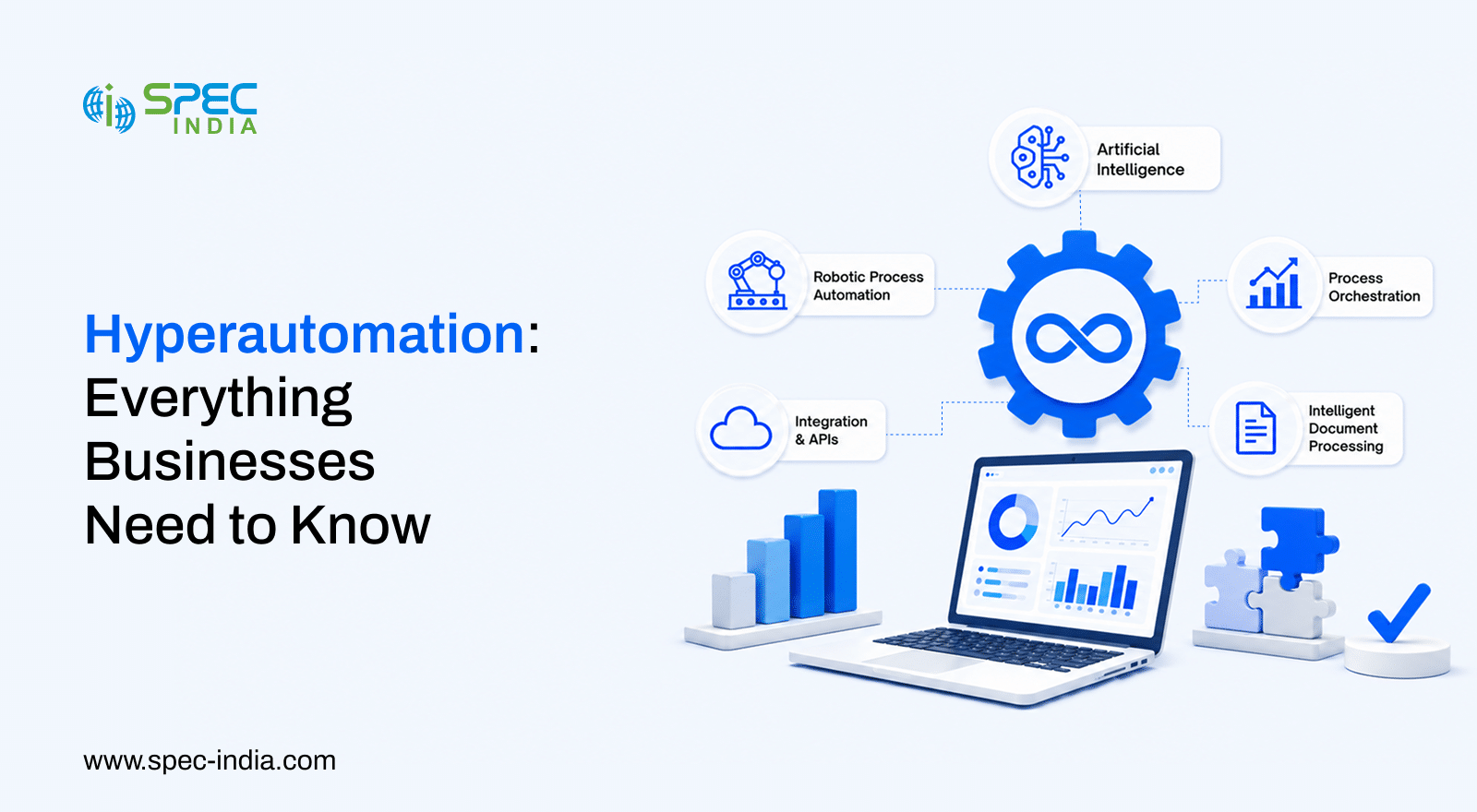
Using bots isn’t about automating a single task, but it’s about orchestrating an entire operating model, including bots, AI agents, AI models, and analytics engines working together across departments that used to run on disconnected systems and manual handoffs.
Hyperautomation is now a top strategic priority for roughly 90% of large enterprises, and on the ground, this is already visible as more than 72% of large enterprises worldwide are planning to complete multiple automation tool implementations within two years, bringing together three core automation technologies
1. RPA
2. AI
3. Process mining
This guide breaks down what hyperautomation is, how it functions mechanically, where it delivers ROI, and what separates a successful rollout from an expensive shelf-ware project.
What is Hyperautomation?
Hyperautomation is the disciplined integration of robotic process automation (RPA), artificial intelligence (AI), machine learning, process mining, and low-code development into a single, orchestrated automation strategy spanning an entire business function.
Understanding this hyperautomation definition matters because the term is diluted in vendor marketing and must be associated with AI-powered automation tailored to enterprise requirements.
Under hyperautomation, RPA automates repetitive tasks, but only if it follows fixed rules and helps move data from Excel into an ERP, such as extracting a field from an invoice.
The moment a process requires judgment, like when you need the machine to understand unstructured data, interpret a customer complaint, or decide whether a claim needs escalation, simple RPA cannot handle it.
And this is where we bring in hyperautomation: AI and machine learning handle ambiguity, process mining identifies which workflows are worth automating in the first place, and BPM governs the whole thing.
When we say automation, it’s not just giving robots a task; instead, it’s business process automation applied end-to-end, so that entire value chains, whether it’s
- Order-to-cash
- Procure-to-pay
- Claims-to-settlement
Several such processes run with minimal manual intervention while remaining auditable, compliant, and adjustable as conditions change.
How Does Hyperautomation Work for Business Operations?
Now that you understand what hyperautomation is, let’s look at how hyperautomation works in a live enterprise environment: it comes down to five interlocking stages, and skipping any one of them is where most programs quietly fail.
1. Process Discovery
Before a single bot is deployed, process mining tools ingest system logs and event data to map how work actually moves through the organization, not how the org chart says it should.
This step helps identify bottlenecks that no one has documented: approval loops, duplicate data entry, and three teams touching the same invoice.
2. Opportunity Scoring
Not every process deserves automation, and we have found that high-volume, rules-heavy, error-prone tasks are better if they are automated, including;
- Accounts payable reconciliation
- KYC checks
- Claims intake
3. Task Automation
The next step is to plan and build RPA bots to take over the repetitive and high-volume processes, like;
- Data analytics
- Data entry
- System-to-system transfers
- Report generation
This is where most legacy automation efforts stopped and where hyperautomation continues.
4. AI for Judgment
The utilization of AI and its technologies is important for business process automation and a core part of hyperautomation technology, and the bots are enabled with;
- Natural language processing for reading and processing unstructured emails and contracts.
- Machine learning models for risk scoring, demand prediction, and finding anomalies.
AI technologies enable a bot to make contextual calls during a project.
5. Continuous Monitoring
For continuous monitoring of hyperautomation services, you need dashboards to track cycle time, exception rates, and cost per transaction in real time, feeding data back into the process mining layer so the automation strategy keeps adapting rather than calcifying into another legacy system.
Core Technologies Behind Hyperautomation
Hyperautomation isn’t about using a single technology or tool; it’s an integration exercise across various automation tools and technologies. Understanding each layer’s role is what separates a coherent automation strategy from a pile of disconnected licenses.
-
Robotic Process Automation (RPA)
RPA handles structured, repetitive, rules-based tasks, and advanced bots use artificial intelligence to implement reasoning for unstructured inputs while leveraging;
- Natural Language Processing
- Computer vision
- Generative models
These multiple automation technologies and solutions built on them interpret rather than just execute.
-
Machine learning
ML builds on the existing models and processes by improving predictions over time and helping with achieving;
- Fraud scoring
- Demand forecasting
- Churn prediction
The more transaction data flows through the system, the better the results, leading to multiple benefits of hyperautomation.
-
Intelligent Document Processing (IDP)
Powered by optical character recognition (OCR), IDP is useful for converting scanned contracts, invoices, and forms into structured, usable data, which is critical for industries still buried in PDFs and paper.
-
Process Mining
This is the diagnostic layer, using event logs to reveal where, in existing processes, business process automation will move the needle versus where it will just digitize a broken process.
-
Low-code Development
Platforms let business analysts, not just engineers, build and adjust workflow logic, compressing the gap between identifying a bottleneck and fixing it.
-
Business Process Management (BPM)
BPM provides the governance backbone for hyperautomation use cases, especially by managing version control, audit trails, and workflow ownership, ensuring that the hyperautomation solutions and systems you use don’t become an ungoverned sprawl of shadow bots.
Key Benefits of Hyperautomation
Those who ask what is hyperautomation also want to know the benefits of robotic process automation. Hyperautomation combines advanced technologies like AI and RPA to automate complex processes and bypass trivial permissions that humans otherwise handle through contextual understanding.
Once implemented, workflow automation has several advantages;
1. Operational Efficiency
Once RPA, AI, and process mining work off the same data layer rather than three disconnected tools, your manual effort decreases, especially in functions that require additional employees to handle repetitive work, such as data entry, reconciliation, and first-line customer queries.
2. Decision-making Accelerates
AI models flag exceptions and route them to the right person instantly, rather than letting them sit in a queue and create a backlog of complaints. Better decision-making across every process means higher accuracy and more effective compliance, since automated workflows leave a consistent audit trail that manual processes rarely do.
3. Operational Costs Reduce
Hyperautomation solutions lead to cost reductions through reduced rework and by enabling AI models and RPA bots to replace multiple people, completing the same work in less time.
With better audit trails, you will incur fewer compliance penalties and rely less on manual overflow staffing during peak periods.
4. Customer Experience
Faster claims processing, quicker loan approvals, and real-time order tracking improve customer satisfaction, and all these benefits trace back to the same underlying automation layer.
5. Scalability Across Businesses
Hyperautomation helps with business scalability in a way simple task automation tools never could. This means a document-processing bot solution built for finance can often be adapted for HR or legal with far less rework than building each one from scratch.
Enterprises that want this kind of leverage typically don’t build it alone; they partner with providers that offer dedicated digital transformation and robotic process automation (RPA) services to compress the timeline from pilot to enterprise-wide rollout. Partner with SPEC India to leverage the benefits of hyperautomation and bring uniformity and speed to your processes.
Hyperautomation Use Cases Across Industries
Hyperautomation executes complex tasks, going beyond basic automation by thinking and learning from the continuous flow of data, and successfully replacing manual work.
| Industry | Hyperautomation Use Case | Business Outcome |
|---|---|---|
| Manufacturing | Predictive maintenance via IoT and automated procurement triggers. | Reduced downtime, fewer emergency parts orders. |
| Healthcare | AI-driven prior-authorization and patient intake automation. | Turnaround cut from days to minutes; reduced clinician admin load. |
| Banking | Automated KYC, fraud scoring, straight-through transaction processing. | Faster onboarding, lower compliance risk, reduced back-office cost. |
| Logistics | Automated exception handling and demand forecasting. | Fewer manual escalations, tighter inventory-to-demand alignment. |
| Retail | Dynamic inventory allocation and automated returns workflows. | Faster fulfillment cycles, improved customer satisfaction. |
| HR | Automated resume screening, onboarding, benefits processing. | Faster hiring cycles, reduced administrative overhead. |
1. Manufacturing teams overlay hyperautomation with IoT telemetry to detect micro-stoppages on the line and trigger automated procurement of spare parts before the entire operation halts, shifting maintenance from reactive to predictive.
2. Healthcare organizations automate patient intake and prior-authorization workflows; for instance, in a health system, hyperautomation can cut prior-auth turnaround from hours to minutes by layering AI classification and smart forms into its intake process.
3. Banking and financial services use hyperautomation for KYC checks, fraud scoring, and transaction processing, and today we are seeing financial institutions automating more than 60% of repetitive back-office activity.
4. Logistics and supply chain operations apply hyperautomation solutions for a few systems, including;
- Shipment exception handling
- Demand forecasting
- Automated carrier selection
This use of automation reduces manual firefighting, which would otherwise eat into margins during peak season.
5. Retail and e-Commerce brands leverage hyperautomation for dynamic inventory allocation and returns processing, helping close the gap between demand signals and fulfillment and leading to better customer satisfaction.
6. Human Resources teams apply business process automation for;
- Resume screening
- Onboarding documentation
- Administration work
In essence, it’s effective for handling high-volume, rules-heavy, and traditionally understaffed work in the HR environment.
Common Challenges in Hyperautomation Adoption
Hyperautomation solutions don’t operate without directly confronting friction points. Whether you are using it to automate complex business processes, back-office operations, or front-desk functions, hyperautomation does face some challenges.
1. Identifying the right processes: Knowing which process to automate is sometimes more difficult than implementing intelligent automation solutions. Automating a broken process just makes it fail faster, and when aiming to run it at scale, process discovery must come before automation.
2. Integration with legacy systems: Enterprises running core banking platforms, ERP systems, or hospital information systems built two decades ago can’t simply replace them.
To overcome this, developers use an API-first, event-driven software architecture that allows RPA bots and AI agents to interact with legacy infrastructure, which is what separates experienced enterprise software development service providers from generalist vendors.
3. Change Management: Automation processes fail less often because of technology and more often because frontline teams don’t want to accept, or cannot accept, the process of redesigning, leading them to quietly work around the new system.
4. Data Quality: AI and ML models trained on inconsistent, siloed, or duplicate data will produce unreliable outputs regardless of how sophisticated the algorithm is. So, if you supply low-quality AI solutions trained on garbage data, the results will be equally detrimental to your processes.
5. Security and Governance: Hyperautomation touches sensitive financial, health, and customer data across systems, so access controls, encryption standards, and audit trails must be built into the architecture from day one.
Frameworks like GDPR and emerging AI-specific regulations add to this complexity, demanding that enterprises increasingly provide documented evidence that automated decisions are explainable and compliant, not just fast.
How to Get Started with Hyperautomation?
With an understanding of how hyperautomation works, let’s move on to know how to implement workflow automation, and for this, begin with automation initiatives around a disciplined sequence, including;
- Assess current-state processes with real data rather than assumptions,
- Identify the highest-friction points using process mining
- Define measurable goals tied to cost and cycle time rather than vague efficiency
- Select a technology stack that integrates with existing systems instead of forcing a replacement.
The best approach is to first run a pilot test, scope it to a single process or department, and assess the results after 90 to 120 days. This will validate the approach before you can think about scaling it to the next level, and from there, you can scale the same automation with process- and department-specific customizations.
Each new function added to the automation layer should reuse infrastructure and lessons learned from the previous one, which is exactly where reusable IDP models and shared BPM governance start paying for themselves across the enterprise.
If your organization needs a partner that can move from process assessment to a live pilot without adding operational risk, dedicated hyperautomation services make the difference between a stalled proof of concept and a production system. SPEC India will scope and build a custom hyperautomation implementation plan tailored to your goals, processes, budget, and talent.
Why Choose SPEC India for Hyperautomation Solutions?
SPEC India has spent 39+ years building enterprise software long enough to have modernized systems well before hyperautomation was a category, and long enough to know exactly where legacy infrastructure fights back during integration.
That experience translates into practical hyperautomation solutions, which include;
- Deep technical bench strength across RPA, AI, ML, and workflow automation
- Custom builds designed around a client’s actual systems rather than a one-size-fits-all platform
- End-to-end consulting that covers process discovery, pilot deployment, and enterprise-wide scaling under one roof.
As one of the established AI software development companies with a track record in both legacy modernization and modern AI integration, SPEC India also brings dedicated intelligent document processing capability to handle unstructured data.
Ready to map your automation opportunities? Connect with SPEC India’s automation strategy and AI software development services team to scope a pilot built around your existing systems, not a generic template.

SPEC INDIA is your trusted partner for AI-driven software solutions, with proven expertise in digital transformation and innovative technology services. We deliver secure, reliable, and high-quality IT solutions to clients worldwide. As an ISO/IEC 27001:2022 certified company, we follow the highest standards for data security and quality. Our team applies proven project management methods, flexible engagement models, and modern infrastructure to deliver outstanding results. With skilled professionals and years of experience, we turn ideas into impactful solutions that drive business growth.
Table of contents
- What is Hyperautomation?
- How Does Hyperautomation Work for Business Operations?
- Core Technologies Behind Hyperautomation
- Key Benefits of Hyperautomation
- Hyperautomation Use Cases Across Industries
- Common Challenges in Hyperautomation Adoption
- How to Get Started with Hyperautomation?
- Why Choose SPEC India for Hyperautomation Solutions?
Delivering Digital Outcomes To Accelerate Growth
Let’s TalkTable of contents
- What is Hyperautomation?
- How Does Hyperautomation Work for Business Operations?
- Core Technologies Behind Hyperautomation
- Key Benefits of Hyperautomation
- Hyperautomation Use Cases Across Industries
- Common Challenges in Hyperautomation Adoption
- How to Get Started with Hyperautomation?
- Why Choose SPEC India for Hyperautomation Solutions?
Delivering Digital Outcomes To Accelerate Growth
Let’s Talk
Let’s get in touch!
India
SPEC House, Parth Complex, Near Swastik Cross Roads, Navarangpura, Ahmedabad 380009, INDIA.
-
 +91-79-26404031, 32-33-34
 -
 [email protected]