

How a Field Service Management App Increased Technician Productivity
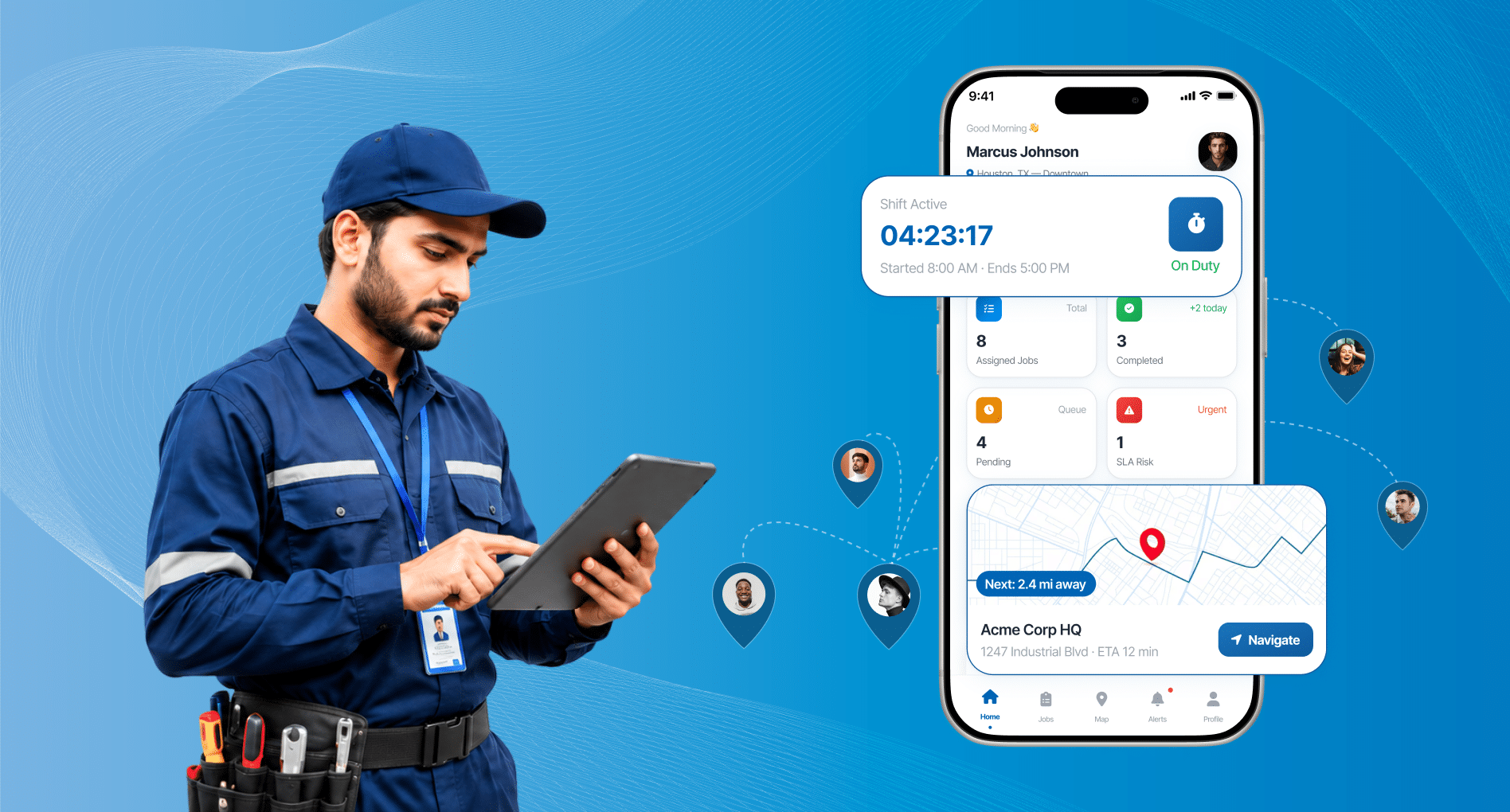
Our client is a mid-sized utilities and infrastructure maintenance company based in Bristol, serving residential and commercial customers across South West England. With 320+ field technicians, they were running on paper job sheets, WhatsApp groups, and legacy desktop tools, a setup that had long outgrown the scale of the business. A string of missed SLAs and rising customer complaints pushed leadership to act. They came to us for a purpose-built field service management app that would give technicians everything they needed job details, asset history, checklists, and signatures, right on their phone.
-
Industry
Utility -
Country
United Kingdom
Technologies
 React Native
 Node
Node
 AWS Amplify
 GraphQL
 PostgreSQL

Years in Business

Projects Delivered

Enterprise Clients

Countries Served
Business Goals
The client's ambitions went beyond simply digitising their paper forms. They wanted a mobile app that would fundamentally change how their field team works on day to day basis. Their core objectives were:
- Replace paper job sheets and phone-based dispatch with a single mobile app used by every technician on every job.
- Give field staff instant access to full asset histories, digital checklists, and pre-allocated parts before they arrive on site.
- Capture proof of work – photos, videos, and customer signatures — directly through the app, eliminating paperwork at job close.
- Enable offline working so technicians in underground utilities, rural substations, and low-signal areas never lose access to their job queue.
Business Challenges

Fragmented tools with no mobile access
Technicians were getting job updates via phone calls and WhatsApp, then filling paper forms on-site before photographing them back to the office. No single source of truth, no live visibility. Replacing all of this without disrupting active operations required careful phasing and data migration from three separate legacy systems.

Offline capability in challenging environments
A field service app that drops when the signal does is useless. Many technicians regularly work underground or in rural areas with no 4G coverage. The app had to function fully offline — loading jobs, accepting inputs, capturing photos and signatures locally — then sync cleanly once connectivity returned.

Smart scheduling and dispatch on a small screen
The dispatcher console needed to surface the right technician for each job based on live GPS, skill certifications, available parts, and SLA urgency, all feeling fast and intuitive on mobile. The scheduling engine also had to handle constant rerouting for emergency callouts, cancellations, and multi-technician jobs without manual recalculation.

Getting buy-in from a non-technical workforce
A large portion of the team had worked from paper for over a decade and were openly sceptical about switching. The UX had to be genuinely intuitive, not just 'good for software.' Multiple rounds of on-site usability testing with real technicians led to significant design changes that would never have surfaced in a standard review process.
Technical Solutions
We built a three-layer mobile-first platform: a technician app for iOS and Android, a web-based dispatcher console, and a customer notification portal.
-
Offline-First Technician App
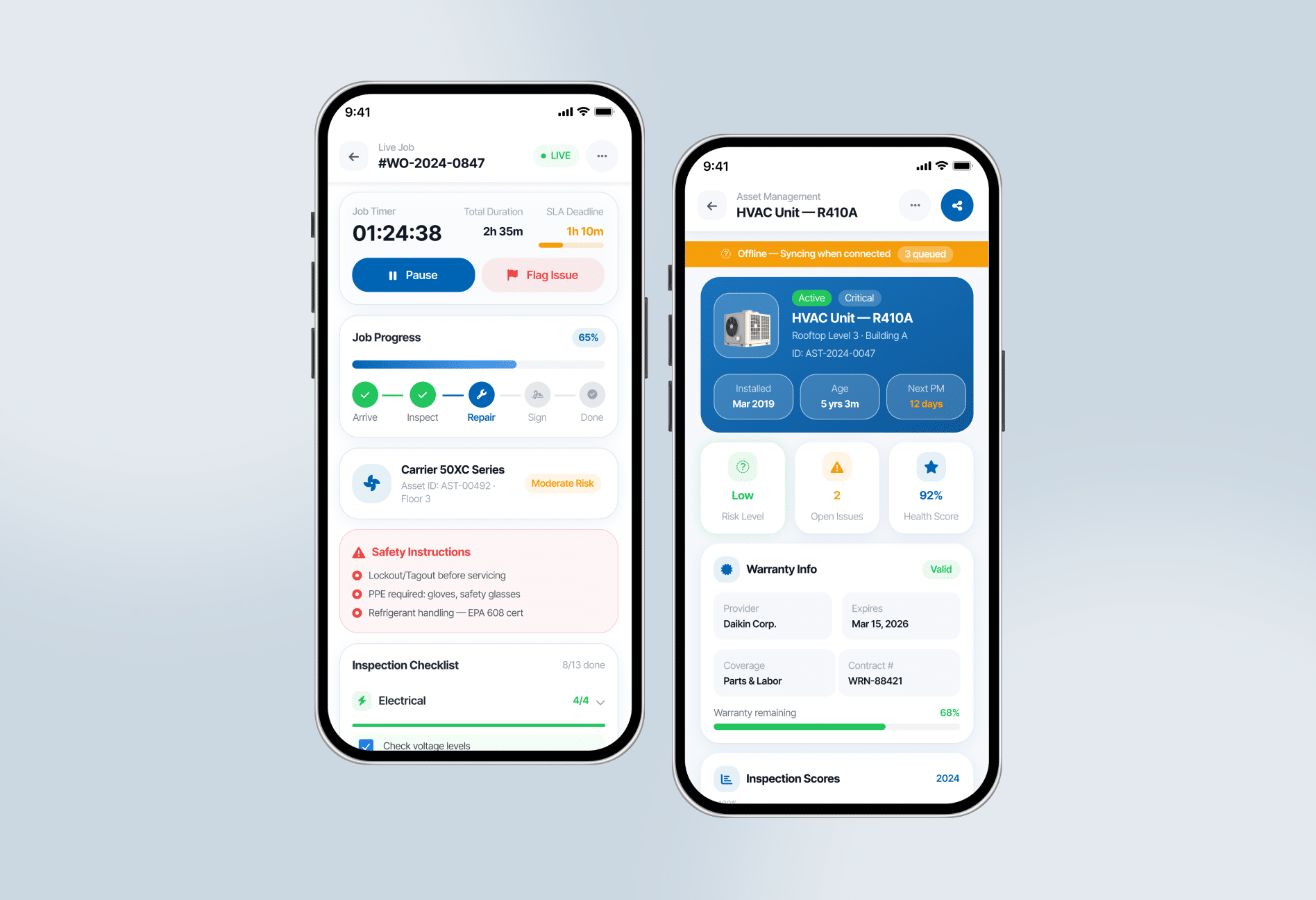
Built with an offline-first architecture from day one. All active job data is cached locally at shift start, and every action — completing a checklist, attaching a photo, capturing a signature — is written to local storage and queued for background sync. Technicians never hit a spinner or error screen because of poor signal.
-
Dispatcher Console & Smart Scheduling
A live map of the full field workforce with drag-and-drop job assignment, SLA countdown timers, and automatic technician suggestions based on proximity, skill match, and workload. The Node.js scheduling engine recalculates routes dynamically throughout the day — no manual intervention needed when jobs change mid-shift.
-
Real-Time Backend
A GraphQL API sits in front of a PostgreSQL database, with Firebase Cloud Messaging handling push notifications and real-time job updates. AWS Amplify manages authentication, on-site media storage, and environment scaling. The full stack runs on AWS with automatic failover and daily backups.
-
Automated Customer Communications
Customers receive automated SMS and push notifications at every job milestone: booking confirmation, technician dispatch with live ETA, arrival, and digital completion with invoice. This removed roughly 60 inbound 'where is my technician?' support calls per day within the first month.
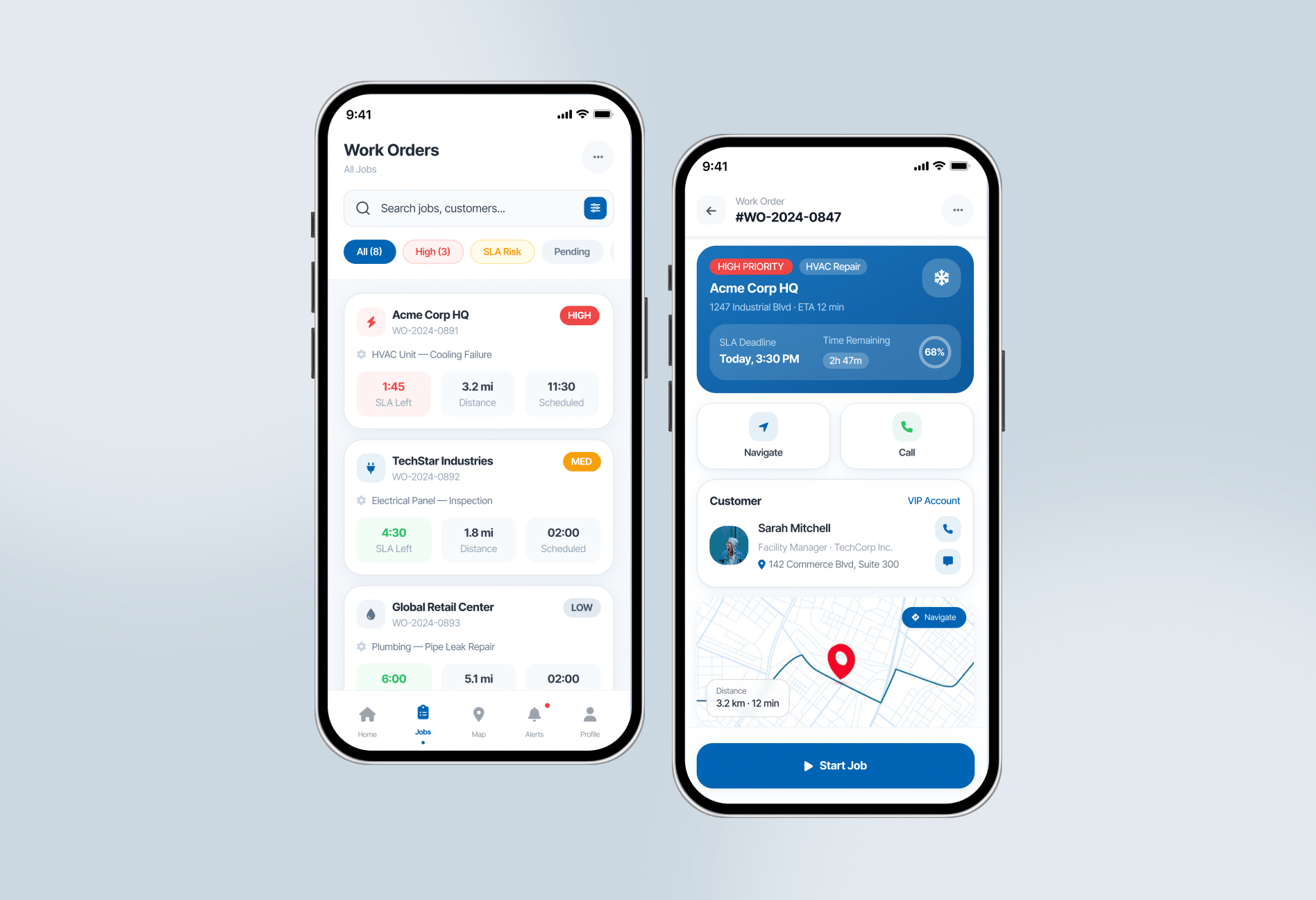
Project Glimpse


Key Features

Work Order Management

Smart Scheduling & Dispatch

Offline Technician App

GPS Workforce Tracking

Asset Management

Preventive Maintenance

Inventory & Parts Management

Digital Inspection Forms

SLA Monitoring & Alerts

Customer Communication Portal

Service History Tracking

Technician Crew Management

Automated Billing & Invoicing

Real-Time Operations Dashboard

Customer Signature Capture
Results
-
01.
Strong Adoption Across the Field Team
Within eight weeks of full rollout, 94% of technicians were completing all job documentation through the app, with zero paper forms in active use.
-
02.
Improved Customer Satisfaction
Customer satisfaction scores improved meaningfully in the first quarter post-launch. Fewer missed ETAs, faster completions, and proactive SMS updates made a visible difference.
-
03.
Operational Visibility
For the first time, the operations director had a live dashboard showing every technician, every open job, and every SLA at risk on one screen.
Let’s get in touch!
India
SPEC House, Parth Complex, Near Swastik Cross Roads, Navarangpura, Ahmedabad 380009, INDIA.
-
 +91-79-26404031, 32-33-34
 -
 [email protected]