| Comparison Area | RPA (Robotic Process Automation) | API Integration |
|---|---|---|
| Best Environment | Legacy systems and manual workflows | Modern cloud and connected systems |
| Interaction Method | Works through the user interface like a human user | Connects directly with backend systems |
| Implementation Speed | Faster for short-term automation needs | Better suited for long-term scalable integrations |
| Performance | Slower due to screen-based execution | Real-time and significantly faster |
| Scalability | Requires additional bots and infrastructure as processes grow | Scales efficiently across enterprise applications |
| System Dependency | Sensitive to UI or workflow changes | More stable through standardized APIs |
| Technical Complexity | Lower entry barrier with low-code/no-code tools | Requires development and integration expertise |
| Ideal Use Cases | Data entry, document processing, legacy workflows | System integration, SaaS connectivity, real-time automation |


Loading...
RPA vs API Integration: Choosing the Right Automation Approach
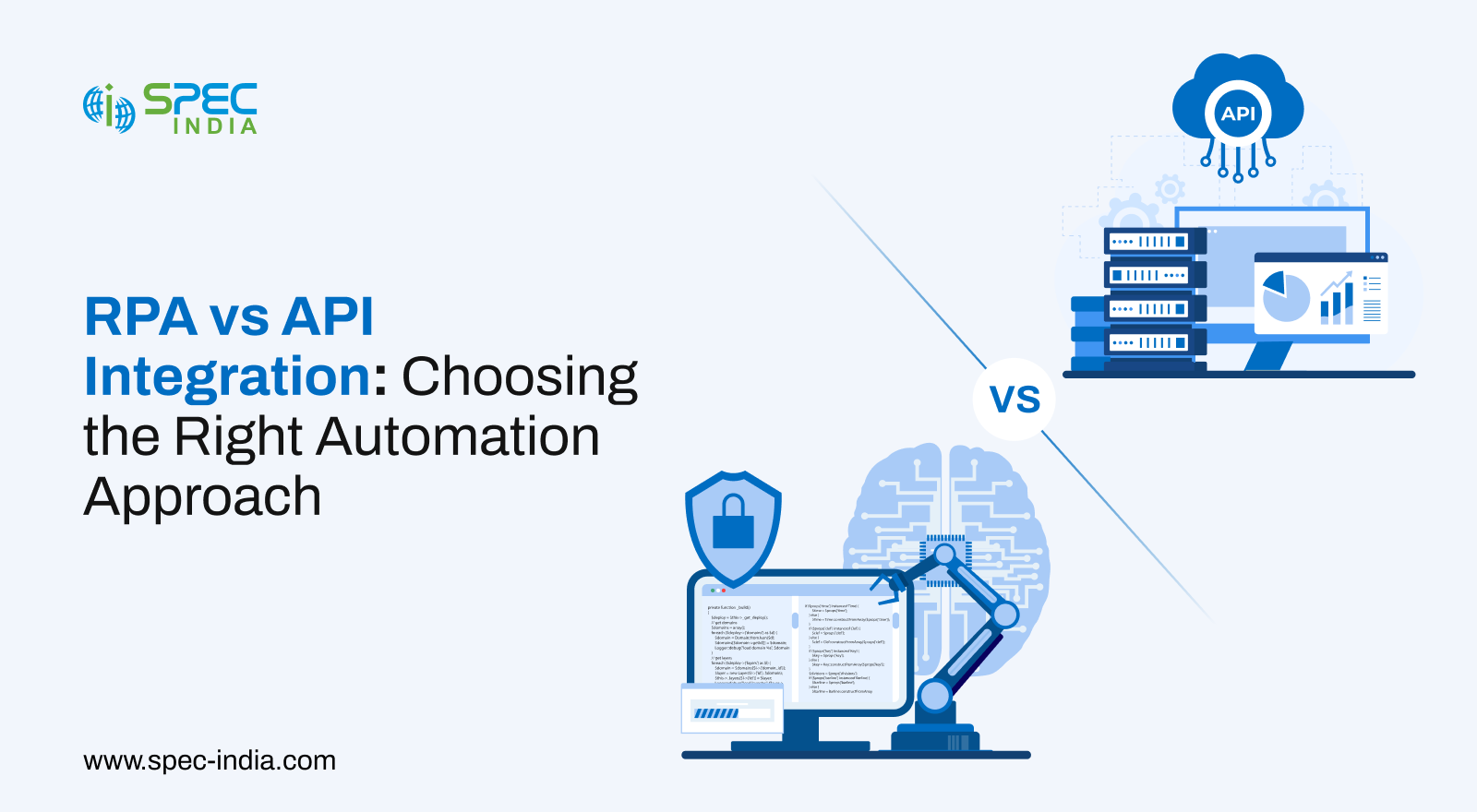
Automation is no longer a luxury reserved for Fortune 500 companies with seven-figure IT budgets. Today, a mid-sized logistics firm in Ohio and a fintech startup in Bangalore are both wrestling with the same core question: how do we connect systems, eliminate manual work, and move faster?
Two automation technologies keep coming up in that conversation; Robotic Process Automation (RPA) and API integration. They both promise efficiency. They both reduce human intervention. But they are fundamentally different tools, and picking the wrong one can cost you months of rework and a budget you didn’t plan to spend.
The debate around RPA vs API integration isn’t new, but it’s become more urgent. As businesses pour money into enterprise automation solutions and digital transformation consulting services, the question of which automation approach to invest in has real financial consequences. Get it right, and you unlock serious operational leverage. Get it wrong, and you’re rebuilding from scratch six months later.
This blog breaks it all down; what each approach actually does, where it shines, where it falls flat, and how to make the right call for your specific situation.
What Is Robotic Process Automation?
Robotic Process Automation works by mimicking what a human does on a screen. An RPA bot can open a browser, log into a portal, copy data from one field, paste it into another, click submit, and move on to the next record — all without anyone sitting at the keyboard. It interacts with the user interface layer of an application, which is exactly what makes it both powerful and fragile.
Think of RPA as hiring a very fast, very consistent virtual employee who never gets tired and never takes a coffee break. The bot follows a script you’ve given it, step by step, and it executes that script thousands of times without deviation. Tools like UiPath, Automation Anywhere, and Blue Prism have made this accessible enough that even business analysts — not just developers — can build and deploy these bots. When paired with the right RPA development services, these implementations can go from concept to production surprisingly fast.
Where RPA truly earns its keep is in legacy environments. Older ERP systems, insurance claim portals, government databases — these platforms were built before the era of open APIs. They have no integration layer to speak of. The only way in is through the front door: the UI. And that’s precisely where RPA walks in confidently.
What Is API Integration?
API integration takes a fundamentally different approach. Instead of navigating a user interface, it talks directly to the system’s backend through a defined communication contract — the API (Application Programming Interface). When System A needs to send data to System B, it makes a structured request, and System B responds with structured data. No screens, no clicking, no visual navigation.
This is how modern SaaS platforms are built to talk to each other. Salesforce, Stripe, HubSpot, Shopify, Slack — virtually every cloud application today exposes a robust API. When your e-commerce platform automatically triggers a fulfillment order the moment a payment clears, that’s backend system integration doing its job quietly and reliably in the background.
API integration services typically require developer involvement, at least at the setup stage. You need to understand authentication (OAuth, API keys), data formats (JSON, XML), and how to handle errors gracefully. Middleware platforms like MuleSoft, Zapier, and Make (formerly Integromat) have lowered the barrier significantly, but the underlying logic still needs to be understood and maintained. That’s why companies often turn to custom software development services to design these pipelines properly from day one rather than stitching together something fragile.
The Numbers Behind Automation Adoption
Before diving deeper into the robotic process automation vs API integration comparison, it’s worth grounding this in some real-world context.
According to Gartner, 90% of finance leaders have implemented or are planning to implement RPA. Meanwhile, a separate report from MuleSoft found that organizations manage an average of 1,061 applications, and only 28% of those are integrated. That gap, between the tools companies run and the tools that actually talk to each other — is precisely where both process automation solutions and API-driven integrations are competing for budget and attention.
These numbers tell a story that most operations and IT teams already feel in their day-to-day: businesses are running on more tools than ever, those tools don’t talk to each other well enough, and the pressure to fix that is mounting fast.
API vs RPA: Key Differences at a Glance
Here’s where things get concrete. When evaluating API vs RPA, rather than speaking in abstractions, it helps to look at the actual points of divergence side by side:
- Layer of interaction: RPA operates at the presentation layer (the UI), while API integration operates at the application layer (the backend). This single distinction drives almost every other difference between the two approaches.
- Setup complexity: RPA bots can often be configured through drag-and-drop interfaces and screen recorders, making them accessible to non-technical users. API integration generally demands coding knowledge or at least a solid understanding of request-response patterns and data mapping.
- Stability: APIs are versioned and contractually stable (for the most part). RPA bots break whenever the UI changes — a redesigned button, a renamed field, or a new login screen can knock a bot offline entirely and require rework.
- Speed: API calls happen in milliseconds. RPA bots, because they’re navigating visual interfaces, are slower by design. For high-volume, real-time workflow automation tools, this performance gap matters enormously.
- Licensing costs: Enterprise RPA tools can be expensive, especially at scale. API integration costs vary widely but often scale more predictably with usage rather than the number of bots deployed.
- Auditability: APIs produce clean, structured logs that are easy to audit and debug. RPA bots can be harder to troubleshoot when something goes wrong mid-process, especially in complex multi-step workflows.
- Scalability: API integrations scale horizontally with relatively little friction. Scaling RPA often means provisioning more bot licenses and managing more virtual machines, which compounds cost quickly.
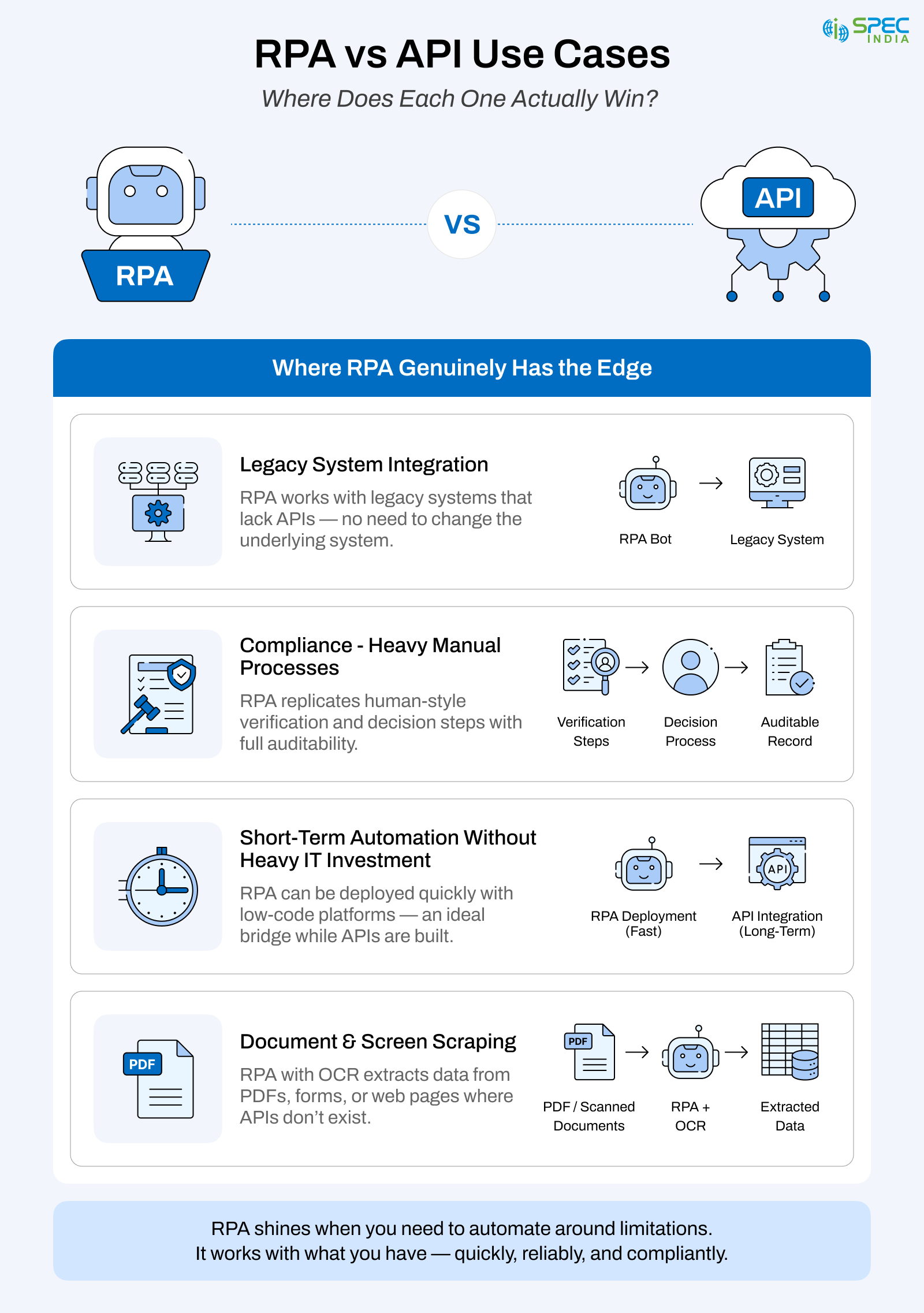
RPA vs API Use Cases: Where Does Each One Actually Win?
This is the part many automation discussions overlook. Understanding what RPA and API integration do is important, but understanding where each approach creates the most operational value is what truly matters when evaluating automation at scale.
The decision between RPA and API integration is rarely about choosing a “better” technology. It’s about choosing the right automation model based on your existing systems, workflow complexity, scalability requirements, and long-term digital transformation goals. In many enterprise environments, both technologies work together to support different stages of automation maturity.
Before diving into specific use cases, here’s a practical comparison of where each approach typically performs best.
Where RPA Genuinely Has the Edge
RPA isn’t a workaround. In the right context, it’s the most practical and cost-effective process automation solution available. Here are the scenarios where it outperforms API-based approaches:
- Legacy System Integration: When you’re dealing with an old ERP system that your finance team refuses to replace because “it just works,” RPA is often your only realistic option. These systems predate modern APIs, and retrofitting them with integration layers is expensive and risky. An RPA bot can sit in front of that legacy interface and extract or input data just as a human would; without touching the underlying system.
- Compliance-Heavy Manual Processes: In industries like insurance, banking, and healthcare, certain processes require human-style verification steps before data moves between systems. RPA can replicate that decision tree precisely, maintaining compliance without cutting corners. It also creates an auditable record of every action the bot took, which regulators often appreciate.
- Short-Term Automation Without Heavy IT Investment: Sometimes you need a process automated now, not after six months of API development. RPA can be deployed relatively quickly with modern low-code platforms. It’s an excellent bridge while longer-term integrations are being built out through custom software development services.
- Document and Screen Scraping: If your process involves pulling data from PDFs, scanned forms, or web pages that don’t expose APIs, RPA combined with OCR (optical character recognition) is hard to beat. API integration simply can’t help you here — there’s no endpoint to call.

Where API Integration Has the Edge
- Real-Time Data Synchronization: Imagine a customer updates their shipping address on your e-commerce site. You want that change reflected instantly in your CRM, fulfillment system, and customer support tool. API webhooks and event-driven architecture make this seamless. RPA, with its polling-based, sequential approach, simply can’t match that responsiveness.
- High-Volume Transaction Processing: Payment gateways process millions of transactions daily. Inventory management systems update thousands of records per hour. At that volume, RPA bots would require enormous infrastructure and still struggle to keep pace. API integration services handle this natively — they’re built for it.
- Data Integrity and Reliability: Because API integrations work with structured, validated data at the backend level, they’re far less prone to data corruption. An RPA bot parsing a screen might misread a number if a font renders differently on a low-resolution display. An API call returns exactly what the system has stored.
- Building Connected Product Ecosystems: If you’re a SaaS company building integrations for your customers — connecting your platform to Salesforce, Slack, or QuickBooks — APIs are the only real answer. You’re not just automating a process; you’re building a product feature that your customers depend on. This is system integration vs automation in its clearest form: one is infrastructure, the other is operational efficiency.
Automation Strategies: How to Actually Make the Decision
Choosing the right approach from your available business process automation tools doesn’t have to be a philosophical debate. Run through these questions honestly, and the answer usually surfaces on its own.
Does the system you’re integrating have an API?
If yes, and if the API covers the functionality you need, start there. It will be more stable, faster, and easier to maintain long-term. This is the simplest filter, and it eliminates a lot of unnecessary debate.
Is the system a legacy platform with no integration layer?
RPA is likely your best path forward. Pair it with a clear plan to revisit when the system is eventually modernized or replaced.
How often does the UI of the target system change?
Frequent UI changes mean your RPA bots will need constant maintenance. Factor that into your cost model honestly — it can add up faster than people expect.
What’s your timeline?
If you need automation deployed in weeks, RPA’s low-code tooling gets you there faster. API integrations done properly take more time to design, test, and secure.
What’s the data volume?
For low-to-medium volume processes that run a few hundred times a day, RPA is perfectly capable. For high-frequency, real-time workflows, API integration is the only scalable choice.
Who will maintain it?
RPA bots can often be maintained by business analysts with some training. API integrations typically require developer involvement for ongoing changes. Your team’s actual skill set matters here; plan for where you are, not where you want to be.
The Hybrid Approach: When Both Make Sense
In practice, mature automation programs don’t choose one or the other — they use both strategically. Many enterprises run API integrations as the primary data pipeline and deploy RPA bots specifically for the edge cases: the legacy system that hasn’t been updated in a decade, the vendor portal that doesn’t offer an API, the one-off report that needs to be pulled from a government website every quarter.
This hybrid model reflects how real enterprise automation solutions actually get deployed. Systems are messy. Some are modern, some are ancient. Some have great APIs, some have none. Building your automation strategies around that reality — rather than an idealized, fully-connected architecture — is what separates pragmatic operations teams from ones perpetually waiting for the “right” conditions to automate.
Companies that have engaged digital transformation consulting services often arrive at this hybrid model naturally, because good consultants don’t push a single technology. They map the process landscape first, then match tools to problems — not the other way around.
Total Cost of Ownership: Think Beyond the Sticker Price
One dimension that gets glossed over in the RPA vs API debate is the total cost of ownership over time. RPA bots have a deceptively low upfront cost when you’re dealing with a simple process and a stable UI. But factor in:
- Bot maintenance every time the UI changes
- Bot monitoring and exception handling infrastructure
- Licensing costs that grow linearly with the number of bots deployed
- Developer or analyst time required to rebuild broken workflows.
API integrations, by contrast, carry higher upfront development costs but tend to be far more durable as long-term workflow automation tools. A well-designed API integration can run for years with minimal intervention, especially when the vendor follows stable versioning practices.
The five-year view on cost often looks very different from the six-month view. Organizations that make automation decisions based on immediate deployment costs sometimes find themselves trapped in an expensive bot maintenance cycle two years down the road; a cycle that was entirely predictable if someone had done the math upfront.
Final Thoughts: There’s No Universal Answer
The honest conclusion in the robotic process automation vs API integration conversation is that neither approach is universally superior. Each is the right answer in different circumstances, and the best automation professionals are fluent in both. The goal isn’t to pick a side — it’s to understand your systems, your constraints, and your objectives well enough to know which tool to reach for in a given situation.
If you’re just starting your automation journey, API integration is worth investing in first. It’s where the industry is headed, the skills transfer broadly, and the backend system integration patterns you learn will apply across dozens of platforms. But don’t dismiss RPA as a lesser approach. When you’re working with legacy systems, tight timelines, or surfaces that simply don’t expose APIs, RPA development services give you a fast, reliable path to automation that API integration physically cannot.
Build your toolkit broadly. Think carefully about total cost, not just deployment speed. And revisit your decisions as your systems evolve — because the right process automation solution today might need to look quite different two years from now.
Looking to implement the right automation approach for your business?
Whether you need API integration services, RPA development services or guidance through a broader digital transformation consulting engagement — working with a team that understands both sides of this equation makes all the difference.

SPEC INDIA is your trusted partner for AI-driven software solutions, with proven expertise in digital transformation and innovative technology services. We deliver secure, reliable, and high-quality IT solutions to clients worldwide. As an ISO/IEC 27001:2022 certified company, we follow the highest standards for data security and quality. Our team applies proven project management methods, flexible engagement models, and modern infrastructure to deliver outstanding results. With skilled professionals and years of experience, we turn ideas into impactful solutions that drive business growth.
Table of contents
Delivering Digital Outcomes To Accelerate Growth
Let’s TalkTable of contents
Delivering Digital Outcomes To Accelerate Growth
Let’s Talk


Let’s get in touch!
India
SPEC House, Parth Complex, Near Swastik Cross Roads, Navarangpura, Ahmedabad 380009, INDIA.
-
 +91-79-26404031, 32-33-34
 -
 [email protected]